Enterprise AI Infrastructure Checklist
The first question in an enterprise AI infrastructure project is often:
Which GPU should we buy?
It matters, but it is rarely the best starting point.
Training, fine-tuning, real-time inference, RAG and AI agents can require very different compute, networking, storage, platform and governance designs.
A safer sequence is:
Workload / Data / Control Requirements → Architecture → GPU / Compute
This article provides a practical 12-point planning checklist.
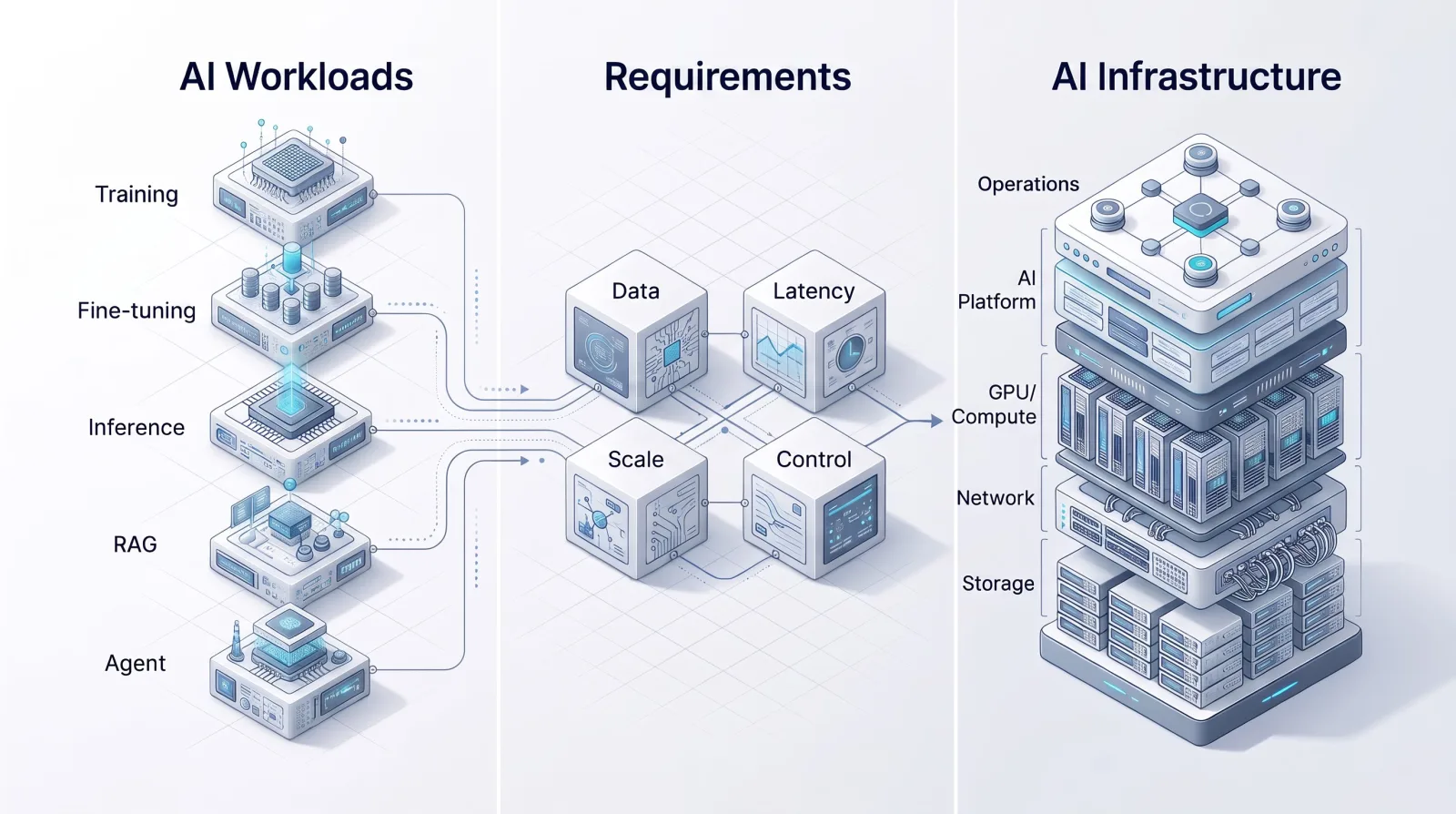
A. Requirements
1. Workload
Define training, inference, RAG, agent, HPC and concurrency requirements.
2. Data and Models
Understand dataset size, sensitivity, model artifacts, checkpoints, embeddings, retention and growth.
3. Deployment and Service Model
Decide whether the environment is public, private, on-prem, hosted, hybrid, air-gapped, internal shared infrastructure or customer-facing cloud.
B. Infrastructure
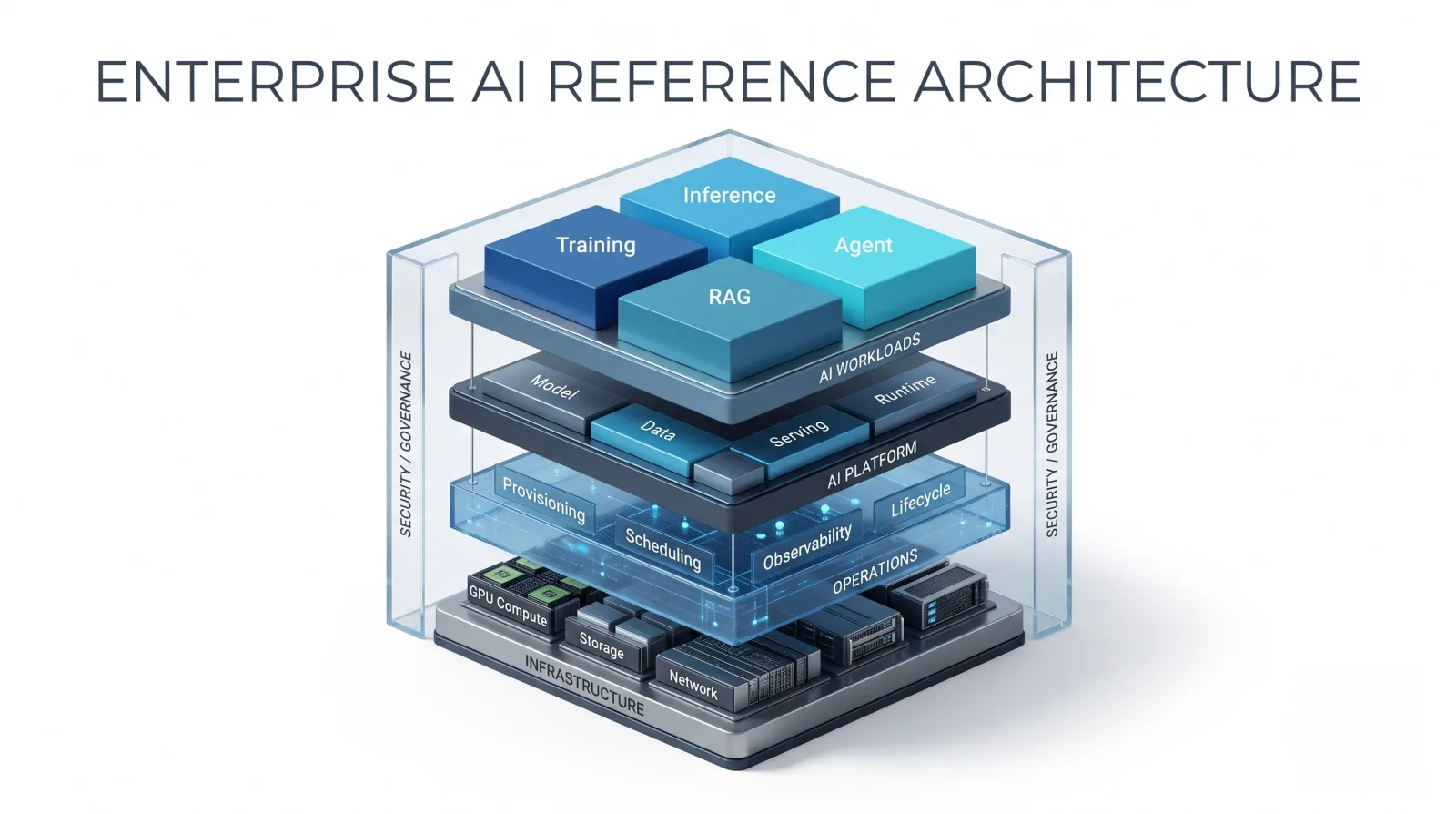
4. GPU and Compute
Choose accelerator memory, node shape, CPU/RAM balance and interconnect based on workload requirements rather than brand popularity.
5. Network
Design bandwidth, topology, storage traffic and service connectivity for the actual workload.
6. Storage
Plan capacity, throughput, IOPS, model storage, datasets, checkpoints and backup.
C. Platform and Operations
7. AI Platform and Runtime
Define drivers, runtimes, containers, orchestration, schedulers, model serving and model/data operations.
8. Resource Operations
Plan provisioning, scheduling, queues, quotas, reservations and placement.
9. Observability, Reliability and Lifecycle
Monitor compute, network, storage, jobs and capacity; design failure recovery, cleanup, upgrade and backup.
D. Control and Business
10. Security, Access and Governance
Design identity, least privilege, network boundaries, data/model access, keys, audit and artifact approval.
NIST AI RMF reinforces the need for lifecycle governance and risk management rather than treating AI trustworthiness as a single technical control.
11. Capacity and Scalability
Plan current demand, growth, maintenance headroom, failure capacity, expansion lead time and new infrastructure generations.
12. Economics and Operating Responsibility
Evaluate hardware, facilities, energy, networking, storage, software, platform engineering, operations, support and upgrades—and decide who will operate the environment over its lifecycle.
The Checklist Is Not a Scorecard
A single critical gap can matter more than ten completed items.
The goal is to identify requirements that are critical to the specific workload.
Public, Private, On-Prem or Hybrid?
There is no universal answer.
Public cloud, private infrastructure and hybrid models solve different workload and operating requirements.
The architecture should follow the workload rather than a fixed ideology.
Internal AI Infrastructure vs. NeoCloud Service
Internal AI infrastructure serves internal users and governance.
A customer-facing NeoCloud service adds productization, customer tenancy, self-service, metering, billing and commercial lifecycle requirements.
Good infrastructure does not automatically become a cloud business.
Where Thaki Cloud Fits
Thaki Cloud is a NeoCloud company providing Cloud Services and On-Premise Solutions.
For infrastructure owners building their own service, the canonical NeoCloud OS architecture is:
Customer Infrastructure → Thaki NeoCloud OS → Customer NeoCloud Service
The required platform and operating model depends on whether the goal is internal enterprise AI or an external cloud service.
Summary
Start with:
Workload → Data → Control → Service Model
Then design:
Compute → Network → Storage → Platform → Operations → Governance → Economics
GPU selection belongs inside that architecture.
FAQ
Should GPU selection come first?
Usually only after workload requirements are understood.
Is Kubernetes mandatory?
No.
Does every enterprise need on-prem AI?
No.
Can governance be added later?
It can, but early design reduces rework risk.
Is this an official certification checklist?
No.
Planning Enterprise AI Infrastructure?
Thaki Cloud can review workload, infrastructure, platform, private/on-prem cloud and operating architecture with you.
Contact UsRelated articles
- What Is GPU Cloud? How It Works, Types, Use Cases, and GPUaaS ExplainedGPU cloud provides on-demand access to GPU computing resources without requiring users to own the hardware. Learn how GPU cloud works, common deployment types, GPUaaS terminology, use cases, benefits, and key considerations.
- What Is an AI Factory? How It Differs from an AI Data CenterAn AI factory is an integrated infrastructure and operating environment for developing, training, deploying, and running AI at scale. Learn how it differs from an AI data center, its core components, lifecycle, and relationship to GPU cloud.
- What Is GPUaaS? How GPU as a Service WorksGPU as a Service (GPUaaS) provides access to GPU compute without requiring organizations to buy and maintain the hardware. Learn how it works, how it relates to GPU cloud, delivery models, operational capabilities, and key buying considerations.
- What Is a Private AI Cloud?A private AI cloud combines private-cloud infrastructure dedicated to one organization with accelerated compute, AI platforms, data services, security, and governance. Learn how it differs from public AI cloud, on-prem AI, sovereign AI, and air-gapped AI.
- Why Owning GPU Servers Is Not the Same as Operating a GPU CloudGPU hardware alone does not create a GPU cloud. Learn how GPU hosting differs from cloud service operations and why self-service, provisioning, scheduling, metering, lifecycle management, and service delivery matter.
- What Is a Neocloud? AI-First Cloud Infrastructure ExplainedNeocloud is an industry term for specialized cloud infrastructure built around GPUs and AI workloads. Learn how neoclouds differ from general-purpose hyperscalers, how they relate to GPU cloud and GPUaaS, and how infrastructure owners can build their own services.
- The Next Step for an AI Factory Is Cloud ServiceBuilding an AI Factory is not the same as operating a customer-facing cloud service. Learn which operational layers—provisioning, tenancy, scheduling, metering, billing, SLA, and lifecycle automation—are required to turn AI infrastructure into a consumable service.
- What Does It Mean to Turn AI Infrastructure into a Cloud Business?Owning AI infrastructure is not the same as operating a cloud business. Learn how infrastructure becomes a product and then an on-demand cloud service through catalog, ordering, provisioning, metering, billing, SLA, and lifecycle operations.
- What Is Bare Metal GPU? Bare Metal vs Virtualized GPULearn what bare metal GPU means, how it differs from GPU VMs, vGPU and passthrough, and which trade-offs matter for performance, isolation, flexibility, utilization and provisioning.
- Private AI Cloud vs Public AI Cloud: What’s the Difference?Compare private and public AI cloud across exclusivity, control, scalability, managed services, operating responsibility and cost structure, and learn which model fits different AI workloads.
- What Is GPU Scheduling? How AI Clouds Allocate GPU ResourcesLearn how GPU scheduling allocates scarce GPU resources across AI workloads, including queues, priorities, quotas, GPU type, topology, multi-GPU jobs, fragmentation, and provisioning.
- What Operations Platform Does an AI Factory Need After Deployment?Learn which capabilities are needed to operate an AI Factory after deployment, including provisioning, GPU scheduling, access and policy, observability, capacity management, metering, and lifecycle automation.
- What Is On-Prem AI? Why Enterprises Run AI on Their Own InfrastructureLearn what on-prem AI means, how it differs from private AI cloud, and why enterprises may run AI locally for data, model, network, latency, governance, and operational control.
- What Is GPU Multi-Tenancy? How Multiple Tenants Share GPU InfrastructureLearn how GPU multi-tenancy isolates users, compute, GPUs, networking, storage, IAM, quotas, scheduling, and usage across multiple tenants, and where vGPU, MIG, and Kubernetes fit.
- What Is GPU Provisioning? From Request to a Ready-to-Use GPU EnvironmentLearn how GPU provisioning turns a request into a usable GPU environment by coordinating compute, networking, storage, images, runtimes, access, and lifecycle automation.
- How to Turn an AI Factory into a Multi-Customer Cloud ServiceLearn what changes when an AI Factory becomes a multi-customer cloud service, including catalog, tenancy, provisioning, scheduling, metering, billing, SLA, self-service, and lifecycle operations.
- GPU Cloud Commercialization Readiness: What Should Operators Check?Evaluate whether your GPU infrastructure is ready for customer-facing cloud services across productization, tenancy, provisioning, metering, billing, service operations, and lifecycle using a practical 12-point checklist.
- GPU Cloud Profitability: Why Utilization Alone Is Not EnoughLearn why technical GPU utilization is different from billable time, and how saleable capacity, realized pricing, fixed and variable costs, and break-even interact in a hypothetical 32-GPU model.
- Building a GPU Cloud: Open Source vs. Integrated Operations PlatformsCompare self-built open-source GPU cloud stacks with integrated operations platforms across orchestration, tenancy, metering, billing, failure recovery, extensibility, support, and multi-year TCO.
- What Is Self-Service Cloud?Learn why self-service cloud is more than a portal and how catalog, identity, policy, capacity, provisioning, metering and lifecycle work together to enable on-demand cloud consumption.
- What Is On-Demand GPU Service?Understand on-demand GPU as a consumption model rather than a single virtualization or pricing method, and see how capacity, provisioning, metering and release work together.
- What Is a Cloud Service Catalog?Learn how a cloud service catalog turns infrastructure capacity into orderable products and connects product definitions to policy, provisioning and commercial operations.
- From GPU Hosting to GPU CloudLearn how data center operators can evolve GPU hosting into a customer-facing cloud service by adding productization, self-service, automated provisioning, tenancy, metering and lifecycle operations.
- How Telecom Operators Can Build an AI Cloud Service on Owned GPU InfrastructureLearn how telecom operators can extend data center, network and GPU assets into customer-facing AI cloud services through productization, self-service, provisioning, tenancy, metering and lifecycle operations.
- What Is Sovereign AI Cloud?Sovereign AI extends beyond data residency. Learn how control over data, identity, keys, infrastructure, models, operations, jurisdiction and dependencies shapes sovereign AI architecture.
- What Is Air-Gapped AI?Air-gapped AI removes automated external connectivity. Learn how model, data, package, update, observability and lifecycle operations change in disconnected AI environments.