GPU Cloud Commercialization Readiness: What Should Operators Check?
Your GPU servers are installed. Training and inference workloads run successfully.
Now imagine that your first external customer asks:
“We need eight GPU servers for one week. When can we get them, what will it cost, and what happens when the week is over?”
Can your operation answer that question and execute the service consistently?
Knowing the GPU model and available inventory is not enough. A customer-facing GPU cloud needs a product definition, an ordering path, customer boundaries, provisioning, usage records, commercial rules, support operations, and a reliable way to return resources to a saleable state.
The central idea is simple:
Owning GPU infrastructure, operating AI workloads, and delivering a repeatable customer-facing cloud service are three different readiness states.
This article provides a practical 12-point diagnostic for operators evaluating GPU cloud commercialization.
Three Different Readiness States
1. Infrastructure-ready
GPU servers, networking, and storage are deployed and healthy.
At this stage, operators can answer infrastructure questions such as:
- Is the hardware healthy?
- Are network and storage paths working?
- Is capacity physically available?
- Can the fleet be monitored?
This is necessary, but it does not create a sellable service by itself.
2. AI / workload-ready
The environment can execute training, fine-tuning, inference, or other AI workloads.
Drivers, runtimes, scheduling, containers, and AI platform services may already be in place.
This proves that the infrastructure can run AI. It does not prove that independent customers can order and consume it as a cloud service.
3. Service-ready
Customers can select, order, receive, consume, measure, and terminate a service through a repeatable operating model.
That can require:
- service catalog
- customer and organization management
- IAM and quotas
- multi-tenancy
- ordering and fulfillment
- provisioning
- scheduling
- metering
- billing or settlement
- SLA and incident operations
- lifecycle recovery
- APIs and self-service console
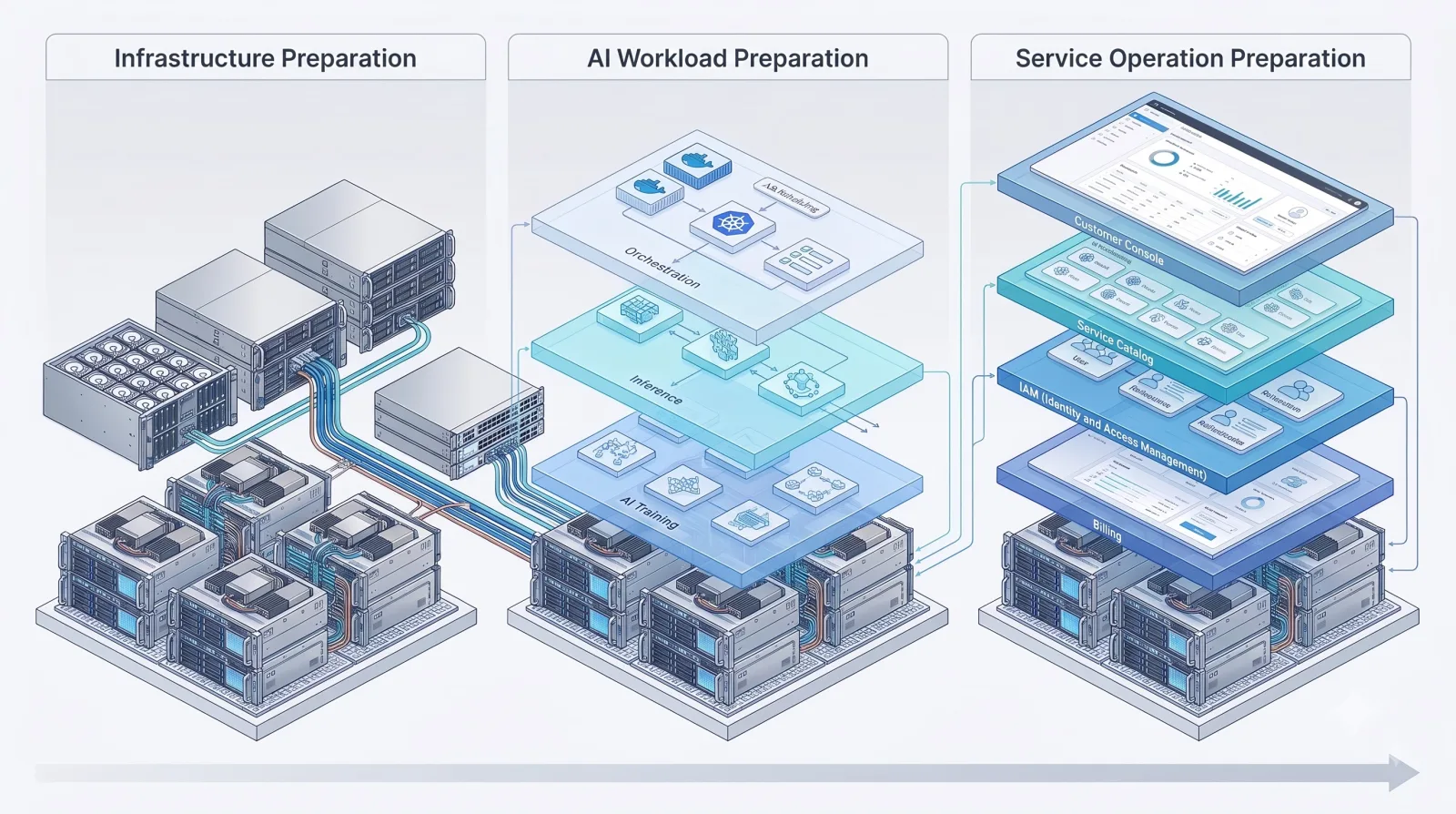
The hardware does not magically become a cloud product. Productization and cloud operations are added on top of the infrastructure.
What Exactly Are You Selling?
“Selling GPUs” is too vague to define a commercial cloud product.
A customer needs a clear service SKU. Depending on the operator, that could be:
- dedicated bare metal GPU servers
- reserved capacity
- GPU VMs
- GPUaaS or on-demand resources
- bundles including specific networking or storage options
Each service needs consistent customer-facing rules for:
- GPU or server specification
- quantity
- duration
- reservation
- pricing and contract
- cancellation
- support
- provisioning expectations
- policy
Infrastructure inventory is not the same thing as a service catalog.
Does Dedicated GPU Eliminate the Need for Multi-Tenancy?
No.
Multi-tenancy is not limited to sharing one physical GPU.
Even when Customer A receives dedicated servers and Customer B receives different dedicated servers, the platform still needs to separate:
- identities
- organizations
- credentials
- networks
- storage
- access policies
- quotas
- usage records
- service states
Dedicated hardware may provide resource exclusivity. It does not define the entire customer boundary.
What Happens After an Order?
A simplified successful flow might look like:
Order → entitlement / policy → capacity reservation → resource assignment → network / storage / access → ready
Commercial operations also need to handle the non-happy paths.
What if:
- capacity is reserved but network provisioning fails?
- the customer cancels during provisioning?
- only part of the requested environment becomes ready?
- a retry is running but billing must not start yet?
- a failed resource is accidentally counted as available?
Service readiness means managing success and failure states consistently, not merely making one demo deployment work.
Metering Is Not Billing
GPU cloud operators often have excellent technical telemetry.
That telemetry does not automatically become a commercial billing record.
A GPU with 0% compute utilization can still be billable if it is reserved exclusively for a customer. A GPU running at 95% utilization for internal testing may generate no revenue at all.
Operators should distinguish:
Technical telemetry
GPU utilization, memory, temperature, power, health, and other operating metrics.
Allocation / reservation records
Which customer controlled which resource during which period.
Billable usage
The usage definition that the customer contract and service policy treat as chargeable.
Rating / billing / settlement
The commercial process that applies pricing and contract rules to billable usage.
The question “How busy was the GPU?” is not the same as “What can we invoice?”
Resource Lifecycle Determines Saleable Capacity
Provisioning speed matters, but so does resource recovery.
After a customer terminates service, the operator may need to:
- revoke credentials
- remove network and security policies
- detach or process storage
- handle customer data
- reset images
- clean the server
- validate hardware health
- close the usage record
- close the billing state
- return capacity to the available pool
A GPU that physically exists but remains in cleaning, failed, or uncertain state is not necessarily immediately saleable.
Resource turnaround therefore affects real commercial capacity.
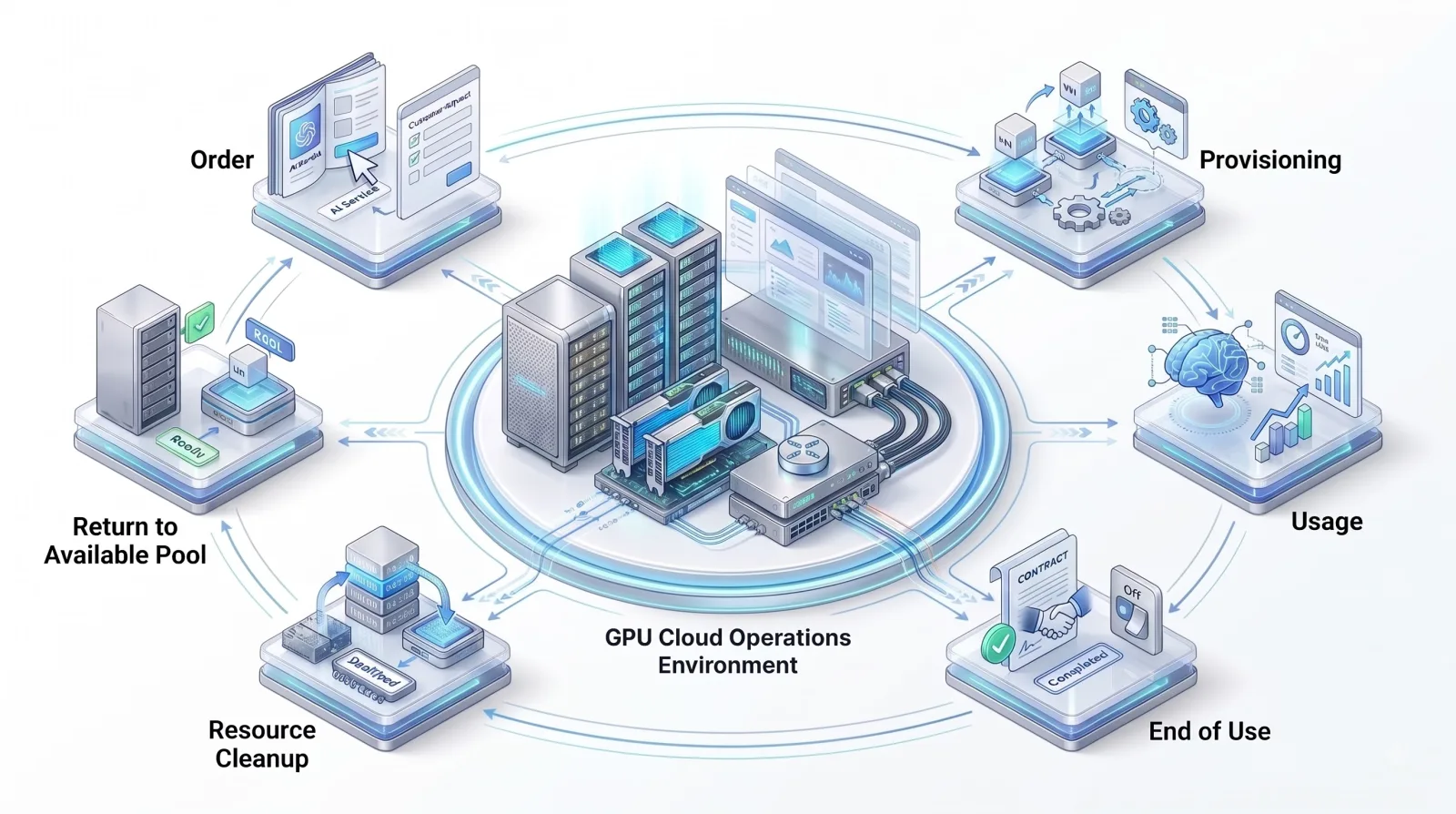
The 12-Point GPU Cloud Readiness Checklist
This is a working diagnostic, not an industry certification.
A. Service Productization
1. Service specification
Can customers understand exactly what they can buy—GPU type, quantity, bare metal or VM, networking, storage, and duration?
2. Price / contract / reservation policy
Are price, commitment, reservation, cancellation, and support rules defined consistently between sales and operations?
3. Ordering / service state
Can the operator track the order through states such as ordered, reserved, provisioning, ready, active, terminating, failed, cancelled, and completed?
B. Customers & Resources
4. Organization / IAM / quota
Can customer organizations, users, roles, credentials, and quotas be independently managed?
5. Validated tenant isolation
Have identity, network, storage, and workload or access boundaries actually been tested?
6. Allocation / provisioning state
Can the platform track whether compute, GPU, network, storage, images or runtimes, and access are truly ready?
C. Commercial & Operations
7. Billable usage record
Is there a commercial usage record that can be tied to the contract, separately from raw technical telemetry?
8. Billing / settlement correctness
Do rating, invoicing or settlement, cancellations, and adjustments remain consistent with actual service state?
9. Incident / capacity / SLA operations
Can the operator manage failures, maintenance, available capacity, reservations, and customer service commitments?
D. Lifecycle & Growth
10. Repeatable procedures
Are ordering, provisioning, retry, rollback, support, and termination repeatable processes rather than individual engineer knowledge?
11. Termination / reset / reallocation
Can customer access, data, network, storage, and server state be safely cleaned before capacity returns to the pool?
12. New inventory / SKU expansion
Can new GPU models, servers, locations, and service SKUs be added without rebuilding the operating model from scratch?
A High Score Does Not Automatically Mean Service-ready
The checklist should not be reduced to a simple score.
An operator may pass ten out of twelve items and still have a serious commercial or security risk if one of the missing capabilities is:
- tenant isolation
- customer data handling
- billing correctness
- access revocation
- failure recovery
Critical controls should be validated first. The rest of the workflow should then be tested for repeatability.
How Thaki Cloud Frames the Problem
Thaki Cloud’s canonical NeoCloud architecture is:
Customer Infrastructure → Thaki NeoCloud OS → Customer NeoCloud Service
The infrastructure owner retains its infrastructure and operates the resulting service under its own brand, policies, and business model.
Depending on the project and environment, the Thaki NeoCloud OS capability model spans areas such as service catalog, ordering and fulfillment, customer and organization management, multi-tenancy, provisioning, scheduling, metering, billing or settlement integration, SLA, observability, capacity, and lifecycle automation. Actual feature availability and integration requirements should be verified for the target environment.
The point is not for Thaki Cloud to rent the operator’s GPUs on its behalf.
The point is to provide the software and operating layer that can connect owned AI infrastructure to the operator’s own customer-facing service.
Summary
The first commercialization question should not be:
“How many GPUs do we have?”
It should be:
“If a customer orders tomorrow, can we reliably create the service, isolate it, measure it, bill it, terminate it, and return the resource to a saleable state?”
Infrastructure-ready and service-ready are separated by productization and operations.
The 12-point checklist is designed to reveal that gap.
FAQ
Can we launch a GPU cloud because our GPU servers are already operational?
Possibly, but hardware readiness alone is not enough. Product definition, ordering, tenant isolation, provisioning, metering, billing, support, and lifecycle need to form a repeatable service.
Do dedicated GPU services still need multi-tenancy?
Often yes. Dedicated hardware does not eliminate the need to isolate customer identity, networks, storage, credentials, policy, and usage records.
Can GPU utilization data be used directly for billing?
Technical utilization may inform operations, but it is not automatically the billable unit. Commercial billing usually depends on allocation, reservation, contract, rate, and service state.
Does fast provisioning mean the service is ready?
Provisioning is one important capability. A commercial service also needs order management, customer isolation, metering, billing, failure recovery, termination, and resource recycling.
Is this 12-point list an industry certification?
No. It is a practical working diagnostic for identifying commercialization gaps.
Evaluate Your GPU Cloud Commercialization Readiness
If your GPU infrastructure is operational but you are evaluating what remains before customer launch, Thaki Cloud can review the architecture and operating model with you.
Contact UsReferences
Related articles
- What Is GPU Cloud? How It Works, Types, Use Cases, and GPUaaS ExplainedGPU cloud provides on-demand access to GPU computing resources without requiring users to own the hardware. Learn how GPU cloud works, common deployment types, GPUaaS terminology, use cases, benefits, and key considerations.
- What Is an AI Factory? How It Differs from an AI Data CenterAn AI factory is an integrated infrastructure and operating environment for developing, training, deploying, and running AI at scale. Learn how it differs from an AI data center, its core components, lifecycle, and relationship to GPU cloud.
- What Is GPUaaS? How GPU as a Service WorksGPU as a Service (GPUaaS) provides access to GPU compute without requiring organizations to buy and maintain the hardware. Learn how it works, how it relates to GPU cloud, delivery models, operational capabilities, and key buying considerations.
- What Is a Private AI Cloud?A private AI cloud combines private-cloud infrastructure dedicated to one organization with accelerated compute, AI platforms, data services, security, and governance. Learn how it differs from public AI cloud, on-prem AI, sovereign AI, and air-gapped AI.
- Why Owning GPU Servers Is Not the Same as Operating a GPU CloudGPU hardware alone does not create a GPU cloud. Learn how GPU hosting differs from cloud service operations and why self-service, provisioning, scheduling, metering, lifecycle management, and service delivery matter.
- What Is a Neocloud? AI-First Cloud Infrastructure ExplainedNeocloud is an industry term for specialized cloud infrastructure built around GPUs and AI workloads. Learn how neoclouds differ from general-purpose hyperscalers, how they relate to GPU cloud and GPUaaS, and how infrastructure owners can build their own services.
- The Next Step for an AI Factory Is Cloud ServiceBuilding an AI Factory is not the same as operating a customer-facing cloud service. Learn which operational layers—provisioning, tenancy, scheduling, metering, billing, SLA, and lifecycle automation—are required to turn AI infrastructure into a consumable service.
- What Does It Mean to Turn AI Infrastructure into a Cloud Business?Owning AI infrastructure is not the same as operating a cloud business. Learn how infrastructure becomes a product and then an on-demand cloud service through catalog, ordering, provisioning, metering, billing, SLA, and lifecycle operations.
- What Is Bare Metal GPU? Bare Metal vs Virtualized GPULearn what bare metal GPU means, how it differs from GPU VMs, vGPU and passthrough, and which trade-offs matter for performance, isolation, flexibility, utilization and provisioning.
- Private AI Cloud vs Public AI Cloud: What’s the Difference?Compare private and public AI cloud across exclusivity, control, scalability, managed services, operating responsibility and cost structure, and learn which model fits different AI workloads.
- What Is GPU Scheduling? How AI Clouds Allocate GPU ResourcesLearn how GPU scheduling allocates scarce GPU resources across AI workloads, including queues, priorities, quotas, GPU type, topology, multi-GPU jobs, fragmentation, and provisioning.
- What Operations Platform Does an AI Factory Need After Deployment?Learn which capabilities are needed to operate an AI Factory after deployment, including provisioning, GPU scheduling, access and policy, observability, capacity management, metering, and lifecycle automation.
- What Is On-Prem AI? Why Enterprises Run AI on Their Own InfrastructureLearn what on-prem AI means, how it differs from private AI cloud, and why enterprises may run AI locally for data, model, network, latency, governance, and operational control.
- What Is GPU Multi-Tenancy? How Multiple Tenants Share GPU InfrastructureLearn how GPU multi-tenancy isolates users, compute, GPUs, networking, storage, IAM, quotas, scheduling, and usage across multiple tenants, and where vGPU, MIG, and Kubernetes fit.
- What Is GPU Provisioning? From Request to a Ready-to-Use GPU EnvironmentLearn how GPU provisioning turns a request into a usable GPU environment by coordinating compute, networking, storage, images, runtimes, access, and lifecycle automation.
- How to Turn an AI Factory into a Multi-Customer Cloud ServiceLearn what changes when an AI Factory becomes a multi-customer cloud service, including catalog, tenancy, provisioning, scheduling, metering, billing, SLA, self-service, and lifecycle operations.
- GPU Cloud Profitability: Why Utilization Alone Is Not EnoughLearn why technical GPU utilization is different from billable time, and how saleable capacity, realized pricing, fixed and variable costs, and break-even interact in a hypothetical 32-GPU model.
- Building a GPU Cloud: Open Source vs. Integrated Operations PlatformsCompare self-built open-source GPU cloud stacks with integrated operations platforms across orchestration, tenancy, metering, billing, failure recovery, extensibility, support, and multi-year TCO.