From GPU Hosting to GPU Cloud
If a data center already owns GPU servers and provides dedicated capacity to customers, does it need to replace the infrastructure to become a GPU cloud provider?
Not necessarily.
The difference between GPU hosting and GPU cloud is often less about the physical hardware and more about the operating model around that hardware.
Existing GPU servers, networking, storage and data-center operations can remain valuable foundations.
The cloud transition adds layers such as:
- productization
- self-service
- customer and tenant boundaries
- capacity policy
- repeatable provisioning
- metering and billing integration
- lifecycle recovery
- service state, support and observability
Moving from GPU hosting to GPU cloud is primarily an operating-model transformation, not a hardware replacement project.
Hosting and Cloud Are Different Operating Models
GPU hosting remains a valid service model.
Long-term dedicated contracts, customized configurations, fixed locations and hands-on operations can be exactly what some customers need.
GPU cloud typically adds a more repeatable consumption experience:
- defined service products
- portal or API requests
- policy and capacity checks
- repeatable fulfillment
- service-state visibility
- usage measurement
- termination and resource recovery
The two models can coexist.
The Same Hardware Can Support Different Services
Consider a data center with twenty eight-GPU servers.
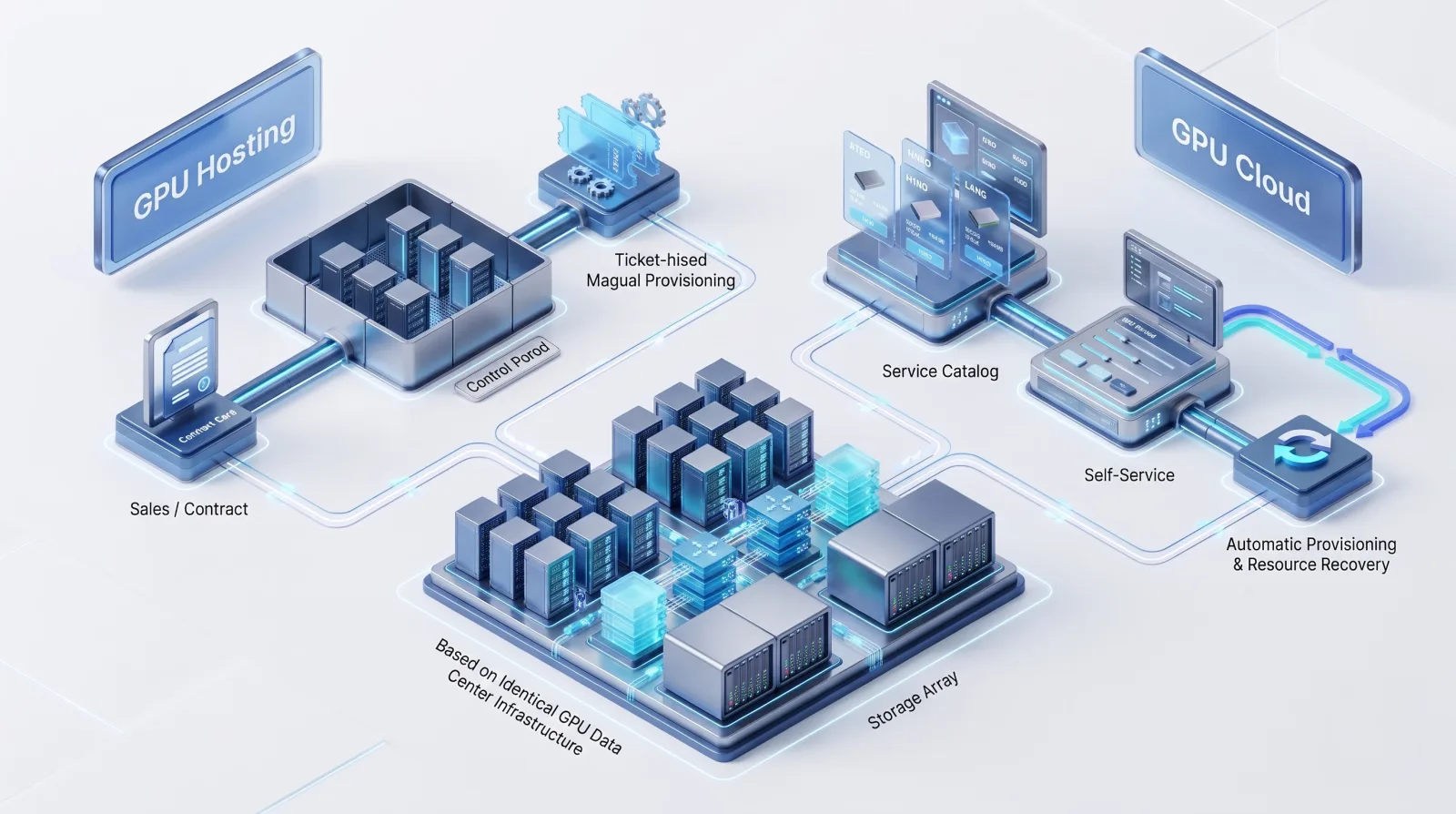
In a hosting model, a customer may contact sales, negotiate a contract, receive a dedicated server and work through a coordinated delivery process.
In a cloud model, the same underlying hardware may be represented as an orderable product. A customer request can flow through entitlement, capacity, reservation, provisioning, access, usage and termination.
The difference is the operating layer around the asset.
Can Existing GPU Infrastructure Be Reused?
Often, but integration must be validated.
Operators should assess:
- GPU and server inventory
- BMC and remote-management capability
- network automation
- storage integration
- image deployment and reset
- monitoring and resource state
- which hardware can map to repeatable products
OpenStack Ironic demonstrates how physical servers can be provisioned and managed through APIs, but every data-center environment still requires validation of hardware, networking, storage and operations integration.
Step 1: Productize Capacity
Hosting often starts with a customer requirement and a custom solution.
Cloud scale benefits from repeatable service products.
Examples might include dedicated GPU servers, GPU VMs, time-bound reservations or defined storage and networking bundles.
The service definition should map to actual capacity and fulfillment logic.
Step 2: Add Self-Service and Policy
Self-service does not have to replace enterprise sales.
Large customers may still negotiate reservations, network design or SLAs.
The self-service layer handles repeatable requests:
- product selection
- order
- status
- consumption
- termination
Policy and quota determine what each customer can request.
Step 3: Establish Customer and Tenant Boundaries
Dedicated hardware does not eliminate the need to separate:
- organizations and users
- credentials
- networks
- storage
- policy
- usage records
- billing records
Multi-tenancy is therefore broader than sharing a physical GPU.
Step 4: Make Provisioning Repeatable
Manual engineering can work well for low-volume dedicated hosting.
As order volume grows, repeated tasks become candidates for standardization:
- server selection
- image deployment
- network configuration
- storage attachment
- credentials
- completion state
The goal does not have to be absolute automation. The goal is repeatability and state consistency.
Step 5: Connect Metering and Commercial Records
Hosting may use monthly or contract-based billing.
Cloud products can introduce more varied usage models.
Technical GPU utilization is not automatically the billing metric.
Operators need a record of:
- customer
- allocated resource
- service period
- product
- contract
- commercial usage state
Step 6: Build Lifecycle Recovery
When customers change more frequently, resource recycling becomes more important.
Termination may require:
- credential removal
- network cleanup
- data handling
- storage detachment
- image reset
- hardware checks
- return to available capacity
Recovery time can directly affect saleable capacity.
A Six-Stage Transition Framework
A practical migration sequence is:
- capacity and inventory
- service catalog and SKUs
- customer, tenant and policy
- provisioning standardization
- metering and billing integration
- lifecycle, recovery and operations
Organizations can implement these stages incrementally based on existing systems and business priorities.
Hosting and Cloud Can Coexist
A provider can offer:
- long-term dedicated hosting
- reserved GPU capacity
- on-demand GPU
- managed AI services
The key is to define capacity policies and operating responsibilities clearly across the product portfolio.
Where Thaki NeoCloud OS Fits
Thaki Cloud’s canonical architecture is:
Customer Infrastructure → Thaki NeoCloud OS → Customer NeoCloud Service
Customer Infrastructure can include operator-owned GPU, server, network, storage, data-center or AI Factory capacity.
Depending on the deployment, Thaki NeoCloud OS can connect service catalog, provisioning, tenancy, allocation and scheduling, usage metering, billing integration, observability and lifecycle operations.
The operator can then expose its own branded NeoCloud service to customers.
Actual hardware, networking, BMC, storage and billing integration must be confirmed for each project.
Summary
The GPU hosting-to-cloud transition is not mainly about replacing servers.
It is about adding an operating model:
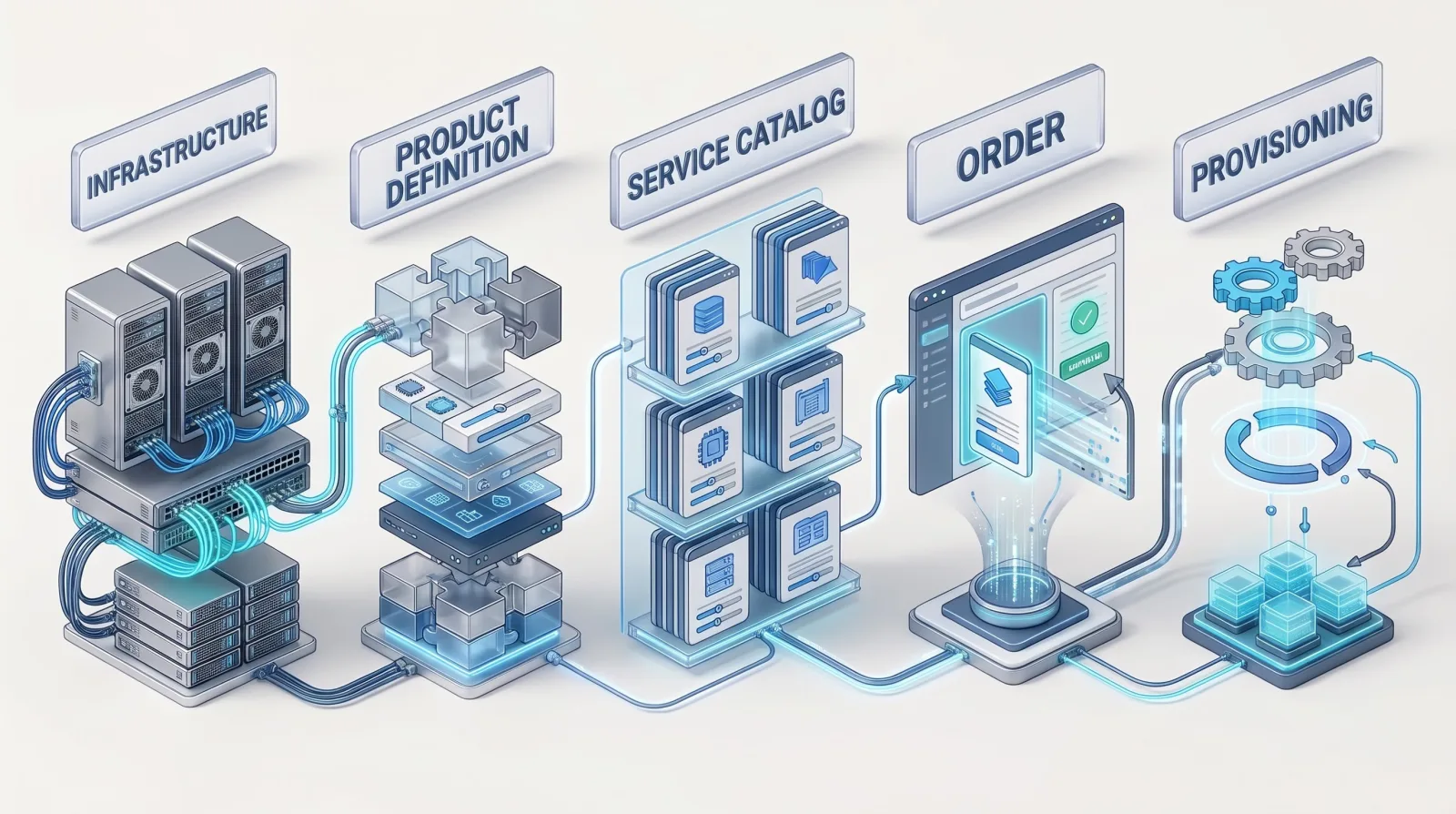
Infrastructure → Product → Self-Service / On-demand Cloud Service
GPU hosting can remain a strong business model. GPU cloud adds another way to productize and consume the same underlying infrastructure.
FAQ
Are GPU hosting and GPU cloud completely different businesses?
No. They can share the same infrastructure and coexist as different service models.
Must existing GPU servers be replaced?
Not necessarily. Integration capability must be assessed.
Can dedicated bare metal be part of GPU cloud?
Yes. Physical servers can be delivered through cloud-style catalog, API, provisioning, metering and lifecycle workflows.
Must all hosting customers move to on-demand?
No.
Is a service catalog required?
It is a key capability for repeatable customer-orderable products, although implementation can vary.
Expanding GPU Hosting into a Cloud Service?
If you are adding productization, self-service, provisioning, metering and lifecycle operations to existing GPU infrastructure, Thaki Cloud can review the transition architecture with you.
Contact UsRelated articles
- What Is GPU Cloud? How It Works, Types, Use Cases, and GPUaaS ExplainedGPU cloud provides on-demand access to GPU computing resources without requiring users to own the hardware. Learn how GPU cloud works, common deployment types, GPUaaS terminology, use cases, benefits, and key considerations.
- What Is an AI Factory? How It Differs from an AI Data CenterAn AI factory is an integrated infrastructure and operating environment for developing, training, deploying, and running AI at scale. Learn how it differs from an AI data center, its core components, lifecycle, and relationship to GPU cloud.
- What Is GPUaaS? How GPU as a Service WorksGPU as a Service (GPUaaS) provides access to GPU compute without requiring organizations to buy and maintain the hardware. Learn how it works, how it relates to GPU cloud, delivery models, operational capabilities, and key buying considerations.
- What Is a Private AI Cloud?A private AI cloud combines private-cloud infrastructure dedicated to one organization with accelerated compute, AI platforms, data services, security, and governance. Learn how it differs from public AI cloud, on-prem AI, sovereign AI, and air-gapped AI.
- Why Owning GPU Servers Is Not the Same as Operating a GPU CloudGPU hardware alone does not create a GPU cloud. Learn how GPU hosting differs from cloud service operations and why self-service, provisioning, scheduling, metering, lifecycle management, and service delivery matter.
- What Is a Neocloud? AI-First Cloud Infrastructure ExplainedNeocloud is an industry term for specialized cloud infrastructure built around GPUs and AI workloads. Learn how neoclouds differ from general-purpose hyperscalers, how they relate to GPU cloud and GPUaaS, and how infrastructure owners can build their own services.
- The Next Step for an AI Factory Is Cloud ServiceBuilding an AI Factory is not the same as operating a customer-facing cloud service. Learn which operational layers—provisioning, tenancy, scheduling, metering, billing, SLA, and lifecycle automation—are required to turn AI infrastructure into a consumable service.
- What Does It Mean to Turn AI Infrastructure into a Cloud Business?Owning AI infrastructure is not the same as operating a cloud business. Learn how infrastructure becomes a product and then an on-demand cloud service through catalog, ordering, provisioning, metering, billing, SLA, and lifecycle operations.
- What Is Bare Metal GPU? Bare Metal vs Virtualized GPULearn what bare metal GPU means, how it differs from GPU VMs, vGPU and passthrough, and which trade-offs matter for performance, isolation, flexibility, utilization and provisioning.
- Private AI Cloud vs Public AI Cloud: What’s the Difference?Compare private and public AI cloud across exclusivity, control, scalability, managed services, operating responsibility and cost structure, and learn which model fits different AI workloads.
- What Is GPU Scheduling? How AI Clouds Allocate GPU ResourcesLearn how GPU scheduling allocates scarce GPU resources across AI workloads, including queues, priorities, quotas, GPU type, topology, multi-GPU jobs, fragmentation, and provisioning.
- What Operations Platform Does an AI Factory Need After Deployment?Learn which capabilities are needed to operate an AI Factory after deployment, including provisioning, GPU scheduling, access and policy, observability, capacity management, metering, and lifecycle automation.
- What Is On-Prem AI? Why Enterprises Run AI on Their Own InfrastructureLearn what on-prem AI means, how it differs from private AI cloud, and why enterprises may run AI locally for data, model, network, latency, governance, and operational control.
- What Is GPU Multi-Tenancy? How Multiple Tenants Share GPU InfrastructureLearn how GPU multi-tenancy isolates users, compute, GPUs, networking, storage, IAM, quotas, scheduling, and usage across multiple tenants, and where vGPU, MIG, and Kubernetes fit.
- What Is GPU Provisioning? From Request to a Ready-to-Use GPU EnvironmentLearn how GPU provisioning turns a request into a usable GPU environment by coordinating compute, networking, storage, images, runtimes, access, and lifecycle automation.
- How to Turn an AI Factory into a Multi-Customer Cloud ServiceLearn what changes when an AI Factory becomes a multi-customer cloud service, including catalog, tenancy, provisioning, scheduling, metering, billing, SLA, self-service, and lifecycle operations.
- GPU Cloud Commercialization Readiness: What Should Operators Check?Evaluate whether your GPU infrastructure is ready for customer-facing cloud services across productization, tenancy, provisioning, metering, billing, service operations, and lifecycle using a practical 12-point checklist.
- GPU Cloud Profitability: Why Utilization Alone Is Not EnoughLearn why technical GPU utilization is different from billable time, and how saleable capacity, realized pricing, fixed and variable costs, and break-even interact in a hypothetical 32-GPU model.
- Building a GPU Cloud: Open Source vs. Integrated Operations PlatformsCompare self-built open-source GPU cloud stacks with integrated operations platforms across orchestration, tenancy, metering, billing, failure recovery, extensibility, support, and multi-year TCO.
- What Is Self-Service Cloud?Learn why self-service cloud is more than a portal and how catalog, identity, policy, capacity, provisioning, metering and lifecycle work together to enable on-demand cloud consumption.
- What Is On-Demand GPU Service?Understand on-demand GPU as a consumption model rather than a single virtualization or pricing method, and see how capacity, provisioning, metering and release work together.
- What Is a Cloud Service Catalog?Learn how a cloud service catalog turns infrastructure capacity into orderable products and connects product definitions to policy, provisioning and commercial operations.