GPU Cloud Profitability: Why Utilization Alone Is Not Enough
A quick GPU cloud revenue estimate often starts like this:
32 GPUs × KRW 4,000 × 720 hours = KRW 92.16 million per month.
The arithmetic is correct, but the business assumption is extreme: every GPU-hour is saleable, sold, billable, and realized at exactly KRW 4,000.
Real GPU cloud economics require separating technical activity from commercial activity.
GPU utilization, allocated or reserved capacity, and billable time are different measures.
This article uses a hypothetical 32-GPU model to show how billable hours, effective price, fixed and variable expenses, and break-even interact.
All figures below are illustrative only. They are not market prices, customer metrics, forecasts, benchmark margins, or verified Thaki Cloud ROI.
GPU Utilization vs. Billable Time
Technical utilization shows how actively the GPU is computing.
Allocated or reserved time shows when capacity has been committed to a customer.
Billable time shows which periods the contract and service policy define as chargeable.
A dedicated GPU may be billable while compute utilization is low because the customer has reserved exclusive access. An internal benchmark can drive utilization to nearly 100% while generating no customer revenue.
Busy GPU does not automatically mean billable GPU.
Theoretical Capacity vs. Saleable Capacity
With 32 GPUs over 720 hours, theoretical capacity is 23,040 GPU-hours.
Actual saleable capacity can be reduced by maintenance, failures, provisioning, cleaning, reserved buffers, internal use, resource fragmentation, or mismatches between available inventory and demanded SKUs.
Commercial analysis should therefore distinguish:
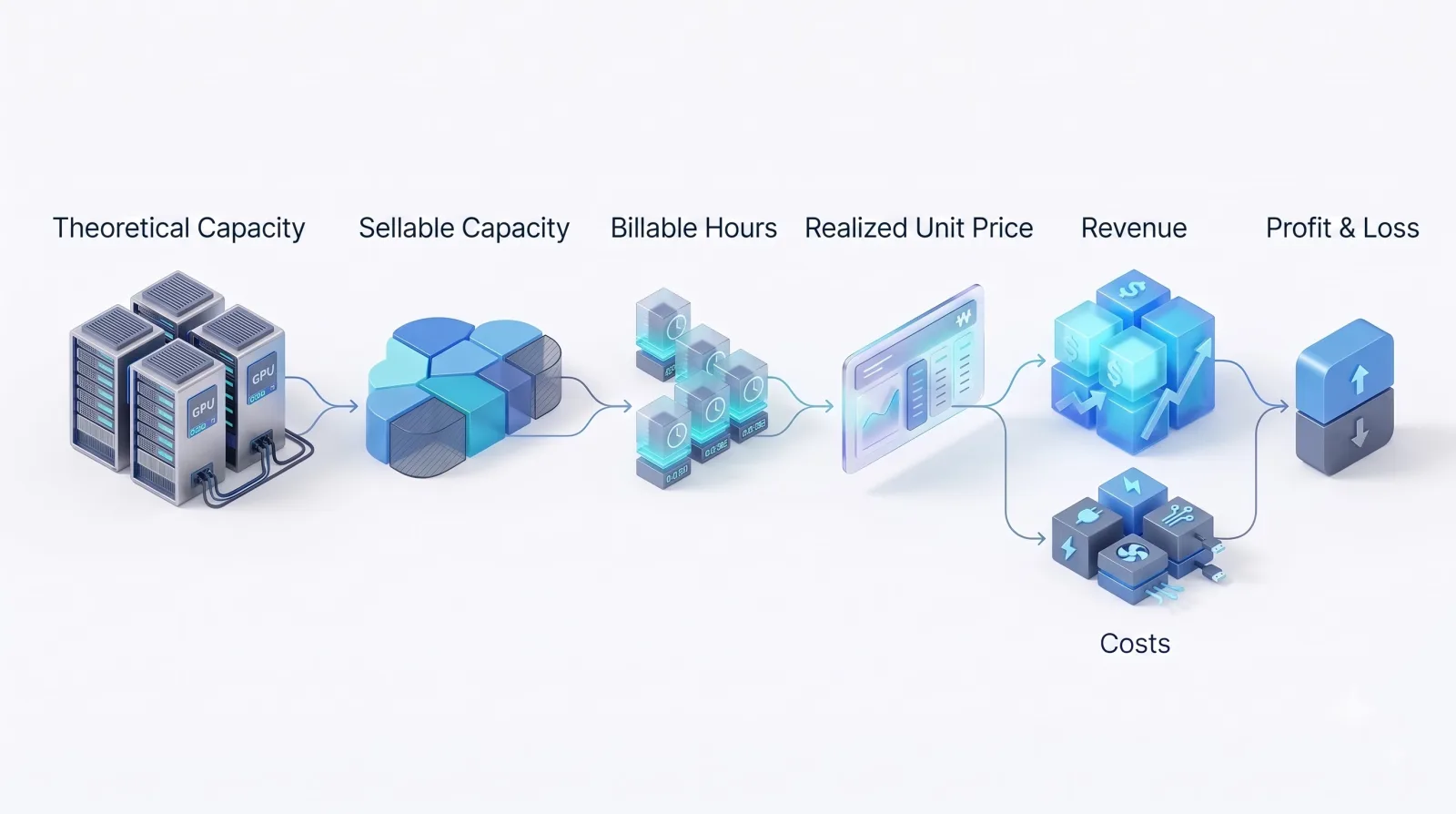
Theoretical GPU-hours → Saleable GPU-hours → Billable GPU-hours
Effective Price Matters More Than List Price
A posted hourly rate may not equal realized price.
The actual price can be affected by volume discounts, reserved contracts, long-term commitments, promotions, negotiated enterprise pricing, credits, or adjustments.
For unit economics, realized price is the relevant revenue input.
Hypothetical 32-GPU Example
Assume:
- 32 identical GPUs
- 30 days / 720 hours
- 23,040 theoretical GPU-hours
- KRW 4,000 effective price per billable GPU-hour
- 50% billable-time ratio
- KRW 30,000,000 monthly fixed expenses
- KRW 300 variable expense per billable GPU-hour
For simplicity, assume all theoretical hours are saleable.
Billable hours: 11,520 GPU-hours
Revenue: KRW 46,080,000
Variable expenses: KRW 3,456,000
Simplified monthly result: KRW +12,624,000
This is a simplified operating illustration, not audited net profit or free cash flow.
Break-even
The hypothetical contribution per billable GPU-hour is KRW 3,700.
Break-even billable-time ratio is approximately 35.2% under these assumptions only.
Sensitivity
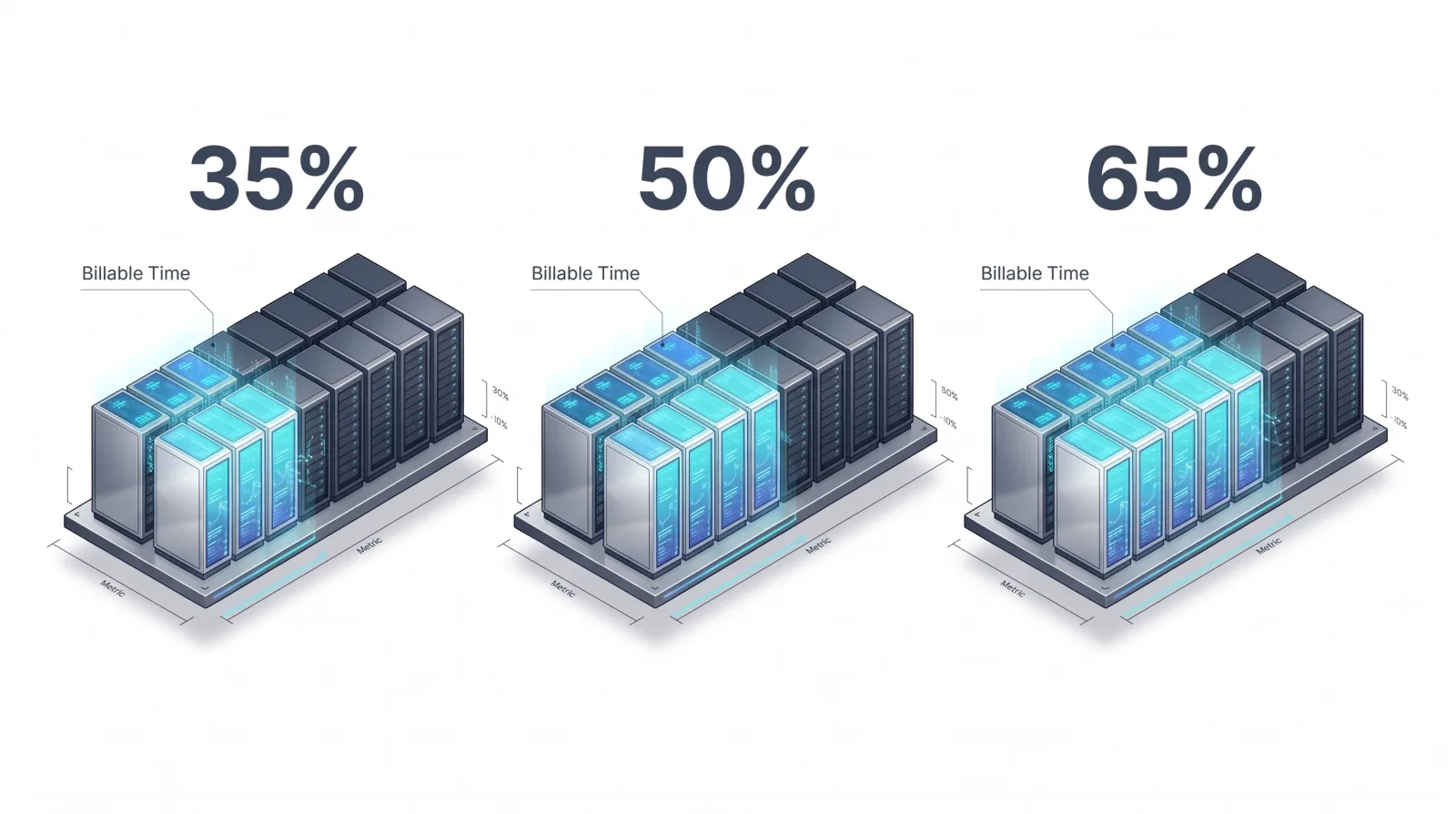
| Billable-time ratio | Monthly revenue | Variable expenses | Simplified monthly result |
|---|---|---|---|
| 35% | KRW 32,256,000 | KRW 2,419,200 | KRW -163,200 |
| 50% | KRW 46,080,000 | KRW 3,456,000 | KRW +12,624,000 |
| 65% | KRW 59,904,000 | KRW 4,492,800 | KRW +25,411,200 |
What Can Operators Actually Influence?
Operators can work on product and SKU demand fit, dedicated versus flexible offerings, reservation policy, provisioning and recycle time, metering and billing correctness, and full cost accounting.
Hardware cost alone is not enough. Power, cooling, facility, network, storage, software, engineering, support, financing, and customer acquisition may all matter.
Does an Operations Platform Improve Profitability?
An operations platform can help standardize service products, automate workflows, track service state, create consistent usage records, and manage resource lifecycle.
Those capabilities can improve operational consistency and scalability.
They do not guarantee utilization, revenue, or margin.
Thaki Cloud’s View
Thaki NeoCloud OS connects customer-owned infrastructure to the operator’s own branded cloud service through cloud operations such as catalog, ordering, provisioning, scheduling, metering, billing or settlement integration, observability, and lifecycle.
From an economics perspective, the useful question is whether the operator can consistently know what capacity is saleable, what is allocated, what usage is billable, whether billing state matches service state, and when capacity returns to the available pool.
Summary
GPU cloud profitability cannot be read from a utilization dashboard alone.
The economic chain is:
Theoretical Capacity → Saleable Capacity → Billable Time → Effective Price → Revenue → Cost
FAQ
Does higher GPU utilization mean higher profitability?
Not necessarily.
Is hourly GPU price enough to calculate revenue?
No. You also need billable hours, saleable capacity, realized pricing, and commercial terms.
Is the 35.2% break-even ratio a market benchmark?
No. It is specific to this hypothetical model.
Is dedicated leasing more profitable than GPUaaS?
There is no universal answer.
Does a cloud operations platform guarantee higher profit?
No.
Reviewing GPU Cloud Economics?
If you are evaluating how product design, capacity policy, metering, billing, and lifecycle affect a GPU cloud business model, Thaki Cloud can review the operating architecture with you.
Contact UsRelated articles
- What Is GPU Cloud? How It Works, Types, Use Cases, and GPUaaS ExplainedGPU cloud provides on-demand access to GPU computing resources without requiring users to own the hardware. Learn how GPU cloud works, common deployment types, GPUaaS terminology, use cases, benefits, and key considerations.
- What Is an AI Factory? How It Differs from an AI Data CenterAn AI factory is an integrated infrastructure and operating environment for developing, training, deploying, and running AI at scale. Learn how it differs from an AI data center, its core components, lifecycle, and relationship to GPU cloud.
- What Is GPUaaS? How GPU as a Service WorksGPU as a Service (GPUaaS) provides access to GPU compute without requiring organizations to buy and maintain the hardware. Learn how it works, how it relates to GPU cloud, delivery models, operational capabilities, and key buying considerations.
- What Is a Private AI Cloud?A private AI cloud combines private-cloud infrastructure dedicated to one organization with accelerated compute, AI platforms, data services, security, and governance. Learn how it differs from public AI cloud, on-prem AI, sovereign AI, and air-gapped AI.
- Why Owning GPU Servers Is Not the Same as Operating a GPU CloudGPU hardware alone does not create a GPU cloud. Learn how GPU hosting differs from cloud service operations and why self-service, provisioning, scheduling, metering, lifecycle management, and service delivery matter.
- What Is a Neocloud? AI-First Cloud Infrastructure ExplainedNeocloud is an industry term for specialized cloud infrastructure built around GPUs and AI workloads. Learn how neoclouds differ from general-purpose hyperscalers, how they relate to GPU cloud and GPUaaS, and how infrastructure owners can build their own services.
- The Next Step for an AI Factory Is Cloud ServiceBuilding an AI Factory is not the same as operating a customer-facing cloud service. Learn which operational layers—provisioning, tenancy, scheduling, metering, billing, SLA, and lifecycle automation—are required to turn AI infrastructure into a consumable service.
- What Does It Mean to Turn AI Infrastructure into a Cloud Business?Owning AI infrastructure is not the same as operating a cloud business. Learn how infrastructure becomes a product and then an on-demand cloud service through catalog, ordering, provisioning, metering, billing, SLA, and lifecycle operations.
- What Is Bare Metal GPU? Bare Metal vs Virtualized GPULearn what bare metal GPU means, how it differs from GPU VMs, vGPU and passthrough, and which trade-offs matter for performance, isolation, flexibility, utilization and provisioning.
- Private AI Cloud vs Public AI Cloud: What’s the Difference?Compare private and public AI cloud across exclusivity, control, scalability, managed services, operating responsibility and cost structure, and learn which model fits different AI workloads.
- What Is GPU Scheduling? How AI Clouds Allocate GPU ResourcesLearn how GPU scheduling allocates scarce GPU resources across AI workloads, including queues, priorities, quotas, GPU type, topology, multi-GPU jobs, fragmentation, and provisioning.
- What Operations Platform Does an AI Factory Need After Deployment?Learn which capabilities are needed to operate an AI Factory after deployment, including provisioning, GPU scheduling, access and policy, observability, capacity management, metering, and lifecycle automation.
- What Is On-Prem AI? Why Enterprises Run AI on Their Own InfrastructureLearn what on-prem AI means, how it differs from private AI cloud, and why enterprises may run AI locally for data, model, network, latency, governance, and operational control.
- What Is GPU Multi-Tenancy? How Multiple Tenants Share GPU InfrastructureLearn how GPU multi-tenancy isolates users, compute, GPUs, networking, storage, IAM, quotas, scheduling, and usage across multiple tenants, and where vGPU, MIG, and Kubernetes fit.
- What Is GPU Provisioning? From Request to a Ready-to-Use GPU EnvironmentLearn how GPU provisioning turns a request into a usable GPU environment by coordinating compute, networking, storage, images, runtimes, access, and lifecycle automation.
- How to Turn an AI Factory into a Multi-Customer Cloud ServiceLearn what changes when an AI Factory becomes a multi-customer cloud service, including catalog, tenancy, provisioning, scheduling, metering, billing, SLA, self-service, and lifecycle operations.
- GPU Cloud Commercialization Readiness: What Should Operators Check?Evaluate whether your GPU infrastructure is ready for customer-facing cloud services across productization, tenancy, provisioning, metering, billing, service operations, and lifecycle using a practical 12-point checklist.
- Building a GPU Cloud: Open Source vs. Integrated Operations PlatformsCompare self-built open-source GPU cloud stacks with integrated operations platforms across orchestration, tenancy, metering, billing, failure recovery, extensibility, support, and multi-year TCO.