What Is a Cloud Service Catalog?
Suppose a data center owns one hundred GPU servers.
Operations knows each server’s GPU type, memory, network connection, rack location and current status.
Can a customer use that information to order a cloud service?
Not necessarily.
An infrastructure inventory and a customer-facing service product are different things.
A cloud service catalog is the layer that translates infrastructure capability into something a customer can actually select and order.
A cloud service catalog defines what the customer can consume, under which conditions, and how that product maps to the underlying operating workflow.
A Service Catalog Is Not an Inventory List
Inventory answers questions such as:
- what hardware exists?
- what is available?
- what is in use?
- what is under maintenance?
Customers typically do not want to order a server asset ID.
They want a product such as:
- a dedicated eight-GPU server
- a GPU VM
- time-bound GPU capacity
- a defined compute, storage and networking bundle
The catalog turns infrastructure characteristics into orderable service products.
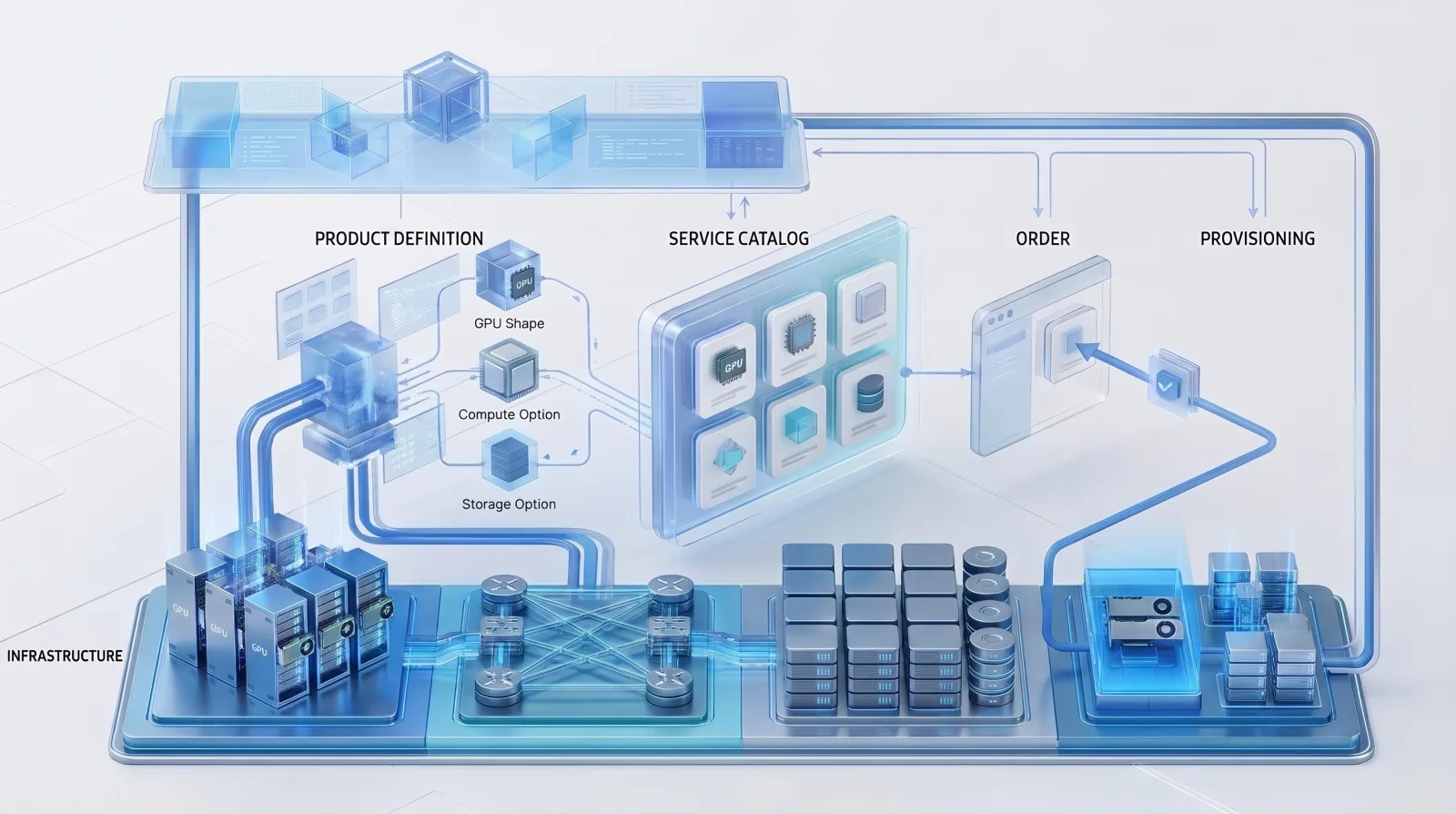
What Can a Catalog Item Contain?
Depending on the service, a catalog item may define:
- product or SKU
- GPU type and quantity
- bare-metal, VM or workload form
- compute shape
- networking options
- storage options
- reservation or duration rules
- region or site
- eligibility and quota
- price or contract mapping
- provisioning template
- termination and recovery policy
- support or SLA scope
Not every field is required for every service. The point is to connect the customer-facing product to the operating model behind it.
Inventory vs. Price List vs. Service Catalog
Inventory
Describes what resources physically or logically exist.
Price list
Describes pricing information or commercial rates.
Service catalog
Defines what the customer can order and under which service conditions.
A catalog can reference inventory and pricing, but it is not identical to either.
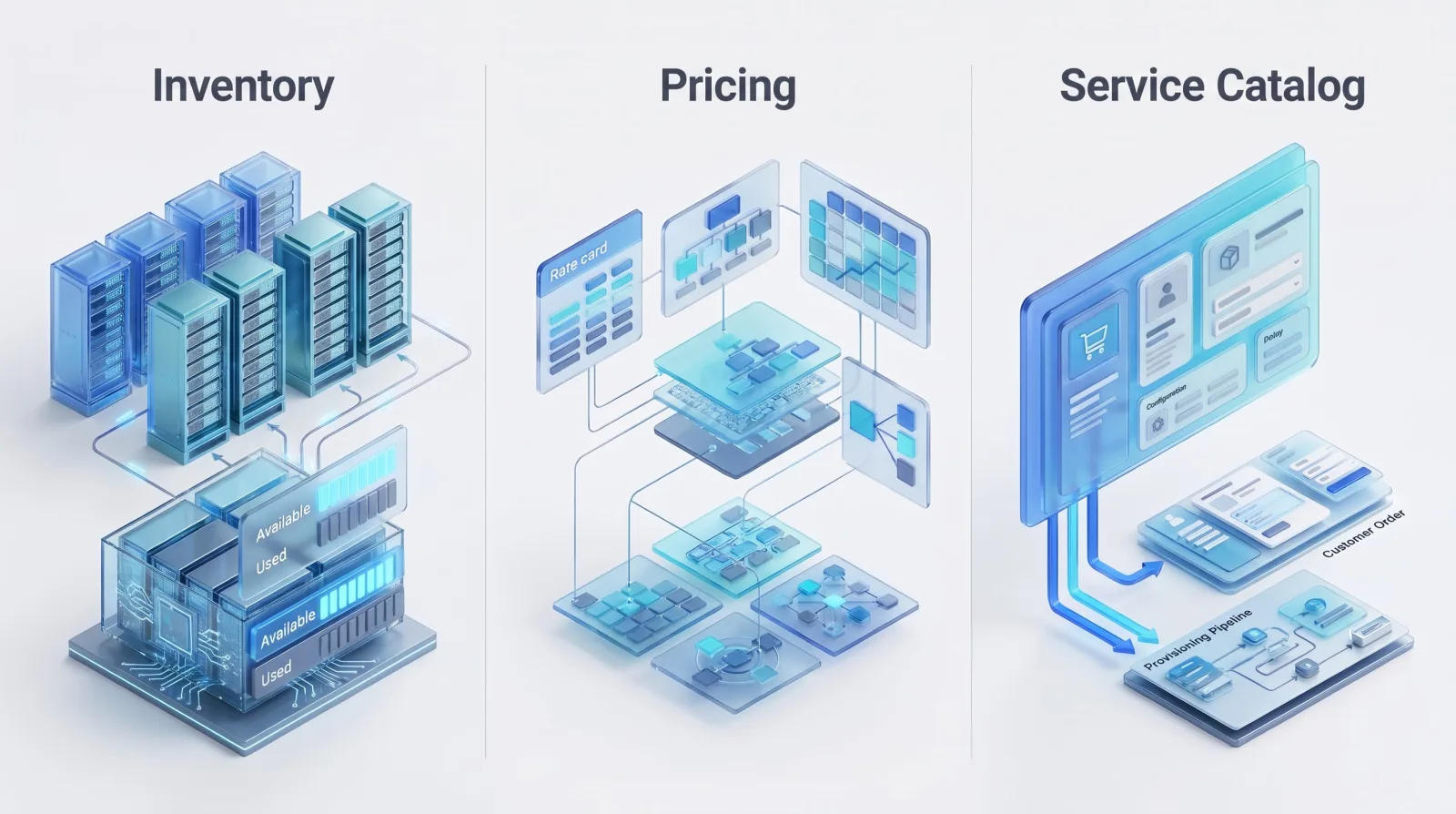
The Catalog Must Connect to Real Capacity
A product can exist in the catalog even when the required capacity is unavailable.
That creates a critical operating question: how does the customer request map to actual supply?
Operators may use real-time availability, reservations, wait states, approval policies or alternative offers.
The important requirement is that the catalog not drift away from operational reality.
The Catalog Must Connect to Provisioning
If the customer orders “Dedicated GPU Product A,” the platform needs to know how to create that service.
That may include:
- server selection
- image deployment
- network configuration
- storage
- credentials
- completion criteria
Repeatable service delivery requires a relationship between product definition and provisioning logic.
The Catalog Must Also Align with Billing
The catalog is not the billing engine.
However, it defines what was sold.
If the product says “seven-day dedicated GPU reservation” while operations meters GPU utilization and billing charges VM runtime, the service has conflicting definitions.
Product, service state, usage records and commercial rules need to remain aligned.
Do Not Confuse This with the OpenStack Keystone Service Catalog
OpenStack Keystone also uses the term “service catalog,” but for a different technical purpose.
Keystone’s service catalog helps API clients discover OpenStack services and their endpoints.
The commercial service catalog discussed in this article defines customer-orderable products.
The two can coexist, but they solve different problems.
Productization Is the Real Purpose
A good catalog should not simply expose every infrastructure option.
Its job is to create repeatable products that customers can understand and operators can fulfill.
That is the transition:
Infrastructure → Product
For infrastructure owners, this is one of the first steps toward a scalable cloud operating model.
Where Thaki NeoCloud OS Fits
Thaki Cloud’s canonical architecture is:
Customer Infrastructure → Thaki NeoCloud OS → Customer NeoCloud Service
Depending on the deployment, Thaki NeoCloud OS can connect service catalog to provisioning, tenancy, allocation and scheduling, usage metering, billing integration and lifecycle operations.
Actual product models, supported hardware and integration scope must be confirmed for each project.
Summary
A cloud service catalog is not an inventory list and not simply a price sheet.
The operating chain is:
Infrastructure capability → product definition → policy and options → service catalog → order → provisioning
That is how raw infrastructure starts becoming a repeatable cloud product.
FAQ
Is an inventory screen a service catalog?
No.
Is a service catalog just a price list?
No.
Must every GPU model be exposed as a catalog item?
No.
Is this the same as the OpenStack Keystone service catalog?
No. Keystone’s catalog is primarily for API service discovery.
Does a catalog complete the cloud service?
No. Identity, policy, capacity, provisioning, metering, billing and lifecycle still need to connect.
Turning GPU Capacity into Cloud Products?
If you are defining orderable services on top of owned GPU or AI infrastructure, Thaki Cloud can review how the catalog should connect to policy, capacity, provisioning, metering and lifecycle.
Contact UsRelated articles
- What Is GPU Cloud? How It Works, Types, Use Cases, and GPUaaS ExplainedGPU cloud provides on-demand access to GPU computing resources without requiring users to own the hardware. Learn how GPU cloud works, common deployment types, GPUaaS terminology, use cases, benefits, and key considerations.
- What Is an AI Factory? How It Differs from an AI Data CenterAn AI factory is an integrated infrastructure and operating environment for developing, training, deploying, and running AI at scale. Learn how it differs from an AI data center, its core components, lifecycle, and relationship to GPU cloud.
- What Is GPUaaS? How GPU as a Service WorksGPU as a Service (GPUaaS) provides access to GPU compute without requiring organizations to buy and maintain the hardware. Learn how it works, how it relates to GPU cloud, delivery models, operational capabilities, and key buying considerations.
- What Is a Private AI Cloud?A private AI cloud combines private-cloud infrastructure dedicated to one organization with accelerated compute, AI platforms, data services, security, and governance. Learn how it differs from public AI cloud, on-prem AI, sovereign AI, and air-gapped AI.
- Why Owning GPU Servers Is Not the Same as Operating a GPU CloudGPU hardware alone does not create a GPU cloud. Learn how GPU hosting differs from cloud service operations and why self-service, provisioning, scheduling, metering, lifecycle management, and service delivery matter.
- What Is a Neocloud? AI-First Cloud Infrastructure ExplainedNeocloud is an industry term for specialized cloud infrastructure built around GPUs and AI workloads. Learn how neoclouds differ from general-purpose hyperscalers, how they relate to GPU cloud and GPUaaS, and how infrastructure owners can build their own services.
- The Next Step for an AI Factory Is Cloud ServiceBuilding an AI Factory is not the same as operating a customer-facing cloud service. Learn which operational layers—provisioning, tenancy, scheduling, metering, billing, SLA, and lifecycle automation—are required to turn AI infrastructure into a consumable service.
- What Does It Mean to Turn AI Infrastructure into a Cloud Business?Owning AI infrastructure is not the same as operating a cloud business. Learn how infrastructure becomes a product and then an on-demand cloud service through catalog, ordering, provisioning, metering, billing, SLA, and lifecycle operations.
- What Is Bare Metal GPU? Bare Metal vs Virtualized GPULearn what bare metal GPU means, how it differs from GPU VMs, vGPU and passthrough, and which trade-offs matter for performance, isolation, flexibility, utilization and provisioning.
- Private AI Cloud vs Public AI Cloud: What’s the Difference?Compare private and public AI cloud across exclusivity, control, scalability, managed services, operating responsibility and cost structure, and learn which model fits different AI workloads.
- What Is GPU Scheduling? How AI Clouds Allocate GPU ResourcesLearn how GPU scheduling allocates scarce GPU resources across AI workloads, including queues, priorities, quotas, GPU type, topology, multi-GPU jobs, fragmentation, and provisioning.
- What Operations Platform Does an AI Factory Need After Deployment?Learn which capabilities are needed to operate an AI Factory after deployment, including provisioning, GPU scheduling, access and policy, observability, capacity management, metering, and lifecycle automation.
- What Is On-Prem AI? Why Enterprises Run AI on Their Own InfrastructureLearn what on-prem AI means, how it differs from private AI cloud, and why enterprises may run AI locally for data, model, network, latency, governance, and operational control.
- What Is GPU Multi-Tenancy? How Multiple Tenants Share GPU InfrastructureLearn how GPU multi-tenancy isolates users, compute, GPUs, networking, storage, IAM, quotas, scheduling, and usage across multiple tenants, and where vGPU, MIG, and Kubernetes fit.
- What Is GPU Provisioning? From Request to a Ready-to-Use GPU EnvironmentLearn how GPU provisioning turns a request into a usable GPU environment by coordinating compute, networking, storage, images, runtimes, access, and lifecycle automation.
- How to Turn an AI Factory into a Multi-Customer Cloud ServiceLearn what changes when an AI Factory becomes a multi-customer cloud service, including catalog, tenancy, provisioning, scheduling, metering, billing, SLA, self-service, and lifecycle operations.
- GPU Cloud Commercialization Readiness: What Should Operators Check?Evaluate whether your GPU infrastructure is ready for customer-facing cloud services across productization, tenancy, provisioning, metering, billing, service operations, and lifecycle using a practical 12-point checklist.
- GPU Cloud Profitability: Why Utilization Alone Is Not EnoughLearn why technical GPU utilization is different from billable time, and how saleable capacity, realized pricing, fixed and variable costs, and break-even interact in a hypothetical 32-GPU model.
- Building a GPU Cloud: Open Source vs. Integrated Operations PlatformsCompare self-built open-source GPU cloud stacks with integrated operations platforms across orchestration, tenancy, metering, billing, failure recovery, extensibility, support, and multi-year TCO.
- What Is Self-Service Cloud?Learn why self-service cloud is more than a portal and how catalog, identity, policy, capacity, provisioning, metering and lifecycle work together to enable on-demand cloud consumption.
- What Is On-Demand GPU Service?Understand on-demand GPU as a consumption model rather than a single virtualization or pricing method, and see how capacity, provisioning, metering and release work together.
- From GPU Hosting to GPU CloudLearn how data center operators can evolve GPU hosting into a customer-facing cloud service by adding productization, self-service, automated provisioning, tenancy, metering and lifecycle operations.