What Is Air-Gapped AI?
Air-gapped AI is often described as “AI without internet access.”
That is directionally useful, but an air gap is stricter than an ordinary private network or firewall.
NIST defines an air gap as an interface between systems where there is no physical connection and no automated logical connection; data crosses the interface only manually under human control.
For AI, that distinction changes the entire operating model.
Models, datasets, packages, container images, drivers, patches and observability tooling may normally depend on external repositories and APIs.
In an air-gapped environment, those dependencies need controlled alternatives.
Air Gap vs. Private Network vs. Segmentation
A private network can still have controlled connectivity.
Network segmentation separates zones but does not necessarily remove automated connections.
An air gap removes both physical connection and automated logical connection across the boundary.
“Network separation” or Korean 망분리 can describe different implementation models and should not automatically be treated as identical to a strict air gap.
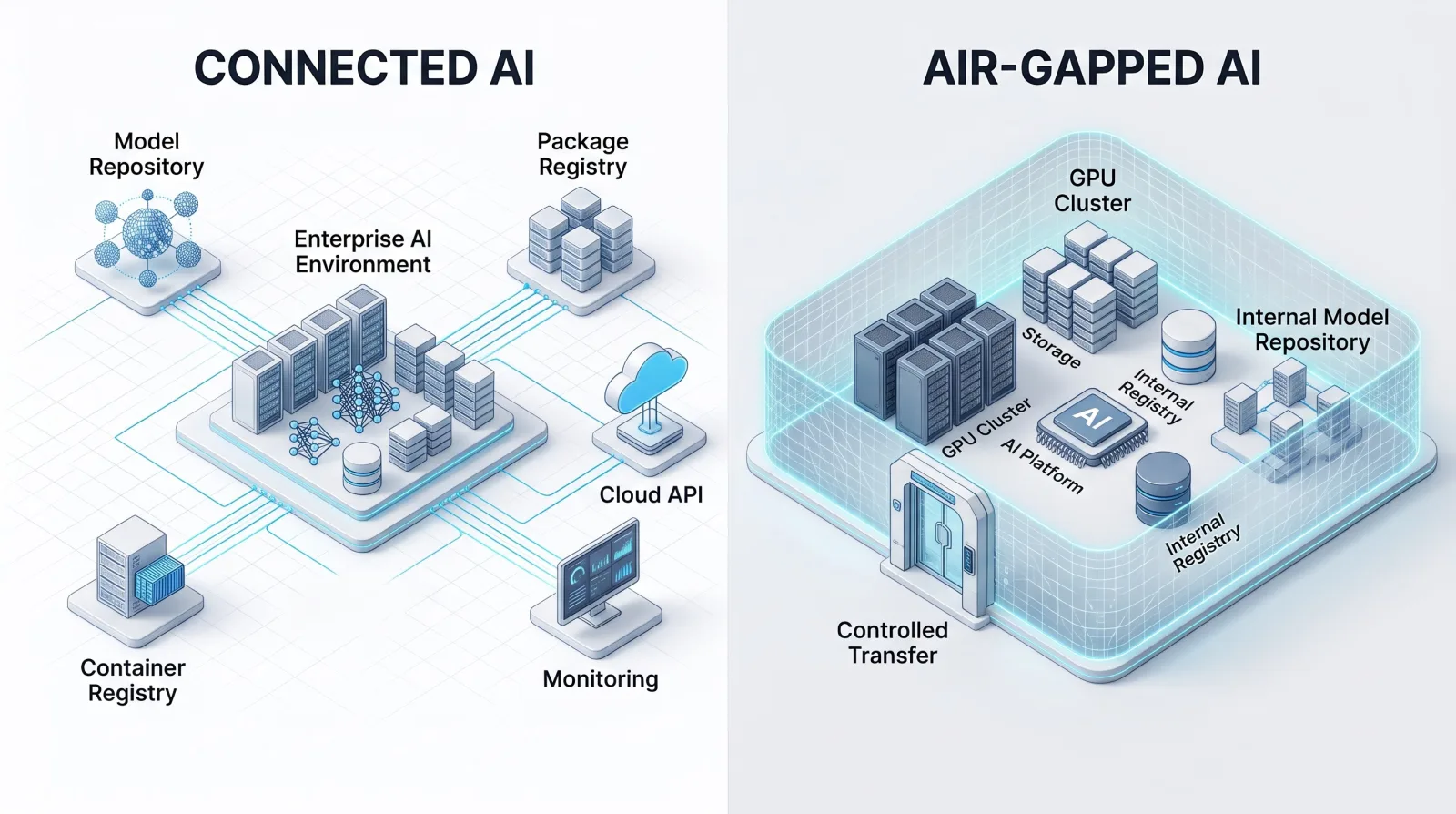
Why AI Is Challenging in Disconnected Environments
An AI workload may require:
- model weights
- tokenizers
- datasets
- container images
- Python packages
- GPU drivers and runtimes
- evaluation artifacts
- security updates
Those dependencies must be staged, verified, transferred and maintained without ordinary online access.
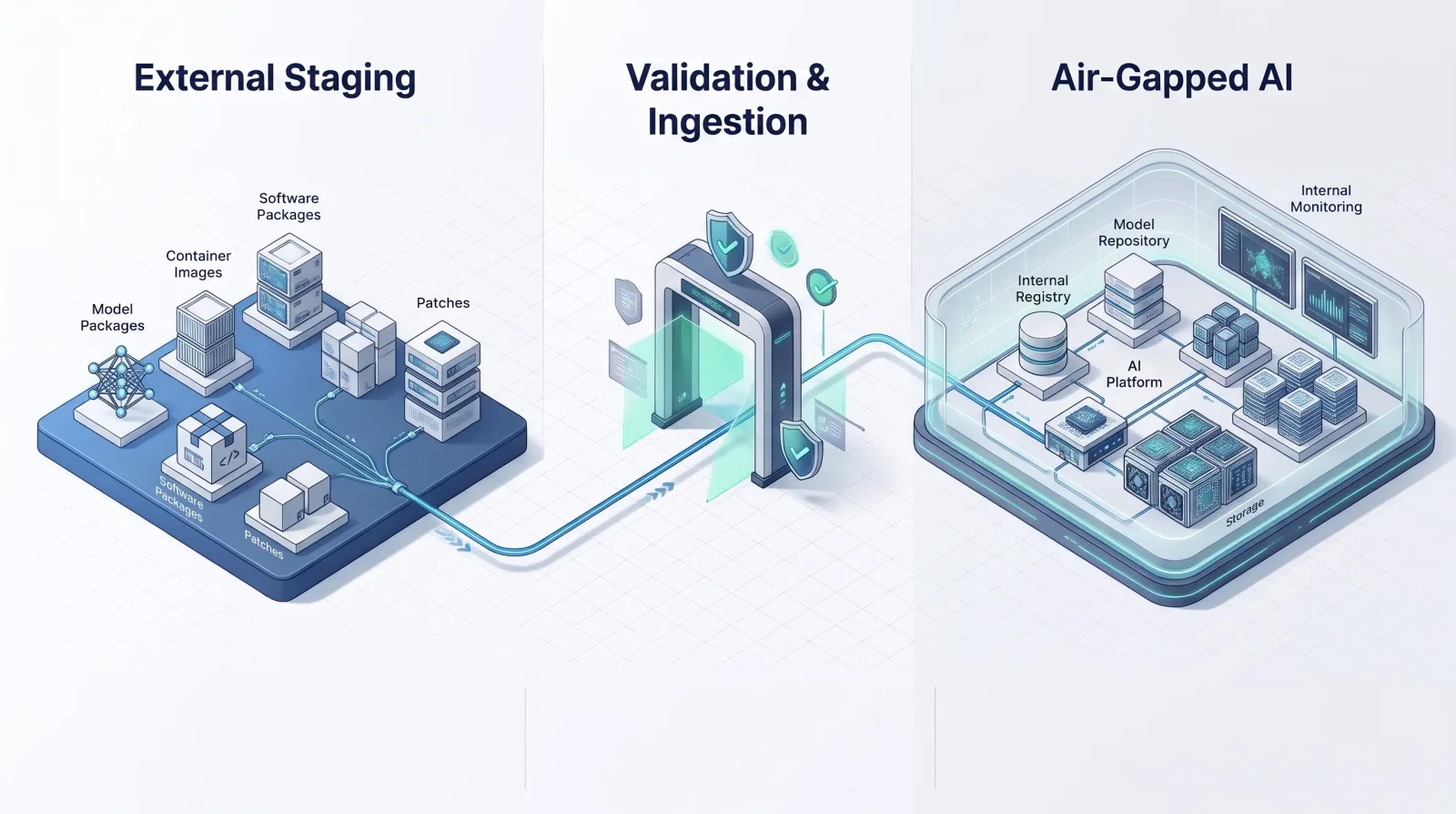
Internal Registries and Repositories
Air-gapped operations may require internal versions of:
- container registries
- package repositories
- model repositories
- dataset storage
- source repositories
The important requirement is not only storage. Operators need to know which artifacts are approved, deployed and current.
Model and Software Updates Become Change Management
A model update may involve acquisition, integrity verification, security scanning, evaluation, approval, controlled transfer, registration, deployment and rollback planning.
The exact workflow depends on organizational policy.
RAG and Agents Become More Self-Contained
Air-gapped RAG may require embedding, vector databases, parsing, OCR and model serving to remain inside the environment.
Agents that normally call internet services or SaaS APIs need alternative internal tools and data sources.
Observability Must Also Work Offline
Metrics, logs, alerts, traces and GPU monitoring must be stored and operated inside the boundary when external monitoring services are unavailable.
Air Gap Is Not a Security Guarantee
Reduced connectivity can reduce some exposure, but other risks remain:
- supply-chain compromise
- transferred media or artifacts
- insiders
- patch delays
- credentials
- physical access
- misconfiguration
Air gap is a control, not a complete security program.
Operational Resilience Matters
Disconnected environments need stronger local recovery capability, offline packages, backups, documentation and skills because external support may not be immediately available.
Relationship to On-Prem, Private and Sovereign AI
On-prem describes deployment location.
Private AI cloud describes an operating model.
Air-gapped AI describes a connectivity and transfer boundary.
Sovereign AI describes a broader control and jurisdiction model.
They can overlap without being equivalent.
Where Thaki Cloud Fits
Thaki Cloud supports private and on-premise AI environments on customer-controlled infrastructure.
Actual support for a specific air-gapped deployment depends on the customer environment and required integrations and must be confirmed.
Summary
Air-gapped AI is not simply an AI server with no browser access.
It requires the full AI software and artifact lifecycle to work without automated external connectivity.
The operating challenge is:
Model + Data + Package + Runtime + Patch + Operations
inside a controlled boundary.
FAQ
Is every internet-blocked system air-gapped?
No.
Is network separation the same as an air gap?
Not necessarily.
Can LLMs run air-gapped?
Yes, with an appropriate internal software and model supply chain.
Can RAG run air-gapped?
Yes.
Does an air gap eliminate security risk?
No.
Operating AI in a Disconnected Environment?
Thaki Cloud can review private and on-premise AI architecture for environments with restricted external connectivity.
Contact UsRelated articles
- What Is GPU Cloud? How It Works, Types, Use Cases, and GPUaaS ExplainedGPU cloud provides on-demand access to GPU computing resources without requiring users to own the hardware. Learn how GPU cloud works, common deployment types, GPUaaS terminology, use cases, benefits, and key considerations.
- What Is an AI Factory? How It Differs from an AI Data CenterAn AI factory is an integrated infrastructure and operating environment for developing, training, deploying, and running AI at scale. Learn how it differs from an AI data center, its core components, lifecycle, and relationship to GPU cloud.
- What Is GPUaaS? How GPU as a Service WorksGPU as a Service (GPUaaS) provides access to GPU compute without requiring organizations to buy and maintain the hardware. Learn how it works, how it relates to GPU cloud, delivery models, operational capabilities, and key buying considerations.
- What Is a Private AI Cloud?A private AI cloud combines private-cloud infrastructure dedicated to one organization with accelerated compute, AI platforms, data services, security, and governance. Learn how it differs from public AI cloud, on-prem AI, sovereign AI, and air-gapped AI.
- Why Owning GPU Servers Is Not the Same as Operating a GPU CloudGPU hardware alone does not create a GPU cloud. Learn how GPU hosting differs from cloud service operations and why self-service, provisioning, scheduling, metering, lifecycle management, and service delivery matter.
- What Is a Neocloud? AI-First Cloud Infrastructure ExplainedNeocloud is an industry term for specialized cloud infrastructure built around GPUs and AI workloads. Learn how neoclouds differ from general-purpose hyperscalers, how they relate to GPU cloud and GPUaaS, and how infrastructure owners can build their own services.
- The Next Step for an AI Factory Is Cloud ServiceBuilding an AI Factory is not the same as operating a customer-facing cloud service. Learn which operational layers—provisioning, tenancy, scheduling, metering, billing, SLA, and lifecycle automation—are required to turn AI infrastructure into a consumable service.
- What Does It Mean to Turn AI Infrastructure into a Cloud Business?Owning AI infrastructure is not the same as operating a cloud business. Learn how infrastructure becomes a product and then an on-demand cloud service through catalog, ordering, provisioning, metering, billing, SLA, and lifecycle operations.
- What Is Bare Metal GPU? Bare Metal vs Virtualized GPULearn what bare metal GPU means, how it differs from GPU VMs, vGPU and passthrough, and which trade-offs matter for performance, isolation, flexibility, utilization and provisioning.
- Private AI Cloud vs Public AI Cloud: What’s the Difference?Compare private and public AI cloud across exclusivity, control, scalability, managed services, operating responsibility and cost structure, and learn which model fits different AI workloads.
- What Is GPU Scheduling? How AI Clouds Allocate GPU ResourcesLearn how GPU scheduling allocates scarce GPU resources across AI workloads, including queues, priorities, quotas, GPU type, topology, multi-GPU jobs, fragmentation, and provisioning.
- What Operations Platform Does an AI Factory Need After Deployment?Learn which capabilities are needed to operate an AI Factory after deployment, including provisioning, GPU scheduling, access and policy, observability, capacity management, metering, and lifecycle automation.
- What Is On-Prem AI? Why Enterprises Run AI on Their Own InfrastructureLearn what on-prem AI means, how it differs from private AI cloud, and why enterprises may run AI locally for data, model, network, latency, governance, and operational control.
- What Is GPU Multi-Tenancy? How Multiple Tenants Share GPU InfrastructureLearn how GPU multi-tenancy isolates users, compute, GPUs, networking, storage, IAM, quotas, scheduling, and usage across multiple tenants, and where vGPU, MIG, and Kubernetes fit.
- What Is GPU Provisioning? From Request to a Ready-to-Use GPU EnvironmentLearn how GPU provisioning turns a request into a usable GPU environment by coordinating compute, networking, storage, images, runtimes, access, and lifecycle automation.
- How to Turn an AI Factory into a Multi-Customer Cloud ServiceLearn what changes when an AI Factory becomes a multi-customer cloud service, including catalog, tenancy, provisioning, scheduling, metering, billing, SLA, self-service, and lifecycle operations.
- GPU Cloud Commercialization Readiness: What Should Operators Check?Evaluate whether your GPU infrastructure is ready for customer-facing cloud services across productization, tenancy, provisioning, metering, billing, service operations, and lifecycle using a practical 12-point checklist.
- GPU Cloud Profitability: Why Utilization Alone Is Not EnoughLearn why technical GPU utilization is different from billable time, and how saleable capacity, realized pricing, fixed and variable costs, and break-even interact in a hypothetical 32-GPU model.
- Building a GPU Cloud: Open Source vs. Integrated Operations PlatformsCompare self-built open-source GPU cloud stacks with integrated operations platforms across orchestration, tenancy, metering, billing, failure recovery, extensibility, support, and multi-year TCO.
- What Is Self-Service Cloud?Learn why self-service cloud is more than a portal and how catalog, identity, policy, capacity, provisioning, metering and lifecycle work together to enable on-demand cloud consumption.
- What Is On-Demand GPU Service?Understand on-demand GPU as a consumption model rather than a single virtualization or pricing method, and see how capacity, provisioning, metering and release work together.
- What Is a Cloud Service Catalog?Learn how a cloud service catalog turns infrastructure capacity into orderable products and connects product definitions to policy, provisioning and commercial operations.
- From GPU Hosting to GPU CloudLearn how data center operators can evolve GPU hosting into a customer-facing cloud service by adding productization, self-service, automated provisioning, tenancy, metering and lifecycle operations.
- How Telecom Operators Can Build an AI Cloud Service on Owned GPU InfrastructureLearn how telecom operators can extend data center, network and GPU assets into customer-facing AI cloud services through productization, self-service, provisioning, tenancy, metering and lifecycle operations.
- What Is Sovereign AI Cloud?Sovereign AI extends beyond data residency. Learn how control over data, identity, keys, infrastructure, models, operations, jurisdiction and dependencies shapes sovereign AI architecture.
- Enterprise AI Infrastructure ChecklistPlan enterprise AI infrastructure with a 12-point checklist covering workloads, data, deployment model, GPU compute, network, storage, platform, security, governance, operations, capacity and economics.