Building a GPU Cloud: Open Source vs. Integrated Operations Platforms
If an operator deploys OpenStack and Kubernetes, is the commercial GPU cloud ready?
Open source can absolutely support a real GPU cloud.
OpenStack can provide infrastructure services and identity, networking, image, and compute capabilities. Ironic can provision physical bare metal machines. Kubernetes can orchestrate container workloads and expose GPUs as schedulable resources through device plugins. Prometheus, Grafana, and NVIDIA DCGM exporter can provide monitoring and GPU telemetry.
Those are substantial capabilities.
The build-versus-buy question is therefore not:
“Can open source build a GPU cloud?”
It is:
“Who will integrate and own the complete customer service workflow from order to resource recovery?”
What the Core Open Source Components Do
OpenStack and Ironic
OpenStack can provide cloud infrastructure services. Ironic is specifically a bare metal provisioning project and can manage physical machine lifecycle.
It should not be described as a complete commercial GPUaaS platform by itself.
Kubernetes
Kubernetes orchestrates container workloads and can schedule GPU resources exposed through vendor device plugins.
It also provides mechanisms such as namespaces, RBAC, and quotas that can support multi-team environments.
It is not, by itself, a customer product catalog, contract, pricing, invoice, and settlement platform.
Prometheus, Grafana, and NVIDIA DCGM exporter
DCGM exporter exposes NVIDIA GPU telemetry in Prometheus format. Prometheus stores and queries metrics, and Grafana visualizes them.
That stack is useful for infrastructure and GPU observability.
Technical telemetry is not automatically a customer billing record.
The Missing Question: Who Owns the Workflow?
Consider a customer order:
- choose a product
- validate identity and entitlement
- create order or reservation
- reserve capacity
- provision GPU server, network, and storage
- create customer access
- measure usage
- rate and bill
- terminate the service
- clean and return the resource
Each step may involve a different system.
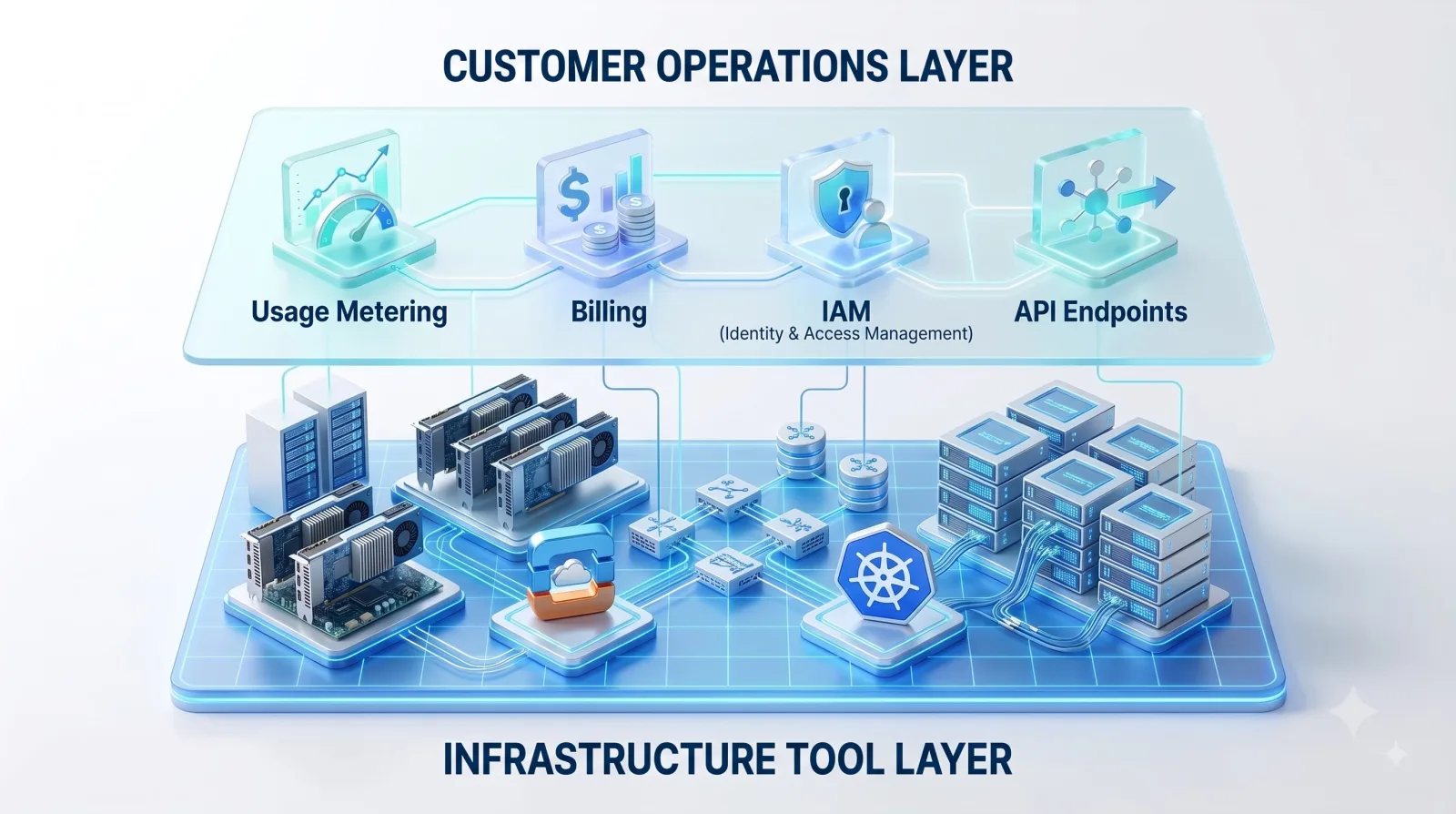
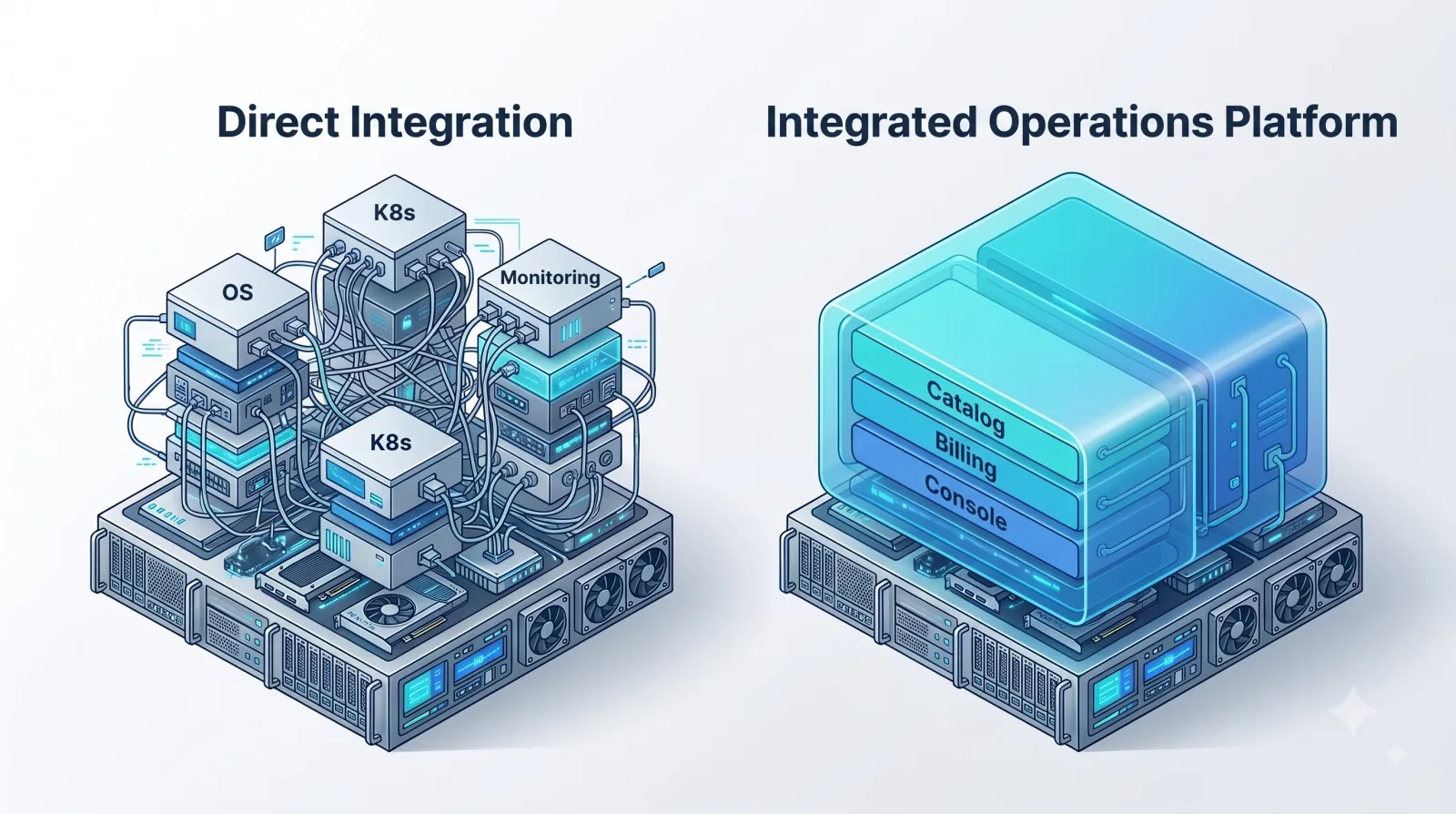
A self-built architecture can integrate these systems with custom services and APIs.
An integrated operations platform can provide more of the workflow as a unified layer.
Both are viable.
Failure States Reveal the Real Integration Cost
Suppose GPU capacity reservation succeeds, but network provisioning fails.
Who:
- retries the network operation?
- releases or retains the GPU reservation?
- cleans up partially created resources?
- reports the correct service state to the customer?
- prevents billing from starting incorrectly?
- returns the GPU to available capacity?
- records the failure for audit and incident response?
This is not primarily an OpenStack-versus-Kubernetes problem.
It is a workflow ownership and state reconciliation problem.
Commercial cloud systems need to handle partial failure, retry, rollback, and billing correctness—not only the happy path.
Build vs. Integrated Platform
A fair comparison should include:
- existing hardware integration
- service catalog
- order-to-fulfillment workflow
- IAM and multi-tenancy
- metering versus pricing and billing
- integration APIs
- failure and rollback ownership
- upgrades, security, and support
- customization
- vendor dependency
- internal engineering requirements
- 3–5-year TCO
Neither approach wins automatically.
When DIY Can Be Rational
DIY can make sense when:
- the environment is internal-only
- the organization already has strong cloud platform engineers
- deep customization is strategic
- customer portal, identity, ordering, and billing systems already exist
In such cases, internal ownership may provide flexibility and control.
When an Integrated Platform Is Worth Evaluating
An integrated platform can be worth evaluating when:
- the service is external and multi-customer
- self-service and on-demand delivery are required
- platform engineering capacity is limited
- service products and SKUs are expanding
- repeatable workflow standardization is increasingly important
License Cost Is Not TCO
Open source can reduce software license fees.
That does not make engineering, integration, testing, upgrades, security, incident response, billing integration, documentation, and support free.
Commercial platforms add license or subscription cost but may reduce some internal development burden.
The right comparison is multi-year ownership cost, not license fee alone.
Seven Questions for a CTO or Architect
- Who validates and maintains actual hardware, network, and storage integration?
- How is tenant isolation implemented across identity, network, storage, workload, and usage data?
- Who owns retry, rollback, and reconciliation after partial failure?
- Can usage and billing be audited back to customer, resource, time, contract, and rate?
- Who owns incident response, upgrades, security patches, and compatibility?
- How easily can new GPU models, SKUs, APIs, or sites be added?
- What is the full 3–5-year TCO including engineering, integration, operations, support, and migration?
Where Thaki NeoCloud OS Fits
Thaki Cloud’s canonical architecture is:
Customer Infrastructure → Thaki NeoCloud OS → Customer NeoCloud Service
Thaki NeoCloud OS is the software and cloud-operations layer between customer-owned infrastructure and the operator’s own branded service.
It should not be positioned as a mandatory replacement for OpenStack or Kubernetes.
The relevant architecture question is how it integrates with the target environment and which responsibilities it takes on across service catalog, ordering, tenant operations, provisioning, metering or billing integration, failure state, and lifecycle. Actual integration and feature support must be verified for the project.
Summary
Open source can build GPU cloud infrastructure and service capabilities.
Integrated platforms can also be a valid approach.
The decision becomes clearer when the organization asks:
Who owns integration, failure recovery, lifecycle responsibility, extensibility, and multi-year TCO?
FAQ
Is OpenStack enough to build a GPU cloud?
It can be a major infrastructure foundation, but commercial product, order, billing, and service lifecycle functions may require additional components and integration.
Can Kubernetes provide GPUaaS?
Kubernetes can orchestrate and schedule GPU workloads, but customer-facing commercial lifecycle functions require additional systems.
Can Prometheus metrics be used directly for billing?
Technical metrics are not automatically billable usage records. Commercial context is required.
Is open source always cheaper?
No. Engineering and operating cost need to be included.
Does an integrated platform create vendor dependency?
It can. APIs, portability, customization, and exit strategy should be evaluated.
Reviewing a GPU Cloud Build-vs-Buy Decision?
If you are evaluating whether to extend an existing OpenStack / Kubernetes environment with custom commercial services or adopt an integrated operations platform, Thaki Cloud can review the architecture with you.
Contact UsRelated articles
- What Is GPU Cloud? How It Works, Types, Use Cases, and GPUaaS ExplainedGPU cloud provides on-demand access to GPU computing resources without requiring users to own the hardware. Learn how GPU cloud works, common deployment types, GPUaaS terminology, use cases, benefits, and key considerations.
- What Is an AI Factory? How It Differs from an AI Data CenterAn AI factory is an integrated infrastructure and operating environment for developing, training, deploying, and running AI at scale. Learn how it differs from an AI data center, its core components, lifecycle, and relationship to GPU cloud.
- What Is GPUaaS? How GPU as a Service WorksGPU as a Service (GPUaaS) provides access to GPU compute without requiring organizations to buy and maintain the hardware. Learn how it works, how it relates to GPU cloud, delivery models, operational capabilities, and key buying considerations.
- What Is a Private AI Cloud?A private AI cloud combines private-cloud infrastructure dedicated to one organization with accelerated compute, AI platforms, data services, security, and governance. Learn how it differs from public AI cloud, on-prem AI, sovereign AI, and air-gapped AI.
- Why Owning GPU Servers Is Not the Same as Operating a GPU CloudGPU hardware alone does not create a GPU cloud. Learn how GPU hosting differs from cloud service operations and why self-service, provisioning, scheduling, metering, lifecycle management, and service delivery matter.
- What Is a Neocloud? AI-First Cloud Infrastructure ExplainedNeocloud is an industry term for specialized cloud infrastructure built around GPUs and AI workloads. Learn how neoclouds differ from general-purpose hyperscalers, how they relate to GPU cloud and GPUaaS, and how infrastructure owners can build their own services.
- The Next Step for an AI Factory Is Cloud ServiceBuilding an AI Factory is not the same as operating a customer-facing cloud service. Learn which operational layers—provisioning, tenancy, scheduling, metering, billing, SLA, and lifecycle automation—are required to turn AI infrastructure into a consumable service.
- What Does It Mean to Turn AI Infrastructure into a Cloud Business?Owning AI infrastructure is not the same as operating a cloud business. Learn how infrastructure becomes a product and then an on-demand cloud service through catalog, ordering, provisioning, metering, billing, SLA, and lifecycle operations.
- What Is Bare Metal GPU? Bare Metal vs Virtualized GPULearn what bare metal GPU means, how it differs from GPU VMs, vGPU and passthrough, and which trade-offs matter for performance, isolation, flexibility, utilization and provisioning.
- Private AI Cloud vs Public AI Cloud: What’s the Difference?Compare private and public AI cloud across exclusivity, control, scalability, managed services, operating responsibility and cost structure, and learn which model fits different AI workloads.
- What Is GPU Scheduling? How AI Clouds Allocate GPU ResourcesLearn how GPU scheduling allocates scarce GPU resources across AI workloads, including queues, priorities, quotas, GPU type, topology, multi-GPU jobs, fragmentation, and provisioning.
- What Operations Platform Does an AI Factory Need After Deployment?Learn which capabilities are needed to operate an AI Factory after deployment, including provisioning, GPU scheduling, access and policy, observability, capacity management, metering, and lifecycle automation.
- What Is On-Prem AI? Why Enterprises Run AI on Their Own InfrastructureLearn what on-prem AI means, how it differs from private AI cloud, and why enterprises may run AI locally for data, model, network, latency, governance, and operational control.
- What Is GPU Multi-Tenancy? How Multiple Tenants Share GPU InfrastructureLearn how GPU multi-tenancy isolates users, compute, GPUs, networking, storage, IAM, quotas, scheduling, and usage across multiple tenants, and where vGPU, MIG, and Kubernetes fit.
- What Is GPU Provisioning? From Request to a Ready-to-Use GPU EnvironmentLearn how GPU provisioning turns a request into a usable GPU environment by coordinating compute, networking, storage, images, runtimes, access, and lifecycle automation.
- How to Turn an AI Factory into a Multi-Customer Cloud ServiceLearn what changes when an AI Factory becomes a multi-customer cloud service, including catalog, tenancy, provisioning, scheduling, metering, billing, SLA, self-service, and lifecycle operations.
- GPU Cloud Commercialization Readiness: What Should Operators Check?Evaluate whether your GPU infrastructure is ready for customer-facing cloud services across productization, tenancy, provisioning, metering, billing, service operations, and lifecycle using a practical 12-point checklist.
- GPU Cloud Profitability: Why Utilization Alone Is Not EnoughLearn why technical GPU utilization is different from billable time, and how saleable capacity, realized pricing, fixed and variable costs, and break-even interact in a hypothetical 32-GPU model.