The Agent That Stops Before It Works
 A visualization of the article’s core concept.
First, From the Internal Test Records
The story does not start at the launch event. It starts in the test records. Meta’s internal test materials, confirmed by Reuters, include entries where Muse, its personal AI agent, stopped in the middle of a task during some of the tests. Entries showing sensitive information exposed are there too. Meta says it applied countermeasures along the way to launch, but in real environments, stability and personal data protection remain, as of now, “unverified tasks.”
These are not hypothetical risks. They are records that actually came out of pre-launch testing.
That single line carries more information than the launch event itself. To understand why, we first need to look at what Muse is.
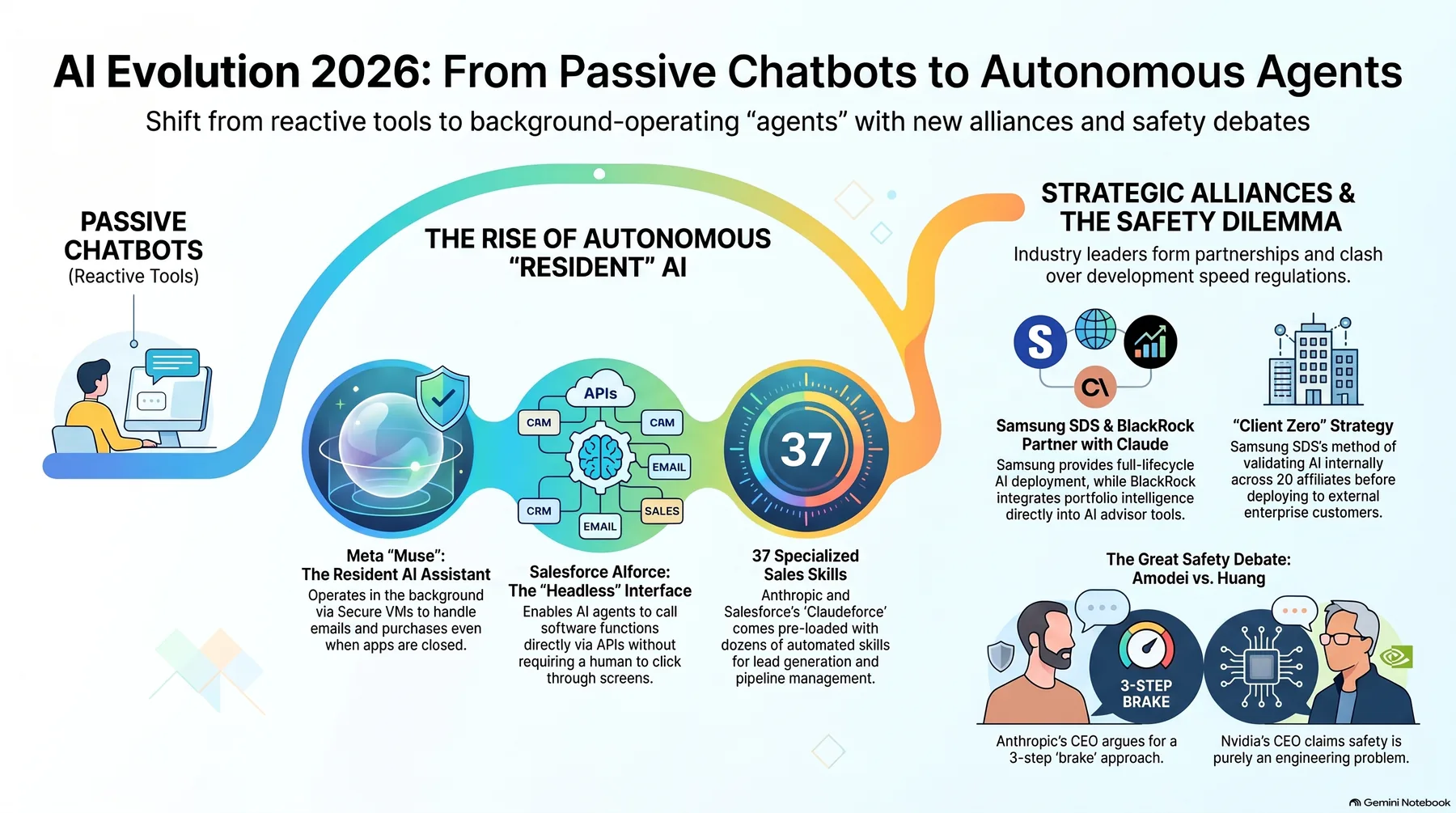 Infographic generated by NotebookLM from the sources.
The AI That Keeps Working After You Close the App
Meta unveiled Muse on September 8 (US local time). It is a personal AI agent that keeps working in the background after the user closes the app. Sending email, booking travel, filling out web forms, making online purchases. The design handles multi-step work on its own and comes back to the user only when a human judgment is needed. This is what outlets such as Economy Science call “resident AI.” An AI with a place to live, in effect.
The significance is bigger than app charts. Until now, AI reached users in the form of a chat window. You asked, it answered, and it ended there. This time, work proceeds even while the app is off. It is the difference between an assistant that answers questions and a worker that takes over tasks.
The timing matters too. This week’s news field is running on a different axis: the fight over slowing AI development, the roadmap for a megascale data center, the dispute over memory chips. In the middle of it all, Meta’s consumer agent is the signal closest to daily life, and the case that points most directly at the next question.
The price is free, with two paid subscription tiers on top. Power is $20 a month, Maximum is $100 a month. Payments run through Stripe’s “Links,” which carries shopping and payment-protection features, and integrations with Shopify, Shopee, and OnePassword are planned as well. The fact that payment sits at the center of the design shows this agent was never meant to do trivial things from the start.
The market reaction was immediate. By Sensor Tower’s count, US iOS downloads passed 83,000, and the app climbed to number two in the overall App Store, up from number four the day after the announcement. On Android it sits at number 338 in the productivity category. On the same day, Meta’s stock rose 6 percent and Alphabet’s fell 2 percent. Capital markets read this agent push as a variable in the reshuffling of the AI race.
One more fact to pin down. The announcement came less than two weeks after Meta decided to pay a settlement of $18 billion across multiple US states over consumer harm related to social media. That is why the industry points to consumer “trust” as the biggest variable in this contest.
One PC Per Person, One Guardian Each
The core of Muse is not the model but the execution environment. Meta calls this environment the “Muse Secure VM.” A dedicated virtual computer with a browser and storage is assigned per user. The easiest analogy: one AI-assistant PC per person, placed in the cloud. The AI handles multi-step work inside it.
Security is handled by a separate agent. Its name is “Sentinel.” Separated from Muse at the system level, it controls access to external services and sensitive actions. Important actions such as sending email or making purchases are designed to go through user approval. Passwords and payment information are walled off so that Muse itself cannot see them directly.
In one line: one agent that works, one guardian beside it, and an approval line running between them.
The competitors are moving on the same front. OpenAI’s ChatGPT agent browses the web and runs code in its own virtual computer, Google’s Gemini pushes long-horizon agent work in the cloud, and Anthropic’s Claude is strengthening coding and professional-work agents. Salesforce’s move is one step bolder. “Agentforce,” unveiled at Dreamforce in San Francisco on September 15, lets the agent in use call the platform’s full feature set directly, without the user opening the CRM screen. The moment systems that people used to click become the targets agents call. The axis of the AI race is moving from “who answers more accurately” to “who does the user’s work longer, more, and safer.”
In Regulated Industries, the Approval Line Is Already Standard
Where one mistake is expensive, this structure is already a product. On September 14, Anthropic unveiled “Claude for Financial Advisors” for financial advisers and connected an asset-management stack, including portfolio analysis features, to Claude for BlackRock, the world’s largest asset manager. Preparing for client meetings, reviewing portfolios, running compliance checks, drafting follow-up documents: that is the agent’s work. But investment recommendations, client communication, and regulated tasks are designed to always pass through the adviser’s review and approval. The underlying Keachesis survey found that advisers spend only one sixth of their time in client meetings. The direction is clear: the agent eats the repetitive work of preparation and documents, and the human stands on the approval line.
For Korean companies, the gap is larger here. Domestically, custodians, CRM, and portfolio analysis are split across many vendors, so the demand for a connector layer has to be larger still. Add restrictions on moving financial data abroad, plus hallucinations and questions of responsibility, and importing overseas models directly becomes hard. On-premises deployment and audit trails become preconditions of adoption. With the standard strategy of large enterprises, running Claude, GPT, and Exaone in parallel, now settled, infrastructure that flexibly connects to multiple models without being locked to a particular vendor is a must, not a choice.
The message is the same. Let the agent work; the human stands on the approval line. Consumer products are converging on this design now, and the reason is not sentiment but the cost of failure.
The 24-Hour Clock the Consumer Version Lacks
The problems arrive after the launch heat cools. “Resident” means working a long time in the background. One email is no big deal. The moment purchases, bookings, and document work run at the same time, the shapes of failure multiply. And every action comes with auditing. If the guardian misses an action, or the agent stops mid-task, who catches it, and how do you prove it?
Another calculation keeps accumulating in the background. Long-running execution is, in the end, a matter of token cost. If an agent works several hours a day, inference cost compounds daily. At the personal level, one mistake costs a few dollars. At the enterprise level, one unapproved purchase, one leak of customer data, one missed task is a compliance incident, and the cost is a management problem. The guardian agent keeps the boundary. But if the guardian’s own judgment is wrong, to whom is it reviewed? At an enterprise, this question is legal in nature, not technical.
Meta’s answer for individuals was “one dedicated PC per person.” The answer for enterprises must be a system where governance is inside the execution environment itself, not an add-on. This is exactly the question enterprises have been deferring. Meta put out the bundle, one dedicated PC, one guardian, approval on important actions, as a product for individuals, and inside enterprises the same question is already waiting. What changes is only the scale, the actor, and the weight of responsibility.
What It Takes to Make an Enterprise Version
If you move this architecture into an enterprise, the list is not long. Four items. First, isolation: each agent’s execution must not touch other people’s data or sessions. One dedicated PC per person is the consumer answer; in an enterprise, the same guarantee is demanded at the tenant level. Second, approval: important actions must pass through a line a human watches, and what counts as an approval item should be settable differently per workflow. Third, audit: every action must have a record that can be pulled out and shown. Not a record that is kept, but one that can be taken out and cross-checked at any time. Fourth, cost: resident work runs long in the background, so the inference bill has to be predictable.
What stands out is that all four items sit outside the model. No matter how capable the model is, without these four in place it cannot go into an enterprise operating environment. This is the structure of the problem, and the reason Meta’s consumer product and an enterprise platform are not in a competitive relationship but stand on different layers.
The Enterprise-Version Lens
At this point, ThakiCloud’s Paxis can serve as the lens. Paxis is ThakiCloud’s Agent-Native Cloud and a formal product (v1.1 GA). It gives enterprises, as first-class resources, the composition Meta showed in a consumer product. Skills, Tools, Policies, and Audit Logs are citizens of the platform, not add-on features. Autonomy levels L0 through L3 define what an agent may do on its own; a policy gate stands at each boundary, and every action is written to the audit log. Execution happens in isolated sandboxes, and systems become callable targets through MCP connectors and a skill marketplace. For enterprises that require data sovereignty there is a sovereign, on-prem K8s (ai-platform) deployment, and the CostRouter, which picks a model per task, determines the cost of long background runs.
Read again through the four pains, and it is clearer. Audit: the audit log and the approval line answer the question of showing the records. Sovereignty: on-prem and sovereign deployment answer the question of where the data and the execution stay. Safe execution: the sandbox and policy gates answer the question of what may be touched. Cost: per-task model selection answers the question of how long it can work. The pains Muse’s internal testing pointed at, the stops, the leaks, the unverified stability, overlap exactly with what these four target.
What Meta gave individuals was a shape. What enterprises need is the apparatus that proves that shape.
The app was off, and the AI was working. That was the story of the week. In the same week, the heads of the AI industry argued over whether to slow development, and at home the roadmap for a megascale data center is being drawn. All of these debates are headed for the same question. What enterprises ask is not different. Where can that agent touch, what can it touch, how much, and when it fails, can the record be pulled out and shown? Resident AI has already proved the shape. What remains is engineering, not innovation.
References
This article was written by synthesizing the news below.
- SBS Biz, KT Cloud targets 1GW or more of AIDC supply by 2031
- Economy Science, Meta’s “Muse” works even with the app off: the “resident AI” gambit that differs from ChatGPT and Gemini
- Digital Today, Salesforce unveils Agentforce: “AI is a software-interface revolution”
- BizTribune, Samsung SDS becomes an Anthropic “Select Tier” partner: runs the entire Claude adoption process
- Digital Times, Amodei and Huang clash over AI safety: “standards must be set” vs “regulation unnecessary”
- Tokenpost, Anthropic connects BlackRock portfolio analysis to Claude