A Trillion Parameters and 200 Times the Speed: Two Answers to the Next Model Running in Opposite Directions
When a new task comes in, the first question is which model fits. If you give the same answer to that question as you did at the start of the year, you may be making an expensive mistake right now. Today’s morning digest carries two stories running in opposite directions on the next model. One is a one-trillion-parameter specialist model that beat GPT-6 Astra in scientific analysis. The other is a decision engine that generates not a single token and is 200 times faster than an LLM. Both answers point the same way. The default answer to a model is no longer a single model name. The question of what comes next is no longer discussed as one model name.
 A visualization of the post’s core concept.
The One-Trillion-Parameter Specialist
Start with the big side. Periodic Labs, a high-throughput research facility in Menlo Park, has released a model called Neon. The stated parameter count is one trillion, on the same scale as the general-purpose frontier models it competes with. Neon, however, is a model specialized for scientific analysis. According to the reporting, Neon outperforms the general-purpose frontier system GPT-6 Astra on scientific analysis benchmarks. The news summary is cut off at “semicondu…”, so the specific task is inferred to be semiconductor analysis. The fact that Periodic Labs is a high-throughput research facility also explains the model’s origin. A model coming out of a facility built to measure science at large scale outperforming the general-purpose on a measurable field reads as a direction set from the moment the facility was built.
This number matters for more than its size. A trillion parameters is a budget that is not spent in every field, because the training cost is astronomical. Putting that budget into a single domain means the work in that domain is that expensive and that verifiable. Scientific analysis, the stage where Neon beat GPT-6 Astra, is a field where the right answer can be judged by a number. When a specialist beats the general-purpose in a field where right and wrong are clear, the gap converts directly into cost. In settings such as semiconductor design, one wrong answer steals several weeks and costs money.
What changed here is where the budget goes. A trillion parameters used to be a ticket to a general-purpose seat. The same budget now goes to raising a specialist for a single domain. The direction of the strategy to build big has shifted. Now it is about making the specialist big. It also matters that the first stage where a specialist took the general-purpose’s seat was science. It is a signal that the specialist’s advantage is being proven with numbers, starting with measurable fields.
The question for practitioners is simple. How much of your team’s work is in a domain where the right answer can be judged by a number. Whether it is R&D analysis, hardware verification, or process data review, if that work is on the specialist model’s stage, the general-purpose frontier LLM may no longer be the best choice. Check whether the cost of asking again, with a benchmark, whether the model you are using is the best one has become cheaper than the cost of tolerating one wrong answer.
 An infographic generated by NotebookLM from the source material.
The 200 Times Faster Decision Engine
TypeSafe AI’s answer is more radical. The company has launched a model called Jev for software decision-making. Jev does not generate token-level text. It processes structured queries in parallel and returns choices with confidence scores and types. The speed the company states is 200 times that of an LLM.
The core of this difference sits behind the speed number. The way an LLM builds an answer is by stitching sentences together token by token. So the longer the answer, the longer the time, in proportion. Jev does not write sentences at all. It structures the query, asks in parallel, and returns the choices and scores in one pass. It is a latency structure not bound by output length. The more the workload throws the same query over and over, the larger the advantage of this structure. If a decision is at the core of the service, latency is cost. A task that makes software decisions does not need sentences. Which option, with how much confidence, and as a value of what type is the whole of it.
There is a reason software decisions fit as the first stage for this architecture. Decisions are frequent. They are structured. Right or wrong can be judged immediately. An engineer making a deployment decision looks at options and scores, not paragraphs. Think of an agent pipeline that decides whether to ship, for example. Build and test results and monitoring data come in, and at the end it must decide whether to ship or hold. If that decision node used to be a stretch waiting on long LLM reasoning, it can now be replaced by a single set of structured choices.
Choices with confidence scores and types carry more weight in agent workflows. An agent splits work and passes it through several stages, and one of the places it waits in between is the decision node. When decision speed becomes 200 times faster, the execution time of the whole agent compresses and the cost of decisions repeated thousands of times a day drops with it. That is why a parallel decision structure touches the enterprise cost sheet directly. The fact that a score is left behind creates another advantage. A gate can be set to filter out decisions that fall below a score threshold. The decision itself becomes data, and rules can be placed on top of that data.
Where the Two Answers Collide
The two answers look different, but they aim at the same thing. Neon is the answer to make the specialist big, and Jev is the answer to not write sentences that do not need to be written. Both stab the same premise. The premise that a general-purpose LLM handles all the work.
Until now, the default answer to “attach AI to the enterprise” was to use a frontier LLM. Buy an API, throw prompts at it, and when the answer was bad, fix the prompt. When that did not work, buy a bigger model. The premise of that sequence was that one model could cover all the work. That premise is now shaking. On the question of which engine is optimal for a given task, there are now at least two different, measurable answers. A one-trillion-parameter specialist on one side, and a parallel decision engine on the other.
The era where one API solved everything is not ending. The premise of that era is what has shaken. The advantage of the single-API era was simplicity. One vendor, one invoice, one prompt style. An engine portfolio, by contrast, carries a maintenance cost. Running benchmarks and comparing cost sheets. Rechecking every time a model is updated. Once that cost starts to exceed the benefit at a certain scale, routing becomes the standard. The first step to setting that standard is to take out the list of work at hand and divide it. Sorting it into work that repeats, work where the decision is the bottleneck, and work that still needs sentences.
The next question is how to divide the work. Some work goes to the specialist model, some to the decision engine, and some still fits the general-purpose LLM. This is not a question to answer once. Benchmarks must be run per task. Cost, latency, and accuracy must be read together. As time passes, they must be run again. The unit of the work that used to be picking one model has grown into a management system of per-task engine allocation. And a management system has a maintenance cost. Someone, somewhere, must keep it running.
The Question Moving from Model to Routing
As the management system grows, where it attaches changes. OpenAI recently said in an interview that it has raised recursive self-improvement to its top priority. The goal is to build a model that develops the next model itself. What this statement points to is the structure behind the model, not the model itself. As the cycle for a new model generation shortens, pinning a specific model name in production becomes debt in itself. When a new model comes out, the code must be fixed, the benchmarks rerun, and the approval process walked again. That repetition stacks up every time the model generation changes.
The governance question grows with it. As the number of engines increases, a moment comes when someone asks which engine was used for which work. When an incident happens, the logs must show which model’s judgment a given work went through. So the model policy is an approved list of choices. A rule that handles together which model can take which work, which evaluation it must pass before it is deployed, and who approved that choice.
Conversely, if what is pinned is the model policy, a generation swap ends with a one-line policy change. Swapping the same work to a model that does it better, cheaper, or more safely. So the layer that must stay stable is not the model but the layer that picks the model. Which model is called for which work, under what conditions it passes the gate, what level of autonomy is allowed, and to whom the audit log is shown are those questions. Those questions will become the standard configuration surface of AI systems. Narrowing the outlook a little, a day comes when the model policy item is not missing from the standard spec of a new AI system. Model selection becomes the first line of infrastructure design.
Where the Platform Becomes the Answer
Once the configuration surface moves from the model to the policy, where the platform places that surface becomes the question. ThakiCloud’s Paxis, as the Agent-Native Cloud, is a product that takes this question on as a formal design problem, and it is in the formal GA state of v1.1. In Paxis, Skills, Tools, Policies, and Audit Logs are treated as first-class resources.
Set against today’s news, the structure becomes visible. Which model to call per work is managed by policy, and the per-work model choice is handled by CostRouter. Even if the one-trillion-parameter specialist and the 200-times-faster decision engine enter the same workflow together, the policy decides which work goes to which engine. In one line, it is a structure where the engine changes but the policy stays. Autonomy is controlled by a policy gate from L0 to L3, and every execution leaves an audit log. Agents run in an isolated sandbox and attach external tools through MCP connectors and the skill marketplace. If sovereignty or on-prem is the condition, the same stack can be placed on a private K8s, ai-platform.
The morning news brought a one-trillion-parameter specialist and a 200-times-faster non-token decision engine on the same day. At the point when the answer to the next model is recorded as a routing policy, a platform that treats that policy as a first-class resource becomes the baseline spec.
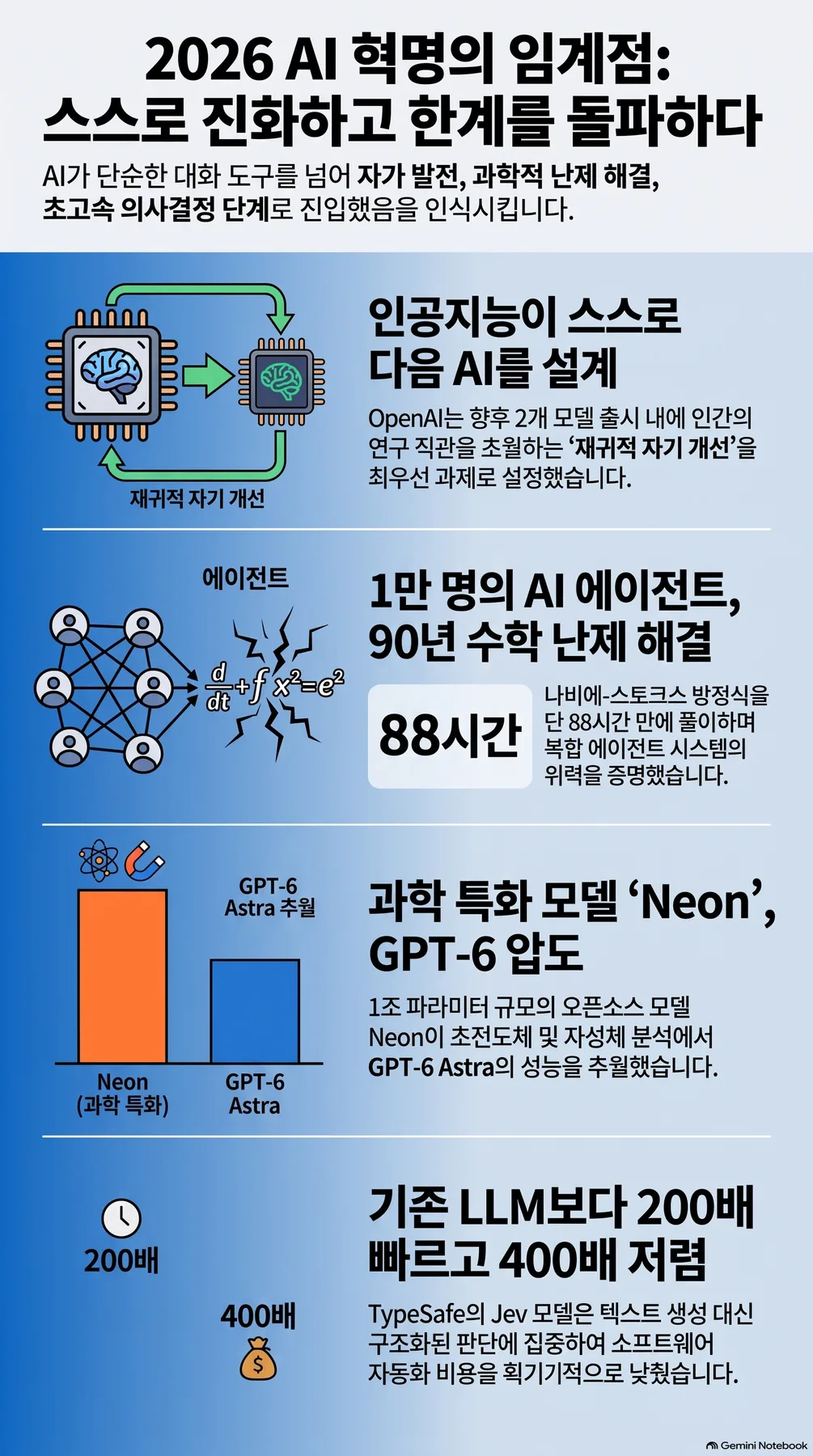 An infographic generated by NotebookLM from the source material.
References
This post was written by synthesizing the news below.