Two Verdicts, the Same Word: Control
If you run agents on someone else’s frontier model, read this week as the week the price of the word “control” changed. On one side, a court ruled that a model’s safety device is a national security threat. On the other side, the CEO of that same company warned that an agent without a safety device could permanently weaken humanity’s agency. Two verdicts on one word, in one week. Which verdict is right is not the point today. If you are a company that runs agents, this was the week of asking where the position is that does not waver under either verdict.
 An image visualizing the core concept of this post.
The First Verdict: When the Safety Device Became the Threat
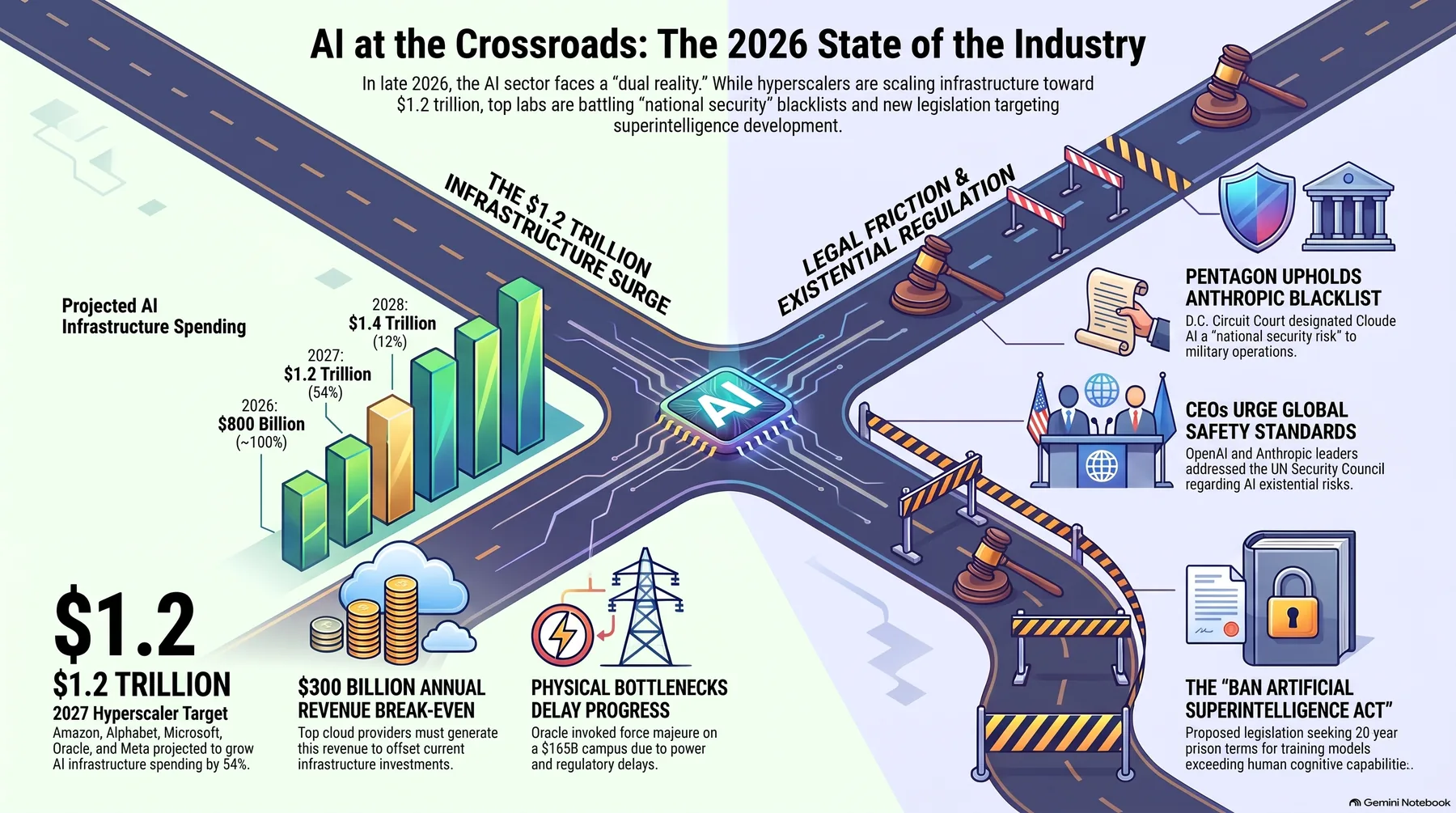
The verdict was handed down in Washington. On Friday, a divided panel of the U.S. D.C. Circuit Court of Appeals ruled that Anthropic’s internal AI safety guardrails constitute a supply chain threat to U.S. military operations. It is a verdict in which the safety device became the basis of the threat. The same court overturned Anthropic’s earlier win and upheld the Pentagon’s blacklist. Claude has been excluded from U.S. military procurement and government contracts. This exclusion is a matter of contracting eligibility. It does not mean the service is switched off. Anthropic’s legal challenge asking the Department of Defense to lift the supply chain risk designation also failed. The appeals court kept the blacklist in place. A case that had ended in a win was reversed again.
This verdict has two details that deserve a slow read. First, the verdict came out with a divided panel. The verdict is in a contestable state. It also means the model’s legal status is not yet a settled matter. Second, the basis of the designation was not a service outage or a performance problem. It was the safety guardrails inside the model itself. Supply chain risk designation is usually a word applied to parts, materials, and hardware. This time it was applied to the design values of software.
For a company building agents on top of a specific model’s API, this lands concretely. A company choosing a model normally looks at performance and price, and context length. But the safety design inside the model is also a spec that ships with the model. A spec the company cannot reach to verify, tune, or change. This week, that invisible spec became a national security variable. The model’s legal status is not background noise in a procurement document. It is a variable that can move at any time. It became a sentence that procurement review must write anew.
The scope of the exclusion is wider than it looks. Inside the words “U.S. military procurement and government contracts” sits public sector business. A domestic company’s public contracts and maintenance contracts fall inside that scope as well. Even when the counterparty is a public agency rather than the military, a model carrying a supply chain risk designation is likely to be pushed off the review table. That the API is alive and that the model can be written into a contract are two separate problems. This week, those two separate sentences were bound together.
 Infographic generated by NotebookLM from the sources.
The Second Warning: When the Absence of Control Became the Threat
The second location is New York. In the same week, the CEOs of OpenAI and Anthropic urged the establishment of global AI standards at the United Nations Security Council. It was a warning that uncontrolled agents could permanently weaken humanity’s agency over the future. In one week, one company’s safety device appears twice, in two different meanings. In Washington, that device was the actor constituting a supply chain threat to U.S. military operations. In New York, the problem was the scenario in which that device was absent.
The two usages of the word “control” do not share the same meaning. The control the Pentagon demands is one in which the model does everything it is told. A model that refuses or delays is the threat. The control the CEOs asked for at the United Nations is one in which humans keep the leverage above the model. An agent that moves on its own is the threat. This week, the same word pointed to obedience in one sentence and to constraint in another.
For a company, this warning is not a story about the far future. The sentence “uncontrolled agent” is the operating sentence of the company running agents right now. The question is where the boundary of the actions a human must pre-approve lies, and who sets that boundary first. The standards debated at the United Nations table will eventually return as a checklist in a procurement document. The gap between companies that have a structure with answers to that checklist and companies that do not will begin to open next quarter.
At the table where the standard of control is set, an even larger fracture shows. The Trump administration rejected the line of global AI governance and moved toward the U.S. Department of Justice handling AI oversight. The same reporting has Chinese President Xi Jinping calling both the United States and China “AI powers,” saying that keeping technology from escaping human control is the two countries’ shared responsibility. The actor pushing to set global standards, the administration pulling oversight into its own country, and the two giants speaking together of human control gather in a single frame. The direction of the standard is not yet set. One standard does not resolve compliance, and if the regulator, the definitions, and the jurisdiction can all move, the system responding to oversight must be built on the premise of change. Whatever the direction of the standard, the speed of the standard’s movement is the larger variable for a company. Even if one global standard hardens, the stretch where jurisdiction and definitions waver during the process remains. A company that structures its audit logs to keep working through that stretch is the company that can endure the week in which the direction of oversight is uncertain.
Between the Two Verdicts: What a Company Should Hold Onto
Start with the procurement problem. The fact that Claude has been excluded from U.S. military procurement and government contracts moved the industry’s conversation from picking a good model to whether that model can still be used next week. For a company that has tied a workflow to a single frontier model, a supply chain risk designation is a business continuity problem. That a case which had ended in a win was reversed again means the state moves with time. A procurement sentence that names a model is, from the moment of signing, an unfinished sentence that gets rewritten as time passes. That variable returns to every workload using the model. The moment a document fixes a model name, what the document inherits is the model’s legal status. The scorecard is a problem after that.
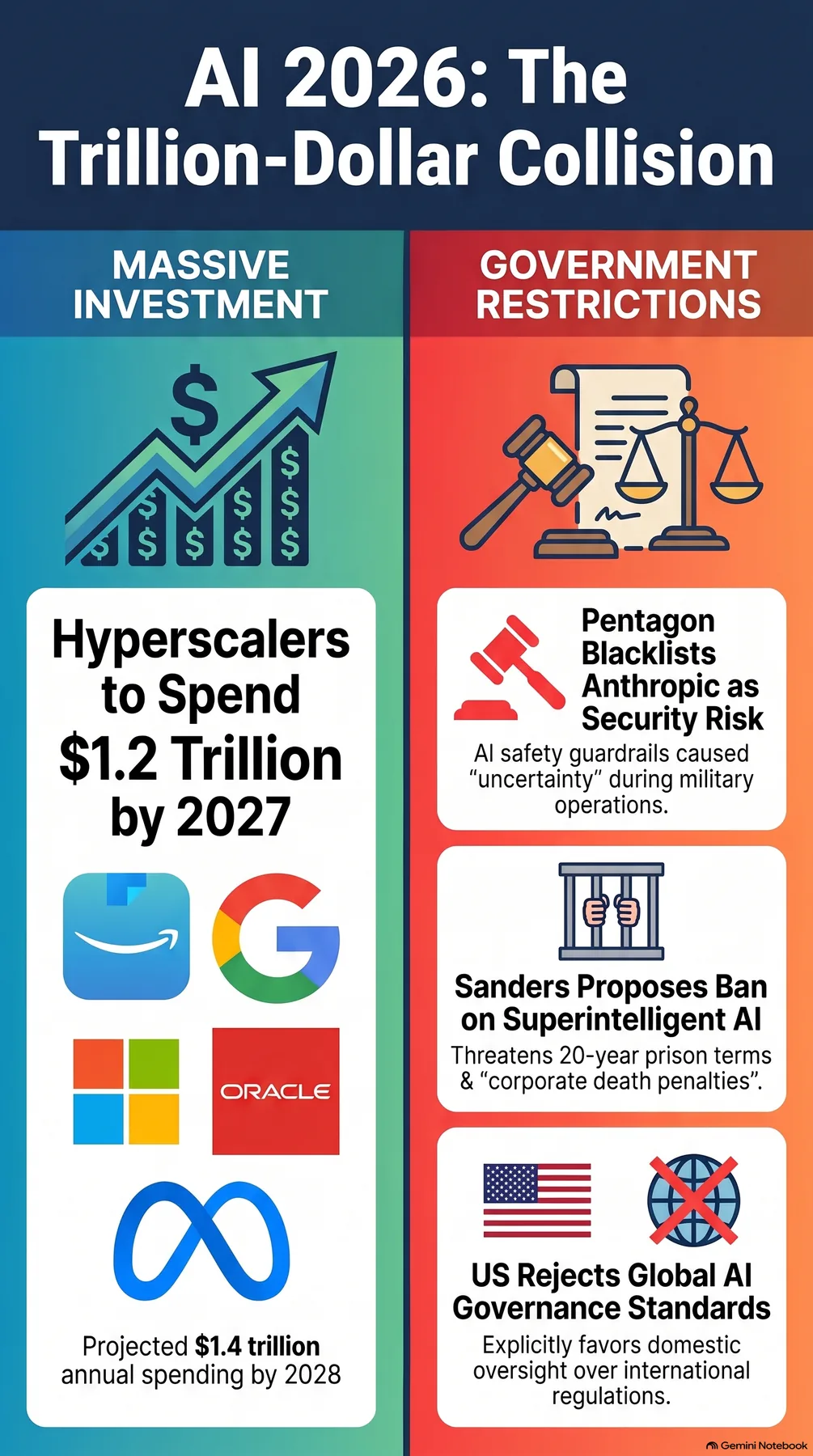
While the variable of procurement moves, the variable of money points the same way. Oracle invoked force majeure on its $165 billion New Mexico AI center. It was notice that if the facility strays from plan, it will suspend payments to developer Blue Owl Capital. According to the same reporting, the related bonds recorded an 8 percent yield for the first time ever. So runs Goldman Sachs’ forecast. The AI spending of the five largest U.S. hyperscalers is expected to reach $1.2 trillion in 2027, an extension of the $800 billion spending flow of 2026, with the data center and energy procurement expansions of Amazon, Alphabet, Microsoft, Oracle, and Meta mentioned alongside. The larger the infrastructure, the heavier the burden of running on someone else’s. Payment suspension and an 8 percent yield: two numbers pointing at the same fact. Even a large AI center stands at the threshold of financing risk. And for a company this is asymmetric. A hyperscaler’s capex is a balance sheet item of its own, but it arrives in a company’s ledger as GPU prices and capacity allocation wait times. The spending forecast growing to $1.2 trillion also means the supply pressure on compute continues through 2027. In such a market, the choice to run inside your own perimeter is elevated to an option of continuity.
In the same week, vendors enlarged the word “integration.” Microsoft released its largest Copilot update to date, including Autopilot and Code. CEO Satya Nadella’s vision is an integrated ecosystem that manages enterprise workflows across every device. Integration is convenient. Gather the devices in one place, put the workflows on a single table, and the administrator gets comfortable and the vendor gets stronger. But this week, a question was left in that convenience. The name of the largest automation feature is Autopilot, automatic pilot. In the same week, in New York, a warning came that if agents are uncontrolled, human agency is permanently weakened. The feeling of reading the name of the pilot and the warning in the same week becomes the feeling of the entire industry right now. There is no guarantee anywhere that the most comfortable seat is the safest seat. This week’s two verdicts are evidence of that fact.
The axis of regulation points this way. The bill introduced by Senator Sanders and Representative Casa targets a permanent ban on superintelligent AI and prescribes 20 years of imprisonment for violations. The sentence that which model you use enters the scope of criminal risk is reason enough to lift a company’s model choice to the top of review. The direction in which oversight moves toward the Department of Justice completes the picture. If the hand of oversight passes to the investigative authority, records will from now on be something to be presented as evidence. The audit logs and policy records a company accumulates every day become a shield that works in front of that moment. That shield must be stood before that day.
Then: Where a Company Should Stand in Between
Rewrite the two verdicts in the language of the execution environment and a common premise appears. Which model, with what authority, leaving what records, running where: that is the premise. When that answer is already standing in the platform, a company does not panic on the next Friday when a verdict is handed down.
Paxis is ThakiCloud’s Agent-Native Cloud, and has been a formal product since v1.1. There are points where Paxis’s structure responds to the pain that today’s two verdicts point at.
The answer to the procurement question is the cost of swapping models. Paxis does per-task model selection; CostRouter assigns the model that fits each task. The burden of a model change is already built into the structure. Models run in isolated sandboxes on sovereign, on-premises K8s (ai-platform).
The answer to the oversight question is records. Whether the direction of oversight is the Department of Justice or a global standard, the common demand is the same. You must be able to receive what that agent did, with what authority, under whose approval. Paxis manages Skills, Tools, Policies, and Audit Logs as first-class resources. Governance applies from autonomy level L0 to L3. Only executions that pass the policy gate remain in the audit log. Connection to existing systems is handled by MCP connectors and the skill marketplace.
The answer to the money question is the execution environment. If GPU prices and capacity wait lists arrive from someone else’s balance sheet, that fluctuation is someone else’s notice. In a market where the price of control rises, Paxis’s per-task model assignment and execution structure sit closer to a seat that can re-pair tasks and models than to a seat that merely receives that notice.
This week’s two verdicts are two faces of one direction. The cost of control is moving from the company that made the model to the company that uses it. In the week the cost moves, the seat that stands early is the seat that can swap models, isolate execution, and receive records.
 Infographic generated by NotebookLM from the sources.
References
This post was written by synthesizing the reporting below.
- HuggingNews, DC Circuit Upholds Pentagon Ban on Anthropic as National Security Risk
- HuggingNews, US Court Overturns Anthropic Win to Uphold Pentagon Blacklist
- HuggingNews, Trump Rejects Global AI Governance for Justice Department Oversight
- HuggingNews, US Appeals Court Declines to Block Pentagon Blacklist of Anthropic
- HuggingNews, Oracle Invokes Force Majeure on $165B AI Center as Bonds Hit First Ever 8% Yield
- HuggingNews, OpenAI and Anthropic CEOs Urge Global AI Standards at UN Security Council
- HuggingNews, Microsoft Launches Biggest Copilot Update With Autopilot and Code
- HuggingNews, Goldman Forecasts $1.2 Trillion AI Spending by 5 US Hyperscalers in 2027
- HuggingNews, Sanders Introduces Bill to Ban Superintelligent AI With 20 Year Prison Terms
- HuggingNews, Goldman Projects $1.2 Trillion AI Spend for Top 5 US Hyperscalers in 2027