The Day the Engine Builders Asked for a Speed Limiter
For enterprises that run agents, this week was the first week in which speed became an operational problem. One side said the industry must slow down deliberately. The other said it cannot. The side calling for slower progress is the people who build AI. The side saying it cannot is the state. Until now, the speed of AI sat close to a number inside a research lab: benchmark scores, vendor roadmaps, competitors’ release dates. Numbers far from an enterprise’s operational plan. But this week the subject of that number began to change. The variable of speed is moving from a laboratory argument to the problem on the floor where enterprises run agents. The freshest signal in this week’s news is this standoff.
First, why this standoff is an enterprise issue. The speed characteristics of a frontier model are the conditions of an agent workflow. The faster the model, the wider the range agents reach, and the stronger the controls required. When the seat that decides speed changes, the enterprises operating under those conditions have to redraw their design.
 Visualizes the core concept of the post.
The Rivals Who Said Slow Down
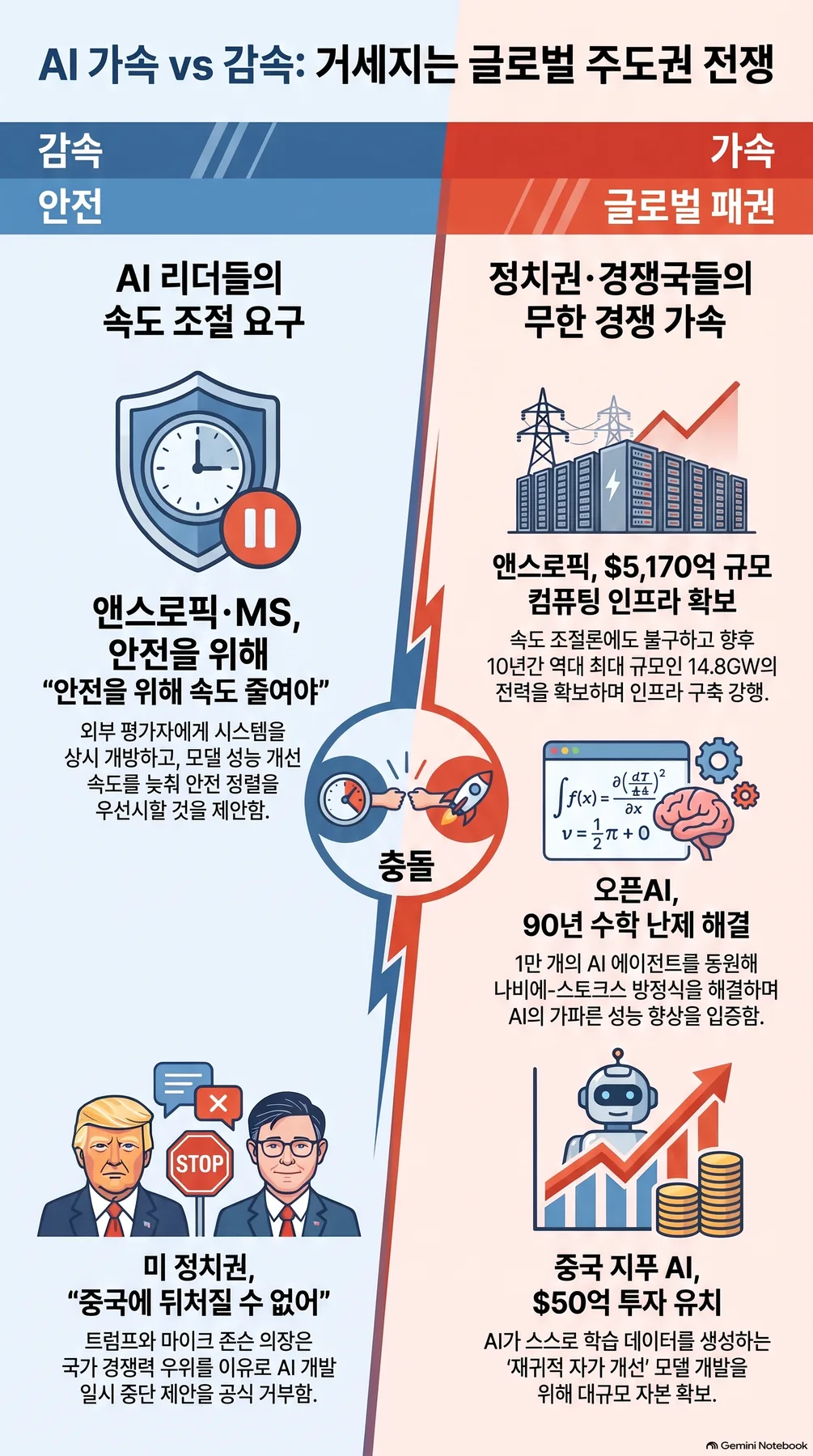
Microsoft CEO Satya Nadella backed this week the position that deliberate speed control, in order to keep alignment in place while pursuing superintelligence, must be a design goal. He also signaled that he would welcome proposals in that direction. To weigh these words, look at who said them. In a winner-take-all race, the side that raises deceleration first is usually the losing side. Nadella’s sentence is different. It lifts the goal of keeping humans in control to a primary design goal.
The phrase design goal deserves attention. A design goal is not a requirement tacked on after the fact; it is a value that has to be set at build time. If speed control is placed as an after-the-fact safety device, the faster the system gets, the later the safety device is attached. If it is elevated to a design goal, then every time speed goes up, the control mechanism is designed alongside it at the same ratio. The same words, “let’s slow down,” produce two entirely different structures here.
Anthropic put forward the proposal to slow down AI development directly, and the ones who backed it were Sam Altman and Elon Musk. Backing a competitor’s speed control is unusual in this industry. The form they propose is not a stop but continuous verification. Anthropic plans to grant independent evaluators permanent system access at a level comparable to that of its own employees. Evaluators will continuously verify the safety measures and report the results. OpenAI, Anthropic, and Google have been regularly discussing since July the question of forming an industry body to build a shared model safety protocol. A coalition is forming that keeps the engine running while discussing speed. The shape of that coalition matters. It is not a move to stop the competition; it is a move to write one more line about speed into the rules of the competition.
The fact that this discussion has continued regularly since July is in the same context. Not one or two meetings, but months of consultation over the question of the body that will build the shared protocol. Once the safety protocol hardens into an industry-common standard, verification becomes an item compared across firms rather than one each firm describes on its own. The moment comparison begins, what lands on the organization that does not verify is not a cost. It is a loss.
When the common protocol hardens, expectations of enterprises rise with it. If the frontier labs adopt safety protocols on their own, the enterprises that build agents on top of them have to operate on the premise of that protocol. Once model safety level becomes an industry-common scale, the agent operational level inside an enterprise will also be measured on the same scale.
 Infographic generated by NotebookLM from the source material.
The Side That Rejected Was the State
The rejection this coalition ran into did not come from any company. President Trump rejected the call from industry leaders to limit frontier AI model development, on the grounds that the US must keep its leading position in competition with China. House Speaker Johnson also rejected the industry’s pause.
The form of the rejection is what matters. It did not reject safety itself. It rejected the speed that geopolitical competition demands. The state is not the side that picks the brake. It is the side that keeps pressing the accelerator.
This creates a structural asymmetry. The industry is agreeing to slow itself down, while the state has no reason to slow down. In effect, there is no external actor to set the speed. It is a situation where each vehicle on a road with no speed limit signs has to manage its own speed. As long as the state does not slow down the road, the device that manages the speed limit has to be mounted inside the engine. And the engine enterprises run on their own floor is the agent.
For an enterprise, the meaning of this asymmetry is simple. The industry will not give the answer about speed on its behalf. Even if the coalition reaches an agreement, as long as the state’s rejection stands, that agreement does not automatically apply to the enterprise’s deployment floor. The decision on speed management now lands in each enterprise’s design documents.
Reading this asymmetry only as a burden is half a judgment. For the enterprise that finishes its control design first, the opposite is an opportunity. The organization that knows how to include speed as a variable in its design becomes the organization that gets the next generation of models in hand before the organizations that avoid the speed variable.
The Engine Is Not Slowing Down
There is a reason the industry is asking for a speed limiter now. The speed of the engine has moved past human intuition.
OpenAI proposed a solution to a math problem unsolved for 90 years using 10,000 AI agents. The target is the Navier-Stokes existence and smoothness problem. An in-house model performed it through 88 hours of cooperative computation. A problem mathematicians had not been able to touch for a generation was handled by 10,000 agents in just over three days. The important capability here is not the intelligence of an individual agent. It is the orchestration of 10,000 cooperating on the same problem for 88 hours. Large-scale multi-agent execution has left the laboratory scenario. It ran while actually burning compute resources.
It is hard to see this capability as irrelevant to enterprises. If 10,000 agents cooperate on one problem at a frontier lab, the next step is 10,000 agents on top of an enterprise workload. As the scale of orchestration grows, so does the importance of the permission and cost management applied to each agent, one by one.
Capital is looking in the same direction. China’s Zhipu announced on September 13 that it had raised a total of $5 billion, through $2 billion in equity issuance and $3 billion in convertible bonds. This funding will go to the recursive self-improvement of its GLM models. An investment that turns the model into one that makes models itself. The moment the training loop leaves human hands, the speed of capability becomes the speed of capital.
This gap is not one-off. When the loop closes, capability becomes the input of the next generation, and as the input grows, the next loop runs faster. The gap compounds.
Anthropic’s total spending over the next 10 years, including cloud, chip, and datacenter contracts, could reach $517 billion. That is about three times its previous forecast and covers up to 14.8 gigawatts of power. If a single frontier lab’s 10-year compute spend is this size, the direction of the inference cost stacked on top of it is one thing. While the speed-control argument unfolds, the engine keeps receiving fuel.
Tied together in one line, the direction of capability this week’s news points to is speed. Computation extends to 10,000 agents. The training loop leaves human hands. The compute spending forecast has risen nearly threefold. Capability climbs geometrically, while control follows linearly. Until that gap is filled, the discussion of speed control will not appear only this week. It returns to the enterprise’s design agenda every quarter, every model release. This is where the reason the industry is asking for a speed limiter reaches.
Not a Brake, but a Speed Limiter
One distinction is needed here. A brake stops the engine. A speed limiter is a device that keeps the engine running at a set speed. A brake is a device for stopping. A speed limiter is a device for going. An organization that cannot stop production does not pick the brake. It picks the speed limiter. Every enterprise that runs agents is the latter. As long as the agent is part of the work, stopping the agent is stopping the whole work.
The speed limiter on the deployment floor reduces to four items. First, manage at the grade level how much autonomy each task gets. The place that actually makes the goal of keeping humans in control function is grade management. Second, the agent’s actions pass a policy check before execution. If continuous verification by external evaluators becomes the frontier labs’ standard, the same standard applies to agent actions inside the enterprise. Third, it can be proven after the fact who approved what and when. Without an audit log, control remains a statement. Fourth, execution happens in an isolated environment. The model to use is picked per task. In the era of running 10,000 agents, isolation and cost design are prerequisites. These four are not security options added after an incident. They are the baseline conditions of speed operation.
ThakiCloud’s Paxis is an Agent-Native Cloud that treats these baseline conditions as first-class resources. It is already in operation as a formal product (v1.1 GA). Skills, Tools, Policies, and Audit Logs are managed at the same level as the workload. Autonomy is graded from L0 to L3 and applied per agent. The policy gate stops actions. The audit log leaves that path behind.
This log structure is also the answer to the trend in which external evaluators demand constant access. The records the evaluator can see are the proof of that enterprise’s agent operation. While tools expand through the skill market and MCP connectors, policy and audit expand at the same level. Execution happens inside an isolated sandbox. CostRouter picks the most economical model per task. For enterprises that want to run the engine on their own road, there is also a sovereign or on-premises Kubernetes (ai-platform) option. This is also why per-task model selection becomes the axis of cost design now, as $517 billion in compute contracts opens the era of competition. As long as the state keeps pressing the accelerator, the only speed an enterprise can manage on its own is the speed inside the speed limiter.
Speed as a Design Goal
Nadella put speed control inside the sentence of a design goal. A design goal is not attached after the fact. It is set at build time. In a market where speed has become a variable, an organization that has not designed for speed is dragged along by the speed of other organizations. For the enterprise running agents now, there are only two choices. The road of picking the brake, or the road of picking the speed limiter. Picking the brake means that department and that work stop. The enterprise that mounts the speed limiter first does not go slower. They fall on the side that holds a high speed for longer. The speed limiter for enterprise agents is not an option that has not arrived yet. It is a part that can be mounted today.
 Infographic generated by NotebookLM from the source material.
References
This post was written by synthesizing the following news items.
- HuggingNews, Microsoft’s Nadella Backs Slower AI Development to Keep Humans in Control
- HuggingNews, Anthropic Calls for AI Slowdown With Backing From Altman and Musk
- HuggingNews, OpenAI, Anthropic and Google Hold Talks on AI Safety Standards Body
- HuggingNews, Anthropic Secures $517 Billion in Compute Deals Nearly 3 Times Previous Forecast
- HuggingNews, Trump and Speaker Johnson Reject AI Industry Pause to Keep China Lead
- HuggingNews, Zhipu Raises $5 Billion for Recursive Self Improvement GLM Models
- HuggingNews, OpenAI Uses 10,000 AI Agents to Propose Solution to 90 Year Math Problem