When the Recipe Became Free, the Kitchen Became the Brand
In one semiconductor production floor, a four-legged robot stands. In the departure lounge at Incheon International Airport, a robot leads passengers to boarding. The two robots have different makers, different bodies, and do completely different work. But according to a report from CNB News, they share one thing: a common AI execution environment called “Airpath.” The maker, it turns out, is Integrite.
Today’s 18 news items come down to two big stories, models and money. But the freshest signal was in neither. It was at the place where the two meet, the “execution environment.” On the day the model becomes a recipe and the execution environment becomes a kitchen. This post reads today’s news through that lens.
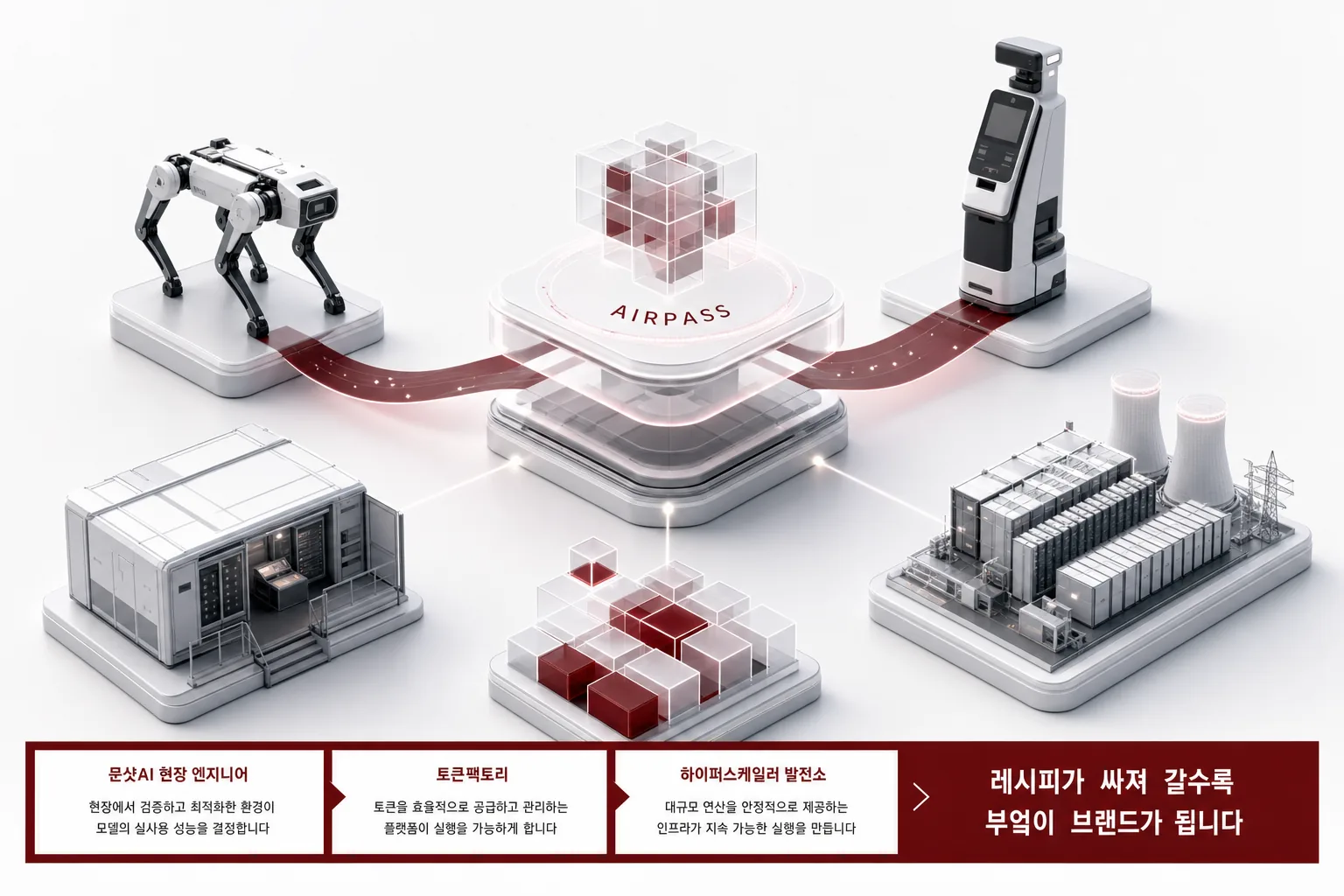 It visualizes the core concept of the article.
1,200 Units and One Kitchen
According to CNB News, Integrite’s Airpath has logged more than 1,200 units supplied and in operation. Instead of letting robots scattered across makers work on their own operating systems, it brings them onto a single execution environment. Collaborative robots, AMR, quadruped, humanoid, it connects the AI models, data, and missions of robots from different makers into one execution environment. The hardware is specific too. V4 is Qualcomm Dragonwing-based, up to 48 TOPS. V5 is 100 TOPS. It unifies Ubuntu, ROS2, Wi-Fi, and 5G into a single BSP.
This environment is already working in two places with very different temperatures. Boston Dynamics’ Spot handles the top-level AI control on a semiconductor production floor, and it has been put in as the AI brain of a self-check-in service robot at Incheon International Airport. But the number worth noting is not the 1,200 units. It is the word “market.” Airpath, which had been industrial B2B supply, has started selling through specialty distribution channels such as Element, Device Mart, and ICBank, and has opened its doors to universities, research institutions, and robot startups. A product built for a specific customer becomes a base any developer can buy. It also provides a path that links 5B- and 8B-class lightweight VLA models with SynaAI, a top-level orchestration platform based on world models, and FlyingLet, and that takes a model developed in an NVIDIA GPU environment (PyTorch, ONNX), moves it to the edge, and optimizes it there.
So why now? The article points to the bottleneck exactly. Every robot maker has a different operating system, data spec, and control system, so the cost of development and integration repeats every time you run multiple heterogeneous robots. The more vision-language-action (VLA) models and robot foundation models (RFM) let robots judge on their own, the more the field gets stuck without a common execution environment and a top-level orchestration layer. The more the robot decides for itself, the more the core of the business becomes where that decision runs and who coordinates it. In other words, what is being sold today is not the robot and not the model, but the “place where execution happens” itself.
The “Place Where Execution Happens” Becomes a Product in Three More Places
The place where execution happens becoming a product is not happening only on the robot floor. Today’s digest has three more.
First, China’s Moonshot AI. According to Global Economic, Moonshot AI has adopted the FDE, the Forward Deployed Engineer method that Palantier devised in the early 2000s. An engineer goes directly into a customer’s field, grasps the problem, secures the data, and develops and applies a solution. Moonshot AI has launched a “Kimi Enterprise Partner Program” and is building FDE organizations jointly with SI and cloud companies. The revenue model is in the field too. Moonshot AI provides the Kimi model and agent technology, the partner handles field deployment, and the two split token usage fees and deployment service costs according to a contracted ratio. The background is strong as well. After Kimi K3, with 280 billion parameters, showed performance close to the top US model at open-source prices at WAIC in July, triggering the “Kimi shock,” more than 70 percent of new users came from overseas, overseas paid-subscription revenue grew 14x, and API revenue grew 10x. It filed a private IPO application on the Hong Kong stock market and is aiming to raise up to $3 billion, with a pre-listing valuation of about $50 billion. The core of what this article says is this. The biggest barrier to enterprise AI adoption is not model performance, but field deployment and build-out capability. The engineer organization itself becomes a revenue source. It means the era has arrived where how fast you secure field data and how deeply you understand the customer’s system, not the model’s performance, is what separates revenue. OpenAI, Anthropic, and Google are also expanding FDE headcount.
Second, KT. According to The Bell, KT’s “Everyone’s AI” strategy aims at 60 million combined service touchpoints, and its core is the token factory. It separates prefill/decode to raise per-minute token throughput (TPM) by about 31 percent, and cuts input tokens by up to 80 percent with prompt compression. To borrow the article’s phrasing, it uses the support for 100 GPUs at the efficiency level of 121. The consortium includes services such as Daeang, Soltec, Musinsa, and BC Card, models such as Upstage and NC AI, and infrastructure such as Rebellions. Taking the fake base-station hacking incident as a lesson, it also designed a security framework that shares the security organization under KT’s AI Business Division with the whole consortium. The unit economics of execution, that is, the efficiency of the execution environment itself, is being sold as a product.
Third, the hyperscaler. According to a TrendForce outlook cited by Beta News, in 2026 the CAPEX of the world’s nine largest CSPs will exceed $886.7 billion, up about 90 percent year over year, with the five North American companies taking about 90 percent. As the key criterion for data-center siting moves from land to whether it can connect to the power grid, the unit of competition has grown from one GPU to the whole data center, and then to the power plant and the grid. Google is investing about $15.1 billion in Finland and has signed a 22-year long-term power purchase agreement with nuclear operator Fortum. The kitchen has reached all the way to the power plant.
The Day the Recipe Gets Free
Why does value move to the kitchen? Because the recipe is getting cheap. The most direct evidence today is Chinese models. According to a WikiTree report, Chinese labs, in a situation where access to NVIDIA’s top chips is restricted, cut the computational complexity of attention down to a single digit and lowered the cost to one-fifth. Raidin stated that Chinese models such as GLM 5.2, Kimi 2.6, and 2.7 handle about 75 percent of engineering work at one-fifth the cost of US models. DeepSeek’s training cost has come down to $5.6 million, and a Stanford report assessed that Anthropic’s top model is only 2.7 percent ahead of DeepSeek. Of Hugging Face’s downloads last year, Chinese open-source models took 41 percent, overtaking the share of US models, and the Ramp AI index tallied that the spending share on platforms for Chinese and open-source models rose from 4.5 percent in January to 6.1 percent in July. Finance Today reported that on the 13th, at the New Delhi BRICS summit, Xi Jinping announced the construction of a dedicated AI open-source zone for BRICS nations. The recipe is getting free by the block.
The side using it has changed too. According to the “2026 Enterprise AI Maturity Index” cited by CEO Score Daily, 52 percent of domestic organizations have adopted agentic AI, and the average AI spend of domestic companies rose 120 percent year over year. In a McKinsey survey, 20 percent of responding corporate leaders answered that AI costs such as token purchases are constraining adoption. When the recipe gets cheap and the number of people coming into the kitchen grows, the competition happens inside the kitchen. Which model for which work, what to stop when it goes wrong, what record to leave, and whose name the data is under.
A Kitchen a Company Can Own Directly
The money side is tightening on the same day. In a report from Global Economic, Reuters cites a JP Morgan internal report and reports the full halt of new loans to megascale AI infrastructure, that is, to gigascale data centers and power grids and cutting-edge semiconductors. The reason is concern over an AI bubble bursting and the difficulty of supplying power to data centers. Credit default swap (CDS) trading volume centered on US tech companies surged 90 percent since early September, and the Bank of England warns that half of the $5 trillion global AI infrastructure investment is a sandcastle built on debt. Oracle’s first-quarter free cash flow is a $5.4 billion deficit. In an era when money is choosing, a company cannot build a kitchen itself for every task.
So the question left for the company becomes clear. Where will my agent live? This question is on the same line as the budget debate moving from “should we use AI” to “in what structure should we use it.” The four pains the news today points to are exactly the shape of that kitchen. The record left behind when work is done, the sovereignty of data that does not cross the boundary, the isolation that catches mistakes, and the cost of how many tokens are consumed. It is at this point that ThakiCloud’s Agent-Native Cloud, Paxis, should be read. Paxis is a formal product and is currently at v1.1 GA. The reason first-class resources are Skills, Tools, Policies, and Audit Logs is that they correspond one to one with these four questions. Bound into one line, it is what you can give the agent (Skills, Tools), what you set even while giving (Policies), and what you leave behind after it has done it all (Audit Logs).
The four pains mesh one to one with Paxis’s structure. For autonomy, the L0-to-L3 governance and policy gate decides which agent performs which task, and an audit log is left for each decision. Execution happens inside an isolated sandbox, and external systems are opened only through managed channels, the MCP connector and the skill market. Sovereign and on-prem Kubernetes deployment is a device that places this structure in a place where data cannot cross the organization’s boundary, and CostRouter picks the model that fits each task, so a one-fifth-cost model is placed only where it is useful.
Airpath showed it from the place where the robot works. Moonshot AI showed it from the place where the engineer stands, KT from the place where the token passes, and the hyperscaler from the power plant. It is the day the recipe became free, the day the kitchen becomes the brand. What is the question a company should ask next? What kitchen will my agent live in?
References
This article was written by synthesizing the news below.
- WikiTree, Chinese AI lab cuts attention computation to one-fifth the cost despite NVIDIA chip limits
- Global Economic, JP Morgan halts large-scale AI infrastructure loans on “AI bubble burst concerns”
- Beta News, Hyperscaler shakes up the AI investment board… dominating chips and power beyond data centers
- Global Economic, China’s Moonshot AI adopts Palantier’s core revenue model, the “Forward Deployed Engineer (FDE)” method
- CNB News, AI execution environment for 1,200 robots… Integrite opens the “Airpath” developer market
- The Bell, [The Bell] KT, core strategy of “Everyone’s AI”: “Ecosystem, Token Factory, Security”
- CEO Score Daily, “Cutting off many unprofitable businesses”… Naver, Kakao change the board with “slimming, AI”
- Finance Today, Xi Jinping “Build BRICS AI open-source zone”… AI leadership competition with the US begins in earnest
- Global Economic, Oracle raises restructuring costs to $2.8 billion… cash flow in the red from AI investment