The Language Wall: When a Korean Query Meets an English Registry, the Total Wall No Fusion Weight Can Remove and the Cost-Quality Frontier of Three Fixes
Any cloud/AI engineer in Korea who runs an LLM agent harness that serves a large skill catalog as naturally callable skills, or who operates the retrieval and routing layer beneath one, should read this post first. The question this paper answers is simple. When a Korean query hits an English registry, how much does hybrid skill routing accuracy drop, and which of the three standard fixes, translation detour / multilingual embedder swap / bilingual descriptions, recovers accuracy at the lowest token cost per route. ThakiCloud’s paper “The Language Wall: A First-Order Margin Model of Cross-Lingual Skill Routing and the Cost-Quality Frontier of Translation Detours versus Multilingual Embedders in an Agent Harness with ~2,200 Skills” formalizes that degradation with a closed-form first-order margin model and derives a total wall that no fusion weight can remove for anchor-free queries. As with the previous papers, that makes it an analytical paper. The model and the frontier are closed form, and a deterministic paired-variant protocol with five pre-registered hypotheses, which fills the model’s predictions with measurements, is registered alongside.
The Problem: The Language Wall the Hybrid Router Has Been Ignoring
The production harness that motivates this work routes a bilingual user base over a skill catalog on the order of 2,200. Every user turn, the hybrid retriever decides which skill to route to. Each candidate d is scored with a weighted linear fusion of the normalized BM25 lexical score b and the dense embedding cosine c, s(q,d) = α·b(q,d) + (1−α)·c(q,d); α is the hyperparameter the earlier papers in the series tried to recalibrate with an online bandit, and the top-5 shortlist is passed to the downstream executor. To first order, the catalog can be called an English corpus. In the 2026-10-14 design snapshot the model assumes, 97.3% of all indexed characters are Latin script, 0 skill names contain Hangul, and only 2.0% of descriptions are Korean-dominant. And yet 25.7% of the descriptions amount to the word “Korean” written as an English token. The wall is advertised, but not bridged.
The cross-lingual information retrieval literature is long, but skill routing has been studied under the implicit assumption that the query and the catalog share the same language. The four papers this series has already published on this router (retriever ceiling, online fusion recalibration, ensemble voting, dense encoder quantization) all asked from the same-language side, because no one had asked what happens when the two sides of the router use different languages. The shape of the perturbation this paper handles is different from the prior study’s. Quantization error is zero-mean variance that enters the fused score through the dense lane only, and the fusion weight α dampens it linearly. Language mismatch, by contrast, is a systematic bias. The dense lane is shifted by a cross-lingual gap δ whose mean does not vanish, and even the lexical lane, once considered the fallback, is damaged. A Korean query’s surface tokens do not appear in the English registry unless anchors such as skill names, product names, or acronyms are carried in the query.
The distinction is not incidental; it is structural. Under quantization, the protection theorem itself says that raising α makes the flip margin monotonically larger and that at α = 1 the lexical lane is an intact fallback. Under the language wall, the fallback margin shrinks to f·Δ_L, where Δ_L is the single-language lexical margin gap and f is the anchor fraction: the share of the query’s salient tokens that exist in surface (Latin) form in the registry text. As f decreases, the fallback dampens; at f → 0, no α can restore a positive margin. That means the router’s own hyperparameter cannot rescue anchor-free queries, and the only remaining lever is to change the model’s parameters: raise f (impossible, since the user wrote in Korean), reduce δ, or change the registry’s surface forms. The fix menu has three items.
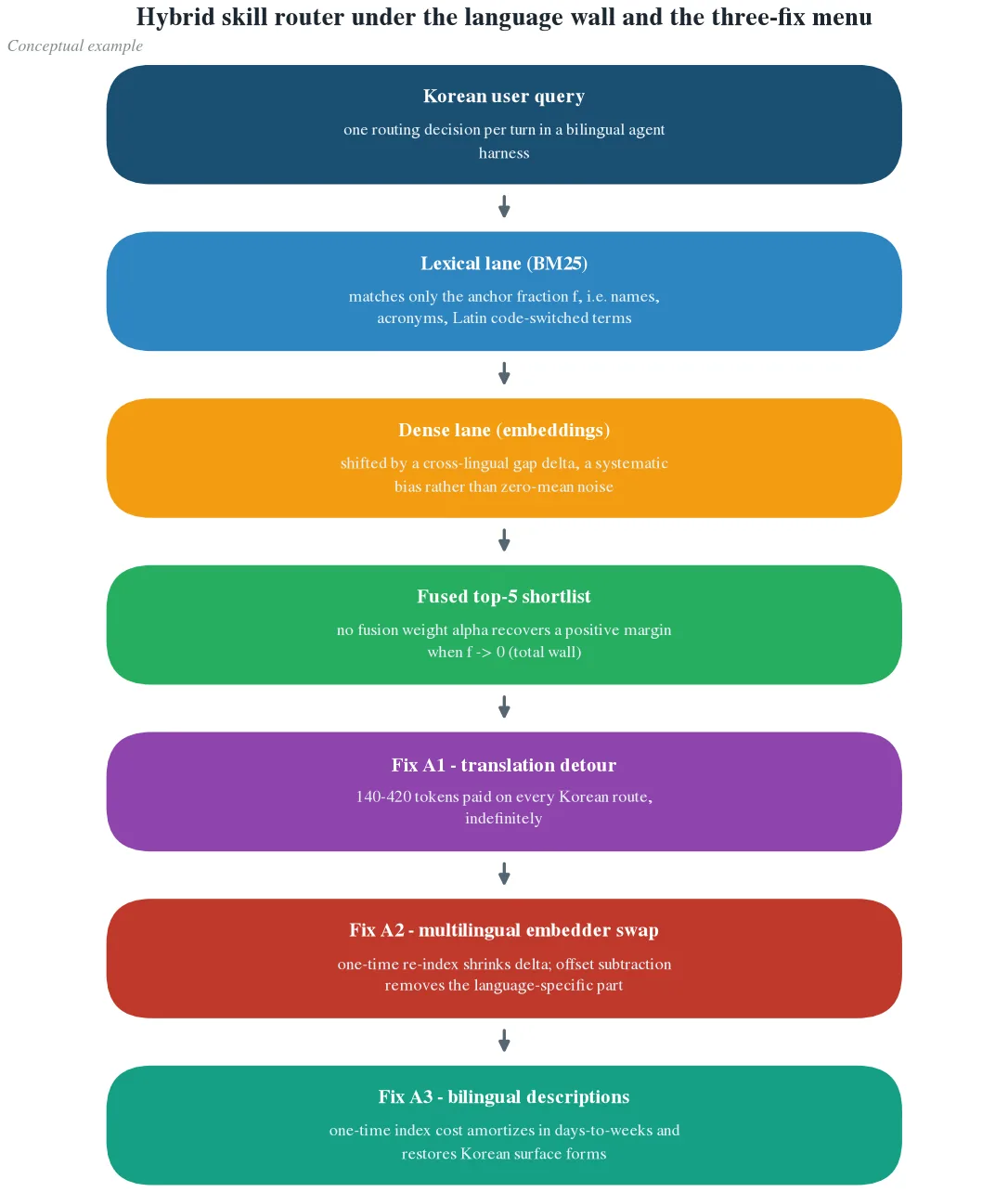 The structure of the deployment and the three-fix menu. A Korean query hits the 97% Latin registry in both router lanes, the fusion weight cannot remove the wall for anchor-free queries, and changing the model’s parameters comes down to three index-side or query-side fixes. (Conceptual illustration, not a measurement)
Core Contribution: the Closed-Form Flip Threshold and the Total Wall
The first-order margin model closes with two assumptions. Fix the query’s gold skill d* and its nearest competitor d_j, and write the English and Korean renderings of the same intent as q^en and q^ko. Because the single-language margin gaps Δ_L(lexical) and Δ_D(dense) are all values observable from the float scores the router already computes for q^en. The first assumption, the anchor fraction f: a non-anchor Korean token has no (approximate) surface match against the English registry under any bag-of-ngrams or morphological tokenization, while an anchor matches at single-language strength, so the cross-lingual lexical margin is f·Δ_L. The second, the dense-lane gap δ: c(q^ko, d*) − c(q^ko, d_j) = Δ_D − δ, with δ ≥ 0. The cross-lingual margin of the fused score is
m′(α) = α f Δ_L + (1 − α)(Δ_D − δ)
The flip threshold comes out in closed form. In the wall regime where the dense-lane gap exceeds the single-language dense margin itself, γ = δ − Δ_D > 0, the necessary and sufficient condition for m′(α) < 0 is α < α_crit(f, δ) = γ / (f Δ_L + γ). α_crit is strictly decreasing in f: maximal at 1 when f = 0, and falling to γ/(Δ_L + γ) as f → 1. An anchor-free Korean query is flipped at every operating point in α ∈ [0,1). The second proposition is the paper’s namesake: the total wall. At f = 0, the margin is non-positive across all α ∈ [0,1], and it is zero only in the fully lexical limit α = 1, but at that limit the query’s discriminative content is, by assumption, not in the surface forms. That is because the router is score-blind between d* and d_j at every α operating point for anchor-free queries.
The third result is that the prior study’s protection theorem inverts. Under quantization, the margin at α = 1 is Δ_L > 0 for any ε, and the flip probability is monotonically decreasing in α. Under the language wall, the fallback margin is f Δ_L and vanishes as f → 0. The monotone protection by α fails exactly where the wall is highest. The practical implication is that α is not a constant to be tuned but a function of the query’s observable anchor fraction. For anchored queries, go fully lexical; for anchor-free ones, do the dense-lane arithmetic. The online bandit null result of the earlier paper is exactly what a stationary-α policy should expect when the query mix changes language.
The dense-lane gap itself splits in two. δ = δ_lang + δ_sem. δ_lang is a language-specific offset common to all registry documents, and it can be handled training-free by simply estimating it at index time and subtracting it. This is the side where the strong same-language preference of recent multilingual dense models is corrected by per-language relative vector subtraction, with the effect confirmed on four multilingual IR benchmarks. δ_sem is a content-specific residual. This is why even the strongest zero-shot multilingual retriever lags the strongest monolingual by 23% relative MRR@10 on Amharic and why fine-tuning does not close it either. Both are data and learning phenomena fixed by index-side and query-side engineering, not by a bigger model.
A diagnostic quantity follows from the threshold. The language-wall index LWI(α; δ) = E_f[1[α < α_crit(f, δ)]] is the expected fraction of queries whose top-1 decision is flipped under the language wall, and it is computed from float32 scores, the observable anchor fraction f, and δ estimated with a single probe set per encoder and direction only. It is the direct analogue of the rank-safety diagnostic p_risk from the quantization paper, with the error term turned into a bias and the safety channel damaged.
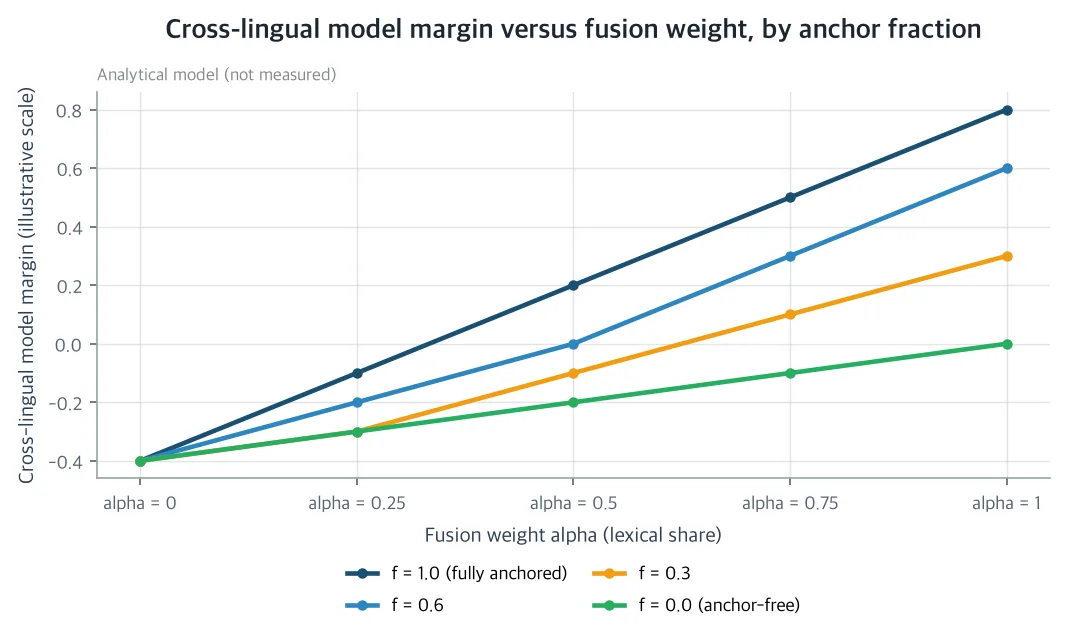 The cross-lingual model margin m′(α) against the fusion weight α for each anchor fraction f. As f gets smaller, the zero-margin crossing moves toward the fully lexical limit, and at f = 0 the margin is non-positive for any fusion weight. A total wall that no choice of α can remove. (Analytical model, not a measurement)
The Cost-Quality Frontier: the Cheapest Fix Measured in Tokens per Route
| The three names in the fix menu carry different cost shapes for a duty cycle of one query per turn on an eternal router. A1, the translation detour, is a pinned LLM translating Korean to English before routing. The cost per route is c_1 = P_t + (a+1) | q | ≈ 140 to 420 tokens (median ~250) plus one serial latency call, and quality is bounded by translation fidelity to the registry vocabulary. The cautionary result for detour-style rewrite is that even within a single language, LLM-assisted query expansion failed to beat non-expanded retrieval and induced topic drift. A2, the multilingual embedder swap, replaces the dense encoder with one that bridges languages and pays a one-time re-index. The per-route marginal cost is at or below that of the existing router. A compact 8M active-parameter retriever scores 56.2 on nDCG@10 for MMTEB Multilingual v2 Retrieval, beating BGE-M3 with roughly 40x the active parameters, and the re-index is pure CPU-minutes. A3, bilingual descriptions, translates the skill descriptions (median 69 words, ~200 tokens per skill once bilingualized) at index time. It costs a one-time O_3 ≈ 4.3×10^5 tokens plus maintenance, but it puts surface forms into the registry and recovers the lexical lane. The index-side variants A2’ (swap plus training-free offset subtraction) and A3q (through an INT8 encoder) compose with the prior study. |
The duty-cycle logic handles the rest. The detour’s c_1 is a cost that goes out on every Korean route, forever repeating, while O_3 goes out once. The amortization horizon of A3 against A1 is H* = O_3/(σ R c_1) ≈ 1,720/(σ R) days, where R is routes per day and σ is the share of Korean routes. At 1,000 Korean routes per day that is about 1.7 days, at 100 about 17 days, and once σ R ≳ 250 it lands within a week. The paper pins only the A1-A3 boundary. The A0-A3 boundary is undetermined because A3’s maintenance rate u is an unspecified parameter, and the A2-A3 boundary cannot be stated in the same unit because A2’s re-index cost is expressed in CPU-minutes rather than tokens. It does not claim a step-function policy over the daily Korean-route volume.
The Pareto structure follows. Beyond H*, A3 weakly dominates A1 in cost and dominates it in quality at every horizon, because A3 restores the surface forms themselves while A1 restores only a paraphrase. In the corner regime where index-side fixes are impossible (a frozen external encoder, a read-only index), A1 is the only per-route quality lever. Whether the embedder swap dominates the detour is not decided by the model. At an exemplary model level, the two swap points (0.30, 0.20) carry a lower marginal cost (25 vs 250 tokens per route) but a higher residual flip rate, so neither Pareto-dominates the detour (0.14), and the detour’s quality ranking against the swap is left to empirical testing. Index-side fixes cluster at encoder-only marginal cost, stepping the residual flip rate down gradually, while the detour sits far to the right with a tokens-per-route premium on top. In the order drawn, A3 is the only one that reaches a flip rate lower than the detour’s.
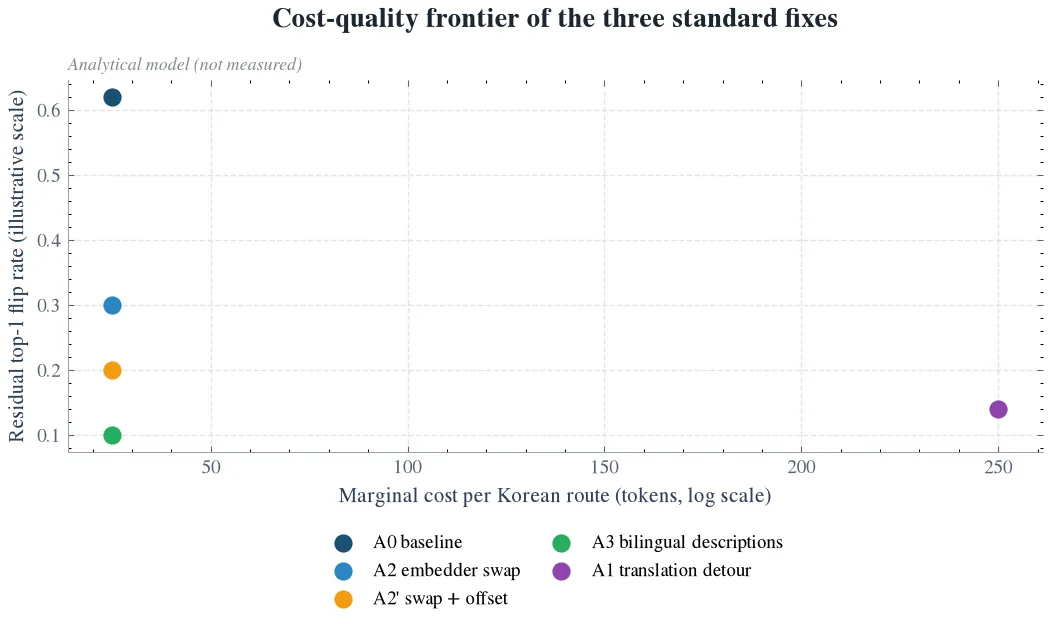 The cost-quality frontier of marginal cost in tokens per route versus residual flip rate. Index-side fixes (embedder swap, offset subtraction, bilingual descriptions) cluster at encoder-only marginal cost and step the residual flip rate down gradually, while the translation detour sits far to the right with a tokens-per-route premium. At an exemplary model level, the detour’s flip rate of 0.14 lies between the two swap points (0.30, 0.20) and the bilingual-descriptions point (0.10); no index-side fix is claimed to dominate the detour, and the swap’s frontier position is left to empirical testing. (Analytical model, not a measurement)
Significance: What Remains for the Company, for Society, and for Science
For the company, the language wall is a structural property of the 97.3% Latin registry. It is not accidental. The 97.3% Latin share is the registry’s center of gravity, and the fix menu operating on the query side (A1) or the index side (A3) is a direct consequence of that asymmetry. Korean users get the same unattended-automation confidence as English users only when the wall is explicitly priced, whether once (A3, A2’) or per route (A1). The predicted best operating point is bilingual descriptions with an offset-corrected, quantized multilingual encoder. The one-time index cost amortizes over days to weeks, and the detour is a silent tax of ~140 to 420 tokens per Korean route; the series’ cost discipline exists to keep that tax explicit. The protocol also scores negative-case abstention on the same gold set as the flip rate. A router that silently misroutes anchor-free Korean queries cannot honestly say “there is no applicable skill.”
For society, it lowers the language wall of the agent skill ecosystem. Non-English speakers get the same routing quality and unattended task-automation confidence as English speakers, and the translation cost is measured per route and bounded rather than paid silently. The asymmetry is documented outside this platform as well. On the human-verified Sinhala-Tamil e-government benchmark, monolingual retrieval on the English index fails almost completely, at below 10% Recall@15; a multilingual embedder produced 96.2%/95.6% against the best translation system’s 92.4%/93.0%; and the English index performs best when served purely English queries. That result is the same asymmetry as this registry’s.
For science, it is the first first-order margin model of cross-lingual hybrid skill routing. It gives the closed-form flip threshold α_crit(f, δ), the total wall at f → 0, and the inversion of the quantization protection theorem, and decomposes the dense-lane gap into a language offset removable on the index side and a content-specific residual. The first cost-quality frontier comparing the three standard fixes in tokens per route on a deterministic graded bench for a 2,000+ skill agent harness is here too, and as the first empirical test of all of it, a deterministic paired-variant protocol with five pre-registered hypotheses (H1-H5) is designated.
Limitations: the Unmeasured Model and Its First Test
The model is first-order. The anchor fraction compresses code-switching into a single scalar f, and character n-gram overlap is not exactly linear in anchor presence. δ is a scalar per direction, but in practice it varies by skill family. The frontier’s cost parameters are order-of-magnitude, and no routing metric of this router is measured or claimed. This paper has no routing experiments. The model and the frontier are analytical; the registry snapshot is an assumed design input rather than a measurement (the actual live router index has 2,275 entries and 2,274 unique names); the cited published values are as in the originals; and every figure is an analytical or parameterized model curve. The direction covers Korean-English only. The model is direction-symmetric, but the evidence is not that symmetric. For the other direction, the cited literature says it runs against the query-language side, and it is out of scope.
Filling the frontier with measurements is the role of the pre-registered protocol. It is a language extension of the series’ deterministic graded benchmark, fixed before any arm is run. To each gold case (q^en, d*) in the existing graded set, a human-authored, versioned Korean variant q^ko of the same intent and a matched negative case for which no catalog skill applies are attached in both languages. For each case, f (computed) and (Δ_L, Δ_D) from the A0 float scores are stored. A0 baseline, A1 detour (pinned translation model and prompt; translations are logged and rescoreable), A2 swap (pinned checkpoint; fusion and RRF unchanged), A2’ (offset estimated once from the probe set), A3 (translated once and pinned; description-budget gate applied), A3q (INT8 encoder). All arms share the gold set, the α grid (0.25, 0.5, 0.75), and the serving configuration, and online adaptation within an arm is forbidden. The metrics are recall@5 by language, top-1 flip under language swap (the fraction of gold cases where q^en and q^ko have different top-1s at the same α), α_crit prediction versus observed LWI, tokens per route by arm, negative-case abstention at a fixed margin threshold, and p95 route latency. The pre-registered hypotheses number five. H1 predicts that under A0, the top-1 flip rate of the anchor-free subset (f < 0.1) is ≥ 0.8 at every α in the grid. H2 predicts that under A0, the flip rate is monotonically decreasing in α for the anchored subset (f ≥ 0.5) and flat or rising for the anchor-free subset. H3 predicts that A2 closes ≥ 50% of A0’s recall@5 gap on the Korean set at ≤ 10% of A1’s per-route marginal tokens. H4 predicts that A3 restores the anchored subset’s recall@5 to ≥ 90% of the monolingual A0 level and cuts the language-swap top-1 flip by ≥ 3x. H5 predicts that A2’ strictly improves A2 on the estimated residual δ without degrading same-language recall@5. Statistics report exact binomial intervals for every rate, with observed flip 0 under the rule-of-three bound, and each hypothesis is declared supported, refuted, or under-resolved against the threshold on its interval. There is no post-hoc selection across arms.
The three figures in this post are all analytical models or conceptual illustrations, not measurements.
The paper and its accompanying materials are available on Hugging Face.
https://huggingface.co/datasets/thaki-AI/daily-paper-2026-10-14-cross-lingual-skill-router-tax