When Can You Trust the Cheap Model: Cutting Multilingual Document OCR Costs with a Confidence-Gated VLM Cascade
This is for engineers who have put two differently sized VLMs into a document OCR pipeline and are wrestling with the question of when to call the expensive model. The short answer: a cascade that uses a single confidence threshold from the small model to escalate only the hard documents to the large model matched, or even slightly beat, the large model’s character error rate on H200 measurements, at roughly 60 to 67 percent of its cost.
Here are the numbers behind that. The small model is the 250-million-parameter SmolVLM-256M-Instruct, the large model is the 2.2-billion-parameter Qwen2-VL-2B-Instruct, and the large model’s compute cost is 8.61x the small one’s. Using the small model alone gives an average CER (character error rate, lower is better) of 0.634, meaning it effectively fails to read about two-thirds of the documents; the large model alone drops CER to 0.045, but at 8.61x the cost. The cascade picks a tradeoff point between these two extremes with a single threshold tau: only documents where the small model’s confidence falls below tau get escalated to the large model, so the escalation rate, expected cost, and expected error rate all become functions of tau.
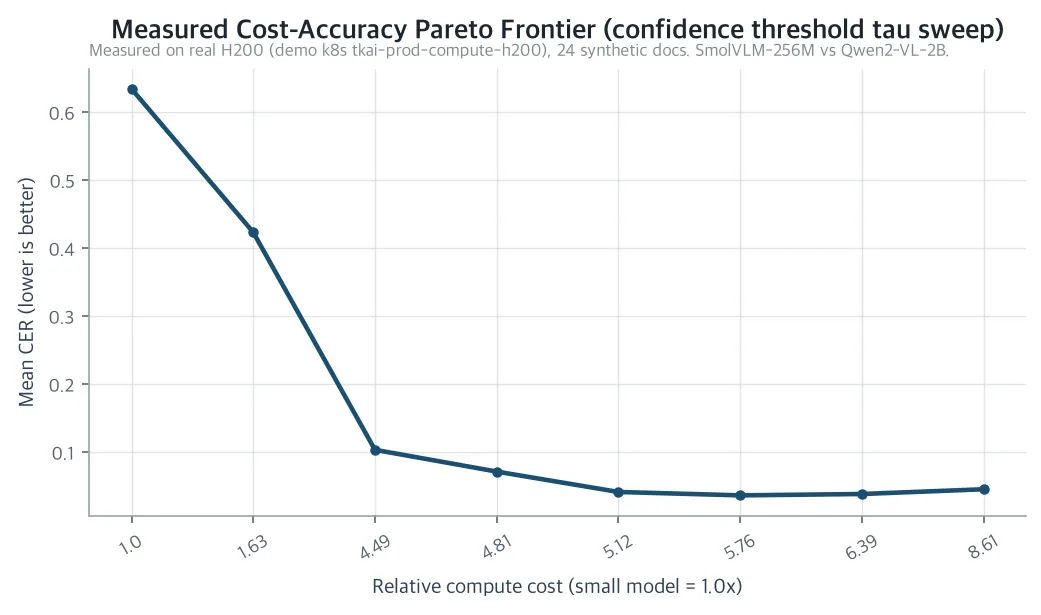 Measured values from an actual H200 node. The leftmost point (1.0x cost, CER 0.634) is the small model alone, and the rightmost point (8.61x cost, CER 0.045) is the large model alone. In the tau = 0.85 to 0.95 range, the cascade reaches a CER of 0.036 to 0.041, matching or slightly beating the large model alone at 5.1x to 5.8x cost.
Sweeping tau across eight points from 0 to 1.01 produces a textbook Pareto curve. At tau = 0.5, only 8.3% of documents escalate, holding CER to 0.423 at 1.63x cost. At tau = 0.7, 45.8% escalate, CER drops sharply to 0.103, and cost rises to 4.49x. At tau = 0.85, escalation reaches 54.2%, CER falls to 0.041, and cost hits 5.12x; at tau = 0.95, escalation reaches 62.5%, CER falls to 0.036, and cost reaches 5.76x. The key point is that the CER of 0.036 to 0.041 in this range is actually a bit lower than the large model’s own 0.045. The cascade got large-model-level accuracy while sending only about half of the documents up to the large model, at 60 to 67 percent of its cost. The data also explains why the cascade edged out the large model: the small model read some easy documents more accurately than the large model did (the large model made small errors around things like line breaks), and because the cascade never escalates those documents, it simply keeps the small model’s correct answer.
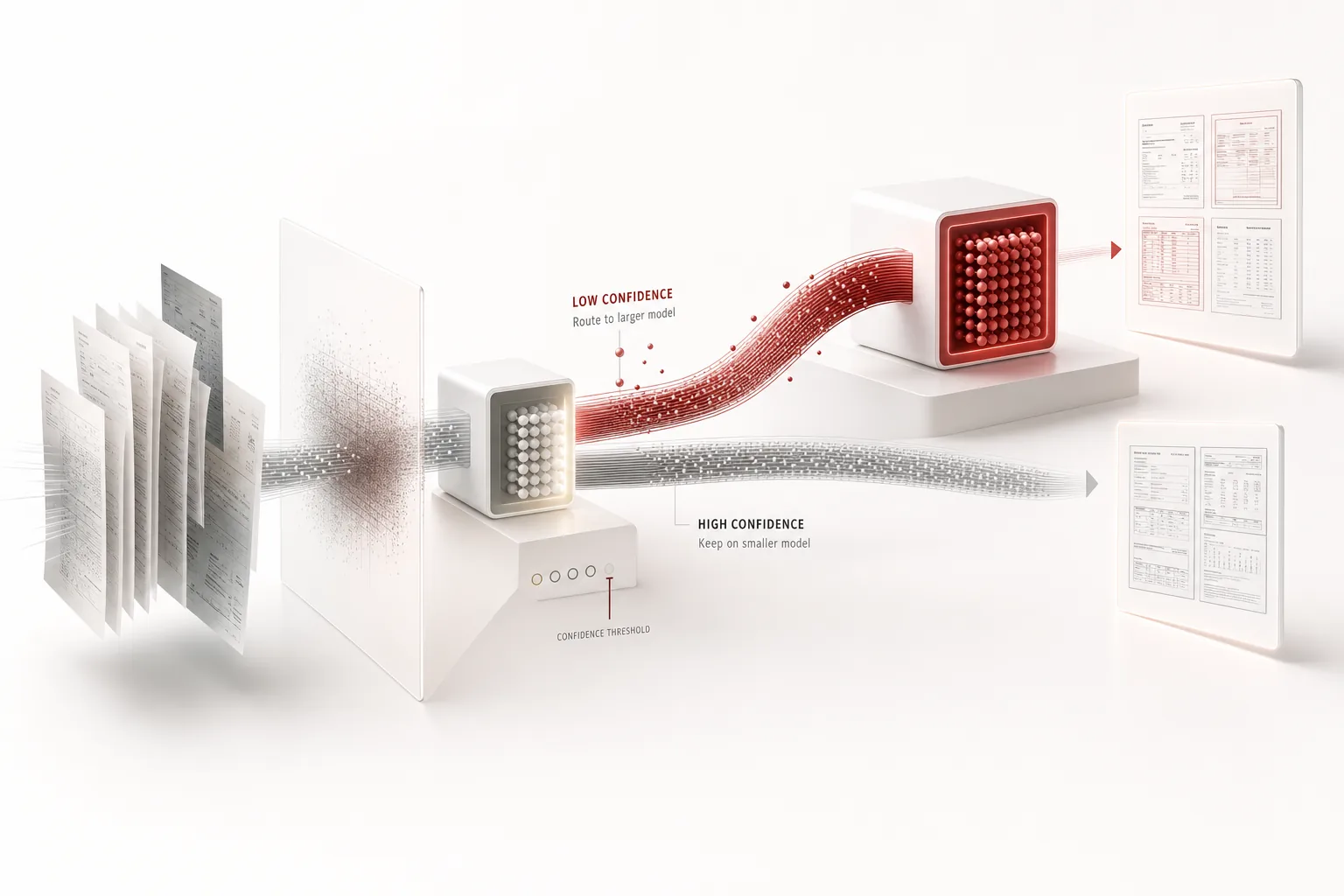 A visual metaphor for the article’s key idea.
Why It Worked: Confidence Honestly Flagged the Documents It Couldn’t Read
Breaking the gain down by language makes clear where it comes from.
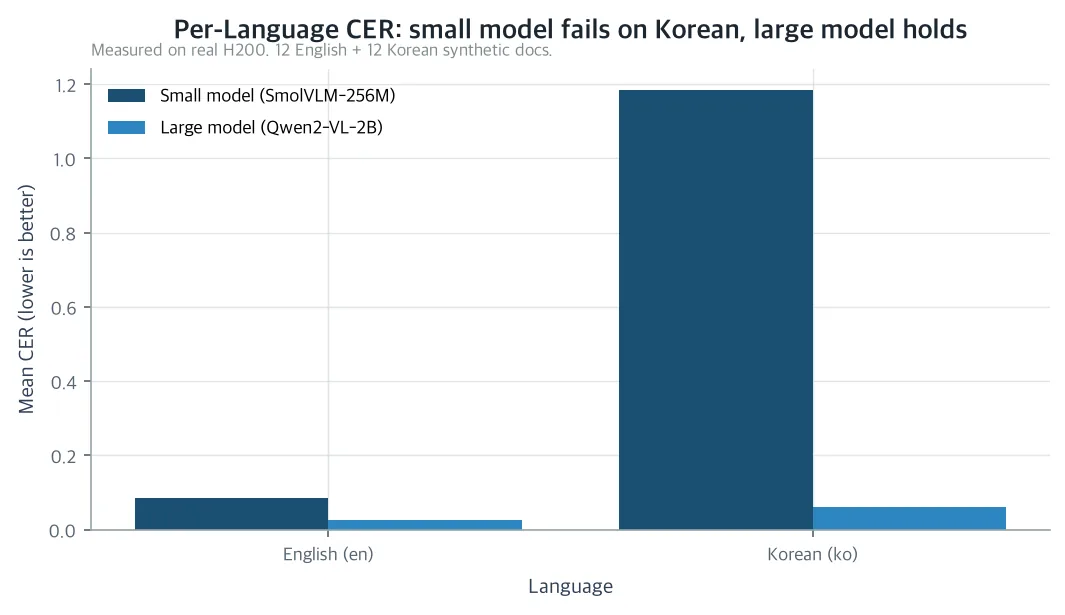 Average CER by language, measured on an actual H200. The small model comes close to the large model on English (0.084 vs. 0.027), but its CER spikes to 1.18 on Korean. Confidence drops in step, from 0.957 on English to 0.625 on Korean, which lets the gate correctly flag Korean documents for escalation.
The small model matches the large model on English but falls apart on Korean. A CER of 1.18 means its output is essentially unrelated to the ground truth, and the actual logs show the small model inventing unrelated English sentences or emitting meaningless repetition. What matters is that its confidence drops right along with it. That fall from 0.957 on English to 0.625 on Korean is the engine that makes the cascade work: because the small model loses confidence on its own whenever it can’t read a document, a single threshold is enough to pick out the hard cases.
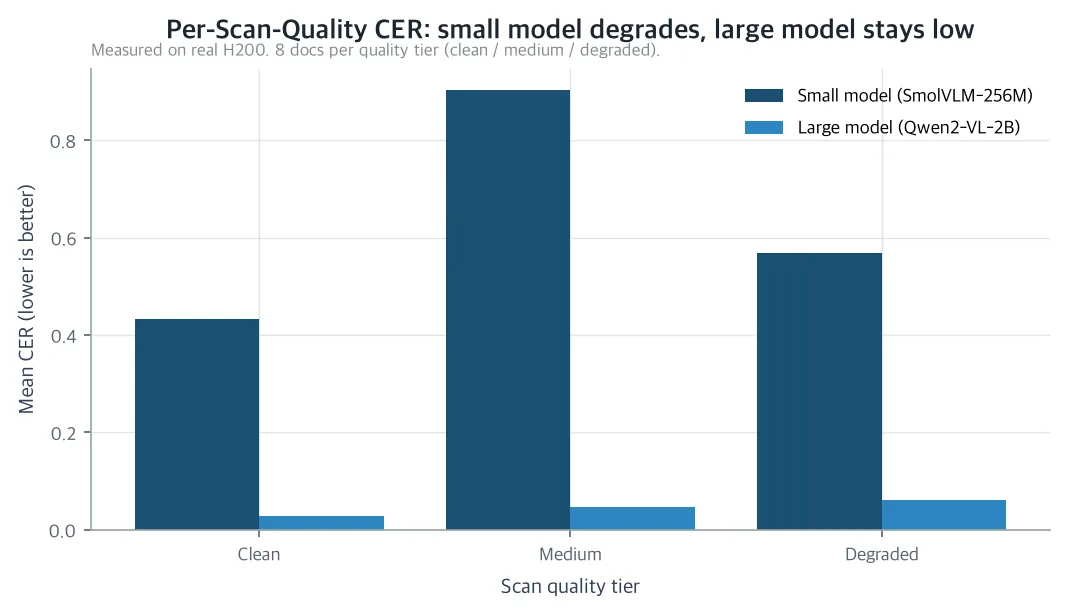 Average CER by scan quality grade, measured on an actual H200. The small model’s error rate is high and uneven across grades (clean 0.43, medium 0.90, degraded 0.57), while the large model stays between 0.03 and 0.06 throughout.
The scan quality axis shows the same pattern. The small model’s error rate swings from 0.43 to 0.90 depending on the grade, while the large model sits quietly between 0.03 and 0.06 regardless of grade. That wide gap between the two bars is the accuracy headroom the cascade can recover, and as long as confidence picks up on that instability, the cascade captures the headroom cost-effectively.
Choosing Tau for Your Own Document Population
Those are the measurements. The question that remains for practice is: what tau should I actually set for my own documents. This sweep already contains the shape of the answer.
The improvement per unit increase in tau is not constant. Raising tau from 0.5 to 0.7 pushes escalation from 8.3% to 45.8% while CER falls from 0.423 to 0.103; cost rises from 1.63x to 4.49x, but a quarter of the error rate for that price is a clear win. Raising tau from 0.85 to 0.95, on the other hand, only pushes escalation from 54.2% to 62.5% (an 8.3-point increase) and cost from 5.12x to 5.76x, while CER improves by just 0.005, from 0.041 to 0.036. That tells you the knee of the curve sits around 0.85; past it, you’re paying more for almost the same result. This is also where the 59% and 67% cost figures relative to the large model alone come from.
So the process looks like this. First, run both models alone on your own documents to establish the two endpoints. Don’t skip this step: if the small model’s CER is already close to the large model’s, there’s no headroom left for a cascade to recover. The gain in this measurement was large precisely because the gap between 0.634 and 0.045 was wide, not because the cascade structure itself is magic.
Next, sweep tau while logging escalation rate and error rate together to find the knee. One thing you must check alongside that: whether confidence actually tracks error on your own data. If that correlation breaks down, the gate escalates the wrong documents no matter where you set the threshold, and the whole cascade stops holding up. Finally, if there are axes where the error rate diverges sharply, such as script or scan quality, it’s safer to set tau separately per axis than to rely on a single global threshold. The fact that English and Korean CER came out at 0.084 and 1.18 respectively in this data is itself the evidence for that.
How Far Should You Trust This Win
To be honest, this is a genuinely positive measurement, but it does not by itself prove superiority at production scale. There are only 24 documents (12 English, 12 Korean), so this should be read as a case study rather than a population estimate. The documents are synthetically rendered, not real-world scans, so they don’t capture distorted scans or complex tables. Confidence here is also just a proxy for the small model’s token certainty, and there’s no guarantee it ranks correct versus wrong answers this well across every document population. Above all, a substantial part of this gain comes from Korean acting as the escalation trigger.
That is exactly where the cascade’s real failure mode lives. The most dangerous case isn’t “low confidence but correct,” it’s “high confidence but wrong.” When the small model runs into an unfamiliar script and confidently produces a plausible but wrong answer, that document never gets escalated, and the cascade quietly absorbs the worst kind of error. This measurement won because confidence honestly dropped along with Korean, but the same structure flips into failure the moment it meets a language where confidence stays high. The GlotOCR benchmark, which reports that most VLMs only work well on fewer than ten scripts and that hallucination increases on low-resource languages, backs up this risk.
So the right design response isn’t to abandon the cascade, it’s to actually verify, per document type, the assumption the cascade depends on. In the text-LLM world, FrugalGPT already reported quality comparable to the top-performing model at up to 98% less cost, and this measurement shows, on a small scale, that the same idea can work for document OCR too. That said, the honest choices are to calibrate thresholds separately by script and scan quality, to design the confidence gate as a multi-signal system that looks at visual certainty and structural signals together rather than a single scalar probability, and to escalate everything or route to human review in the regions where confidence is known to betray you.
Sources
- GlotOCR Bench: OCR Models Still Struggle Beyond a Handful of Unicode Scripts (arXiv:2604.12978)
- FrugalGPT: How to Use Large Language Models While Reducing Cost and Improving Performance (arXiv:2305.05176)
- HuggingFaceTB/SmolVLM-256M-Instruct model card
- Qwen/Qwen2-VL-2B-Instruct model card
The paper’s detail page can be found at the following link: https://huggingface.co/datasets/thaki-AI/daily-paper-2026-07-14-confidence-gated-ocr-vlm-cascade