Nvidia’s 14 Days, the Grid’s 2030
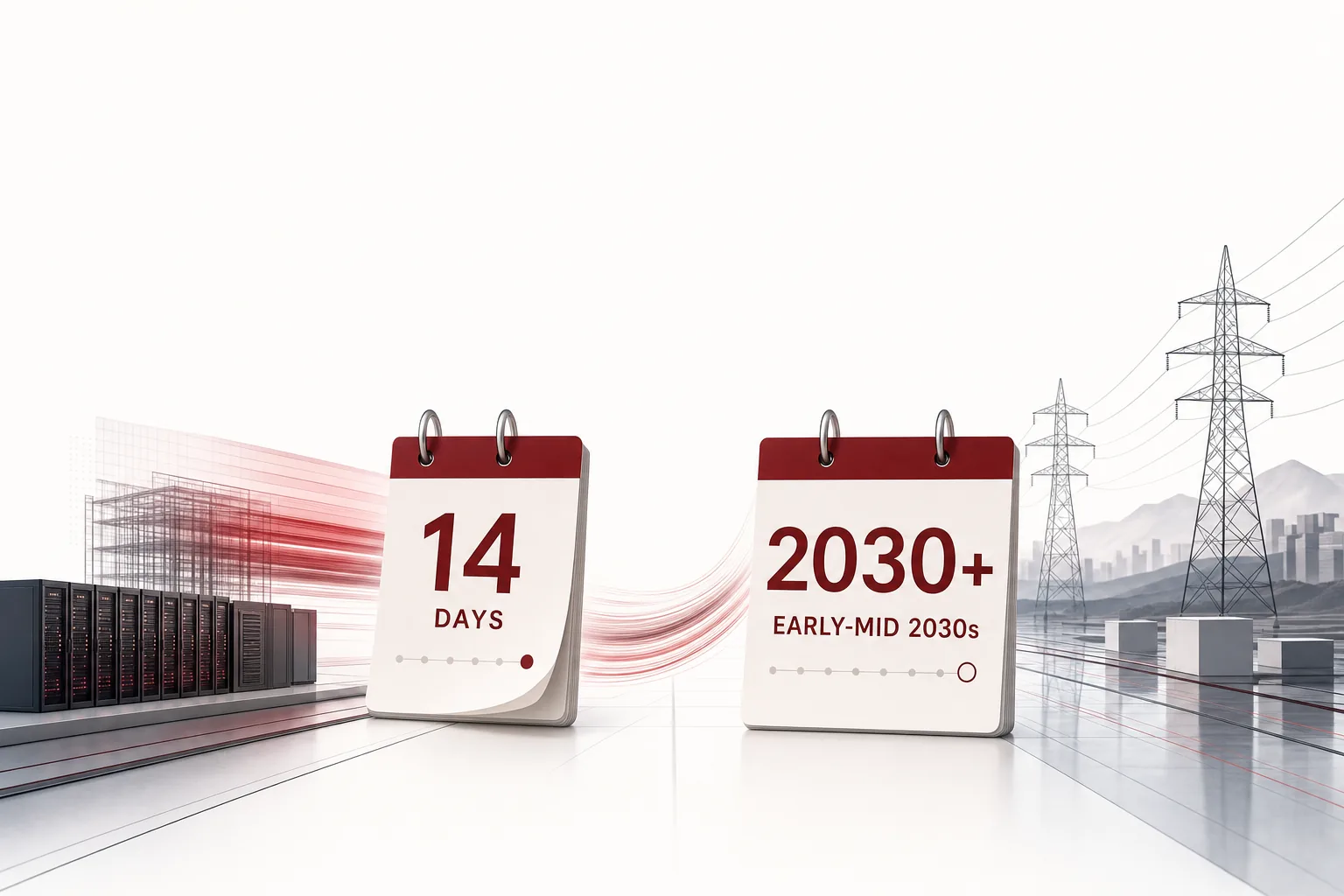 Visualizing the core concept of this post.
Two Calendars on Today’s News Table
At GTC Berlin, Jensen Huang pulled out a container. The idea is to pre-integrate the servers, network, cabling, and liquid cooling at the factory, verify performance, and then load it onto site. By his account, a data center build that used to take about six months can now be done in as little as 14 days. The modular design was named “DSX POD”.
This is where the paradox begins. The faster the construction, the more valuable the connection date becomes. The factory that was once stuck waiting for chips now ships in containers, and the only door left is one: the utility’s intake window for connection applications.
On the other side of the same news table, there was one more calendar. Microsoft has pulled back from the sovereign AI data center it was preparing in Rotton, Essex. The reason was not chips, not land, and not money. It was that the grid connection date had slipped into the early-to-mid 2030s. As the reporting put it, the structure is such that a single grid date can void a multi-trillion-won investment. Microsoft chose to withdraw.
One calendar compresses construction into 14 days, and the other pushes power to 2030. The point of this post is that the latter is a calendar no one can easily fix. The first is a product story, the second is a regulation story, and the two meet in one place: the power meter.
The direction of the data center bottleneck, as the reporting summarized, goes beyond GPU acquisition to power, cooling, land, and permitting. While chips arrive in containers, the remaining bottleneck is standing in line at the utility’s intake window.
The 14-Day Calendar, Time Is Revenue
Huang presented a time sheet for calculation along with the POD. A 1-gigawatt-scale data center takes $50 billion to build, and a mere three-month delay in going live loses a $10 billion revenue opportunity. The four to five months it used to take from equipment arrival to token output is also being cut to about one month.
According to EBN’s reporting, the POD is built on the next-generation AI platform “Vera Rubin” and is scheduled to start shipping in early next year. From the moment of ordering to receiving the container, the question “when does the power come on” has already been thrown one step ahead at a different table.
It is no longer a chip story alone. Seventeen partners take part, including Dell, HPE, Lenovo, Foxconn, Schneider Electric, Vertiv, and Eaton, and the parts supply chain names include Samsung Electro-Mechanics, Japan’s Ibiden, and Taiwan’s Unimicron. The structure brings hyperscalers, neoclouds, and power and cooling companies into a single consortium, and the calculation behind it is to cut two burdens at once: time risk and idle capacity investment. Nvidia is moving to package and sell the entire “AI factory” as a module, from chips to network, storage, cooling, and operational software. In the same news cycle, it also disclosed a schedule to invest about $10 billion in Europe and offer sovereign AI full stacks to the governments of France, the UK, Germany, and Sweden.
But the 14-day figure comes with a condition. It is an “installation phase” baseline that excludes land, grid, and permitting. Actual go-live timing differs by project. The faster you build, the more the bottleneck concentrates where the POD cannot reach, which is the grid.
The 2030 Calendar, the Date That Kills Investment
The Korean government’s response has already begun. The Ministry of Climate, Energy and Environment launched an “AI Data Center Study Group” in August and said it will prepare a grid code dedicated to AI data centers, that is, the rules for connecting to the grid, by the end of the year. The reason is that momentary power swings during AI computation can destabilize the grid.
The grid code is taking shape toward strengthening connection rules so that large-scale consumption facilities, like power plants, must shoulder voltage maintenance and system fault response functions as well. In other words, the data center is moving from “consumer of electricity” to “equipment managed by the grid”.
This rule is more sensitive than it looks. Even a 1% reduction in intake capacity on a new-equipment basis removes 10 megawatts per gigawatt, the size of one small data center. The gigawatt-scale AI data center projects in Ulsan and Donghae are exposed as-is to design changes and construction-period delays. On top of that, direct electricity trading with an LNG power plant, which had been included in the AI data center special act bill that passed the Science, ICT and Broadcast Communications Committee in April, was dropped from the bill passed in plenary in May over the Ministry of Climate, Energy and Environment’s opposition. The path through the national grid has become effectively one route.
From a company’s perspective, this structure shows up directly in total cost of ownership. Electricity price volatility, connection waiting periods, and capacity expansion costs are all exposed at once, and that is why power supply and connection criteria have become the first variable in AI infrastructure investment.
In the end, this means the fate of the gigawatt-scale project has shifted to this date. Korea’s data center power rates are already high, so the sensitivity to a 1% capacity loss and to power efficiency per token has to be greater than in any other market. Rep. Cho Gyeong-tae argued that the new grid code should be excluded in principle from projects already in progress, and the committee decided to verify participation in a cross-ministry task force and a plan to protect existing projects at the comprehensive audit of the Ministry of Science and ICT on the 23rd. The audit’s outcome will become the schedule for the Ulsan and Donghae projects.
Even Huang Surrendered to the Watt
There is a third signal on the same news table. Nvidia announced that DSX MaxLPS will cut power consumption per token by up to 30%, and there is a DSX design that brings cooling water use down to near zero at a 2-gigawatt-scale data center. They compete on speed in front of the connection date, but they concede in front of the “watt”.
On the same day, Jensen Huang also unveiled OpenShell, a reference architecture for running AI agents within a defined scope. More than 100 parties take part in pushing open standardization. The principle is clear. First define the “permitted scope”, and within it, guarantee the safety boundary, least privilege, and observability of the agent that operates. It looks like a safety story, but it is also an economics story. Agents that step outside the boundary burn both tokens and watts twice over.
The background is the token surge. Morgan Stanley estimates that agentic AI can consume up to a million times more tokens than a typical generative AI prompt. Meta raised its 2026 capital expenditure guidance to $135 billion to $145 billion, and its third-quarter free cash flow turned negative at minus $2.12 billion. The more you buy on debt, the larger the share each watt has to produce.
The inference is simple. If the connection date is fixed and capacity is cut by 1%, the remaining degree of freedom is one. How much work you get per unit of power.
Recalculating for Korean Companies
Korea’s sovereign AI investment is already in the groundbreaking phase. According to domestic reporting, the government is reviewing an extension of a roughly 3 trillion won project to secure the core GPUs for sovereign AI, and the national AI computing center, 15,000 GPUs worth 2.5 trillion won, is in the groundbreaking phase. In Nvidia’s sovereign AI tour as well, Korea was named among the group of countries whose government and enterprise AI ecosystems will be supported.
But there is a layer of irony attached. The same reporting also pointed out that the country moving to secure sovereignty could end up in a structure that depends more on a single vendor. In other words, the sovereignty story is, in the end, a supply chain story.
Conversely, if the grid code forces design changes and delays on the gigawatt-scale projects in Ulsan and Donghae, the maturation of the domestic GPU resource pool scheduled for 2027 to 2028 can slip. In that scenario, companies cannot wait for a new data center. They have to work on the compute they already have in hand.
The direction is the same within Korea. LG CNS unveiled a pre-fabricated modular data center and an AI factory full-stack service at “Data Center World Asia 2026” in Singapore, and is moving forward with an agreement to jointly discover and invest in enterprise SW and AI companies with the US investment firm General Atlantic. In the flow where competition moves beyond the supply of GPU resources to full-stack services covering power, cooling, operations, and software, “how fast you can produce tokens” is becoming the standard for customer decisions.
Work per watt is not just a data-center-only future story. It is already in motion on the factory floor. Onpredict combined some 200 of its in-house AI models, “tech cells”, like cells, so that a policy-based orchestrator tunes the four major functions, predictive maintenance, quality prediction, process optimization, and energy efficiency, into a single factory operations decision. Energy efficiency was the KPI being tuned. Consulting firms like PwC are citing manufacturing AI as a core driver for the next leap of Korean manufacturing, and regional AX projects in Daegyeong, Honam, Dongnam, and Jeonbuk are being pushed in succession. The fact that Onpredict passed the KOSDAQ technology evaluation and is targeting a listing in the first quarter of next year means that work per watt is already in the ledger of the domestic factory floor.
So the question changes. Not “how fast can you build the data center”, but “how much work do you complete per unit of power, per unit of time”. And if that work is agent work, the unit of cost moves from the number of GPUs to how many tokens were burned and how many times the loop idled.
The Lens of Work per Watt
This is where Paxis can be pulled out. Paxis is ThakiCloud’s agent-native cloud, a genuine product that reached market as v1.1 GA, and it treats skills, tools, policies, and audit logs as first-class resources.
In a world where the grid is the bottleneck, the value of this structure is very concrete. The first is model selection per task. Not every task requires the most expensive model. If CostRouter sends each task to the cheapest model that can handle it, that is like translating “30% power savings per token” into the language of agent work. The second is the policy gate. An agent without boundaries idles both tokens and watts, but pre-defining autonomy levels from L0 to L3 cuts that waste at the design stage. The third is isolated sandbox execution and audit logs. If all actions are performed within a hardened execution environment, and what was done with which model is left as a record, then whether the grid or an audit asks about work per watt, you can answer with evidence. On top of that, if you connect business tools via MCP connectors and the skill marketplace and run it on a sovereign on-prem K8s, that is, ai-platform, this becomes not a feature to add when a new data center is completed, but equipment to install first in today’s closed network and in-house GPU environment.
In the end, what the grid demands of a company is the posture of treating the watt itself as a first-class resource.
There were two calendars on today’s news table. One compresses construction into 14 days, and the other pushes the grid to 2030. What a company needs is not to pick one of the two, but a third calendar that records how much auditable work each watt did.
References
This post was written by synthesizing the news below.
- Newsway, SK Hynix Faces 1,100 Trillion Won in Investment: The Calculus Behind Solidigm’s Listing
- Digital Times, OpenAI’s GPT Lands on Google Cloud: Top-Tier Model “GPT Astra” Now Available
- Digital Today, From TFM to CEM: A Flood of AI Models Different from LLMs
- The Digital Daily, [On Site] How to Implant an “AI Brain” in a Factory: Onpredict Combines 200 In-House Models to Deliver Tailored Solutions
- The Fact, “A Grid Code Dedicated to AI Data Centers Could Become a New Regulation at the Investment Front”
- Global Economic, “Tripped Up by China’s Low-Price Push”: Anthropic Ahead of a Major IPO, Valuation Cut to “USD 1.5 Trillion”
- Korea Report, Meta: “AI Investment Continues”, Raises Capital Expenditure