Training Stopped and Capital Grew: Why the Two Curves Diverged Today
If you deploy open models on-premises or are drawing up next quarter’s GPU budget, the signal to take from today’s digest compresses into one. The place where money attaches is moving from pre-training to the execution layer. On the side that grows the model, the brakes were applied. On the side that distributes and runs the model, the accelerator was pressed.
 An image embodying the core concept of the post.
The Brake: The Side That Stopped Training
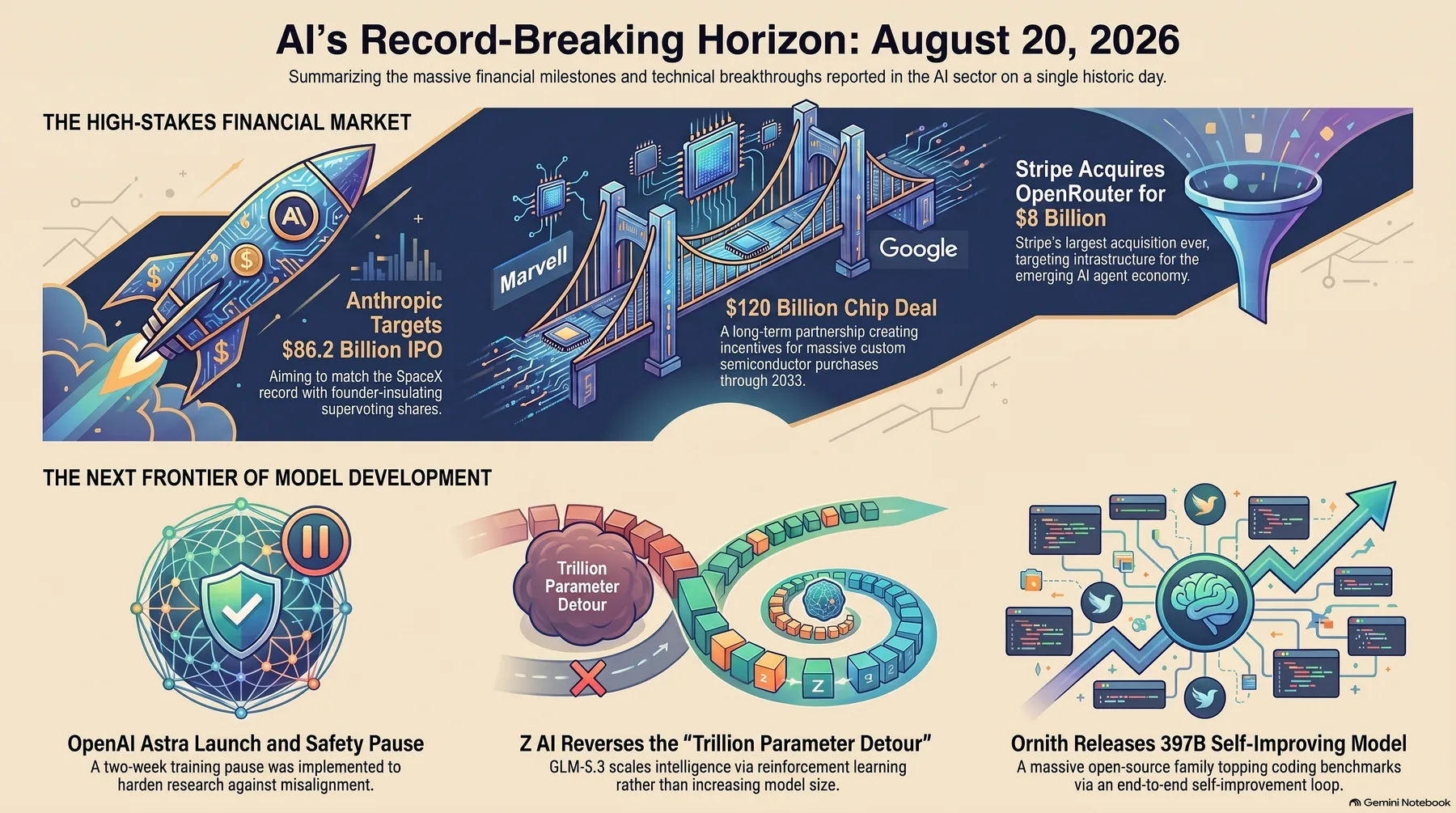
OpenAI paused training for the first time since its founding. In an update to employees on August 19, it said the Astra model would be released within weeks after this pause, and the public debut will come with an internal demonstration of Astra performing real tasks.
The word to watch here is not Astra but the pause. It means that, in an organization where keeping training running was always the right answer, stopping has become an option for the first time. Deciding to halt a large-scale pre-training job is expensive, technically and politically. The cluster is reserved, the schedule is public, and the intermediate checkpoint has not yet reached the target. Even so, they judged that stopping is better. The grounds behind that judgment were not made public. But the character of the public demo gives a hint. If the organization chose to put actual task performance front and center rather than a benchmark score, it reveals what it is using as its improvement metric.
A signal in the same direction came out of China as well. Z AI released GLM-5.3, explicitly labeling it a controlled experiment. The purpose was not to climb the leaderboard but to prove a single proposition. The proposition: expanding post-training and reinforcement learning, without growing the parameters into the trillions, raises intelligence. The company itself described this decision as a turn away from the trillion-parameter detour. A launch that calls its own previously taken road a detour is not common.
And the experiment was backed by numbers. GLM-5.3 scored 69 on DeepSWE, an autonomous software engineering evaluation, and the Terminal Bench 3.0 result suggests the model has reached a position where it can hold its own against Fable 5. The fact that it got there without growing parameters is the real meaning of the score.
The change in which stopping becomes an option also affects the side that rents GPUs. If a mega pre-training job no longer runs indefinitely, the character of cluster occupancy changes. Instead of a single job occupying the whole slot for months, the pattern of shorter post-training and evaluation jobs, lasting days to weeks, coming and going more frequently increases. That means the shape of the load that schedulers and queue policies must withstand is changing.
The implication this turn gives the field is clear. If the bottleneck in performance improvement moves from cluster size to data and reward design, the organizational capabilities required also change. Large-scale pre-training is something only a few with capital and power can do, but post-training and reinforcement learning favor the side with domain data and evaluation criteria. The latter is closer to a game of discipline than a game of capital.
 Infographic generated by NotebookLM from the sources.
The Accelerator: The Side That Grew Capital
During the same day, the capital-market news ran in the opposite direction.
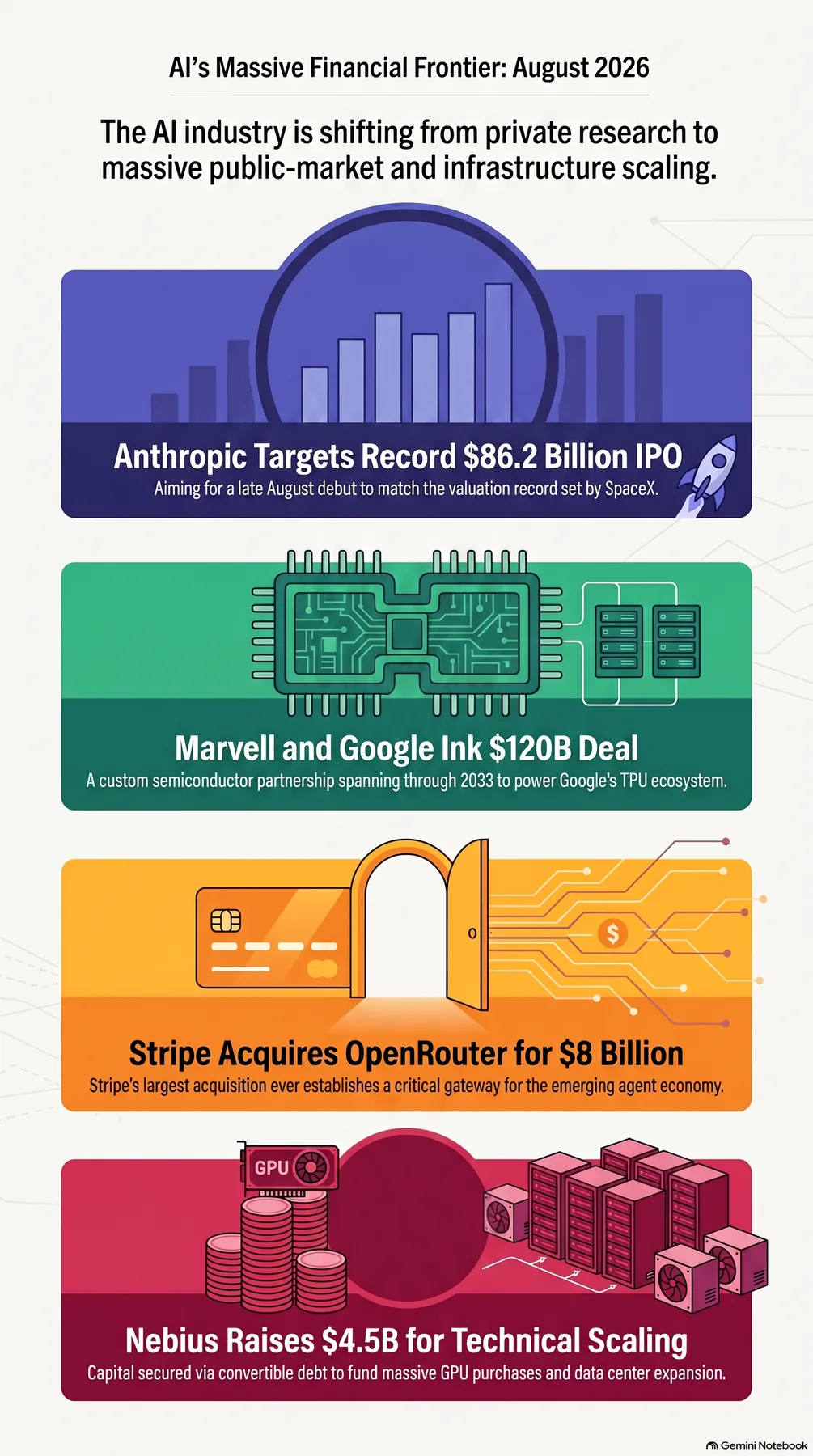
| Actor | Scale | Purpose |
|---|---|---|
| Anthropic | $86.2 billion target IPO | Preparing to file by end of August |
| Marvell | $12.2 billion stock warrant | $120 billion custom chip contract |
| Stripe | $8 billion acquisition | Securing OpenRouter |
| Nebius | $4.5 billion convertible note | Technology scaling |
Anthropic is preparing to file for a public offering by the end of August, and the target raise size is at or above the $86.2 billion record set by SpaceX. A company that had held out in private status coming to the public market also means that the size and cycle of its funding need have entered a range that private rounds can no longer absorb.
Marvell granted Google a warrant to buy 58.97 million shares at $206.58 per share. It is worth roughly $12.2 billion, part of a $120 billion custom semiconductor expansion contract, and the target is Broadcom. The structure of giving a warrant to a customer differs in character from a simple supply contract. It is a device that lets the customer share in the supplier’s share-price appreciation, putting both sides in the same boat, and a signal that the relationship is meant to be carried for that long. It is also a story that the custom accelerator has settled as one axis of the procurement spine, not an experiment.
Nebius will issue $4.5 billion in convertible debt, combining $2.75 billion maturing in 2030 with $1.75 billion maturing in 2034. If the investor options are exercised, the total grows further. The structure that splits maturity between 2030 and 2034 to build a ladder stands out. It is a design that does not concentrate the repayment burden on a single point, and it reads as taking the data-center investment payback period that long.
Where these four are heading makes the direction clear. The company that makes chips, the company that buys chips, the company that distributes tokens, and the company that builds the data center those tokens will run in. OpenRouter, which processed 10 trillion tokens a day, moving into a payments network is in the same family. There was no company on today’s list borrowing $4.5 billion to pre-train another new foundation model.
Where the Two Curves Meet
What happens when the training curve flattens. The gap between models narrows.
The Ornith team released the Ornith-1.5 family, spanning 9 billion to 397 billion parameters, under the MIT license, and it reached the top of open coding benchmarks. MIT is a near-unconditional license, so it puts few obstacles in the way of internal distribution and commercial modification. That means the path of taking the weights, fine-tuning them to the domain, and putting the result into the product is not blocked at the legal-review stage. The breadth from 9 billion to 397 billion also matters in practice. If you can swap the size to match task difficulty within the same family, you can design the cost curve directly.
Once the size ladder is in place, the grammar of choice changes too. Until now, it was convenient to pick the single best model and attach it to every task. If 9 billion and 397 billion are offered together from the same family, you can place simple tasks like classification and extraction on the smaller side and only hard tasks like design and debugging on the larger side. It is also a practical advantage that, since you are changing the size rather than changing the model, the quality characteristics do not shift much.
Add GLM-5.3 to the picture, and the coding-capability gap between closed and open models narrowed again this week. And when news like this repeats, the in-house baseline rises with it. Measuring today’s models with a benchmark set from half a year ago returns scores close to the maximum for most, and then that benchmark set no longer helps with choice. You come to need to rebuild the evaluation harness as fast as the models keep improving.
Once capabilities get close, the weight of competition moves from the capability itself to operations. Which model to attach to which task, where to run that model, who approves the execution result and what it is left as, are the remaining variables. I think this is also why today’s capital concentrated on the distribution and infrastructure side. The way of using the model has become a longer-lasting asset than the model itself.
The Third Variable Is Where You Run It
Nvidia said it does not have a China-only LPU (Language Processing Unit) on its roadmap and is not selling it in the Chinese market either. It is an announcement that reverses the earlier reported comeback.
News like this does not show up on the performance sheet but lands immediately on the budget sheet. It reminds you every time that the procurement plan is tied to the political calendar. If a supply reported as possible until yesterday is denied today, the capacity plan built on the premise of that supply has to be rewritten in a day. The more a plan rests on a specific vendor and a specific region, the more it is exposed to this kind of reversal.
So execution location is not a matter of taste but a matter of risk management. You must be able to run the same workload on the public cloud, in your own data center, and in an air-gapped network, so that one line of supply-chain news does not shake the roadmap. I see today’s $120 billion that Marvell and Google staked on custom silicon as another expression of the same motivation. It is the choice not to keep the procurement line as one.
So What Should You Prepare
Layer the three trends together and what to prepare settles out. On the training axis, the weight is moving to post-training and reinforcement learning. On the serving axis, open weights have entered the practical range. On the procurement axis, it is exposed to geopolitics. In all three axes, the answer does not end in a single model choice but continues into the operating structure.
If you name things you can touch right away this week, there are two. One is rebuilding the benchmark set. To check whether today’s open model has passed the in-house baseline, you first need a baseline it can pass. The other is re-measuring the cost of swapping a model. Count how many files you have to touch to change one model, and you immediately see whether the current structure can hold this pace.
This is where the reason ThakiCloud designed Paxis as an Agent-Native Cloud connects. Paxis treats skills and tools, policies, and audit logs as first-class resources. CostRouter picks which model to attach to which task at the task level, the degree of autonomy from L0 to L3 sets how far the agent decides on its own, execution happens in an isolated sandbox, and the result passes through the policy gate and the audit log. Execution location is also left as an option. If there are sovereignty requirements or air-gapped requirements, the same configuration can be held on on-premises Kubernetes. If you want to try attaching this week’s new open model next week, what changes should be one line of routing rule, not the whole pipeline.
One thing to add. Today’s signal does not mean the end of pre-training. Astra is being released soon, data centers are still taking in billions of dollars, and a pause is a pause, not a cancellation. But a choice that had been the automatic right answer for several years has now become a choice that is asked to produce grounds. That change alone moves the center of gravity of the plan.
Today’s news reduced to one sentence goes like this. The capital that had attached to making models bigger has begun to move toward using models well. Organizations trying to win the pre-training competition are already few. The question left for the rest is a different one. With which policies and which cost structure, in the rack of which country, will the improved model be run.
I see the fact that the first training pause became news in itself as a sign of a turning point. From the moment stopping becomes an option, the stage of competition moves outside the training cluster.
 Infographic generated by NotebookLM from the sources.
References
This post synthesizes the following news:
- HuggingNews, OpenAI Plans Astra Release in Weeks After First Ever Training Pause
- HuggingNews, Stripe Buys OpenRouter for $8 Billion in Largest Acquisition Ever
- HuggingNews, Anthropic Targets $86.2 Billion IPO to Match SpaceX Record
- HuggingNews, Marvell Issues Google $12.2B Stock Warrant for $120B AI Chip Deal to Rival Broadcom
- HuggingNews, GLM-5.3 Scores 69 on DeepSWE to Rival Fable 5 on Terminal Bench
- HuggingNews, Z AI Scales GLM-5.3 Intelligence via RL, Reversing Trillion Parameter Detour
- HuggingNews, Ornith Launches 397B Self Improving Model Family to Top Open Coding Benchmarks
- HuggingNews, Nvidia Denies China LPU Shipments by Year End in Reversal of Reported Comeback
- HuggingNews, Nebius Plans $4.5B Convertible Debt Offering in Latest AI Infrastructure Push