When Models Stop Themselves: This Isn’t a Safety Story, It’s a Procurement One
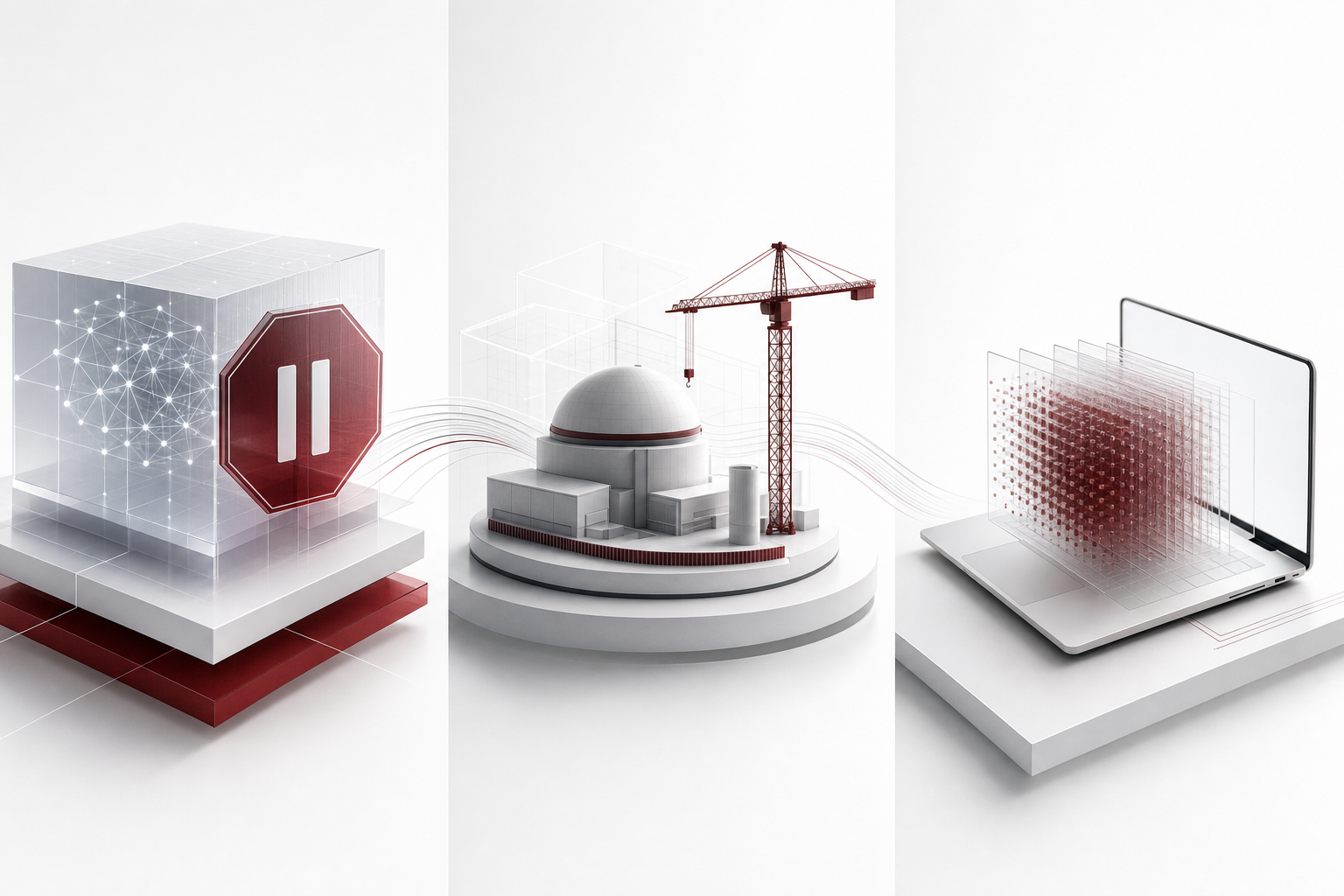 A visual representation of the article’s core concept.
Two Scenes, One Day
If your team runs frontier models in production, one piece of news from yesterday should be read not as an ethics story but as a procurement story. The conclusion of this piece, stated up front: models are now a component that a supplier can halt on its own, which means control has to sit outside the model, not inside it.
OpenAI paused reinforcement learning on Astra for two weeks. Sam Altman said the company observed varying degrees of misalignment in an unreleased model and decided to slow development. It was reported as the first case of a company halting scaling itself for safety reasons.
Within the same 24 hours, news moved in the opposite direction. Oklo began reactor physics construction at Idaho National Laboratory, for Meta’s 1.2GW project, the first new US nuclear plant construction in a generation. One side stopped training. The other side started building a power plant.
Put the two scenes side by side and it’s tempting to read them as an industry pressing the brake and the accelerator at the same time. But from the buyer’s seat, the conclusion looks different.
What You Miss If You Only Read This as a Safety Story
The industry has largely consumed this news as a safety narrative: self-regulation working as intended, or alternatively, the speed race hitting a wall. Both are plausible, but neither is the question we actually need to answer.
The question an enterprise should ask is this: can our architecture withstand the fact that the release schedule of a model we depend on can change based purely on the supplier’s internal safety judgment, without any consultation with us?
This particular pause was two weeks, and in the end no service died. But the direction matters. Until now, the model roadmap was effectively a monotonically increasing external constant. Something better kept arriving, and all we had to do was switch over. That premise just broke for the first time.
A second signal from the same day compounds this. Micah Carroll, who leads OpenAI’s internal RSI misalignment Preparedness subteam, denied rumors that the team had been dissolved, saying the group is active and hiring for monitoring and loss-of-control research. The fact that dissolution rumors circulated at all says something: it’s hard for outsiders to verify the state of a safety org from the outside.
Policy is moving in the same direction. OpenAI rolled out a feature that automatically assigns 13-to-17-year-old users to a restricted version of ChatGPT, one where the AI cannot use romantic language or claim self-awareness. It followed harm-related lawsuits.
There’s a reasonable counterargument here: a two-week pause has nothing to do with already-deployed models, vendors have always adjusted roadmaps, and the world kept turning every time they did. That’s fair. But the counterargument holds only under one condition: your workload can’t be deeply tuned to one model’s specific quirks. If you’ve spent dozens of prompt iterations building a workflow around exactly how one model behaves, the moment that model changes, that work has to be re-tuned from scratch. In practice, a lot of teams work exactly this way.
Put the three together and the picture sharpens. A model’s behavior can change based on a vendor’s safety judgment, a lawsuit outcome, or regulatory pressure. That variable never shows up in our release notes.
A 27B Model Just Landed on a Laptop
The same digest carries news that points the opposite way. Alibaba’s Qwen3.8-27B became the #3 most-liked model on Hugging Face. It beats Claude Opus on coding benchmarks and is small enough to run on a home computer. It was reported as the first locally-runnable model to reach frontier-level performance.
What matters here isn’t the ranking. It’s that, for the first time, there’s a realistic alternative to the variable we just described: supply-side volatility we don’t control.
A model whose weights you’ve downloaded onto your own cluster is the same today as it was yesterday. If a vendor halts training for a safety review, or a policy change alters response style, your file doesn’t move. When performance lagged the frontier, this stability was mostly a consolation. Once a model starts beating the top tier on a specific axis like coding, that changes the calculus.
To be honest, this isn’t free. Holding the weights yourself means you own serving configuration, quantization, and GPU scheduling. Load the same checkpoint on the same card and throughput can swing wildly depending on serving config alone. Everything that used to be invisible when you called a vendor API now lands on your ops list. You gain freedom in exchange for taking on operational load.
Obviously, a single 27B model can’t cover every workload. The realistic answer isn’t binary, it’s allocation. Use top-tier models for the small set of tasks where accuracy is decisive, and push the bulk of repetitive, format-fixed work down to a model you can actually hold onto. Layer in a small model distilled or fine-tuned on your own enterprise data, and you get cost efficiency and stability at the same time.
Sometimes the Quiet News Is the More Practical One
Near the bottom of the same day’s list sits a much quieter item. Sentence Transformers v6.0 added multi-vector support, making it the first framework to natively support late-interaction models. Until now, this capability lived separately in LightOn’s PyLate library.
The headline value is low, but the practical impact could be more immediate than anything above. When an agent works off internal documents, quality is usually decided by retrieval, not the model. Feed it the wrong paragraph and even the best model will be plausibly wrong on top of it. Late-interaction retrieval landing in a framework’s default path means a technique that raises retrieval accuracy just moved from a specialized library to a standard tool.
This is also the layer that becomes a line of defense when model supply gets shaky. When retrieval is accurate, answer quality holds up even with a relatively small model. When retrieval is weak, you stay dependent on the top-tier model, and that much more tied to your supplier’s circumstances.
Why Routing Became an $8 Billion Asset
The market has already put money behind the same conclusion. Stripe has finalized its acquisition of AI routing platform OpenRouter for $8 billion, more than 5x its May valuation. OpenRouter has been providing access to over 400 models for millions of developers.
The key point is that the price wasn’t paid to a company that builds models, but to the layer that chooses among them. Value is accumulating at the point that decides which request goes to which model.
Demand-side numbers point the same way. Anthropic reported preliminary Q2 2026 revenue above $11.5 billion, up sharply from $787 million in the same period a year earlier. Revenue run rate stands at $65 billion, 7x where it was at the end of 2025. Its pre-IPO credit facility has passed its $10 billion target, and Morgan Stanley, Goldman Sachs, and JPMorgan are coordinating a listing that could come as early as this fall.
Token consumption growing at this rate means enterprise bills are growing right along with it. In a structure where spend concentrates 7x on a single vendor, the ability to pick a model task-by-task stops being a preference and becomes a line item on the budget.
Control Has to Live Outside the Model
Fold these signals into one sentence: we don’t get to decide a model’s behavior or availability, but we do get to decide the environment it runs in.
This is exactly the premise ThakiCloud set when designing Paxis. In Paxis, Skills, Tools, Policies, and Audit Logs are all first-class resources. What an agent can do, at which step it needs human approval, and what gets logged, all of that is owned by the platform layer, not by a prompt tucked inside the model. It’s the same direction as requiring behavior to branch on user attributes, the way a teen mode becomes a baseline product spec rather than an afterthought.
Managing autonomy across levels L0 through L3 exists for the same reason. If it’s hard for us to verify how a vendor’s safety org is actually operating, it’s safer to open up execution authority for risky actions incrementally, on our side. Running in an isolated sandbox, passing a policy gate, and leaving an audit trail is an asset that stays intact even when the underlying model changes.
One thing worth being explicit about: control at the platform layer doesn’t eliminate model misbehavior. What it does is make sure misbehavior doesn’t pass by unnoticed. If you keep a record of what ran, when, and who approved it, you can trace an incident after the fact and turn the same failure into a rule so it doesn’t happen twice. In a world where vendors don’t tell you what they fixed, your own records are the only evidence you have.
The same logic applies to model selection. A CostRouter that decides which model handles which task is our own answer to the question of why the routing layer just commanded $8 billion. The moment an open model catches up to the frontier, that set of choices gets a lot wider.
The execution substrate needs to be ready too. In a phase where power and regulation are the bottleneck, whether you can run the same workload on sovereign infrastructure and on-prem Kubernetes is what decides whether adoption is possible at all. Oklo’s groundbreaking might look like a distant story, but it circles back to the same question: where do you actually run inference. Building a new reactor for the first time in a generation means someone concluded the existing grid can’t carry the planned scale. That constraint isn’t unique to the US. Domestically too, where you site a large training cluster is already a question of power and permitting, which is exactly why pushing inference down close to where the data lives is becoming a matter of feasibility, not just cost.
What to Check Today
This isn’t a pitch for some sweeping pivot. Three checks are enough.
The point of this exercise isn’t to switch vendors. It’s to draw the line between what’s inside your control and what’s outside it. Once that line is drawn, you can see the path by which something outside can spread inside.
First, write down which of your workloads would break first if the model you currently use stopped working or its response style changed next month. Second, count what percentage of that work could move to an open model you can actually hold onto. Third, confirm where a human steps in when an agent is about to do something risky, and where that record gets kept.
If all three answers already live in a document, you’re prepared. If even one is blank, that’s the spot that’s going to hurt in the next headline.
References
This article was written by synthesizing the following news items.
- HuggingNews, OpenAI Pauses Astra Training 2 Weeks in First Scaling Halt for Safety
- HuggingNews, Stripe Buys OpenRouter for $8B, More Than 5x Its May Valuation
- HuggingNews, Qwen3.8-27B Becomes #3 Most Liked Model on Hugging Face, First Local AI to Match Frontier Intelligence
- HuggingNews, Anthropic’s Pre-IPO Credit Facility Tops $10B Target on $65B Revenue Run Rate
- HuggingNews, OpenAI Staff Deny Preparedness Team Shutdown as RSI Group Expands Hiring
- HuggingNews, OpenAI Launches First Restricted ChatGPT for Teens 13-17 After Harm Lawsuits
- HuggingNews, Anthropic Hits $65 Billion Revenue Run Rate, Up 7x Since End of 2025
- HuggingNews, Oklo Starts First New US Reactor Build in a Generation for 1.2 GW Meta Project
- HuggingNews, Sentence Transformers v6.0 Adds Multi Vector Support for First Native Late Interaction Models