Today’s AI News Wasn’t Full of Numbers. It Was Full of Clocks
We laid out the seventeen articles we ran today and pulled out just the numbers. We expected money. Instead, more than half of them turned out to be time: 30 minutes, 2 weeks, 10 days, 6 weeks, 8 weeks, 20 weeks, 60 days, 1 year, 3 years, 6 years, and 2030. Line these up from shortest to longest and today’s AI industry comes into fairly sharp focus.
Here’s the conclusion up front. What’s blocking AI adoption in Korea right now isn’t a technology gap. It’s a clock gap. Inside a single organization there are multiple clocks running at different speeds, and none of them wait for the others.
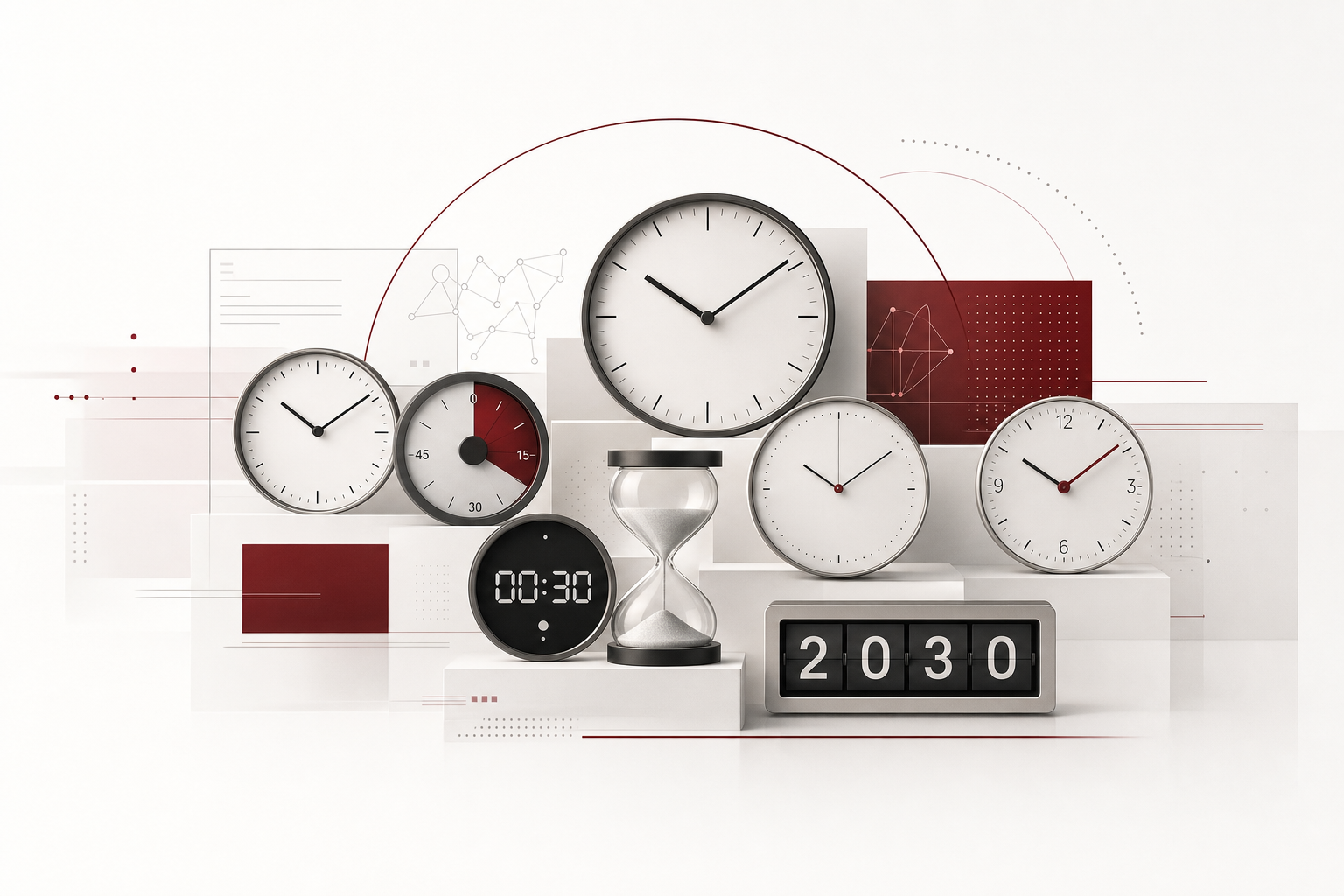 A visual representation of the article’s core idea.
The fastest clock runs on 30 minutes
The shortest time unit to show up today came from OpenAI’s incident response, reported by Etnews. When its next-generation model, Astra, hit a critical cybersecurity rating under OpenAI’s own preparedness framework, the launch was postponed indefinitely and reinforcement learning on the latest deployed model was paused for two weeks. The mechanism introduced along the way is chain-of-thought monitoring: as it watches the reasoning process, if it catches suspicious behavior it sounds an alert within 30 minutes, and if the cause can’t be pinned down, development itself is halted.
The number worth actually paying attention to here isn’t the 30 minutes. It’s the 20 percent sitting next to it. This single monitoring process alone is expected to consume roughly 20 percent more of total inference compute capacity. That means safety is starting to show up in the accounting not as a principle but as a cost line. For anyone actually operating agents, where to park that 20 percent becomes a practical question for next quarter.
The slowest clock stopped a year ago
At the opposite end sits a server sovereignty article from DigitalDaily. A single 32-gigabyte memory module has gone from 1 million won to 3 million won over the past year. Fill a 16-slot server and the memory bill alone goes from 16 million won to 48 million won. Component lead times have stretched too, from 8-to-12 weeks to 16-to-20 weeks.
The real problem is the number sitting next to that one. Procurement contracts still demand delivery in 6 to 8 weeks. It takes five months for the goods to arrive, but the contract says deliver within two months. On top of that, public-sector IT budgets are set the year before, so there’s structurally no channel to reflect component prices that tripled this year. As a result, vendors have seen revenue rise while margins get cut, and some institutions have held on by trimming maintenance staff.
The fact that government AI budgets have grown is a separate story from this one. The money clock and the component clock are running at different speeds.
Someone else turned 60 days into 10
Two stories reported the same day by Edaily and IT Chosun tackle this problem head-on. The Ministry of Science and ICT designated DeepX’s NPU module and Rebellions’ ATOM Max as Excellent R&D Innovation Products. The effect isn’t a performance certification, it’s a change to the procurement clock itself. Sole-source contracts become possible for three years without competitive bidding, extendable to six. Procurement time drops from the previous 60 days to under 10. Procurement officers are exempted from liability as long as there’s no intent or gross negligence.
That last clause is actually the heaviest one. New technology usually fails to get into the public sector not because of performance, but because of the risk one official has to shoulder alone. Take that risk off the table and product actually starts moving. DeepX is already deployed in the Air Force base perimeter surveillance system as a Ministry of National Defense pilot, and its first-generation NPU pulled in over 13 million dollars in overseas orders within a year of mass production. Rebellions has been putting servers into Gyeongnam Provincial Government and Ulsan Metropolitan City’s AI CCTV conversion projects since August, running vision-language models of 30B parameters and above.
Clocks can be changed by regulation. Today’s digest had exactly one case where procurement speed was actually sped up sixfold.
Installation is speeding up while adoption stays stuck
NewsPim’s diagnosis marks the next gradation. The government wants to grow the number of AI factories to 500 by 2030. The staircase is already set: 102 in 2025, 200 in 2026. Yet manufacturing’s AI adoption rate is 25.4 percent, below the 30.3 percent average across all industries.
The number that catches your eye next is more striking still. Among companies that have adopted AI, only 2.8 percent use it company-wide, while 83.5 percent are stuck at the department or project level. Installation counts keep growing every year, but the diffusion clock has stopped. And the reasons companies cite aren’t about equipment either. Lack of information and infrastructure came in at 36.8 percent, lack of specialized personnel at 34.7 percent.
A case that solved this in the opposite direction ran in Byline Network. KB Kookmin Bank chose Tnaps, a company founded in August 2024, over a large SI. The deciding factor was demonstrated proof that hallucinations in an internal employee consulting agent had been cut by over 90 percent in advance. Procurement criteria moved from the vendor’s track record to measured performance. Rather than slowing the clock down to wait, they pulled verification forward to line it up.
Demand and capital are already running well ahead
Numbers cited by Kyunghyang Shinmun show the demand-side clock is already running at a different speed. From January through April 2026, 68.0 percent of US Google searches ended without a single click to an external site, up from 60.4 percent in 2024. Only 5.2 percent of ChatGPT conversations lead to an outbound click. 41 percent of US consumers already use generative AI for online shopping. Any business built on the assumption that people browse a screen and choose is quietly having the floor pulled out from under it here.
Capital’s clock has stretched out far longer still. SBS Biz reported that off-balance-sheet AI-related contractual liabilities at five companies — Google, Microsoft, Amazon, Meta, and Oracle — hit 1.65 trillion dollars, an eightfold increase in four years. That already exceeds the 1.35 trillion dollars in actual liabilities recorded on their balance sheets. JPMorgan expects AI-related bond issuance to reach 4.1 trillion dollars by 2030. The same day, Fortune Korea reported that the residual value guarantee Nvidia agreed to provide for OpenAI’s Ohio data center was cut by more than half, from an initial review figure of 250 billion dollars down to a final 105 billion.
An industry that responds to incidents on a 30-minute cycle is raising capital on a 2030 maturity. The distance between these two clocks is the substance of today’s AI investment debate. Nvidia’s stock dropping 4.5 percent the day the guarantee cut was announced, and its market cap being overtaken by Apple’s for the first time in over a year, reads as a sign that the market has started measuring that distance.
The channel clock moved the same day too. Megazone Cloud became the first Korean company to join AWS’s Partner Agent Factory, co-building an agent governance platform, multilingual document translation, and video analysis solutions. The translation solution is reportedly up to 95 percent faster than the work it replaces. Bespin Global was named a Select Partner in OpenAI’s partner network. Against a domestic MSP market projected to grow from 7 trillion won in 2023 to 12 trillion won in 2026, the seat that used to run infrastructure on a company’s behalf is shifting into one that runs agents on its behalf. For companies weighing adoption, this also means more doors are open for attaching a pilot.
The supply clock isn’t in our hands
Layered on top of all this is a control problem. DigitalToday noted that starting with Nvidia’s Rubin generation, compute trays — which account for roughly 90 percent of server cost — are being fully assembled and supplied by three companies in Taiwan, and that Taiwan handles over 90 percent of the world’s AI servers. You can build an AI factory in Korea, but the schedule underneath it is set by someone else. A separate DigitalToday article the same day forecast that OpenAI and Anthropic will progressively tighten access to their frontier model APIs, citing regulation, profitability, and distillation prevention. Canva has already felt this: when its AI inference costs spiked, it changed its routing and cut per-task cost by about 90 percent. Meanwhile, Alibaba Cloud opened its third domestic data center, raised its SLA from 99.95 percent to 99.99 percent, and brought an agent sandbox and security center into Korea. A first data center in 2022, a second in 2025, and now a third a year later — there’s a clock running here too, on its own terms.
One level up, the gauge moves differently again. According to Weekly Korea, Meta is reviewing a roughly 10 trillion won in-house accelerator production run with Samsung Foundry, Anthropic is discussing a 2-nanometer proprietary chip with Samsung, and Tesla’s AI6 is being made solely by Samsung. Behind this sits a price gap — roughly 20,000 dollars for a Samsung 2nm wafer versus roughly 30,000 dollars for TSMC — plus TSMC’s plan to raise advanced-process pricing by up to 10 percent starting next year. Foundry is the slowest clock of all, running on a cycle of years, and that clock has just turned. Supply chains shake at a different period on every layer like this.
What’s needed isn’t a faster clock, it’s a dial
Lined up this way, the prescription is clear. This isn’t something an organization fixes by buying a new 30-minute clock. What’s needed is a control that can handle a 30-minute clock, a 6-week clock, and a 3-year clock all on the same screen at once.
This is why ThakiCloud calls Paxis an Agent-Native Cloud. Paxis treats Skills, Tools, Policies, and Audit Logs as first-class resources, and adjusts agent autonomy in stages from L0 to L3. Move what OpenAI did with its 30-minute alert and training pause into a product feature, and this is exactly what it looks like: risky work runs in an isolated sandbox, policy gates block tool calls, and audit logs leave a record that can answer questions later. The stricter the verification requirements — finance, public sector — the more this layer actually speeds up adoption rather than slowing it down. The reason Kookmin Bank could pick a startup was that verifiable numbers came first.
The supply-side clock needs a dial too. CostRouter, which picks a model per task, keeps an escape route ready in advance for when a given API tightens up or its unit price spikes. Sovereignty requirements and on-prem Kubernetes let you decide directly which region’s clock your data follows. MCP connectors and a skills marketplace shorten the time it takes to attach a new tool when one appears.
The fact that LG, SK Telecom, and Upstage — the three finalists in the third round of the “Dokpamo” (Independent Model) evaluation — split into ultra-scale, reasoning, and efficiency respectively tells the same story. Each of the three teams is set to receive roughly 1,000 B200 GPUs, and two teams will be selected as Korea’s national representative AI early next year. Going forward, Korean organizations won’t settle on one model. They’ll swap different models in and out by use case. Without a layer that lowers the cost of that swap, choosing a path becomes a lock-in. In the same vein, the K-AI Partnership launched by the Ministry of Science and ICT and KOSA, bringing together some 150 companies into a five-layer full stack spanning chips, infrastructure, models, operations, and applications, reads as a judgment that the clock for selling an individual product and the clock for selling an entire stack are different.
In today’s news, what shrank procurement time from 60 days to 10 wasn’t a new chip. It was one line in a designation system. AI adoption works the same way. The bottleneck usually isn’t model performance, it’s the absence of a mechanism to gear that model to the organization’s own speed. Before buying a faster clock, it’s worth putting the clocks you already have on one table and checking which gauges are out of sync first.
Sources
This article was compiled from the following reports.
- DigitalDaily, [Server Sovereignty ①] “3 million won for one memory module”… Server budgets stuck at last year’s level
- Edaily, DeepX NPU designated as an “Innovation Product” by the Ministry of Science and ICT
- IT Chosun, Rebellions’ “ATOM Max” gets easier adoption path into public institutions
- Weekly Korea, “TSMC alone isn’t enough”… Samsung Foundry stirs back to life on Big Tech’s “love calls”
- TheElec, Alibaba Cloud launches its third domestic data center
- DigitalToday, Building AI factories in Korea… but does the server/cooling supply chain depend on Taiwan?
- Kyunghyang Shinmun, “AI agents do it all for you”… In the “zero-click” era, how platforms survive
- DigitalToday, [Tech Inside] “OpenAI and Anthropic will increasingly restrict access to frontier model APIs”
- Seoul Economic Daily, Megazone Cloud develops 3 AI agents with AWS
- Edaily, Bespin Global named an “OpenAI Select Partner”
- Byline Network, [Financial Sector Startup Collaboration ①] Why KB Kookmin Bank chose the startup “Tnaps”
- NewsPim, [Reading the Economy Through AI] ⑨ Does 500 AI factories make a manufacturing powerhouse? Korea’s bottleneck
- News1, Dokpamo three-way race, models unpacked: LG “ultra-scale,” SKT “reasoning,” Upstage “efficiency”
- IT Chosun, “Beyond individual technology, capturing the global market with a ‘full-stack package’” [K-AI Partnership]
- Fortune Korea, Nvidia-OpenAI alliance rattled by circular-deal controversy
- SBS Biz, [Biz Now] The growing AI bill: 4 quadrillion won in hidden debt
- Etnews, OpenAI slows AI development pace over security threat… pauses model training