8 Gigawatts for 20 Years, 27B in Four Months: The AI Industry Signed Two Contracts on the Same Day
If you’re the one drafting an AI infrastructure budget or setting an internal model standard, here’s the one thing to take from today’s news. The industry is buying power in 20-year blocks while the price of intelligence keeps falling every quarter, and this mismatch in timescales will quietly govern every architecture decision for years to come.
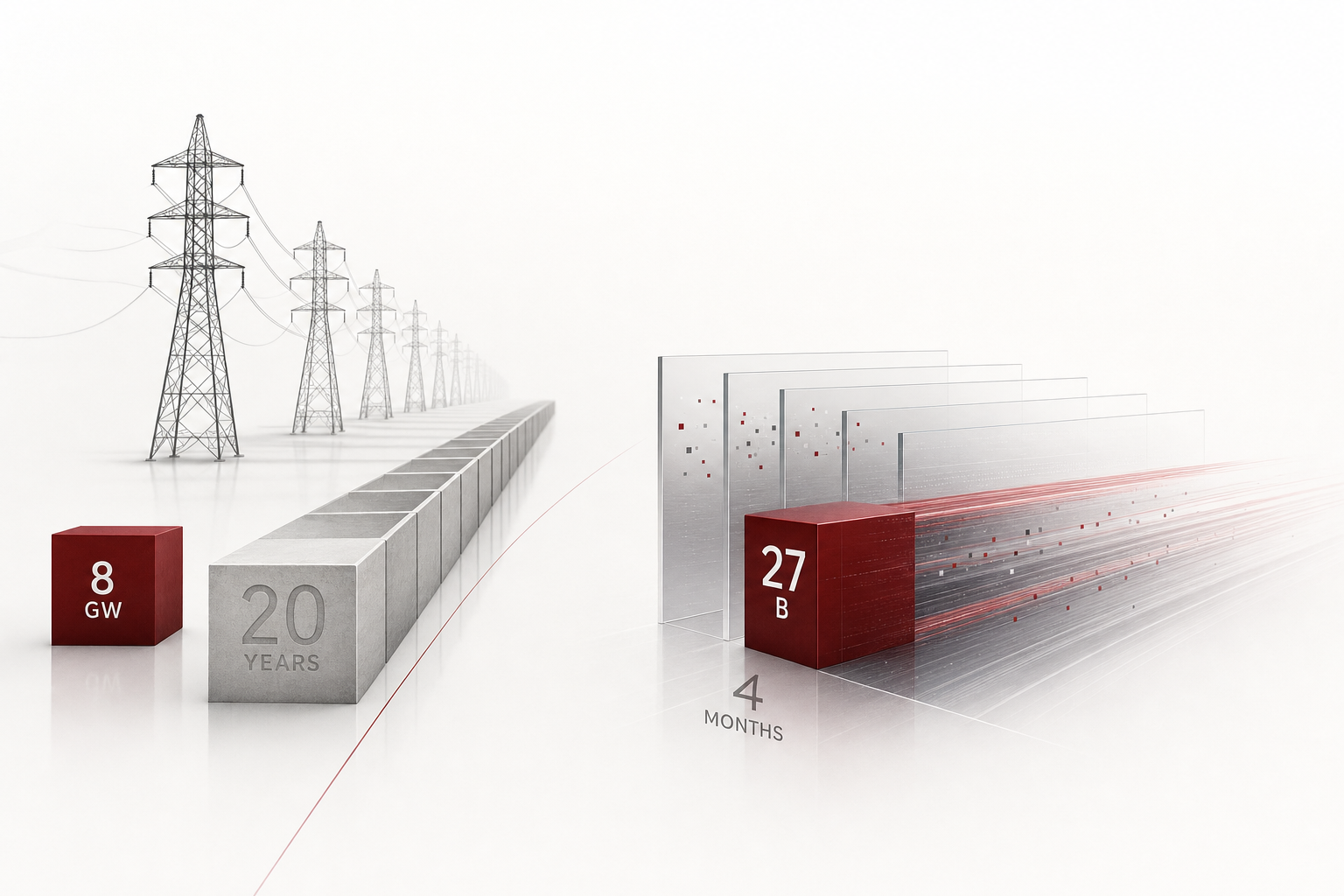 A visual representation of the article’s core concept.
Two Contracts, Same Day
Yesterday brought two pieces of news with opposite characters, arriving side by side. The first: OpenAI signed a 20-year lease with SB Energy to secure roughly 8 gigawatts of IT power capacity at the PORTS-Pike campus. Nvidia scaled back an initial $250 billion proposal and instead backed the structure with a $105 billion guarantee, while SB Energy itself builds, owns, and operates the facility.
The second: Alibaba’s open-weight model Qwen3.8 27B scored 52 on the Artificial Analysis Intelligence Index. It’s being called the first case of a model small enough to run locally landing in the same tier as the industry leaders.
The two stories are written on different clocks. The unit on the first contract is 20 years. The time it took the second story’s model to displace the previous generation was a little over four months. The industry as a whole has one foot planted in a 20-year commitment and the other in a model market that reshuffles every quarter.
The Math Behind Buying 8 Gigawatts in 20-Year Terms
It isn’t hard to see why large campus deals are getting restructured around power, leases, and guarantees. GPU generations turn over every three years, but substations, transmission grids, and cooling infrastructure can’t be built on that timeline. Once the bottleneck moves from the chip to the electricity, contract terms stop tracking chip lifespans and start tracking power-plant lifespans.
The structure worth noting is that SB Energy builds, owns, and operates the facility. The party consuming the compute isn’t shouldering the capital expenditure directly; it’s converting that into a long-term usage commitment instead. Nvidia’s guarantee sits in the middle of that arrangement, shifting the credit risk one more step. The fact that the initial proposal shrank from $250 billion to $105 billion is itself a signal that structures like this can still change shape substantially during negotiation.
There’s a fork here worth naming. Locking an 8-gigawatt-class campus into a 20-year term makes sense for hyperscale operators, but for most companies it was never on the table to begin with. That raises the relative value of regional execution environments sized to what’s actually needed, when it’s needed. The bigger these headline contracts get, the more practical the question becomes: how do you get the same work done without being party to one of them.
The problem is that commitments built this way don’t show up cleanly on a balance sheet.
$3 Trillion Off the Books
Another story from the same day put a fine point on exactly this. Nine major tech companies, including Nvidia and Broadcom, have accumulated roughly $3 trillion in AI-related obligations, three times the amount officially reported as debt. That figure includes $1.2 trillion in unconditional commitments, and a substantial share of it sits outside standard financial statements.
I’m not going to call this a bubble outright, because demand-side signals are strengthening in parallel. Anthropic’s revenue run rate has surpassed $65 billion, a 7x jump, and the company is reportedly preparing for a fall IPO. Enterprise budgets allocated to AI are themselves getting larger, so it’s hard to argue that supply-side commitments are floating on nothing.
Still, the implication for buyers is clear. If a supplier is carrying 20 years of fixed cost, that cost gets reflected in pricing one way or another. And a supplier that needs to recover fixed cost has every incentive to lock customers into long-term commitments. It’s safe to expect long-term commitment clauses to show up more often at the negotiating table in the years ahead.
The Day a 27B Model Hit 52
Back to the other side of the story. An open-weight 27B model reaching a frontier-level score means more than a leaderboard ranking. If fewer parameters can handle the same task, that task now costs less to run, and that reduction didn’t come from negotiating with a model provider. The technology itself produced it.
A change on the context side layered on top of this. OpenAI updated Codex so that ChatGPT account holders, not just API accounts, can now use GPT-5.6 Sol’s 1-million-token context window. This is the first time a memory budget this large has opened up to a regular consumer account rather than an API account. It’s a signal that agent designs carrying an entire long work context around with them are becoming the default rather than a specialized choice.
That said, a single leaderboard score shouldn’t be read as a wholesale replacement for every task. There’s still a wide territory these metrics don’t capture, and in real work, models with identical scores fail differently depending on the domain. Even so, the direction is clear. A significant share of work that used to be reserved for top-tier models only can now move down to models running in your own environment, and that boundary keeps shifting.
Put the two threads side by side and the picture sharpens. On one side, execution environments are hardening into 20-year contracts. On the other, the set of choices for what runs where keeps expanding every quarter. The combination that looked optimal this year and got pinned down as a standard has a lower-than-you’d-expect chance of still being optimal next year.
Why the Routing Layer Sold for $7 Billion
Seen against this backdrop, the news that Stripe acquired the AI model marketplace OpenRouter for over $7 billion reads differently. That’s a 5.4x jump in valuation from May, and what the payments company paid for wasn’t a model or GPU capacity. It was the layer that decides which request gets sent to which model.
Back when there was only one option, routing was treated as plumbing. Now the field runs from 27B open models all the way to top-tier frontier models, each with its own performance and price point, and the right answer differs by task. Using a top-tier model for document classification is wasteful; using a small model for complex multi-step reasoning invites rework costs. The market has now priced in, in dollar terms, the fact that the layer automating this judgment call is itself the margin.
And a layer like this rarely comes back down once it settles into place. The moment a payments company buys the routing, the decision of which model to use ends up living in the same place as your billing system. What matters later, when you want to fold in a different decision criterion, is whether that decision-making authority still sits with you.
Who Owns the Execution Layer
Another story pointed at the same trend. Cursor opened an early beta of Origin, a service that hosts and manages code repositories for paying customers, and the industry is reading it as GitHub’s first direct competitor.
A company that built a coding agent has now moved down into the repository layer, and the reasoning isn’t hard to follow. For an agent to do good work, the code, history, and review context all need to sit in one place, and if that context lives on someone else’s platform, your product’s ceiling ends up tied to someone else’s API. This is a case study in how whoever owns the execution layer eventually expands both up and down the stack from it.
For a company evaluating this, it comes back to the familiar tradeoff between convenience and lock-in. When one vendor bundles editor, repository, and model together, adoption gets easier, but once your work definitions get stored in that vendor’s format, switching costs pile up quietly. It’s exactly the same structure as the routing story above.
The Moment Data Provenance Becomes a Contract Term
One more story deserves a mention. A journalist and a rare-book dealer tracked shipments with an AirTag and reported that Amazon had been buying rare books, shipping them to the LAS8 warehouse in Las Vegas, and feeding them into a training-data pipeline at an undisclosed facility called VGT3. The report also states that the physical books were destroyed in the process.
None of this is technically new, but for a procurement team, it changes the calculus. Models that can’t prove the provenance of their training data are finding it increasingly hard to clear adoption review in regulated industries. Data lineage is about to become a formal line item in model selection criteria, alongside performance and cost.
This connects directly to the rise of open-weight models discussed above. A model trained or fine-tuned on your own data in your own environment can prove its own provenance. Now that the performance gap has narrowed, expect this provability to become a variable that overturns adoption decisions more and more often.
Designing Around a Mismatched Clock
Bringing all of this together, today’s task boils down to one question. In an environment where infrastructure gets fixed for the long haul while intelligence keeps changing fast, how do you keep the rigidity of one side from consuming the flexibility of the other?
The answer is to decouple the layer that runs your work from the infrastructure contract. This is exactly why ThakiCloud designed Paxis as an Agent-Native Cloud. Paxis treats Skills, Tools, Policies, and Audit Logs as first-class resources, and CostRouter owns model selection on a per-task basis. It’s a structure that lets the decision of routing a task that a 27B open model can handle there, and reserving upper-tier models for the segments that genuinely need finer judgment, happen without a human hard-coding that choice every time. If the model market flips again, what needs to change is the routing policy, not the work definitions.
Deployment location follows the same principle. Paxis runs identically on sovereign environments and on-premise Kubernetes, so organizations with strict data lineage or sovereignty requirements can keep the option of running their own models in their own environment. This is paired with L0-through-L3 autonomy governance, policy gates, audit logs, and isolated sandboxing. Regulatory review requires being able to trace back what an agent actually did, and that requirement doesn’t go away just because the model generation changed.
Today’s Takeaway
An 8-gigawatt, 20-year contract and a 27B model that rattled the leaderboard in four months are two faces of the same industry. There’s no need to declare one of them wrong. What’s worth checking right now is which of these two clocks your organization has tied itself to.
Commit to infrastructure for the long term, but keep the execution layer swappable. That is the most practical takeaway today’s news offers.
References
This article was compiled from the following news sources.
- HuggingNews, Nvidia Backs OpenAI Ohio Campus With $105B Guarantee After Scaling Back $250B Proposal
- HuggingNews, Stripe Buys OpenRouter for Over $7 Billion in 5.4x Valuation Leap Since May
- HuggingNews, Alibaba Qwen3.8 27B Matches GPT 5.6 Luna Performance in First Local Model Frontier Score
- HuggingNews, Amazon Buys and Destroys Rare Books to Train AI, First Reveal of Secret VGT3 Hub
- HuggingNews, Cursor Launches Origin Hosting for Paid Users, First Direct Competitor to GitHub
- HuggingNews, Anthropic Revenue Run Rate Tops $65 Billion in 7x Jump Ahead of Fall IPO
- HuggingNews, OpenAI Opens 1 Million Token Sol Context to Codex ChatGPT Users First for Non API Accounts
- HuggingNews, Nine Tech Giants Rack Up $3 Trillion in AI Obligations Tripling Reported Debt