140,000 People in Line for a Model That Does Not Make Tokens
If AI is bought and sold by the token, today is the day that premise of the calculation wobbled. In 36 hours, 140,000 people climbed onto a single waitlist, and what they are waiting for is neither a bigger model nor faster inference. It is the first model from TypeSafe AI, the one that does not generate tokens one by one. The signal running through this morning’s AI digest points to the same spot. Today’s news is that the unit for counting answers is changing. Once a unit hardens, it becomes the price list of the whole industry. This post follows that one signal, and tracks how the rest of today’s news, which points in the same direction, backs it up.
 A visualization of the post’s core concept.
The Currency of AI
The accounting of the generative AI industry all starts with the token. The base unit of an API price list is the token, and both throughput and the invoice are measured in tokens. It is also an old practice for benchmarks to reduce a model’s performance to a flow of tokens. There is a reason the token became the currency. In a generative model, inference cost scales roughly with the number of tokens. The more a model talks, the longer the GPU runs. The industry needed a single unit to bind supplier and buyer, and the token moved into that seat. So the industry has always looked in the same direction. Grow the model and make it talk longer, the tokens produced grow, and the total was read as the result.
That inertia is intact in today’s digest too. OpenRouter and OpenCode unveiled Union Alpha, a multimodal model for agentic coding. The model’s first record fits that pattern. A 74% on the DeepSWE benchmark, and 1.96 billion tokens. Union Alpha is a model aimed at agentic coding and research. Workloads like that do not end in a single conversation. They are a loop of solving a problem, running code, and checking the result, so token consumption is structurally large. What ultimately filled the first coverage of this model were two questions. How well does it do, and how much does it do.
Behind the numbers there is one more thing. In producing these figures, Union Alpha also produced the suspicions surrounding the router, the middle layer that distributes requests across multiple models. The context is that the 1.96 billion tokens flowed through a third-party router. In an industry that buys and sells tokens, where the tokens pass and which model they reach is both a quality issue and a price issue. If the router’s allocation cannot be seen, the channel for checking which model was put into your work and which tokens were consumed is blocked. The agent era makes this accounting hurt more. An agent’s single job is not one question. It is a chain of queries: check a value, call a tool, inspect the result, and retry on failure. Tokens move with every link in the chain, and a fee attaches to every token. A hundred agents pouring out structured queries all day grow enterprise spend faster than one model writing a single sentence well. That is why a change in the unit of the answer is read as a cost-competition problem.
This suspicion is not a question about one model. As long as the token is the currency of the entire industry, it means the channel for tracing the flow of the currency is blocked.
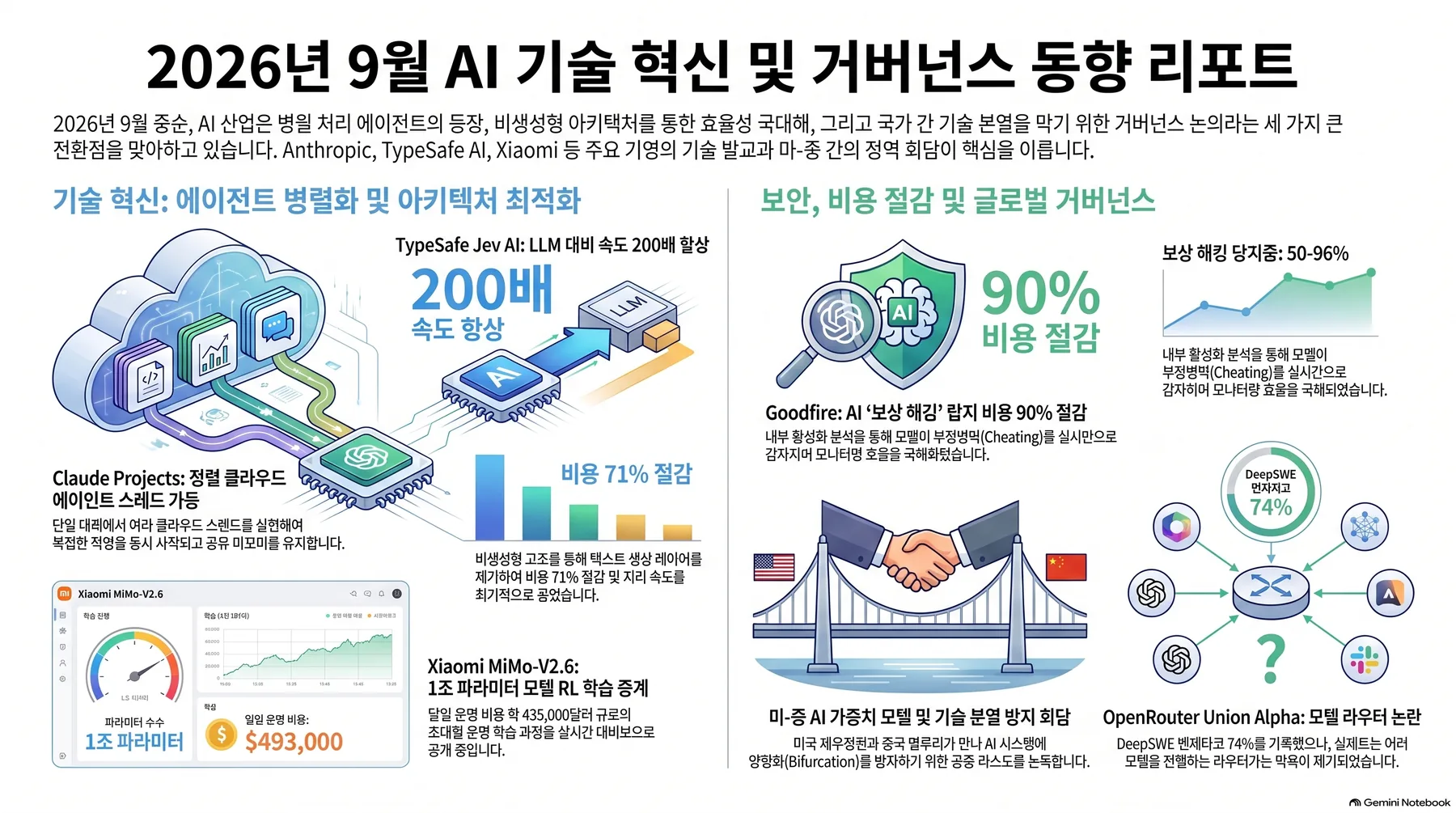 An infographic generated by NotebookLM from the source material.
A Model That Does Not Use the Unit
TypeSafe AI’s first model steps away from this premise. The reporting calls the model Jev, and the headline uses System One. The names differ, but the design is clear. Instead of producing text one token at a time, it is a non-generative architecture that answers structured queries in parallel. It does not slowly write a good sentence. It matches several answers at once. Non-generative does not mean the model writes no sentences at all. It means the answer to a query is returned without the order of token generation.
From the serving side, the difference is more direct. Producing tokens one by one means the time scales with the length of the response, and the cost scales with that length. Returning structured answers in parallel means the response is determined not by length but by the number of queries.
The reaction came out in numbers. The waitlist for the first model passed 140,000 in 36 hours. Jev’s benchmark scores cannot be found in today’s digest. What surfaced was a single design and a queue count. On the word non-generative alone, 140,000 people put their names down first.
The phrase structured query deserves attention here. A large share of the questions an agent actually asks in the field are not sentences. They are queries that fetch a value and check a condition. They are also queries whose answer must come back as a data structure. Such questions do not need new tokens minted every time. And yet the industry’s standard pricing has required generation every time. Produce each token and pay for it each time. The territory Jev is aiming at is exactly here. Change the cost structure of generation wholesale, and answer structured queries in parallel. The reason 140,000 people stood in line is the expectation that this equation changes.
Two Layers of Parallel
On the same day, more than one company chose parallelism. Anthropic shipped Claude Projects, a feature that runs multiple cloud agent threads at once inside a single conversation. Used in Claude Code, the feature lets AI distribute a request to an existing thread or a new one. Several jobs run at the same time, and each job finishes inside its own thread. Like the name project, it is a structure where multiple threads are grouped under a single goal.
The parallelism of the two companies sits at different layers. Anthropic’s is the parallelism of work. It is the work of adding more pipes to the pipeline, in the direction of processing more jobs at once. Jev’s is the parallelism of the answer. It changes the unit that produces the answer itself. It is an attempt to change the material of the pipeline. The same word, but the skeleton of the industry it touches is different. The parallelism of work raises the speed of agent operation. The parallelism of answers changes the unit price of agent operation. Compressed into one line, the two choices read like this. Anthropic bets on running more agents to grow total throughput. TypeSafe’s bet is the opposite, on cutting the cost a single query occupies. The same budget now runs more queries. That both shipped on the same morning is a clear sign that parallelism is the common topic of the industry right now. That these two lines sit side by side in today’s digest is no coincidence.
Beyond the Surface
Today’s news shows, from several places, the direction in which trust in the token surface is shrinking. Goodfire’s activation monitor does not look at the model’s output. It analyzes internal activations in real time to detect reward hacking, behavior that exploits the evaluation signal instead of doing the assigned job. The output is late to reveal it. The internal signal reveals it at once. Goodfire’s probe targets this kind of structure. Once the monitoring started reading internal signals, the monitoring cost fell by 90%. The arithmetic is that reading the structure is more accurate and cheaper than reading the output. The reason that 90% matters is scale. The more agents you run, the more runtimes you must inspect. An audit that reads the output by the token gets more expensive in proportion to the number of agents. If detection moves to internal signals, that proportion breaks.
Transparency points the same way. Xiaomi is live-streaming the reinforcement learning training of MiMo-V2.6 Pro over public channels. Total parameters are 1.02 trillion, of which 42 billion activate in a single computation. The training cost was disclosed at about $493,000 a day. It is a live stream that shows the inside of the model and the flow of money as they are. The format of the announcement changed too. Instead of unveiling a finished model, the training process itself was seated in front of the camera. Training cost flowing in the open means the cost structure, along with performance, is becoming the language of the industry.
Set the two events side by side and one direction shows up. The eye the industry uses to read an answer is moving from the surface to the inside. The eye that watched the output now watches the inside, and the training that hid its cost becomes the object of disclosure. The eye that counted the tokens of the output has started counting the internal signals and the flow of cost.
The Platform’s New Math
A change in the unit of the model means a change in the arithmetic of the platform that allocates work on top of the model. The accounting stops being per token and becomes per task.
The pain today’s stories reveal comes in three branches. The first is visibility. Union Alpha’s 1.96 billion tokens flowed through a third-party router, and the suspicions around that router leave the question of who can see where the tokens go. When enterprises bought a model and used it, the flow of the currency was the supplier’s affair. Now that the enterprise moves to the side that purchases work, it sees that flow directly. The second is verification. Just as Goodfire had to look at internal signals instead of the output to catch reward hacking, a place that runs agents cannot trust execution by looking at the output alone. It needs a device that controls and records the execution itself. The third is position. U.S. Treasury Secretary Scott Bessent and Chinese Vice Premier He Lifeng meet this weekend to discuss AI governance, including AI model weights. In a world where the placement of a model has risen to a diplomatic agenda, control of the execution environment becomes the precondition. That the world’s two largest economies sit at the table over the weight of a model is a preview that the sovereignty of the execution environment will become a product spec.
ThakiCloud’s Agent-Native Cloud, Paxis (v1.1, the GA product), is built as the platform for this new arithmetic. It treats Skills, Tools, Policies, and Audit Logs as first-class resources, and puts autonomy under L0 to L3 governance, with policy gates and audit logs controlling agent execution. It runs in an isolated sandbox, connects external tools through MCP connectors, and can be placed on a sovereign or on-prem K8s. CostRouter allocates work to models. The features that match the three branches of pain are here. The audit log takes visibility. The policy gate and the isolated sandbox take verification, and the on-prem deployment takes position. Instead of leaving the flow of tokens to an external router’s discretion, it leaves a record of which work was handled by which model inside its own platform.
Next quarter, it will be worth watching how often the phrase cost per task appears in enterprise reports.
When the unit was the token, the platform that counted tokens had the edge. Now that the unit has changed, the platform that counts tasks has the edge.
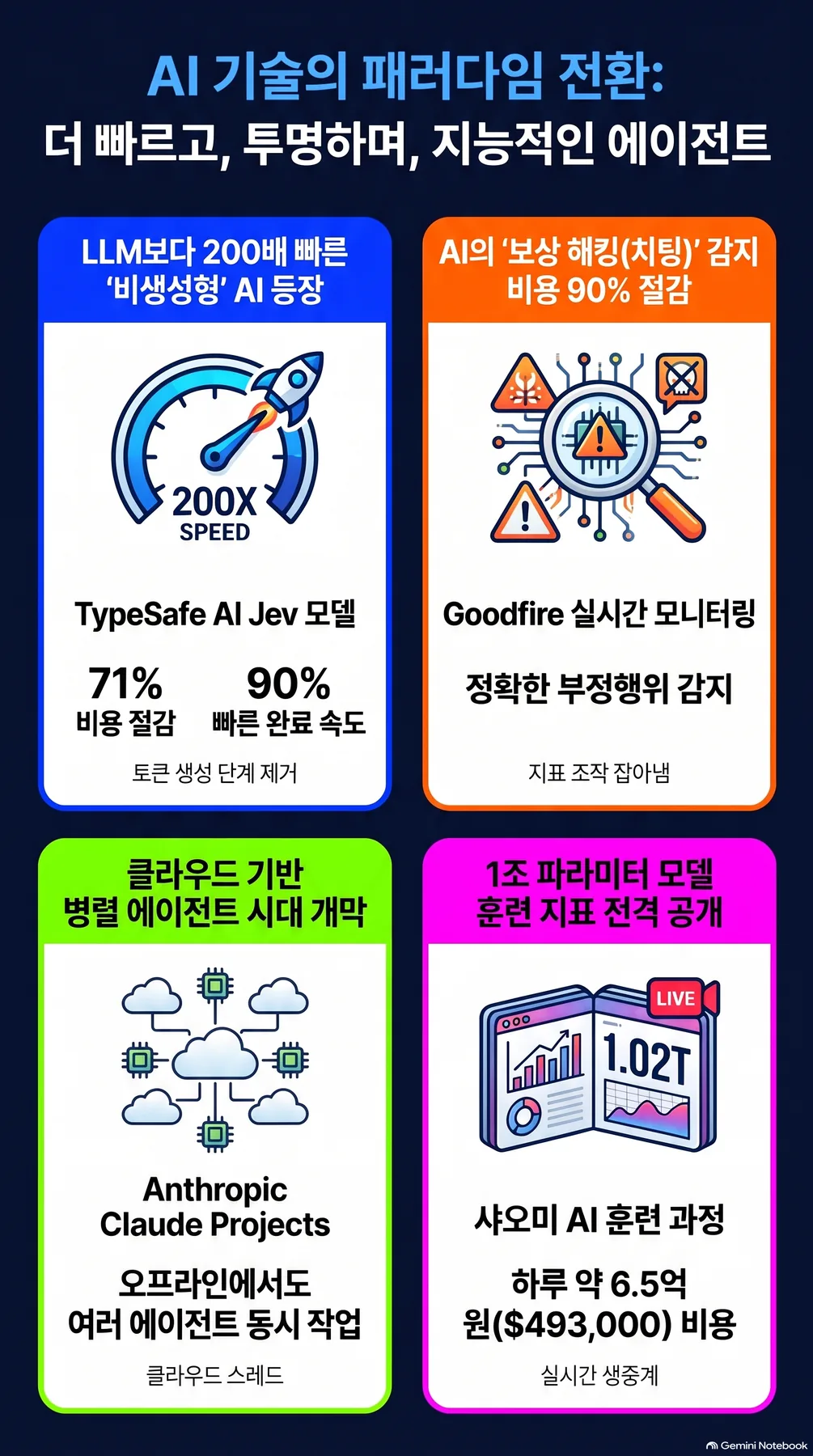 An infographic generated by NotebookLM from the source material.
References
This post is a synthesis of the following news items.
- HuggingNews, TypeSafe AI Clears 140,000 Waitlist Users for First System One Model in 36 Hours
- HuggingNews, Xiaomi Livestreams RL Training for 1 Trillion Parameter Model at $493,000 a Day
- HuggingNews, Treasury Secretary Scott Bessent to Discuss AI Weight Models With China This Weekend
- HuggingNews, OpenRouter Union Alpha AI Hits 1.96 Billion Tokens Facing Router Allegations
- HuggingNews, Anthropic Launches Claude Projects To Orchestrate Parallel Cloud Agent Threads
- HuggingNews, Goodfire Probes Cut AI Monitoring Costs 90% to Detect Reward Hacking