The $0 Decision, a Trillion-Dollar Industry
What is one AI-made decision worth, bought and sold? The answer in this morning’s digest: enterprise AI’s unit is moving from “answers” to “decisions,” and the price of that unit is falling fast. On one side, a decision model is free on an API. On the other, a trillion-scale valuation race is underway. Two price tags set down on the same morning, pointing in exactly opposite directions. Follow the two price tags and you can see the next chapter of enterprise AI. The picture is simple. The most expensive thing and the cheapest thing both hung their price tag on the same morning.
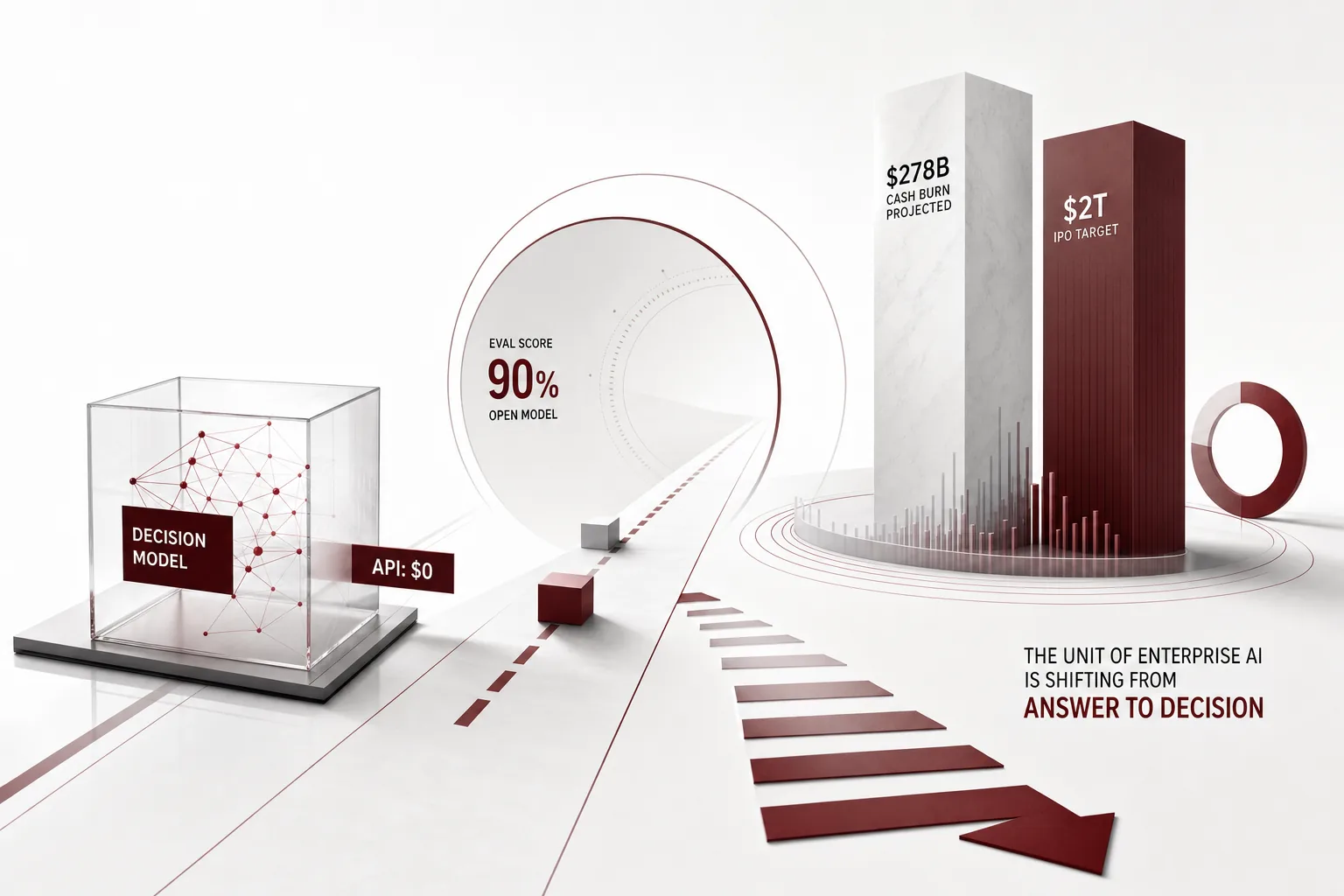 Illustrates the core concept of the post.
The Decision Priced at $0
The first price tag came from Venice. TypeSafe AI’s Jev decision model began being offered as a free beta through the Venice API. Jev is not a chatbot that strings sentences together. It is a specialist model that returns typed answers. It does not dress a conclusion up into a story; it returns the result matched to the type. The fact that the price is 0 is itself a signal that the provider is using this item as an entrance, not a barrier. In a market where a provider keeps something free during the beta period, the position of the price tag becomes the position of the product.
The second price tag came from Bespoke Labs. The company released the open-source framework Nimble. Nimble is a package bundling the model and the data-curation recipe for building a decision agent similar to TypeSafe AI’s. It hit 90% on the Jev eval. In front of the same eval standard, a closed model is free on an API and an open model scored 90%. Two price tags landed on the same morning, and they point one direction. The price of a decision is coming down.
Here is one more line. What Nimble released does not stop at a single model. The data-curation recipe comes with it. What data to select, and in what way, to build a decision agent is all included. In a market where the recipe spreads before the model, the seat of the next competition moves from model performance to data craft. It also means that each company can shape its own decision model for its own work, on top of a public recipe.
Jev is no longer just an eval. It has started to work as a product category. When a decision comes out as a type, you can score it; when it can be scored, you can compare it; when it can be compared, you can replace it. In that process, the price per decision starts to be seen before the brand. Just as benchmark scores were the language of model comparison, a language for measuring decision quality is being born.
When a type is attached, even the cheap side changes. An open-ended answer demands long reasoning every time. A decision is a narrow-range output, so a small, cheap model can fill that range. Here the structure bends, where the cost a model company spends to ship the biggest model was passed straight through to the customer’s cost per decision. The free beta API is also a place to test how far that bend has gotten. The moment a company pulls decisions from a $0 API, it moves from the math of “cost per model” to the math of “cost per decision.” Even the same question gets a different answer when the unit changes.
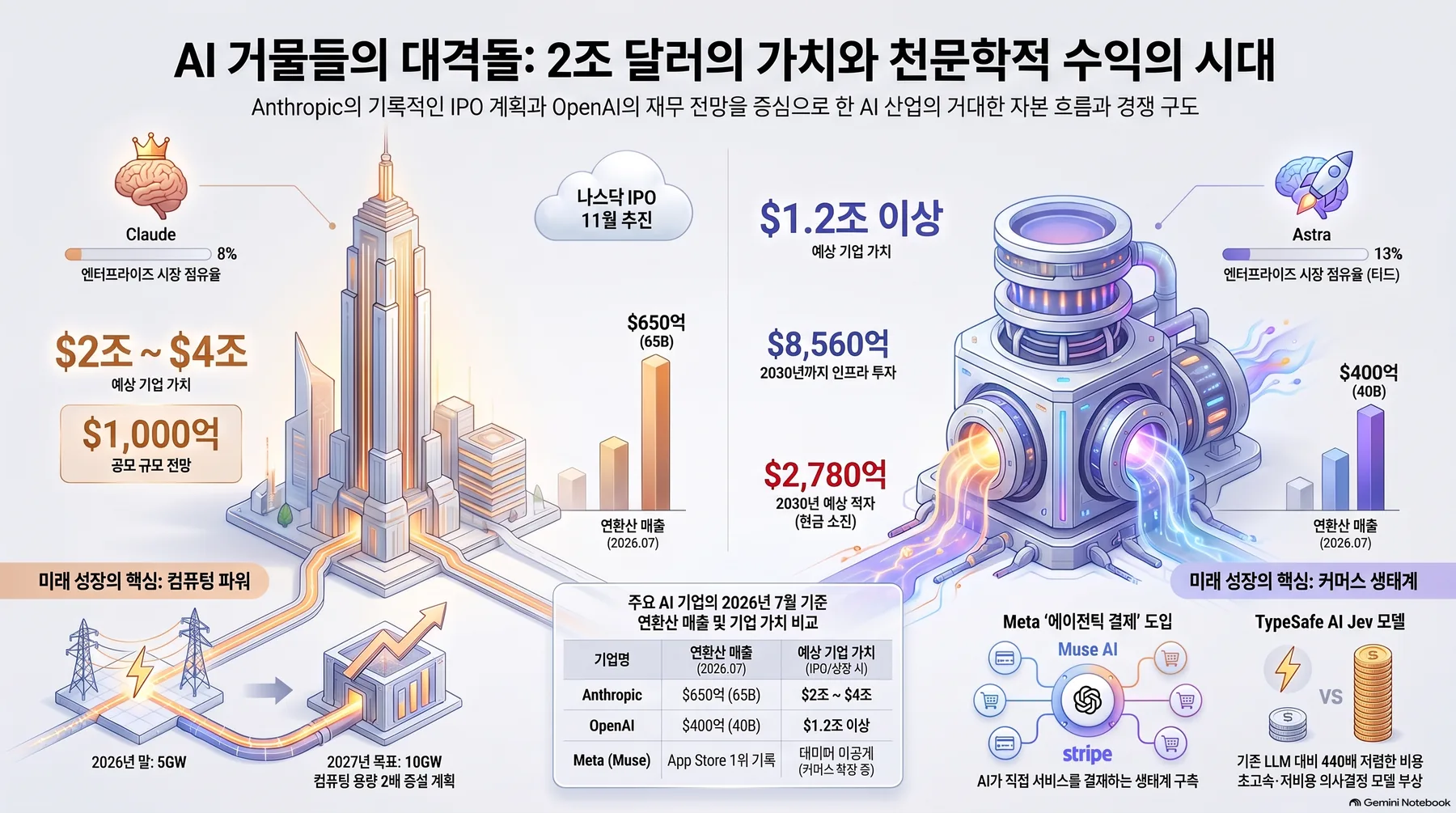 An infographic generated by NotebookLM by synthesizing the source.
A Different Price Tag on the Same Morning
On the other side of the board, money moves in the exact opposite direction. According to OpenAI’s internal financial outlook, cash burn through 2030 is $278 billion. The valuation is $1.2 trillion. The outlook says that because of massive infrastructure costs, current cash on hand will run dry by 2028. That means the biggest model swallows cash the fastest. A burn projection that reaches the trillions shows how much that valuation assumes about future model revenue.
Anthropic runs the race on the other side. Annualized revenue rose to $65 billion in July and is projected to pass $100 billion by the end of 2026. The company is targeting a $2 trillion IPO, which would be the largest ever. It is also considering a new model release to hold enterprise market share against GPT-6 Astra. Reports say it is pushing a November IPO alongside that.
Put the two amounts side by side and you see the difference in business model. OpenAI’s number is the size of a bet on infrastructure. In a structure where the speed at which cash leaves must support the valuation, infrastructure cost sits at the center of the business. Anthropic’s number is the speed of the invoice for usage. In a structure where revenue grows month over month on an annualized basis, customer-side usage is the center of the business. Two branches of a race, one buying future revenue in advance and the other pulling in present revenue, run on the same track.
For a company, this difference arrives as price volatility. The bigger the infrastructure bet, the bigger the wobble in model prices; the bigger the usage billing, the more precise the cost per unit of use. Both leave their mark on the user’s spreadsheet as the number of cost per decision. One side burns cash to grow the biggest model; the other pulls in revenue and goes public. The direction of money is exactly opposite, but the destination is the same. The enterprise market. When two companies run toward the enterprise market, it does not leave only good news for the companies using that market. The more model supply narrows to two companies, the more the risk of price and policy volatility falls to the user. This is the moment a trillion-scale valuation race climbs onto the enterprise buyer’s spreadsheet. With money flowing into models now, one question remains for the enterprise. Does the model stay the final resource, or is it the starting point?
What Gets Expensive When a Type Is Attached
The reason the two price bands split this way is that the two things do different work in the pipeline. The frontier model is a bet on the next capability. Training and inference cost pile on that side, and $278 billion is the number a bet on the biggest model must pay. The decision is an output of the pipeline. When a type is attached to the output, it can be verified; once it can be verified, it becomes evaluable. Once it is evaluable, you can move it to a small, cheap model. The expensive thing and the cheap thing find their places inside the same pipeline.
The moment a decision is verifiable and evaluable, the company’s question changes. From “which model do we rent” to “which model does each decision pass through.” The problem of model choice moves to the problem of decision routing. The number 90% on the Jev eval matters here, because it becomes the seat of routing. The free API is the entrance that lets you try that seat at $0.
The actual shape of routing is setting a decision grade for each task. A contract-review judgment and an inventory-allocation judgment are both “decisions,” but the cost of being wrong differs. Judgments with a large cost get a model with thick verification; judgments with a small cost get a cheap model. When an eval like Jev is the standard, you can turn this allocation into a table of price and quality. Once the table exists, it becomes operations. It is worth reading the 90% score the same way. A model that scores 90% on the Jev eval means it can handle most low-risk judgments on its own. The rest is still handled by the big model. It is a question of composition, not of all or nothing. The bigger the share a cheap model holds in the decision portfolio, the more the whole decision-cost curve bends downward.
Meta news from the same digest fits this configuration too. Meta launched its first Muse connector platform, and third-party developers can now build integrations for the Meta AI assistant. Payment is done natively through Stripe. That means the agent is starting to move into decisions that settle real money. The connector-platform form is the same. Opening integrations to third parties means a decision no longer ends only inside the company boundary. The moment real money’s weight lands on a decision, you can no longer postpone asking who made which decision with what authority.
The Day a Decision Becomes the Unit of Work
In companies that actually use this flow, the unit of work has changed. It is not the model. It is the decision. A platform that governs decisions has a different shape from a platform that managed prompts. The core is recording which policies something passed before execution, and leaving behind who did what with which model when after execution. This record is not an option. It is the operational asset itself.
The pain this morning’s digest surfaces converges on this record problem. The $278 billion burn projection signals that model-price volatility will continue for the next several years. When variance is large, which model a given task uses becomes a cost. A free API and open models mean model supply is not tied up in one place, so the company that secures an alternate path first has the advantage. An agent payment passing through Stripe means each decision needs authority and a record. The three signals ultimately point to the same cell. It means that in the enterprise spreadsheet, model price, decision quality, and the cost of an accident start to be written in the same cell. In a world where model prices wobble, the company that left a document of which model it decided to use when does not get the same invoice twice.
ThakiCloud’s agent-native cloud Paxis is a full product (v1.1 GA) that governs the decision unit. It treats Skills, Tools, Policies, and Audit Logs as first-class resources and governs autonomy as levels from L0 to L3. A policy gate sets a threshold before execution, and an audit log leaves a record after execution. Execution happens in an isolated sandbox, and external tools are connected through MCP connectors and a skill market. It can be put on K8s whether sovereign or on-prem, and CostRouter assigns a model to each task.
The $278 billion cash burn is not distant macro news. It is the future invoice that a company doing decision routing will have to shoulder from model-price volatility. The free decision API is not a promotion either. It is the first sample of starting to price the decision. In a market like this, the seat that settles money last is taken by the platform that can record the price and the policies each decision passed through.
Before the Price Lands
If this reading is right, the enterprise AI market in 2027 will stand in a different shape. The biggest model is the model company’s asset; the decision is the enterprise’s asset. The price of a decision will keep falling. What will not fall is the cost of a wrong decision. The way to catch the opportunity on the falling-price side is to build up in advance the record of the cost that does not fall. The next price tag will not attach to the model but to the platform that records every decision.
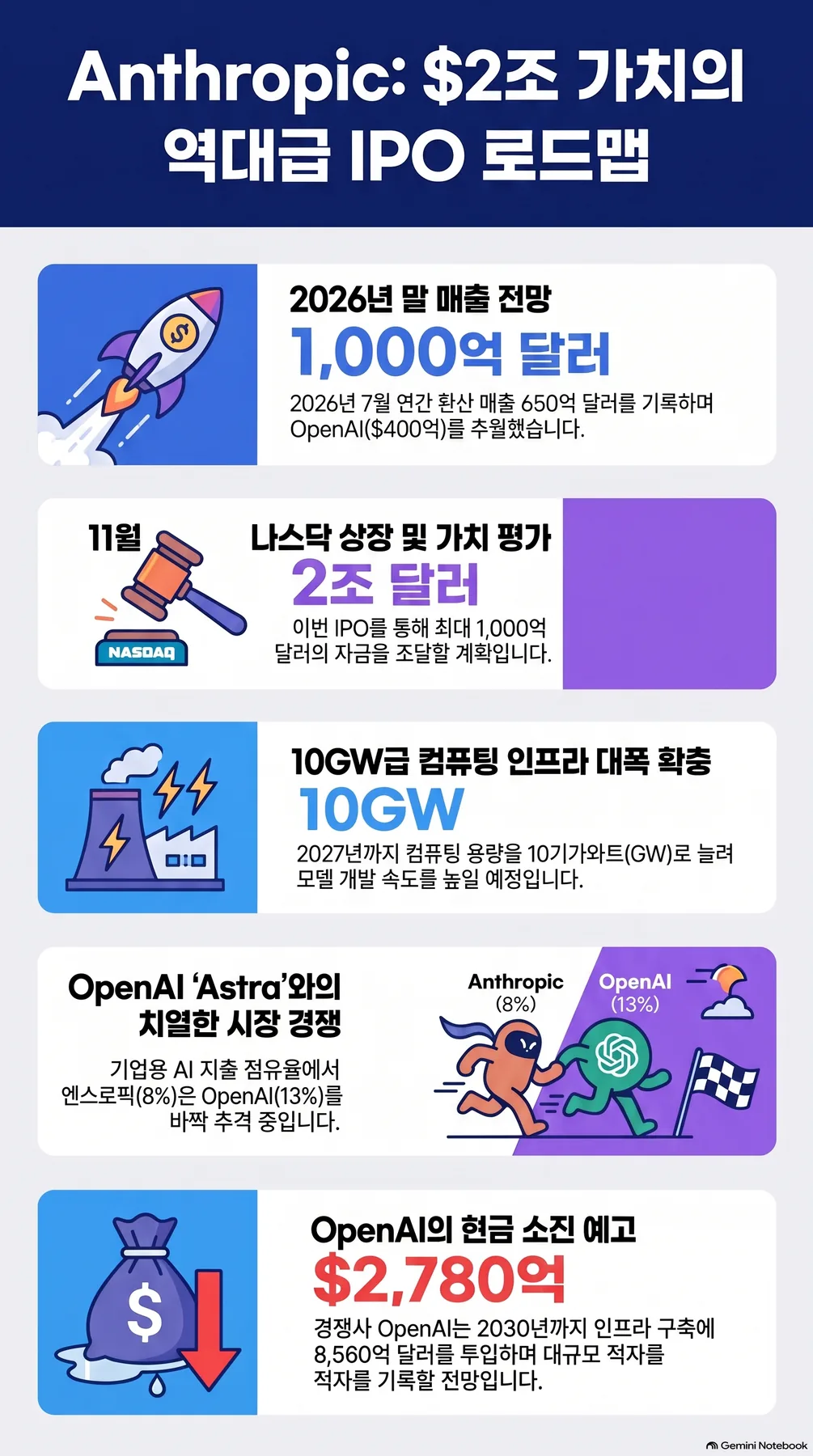 An infographic generated by NotebookLM by synthesizing the source.
References
This post was written by synthesizing the news below.
- HuggingNews, Anthropic Targets Record November IPO and New Model to Combat OpenAI Astra
- HuggingNews, Bespoke Labs Releases Nimble Open Model That Hits 90% on Jev Eval
- HuggingNews, OpenAI Projects $278 Billion Cash Burn Through 2030 With $1.2 Trillion Valuation
- HuggingNews, Meta Launches First Muse Connector Platform With Stripe Agentic Payments
- HuggingNews, Venice Makes TypeSafe AI Jev Decision Model Free on API in Beta
- HuggingNews, Anthropic Targets $100 Billion Revenue Before Record $2 Trillion IPO