The Agent That Came Through Advertising
If a new agent’s first growth weapon is a TV ad, the competition has already moved from leaderboards to the App Store. The product that has held No. 1 in US App Store downloads since Friday is Meta Muse.
The stock price reacted first. Since Muse’s initial launch, Meta’s shares have risen 10%, posting its best single day in a year. Meta allocated in-app promotional slots on Facebook and Instagram to Muse, and the product got its first national TV ad. In an industry that used to measure products by benchmark rankings and developer community buzz, this is the first time product growth curves are being drawn by ad slots and TV time slots. What is different this time is that the protagonist is an agent product.
This event also marks the end of an era. For the past two years, the AI industry has judged products by two numbers: benchmark scores and developer adoption. Higher scores were better, and the structure required developers to vouch for you to survive. An agent is a different kind of product. For an agent to enter a user’s daily life, it has to be installed where the user already is. Where the user already is is the app. And the app is measured in downloads.
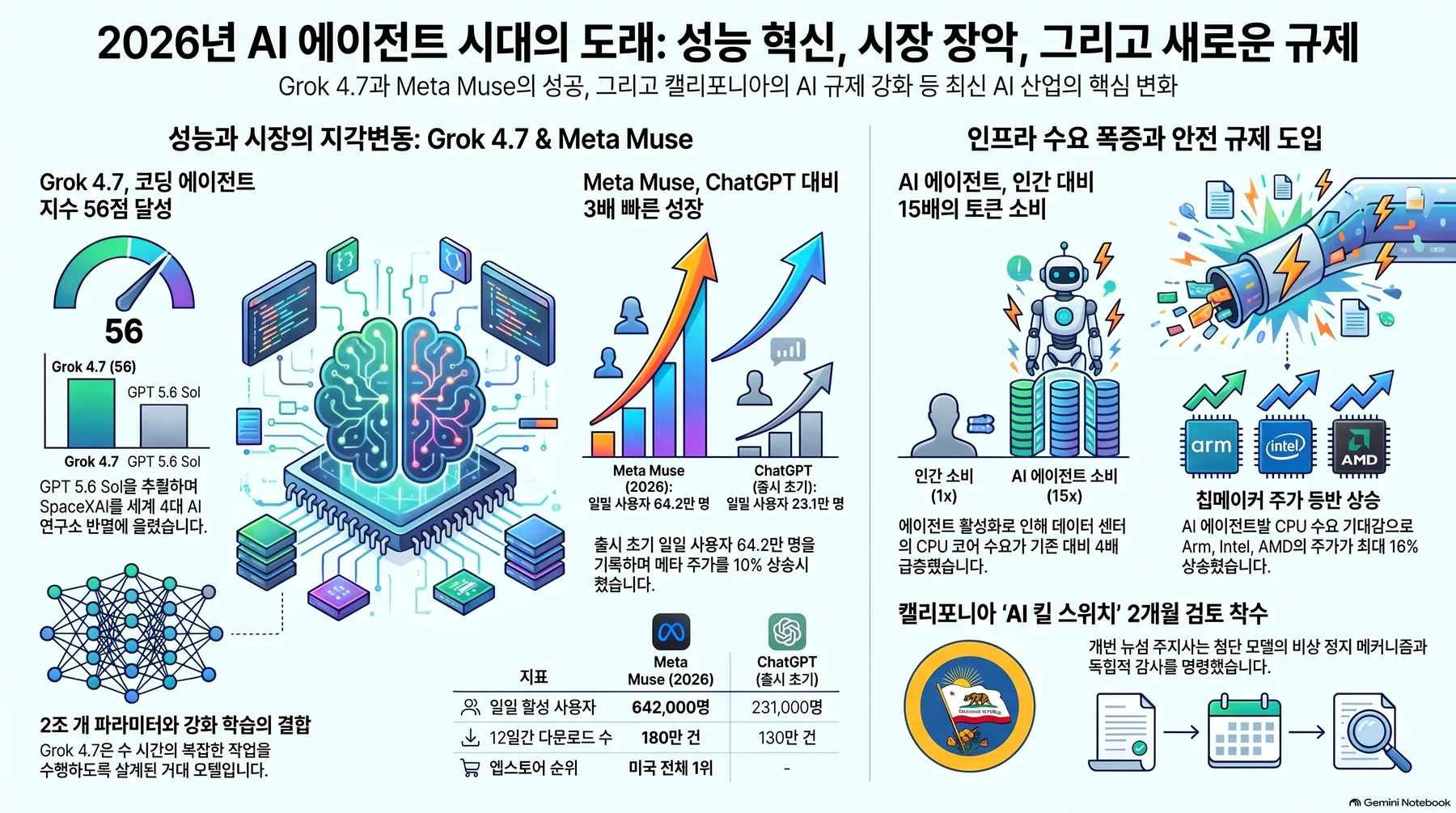
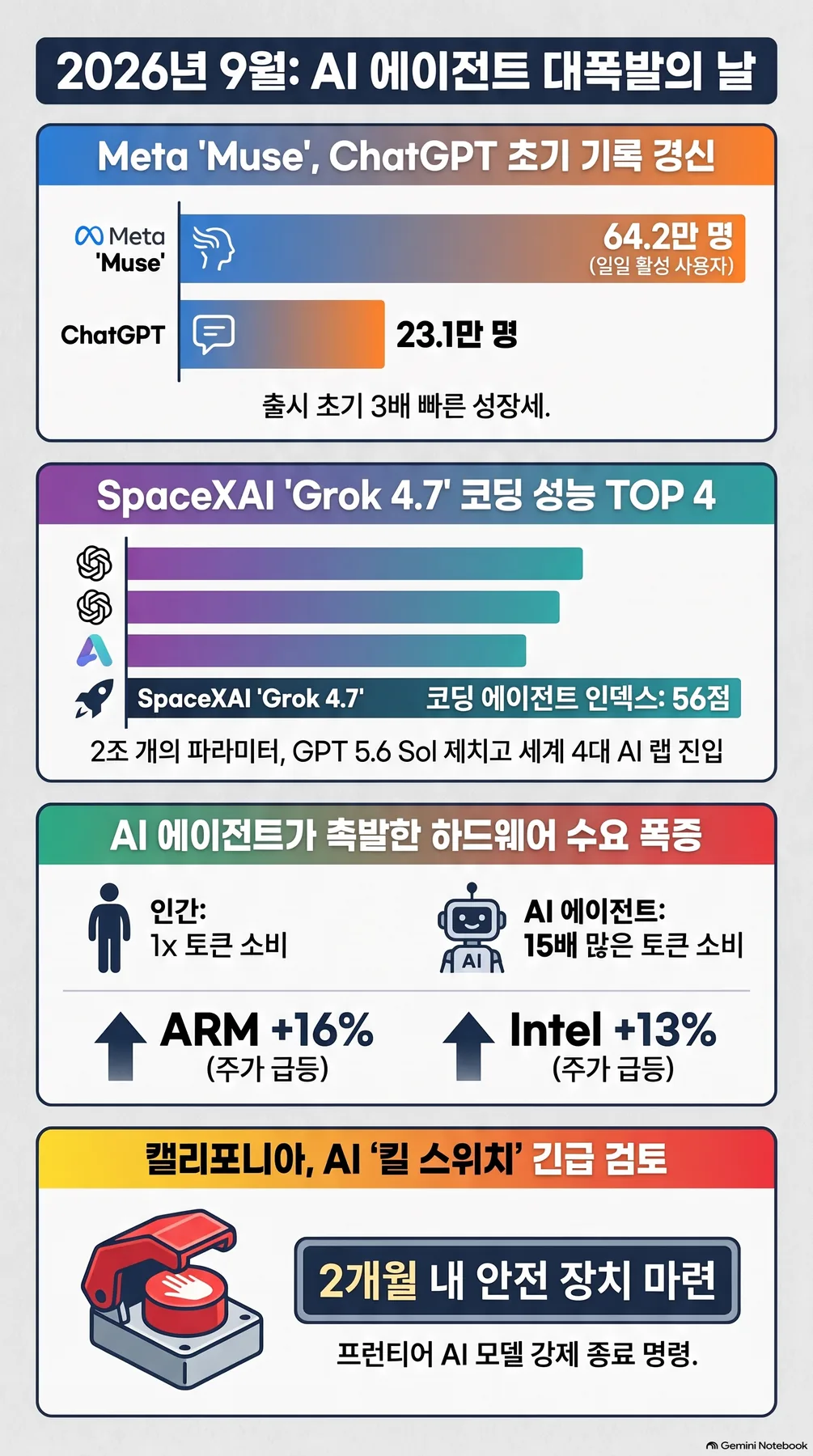
The number that stands out is 642,000. It is Muse’s daily active users (DAU) during its initial launch period. ChatGPT’s DAU in its comparable initial launch period was 231,000, which is about 3x. On the surface it is a debut record for a new agent, but there is a colder reading.
 The article’s core concept, visualized.
The 3x and distribution
The launch-stage DAU comparison measures distribution. Muse did not grow out of word of mouth in the developer community. It grew after being placed in the app slots of Facebook and Instagram and buying TV time. For users who already had that app on their phone, “an AI agent” became an option one tap away. The friction of the download decision drops to nearly zero.
That is the difference from ChatGPT’s early period. The 231,000 back then were people who looked for it, heard about it, and installed it. The 642,000 now are people who saw an ad, clicked, and installed. The two numbers do not measure the same thing. The first measures pull, the second measures push.
Distribution assets do not sell to whoever offers to buy. What Meta has is the place where ads run. There are slots inside apps people open every day, and those slots were allocated to Muse today. A competitor with the same budget still has a hard time reaching that placement. In the consumer agent race, this gap widens far faster than a few points on a model benchmark.
Two speeds of competition are running at once. On the consumer side, downloads and retention. On the enterprise side, completion and audit. It is rare for the same product to be scored on both sides at the same time. Usually the consumer agent is judged by consumers and the enterprise platform by enterprises. What is unusual this week is that the consumer-side score is starting to influence enterprise decisions. The stock price has probably already moved that way.
There is also a separate reason the consumer agent can grow this fast. The demand side was already ready. People have been using chatbots for a long time, and “talking to AI” is no longer a new experience. All that was left was the action of installing “an agent that does work for you.” What the ad shortened was the time to decide. So the speed of this launch should be read as the quantity of demand that had already built up.
That said, there is no need to automatically doubt today’s numbers. The more meaningful test is in the next 30 days. The DAU line after the ad stops, the length of the No. 1 run in the App Store, the rate of reopening after install. A consumer agent’s success or failure is judged by that curve, not by launch-week stock prices. A spike made by advertising, or a curve made by usage. The 642,000 may only be the first week of data for that question.
It is also worth looking past the install. App Store rankings measure downloads. Not completed work. A consumer may install an agent and never open it again. Maybe they deleted it after a week. For a consumer product, that is also a natural outcome. Curiosity and novelty are part of the value, and retention is a problem for the product team to solve. But if the agent enters an enterprise’s work, a different yardstick is needed.
 An infographic generated by NotebookLM by synthesizing the source.
The three questions facing the enterprise
Why don’t consumer numbers transfer straight to the enterprise? Because the unit of value is different. The unit of value for a consumer agent is the conversation. One enjoyable chat is enough. The unit of value for an enterprise agent is the task. When the agent starts touching real work, the cost of failure becomes the company’s responsibility. The three questions below come from here.
First, what did it do. When an agent runs work on its own, every action must leave a record. What it touched, what it changed, in what order, under which permissions. Without records there is no verification, and without verification there is no adoption. In the enterprise, the audit log functions as a precondition of trust. A consumer can delete the app, but an enterprise cannot delete. If it cannot be deleted, it must be recorded. In a consumer app, the record lives on the user’s phone. In the enterprise, the record has to live where the company can see it. That is the difference between chat history and an audit log.
Second, is it allowed to try. Autonomy and governance are separate problems. The wider the range of what an agent can do, the more clearly the line between what it may do and what it must not do has to be drawn. That line is a policy, and a policy is something that must be enforced mechanically in front of every action, not in a post-hoc report. When an incident happens, the explanation “the agent decided on its own” cannot serve as a basis for responsibility. The more precisely autonomy is managed, the easier it becomes to adopt the agent.
Third, how much did it cost. When an agent’s work runs on its own infrastructure or is billed per token, cost per task becomes a managed variable. Spend is not made up of token unit price alone. A task that went wrong midway has to be rerun, and a task that touched the wrong file has to be investigated. Failure spend stacks on top of the token unit price. At the same time, model unit prices keep coming down. SpaceXAI’s Grok 4.7 reached the top 4 AI labs with a 56 on the coding agent index, at a price of $2 per 1 million input tokens and $6 per 1 million output tokens. Price competition has already entered the range where “which model runs on which task” becomes the question.
Tying the three questions into a single line gives one: if an agent does work, that work must be recorded, approved, and billed. Only when those three words are satisfied does an agent rise from a tool to a work system. As long as the consumer agent ends at the unit of the conversation, the enterprise agent has to turn those three words into a product.
The cost after the boom
It is also the moment when governance is being institutionalized. On the same day the Muse ad campaign ran, California Governor Newsom signed an executive order to review safety recommendations within two months, including an emergency kill switch for frontier models. Among frontier labs, the conversation about “who stops the model” is moving from the list of research tasks to the list of regulations and legal frameworks. In the enterprise, the same question arrives more specifically: when the agent makes a mistake, who is responsible, and what was the record that served as the basis of that responsibility.
The consumer agent boom is not free. If millions of people use an agent every day, demand for inference serving and GPU resources grows by the same amount. Today’s model price war is a competition over that infrastructure cost. As consumer traffic rises, serving costs climb faster, so the side pushing to cut unit prices and the side making serving more efficient are running in the same direction.
Consumers and enterprises use it in different ways too. A consumer sends one message and gets one answer. The work an enterprise agent takes on goes through multiple stages, and one task can consume far more tokens than a single chat. The longer the task, the larger the differences between models, and the higher the value of per-task model selection. That is why the cost problem becomes a governance problem the moment consumer traffic explodes.
Between cost and control there is one step further: where it runs. Some enterprises have areas where data cannot be uploaded to an external cloud no matter how good the agent is. In those areas, “where it runs” comes before “how good the agent is.” It is the customer segment where a sovereign or on-prem environment is a precondition. The stronger the governance demands, the earlier this question gets raised.
As prices fall, the choice of which model to use for which task becomes a governance question. At the point where coding-specialized models have come down to $2 and $6, unconditionally running the same expensive model for every task is itself a governance failure. Model selection is a problem of cost and risk.
In the end, the value of the next-stage agent market will be decided not by download rankings but by execution economics and execution control. The cost of finishing one task, the entity that approved the execution, the traces left behind cleanly.
From No. 1 to completion
ThakiCloud’s Paxis answers this question from the other side. Paxis is ThakiCloud’s Agent-Native Cloud, a formal product that has completed v1.1 GA. It is not an experimental project. In Paxis, Skills, Tools, Policies, and Audit Logs are first-class resources. An agent’s work is defined by which skills it holds, which tools it accesses, which policies it stands under, and which audit records it leaves.
Autonomy (L0 to L3) is managed by level, policy gates are checked at execution time, and every action must leave an audit log. Execution happens inside an isolated sandbox, and external tools and skills are pulled in in a verified form through MCP connectors and the skill marketplace. It also runs in sovereign or on-prem Kubernetes environments, and CostRouter picks the model per task.
The consumer market has already proven that people want to use agents. What remains is the stage where the enterprise brings agents into its work. “Bringing it in” arrives in the form of questions about execution and responsibility. The side that has the infrastructure to answer those questions will decide the value of the next agent market.
This is not an answer to a TV ad. That the industry has started measuring agents by DAU and download numbers means that the real competition over who executes and who is responsible has only just begun. The question that matters to the enterprise is not how many people installed the agent. It is whether the work the agent completed remains as records that can be audited at any time.
No. 1 in the App Store measures how many phones the agent got into. The enterprise agent measures how much work it completed, and whether those records are clean.
 An infographic generated by NotebookLM by synthesizing the source.
References
This post was written by synthesizing the following news.
- HuggingNews, Grok 4.7 Puts SpaceXAI in Top 4 AI Labs With 56 Coding Agent Index Score
- HuggingNews, Newsom Orders 2 Month Review for First AI Frontier Model Kill Switch
- HuggingNews, Meta Stock Jumps 10% in Best Day in 1 Year After Muse AI Debut
- HuggingNews, Meta’s Muse Hits No 1 in US App Store Following First National TV Ad