The Morning the Black Box Myth Ended
“Black box” was the most confident descriptor we had for AI over the past decade. This morning, it became outdated. Research on trillion-parameter-scale models has confirmed that the tangled knots of neural networks are far simpler than the scientific consensus once held. Half of the phrase “we do not know what happens inside” turns out to have been a misunderstanding. The black box is opening. And this change does not end with a single research result. On the same morning, the signal that organizations are opening their doors arrived alongside the signal that readable models are pouring out. The question companies will face next moves from “do you understand it” to “where and how do you run that model.”
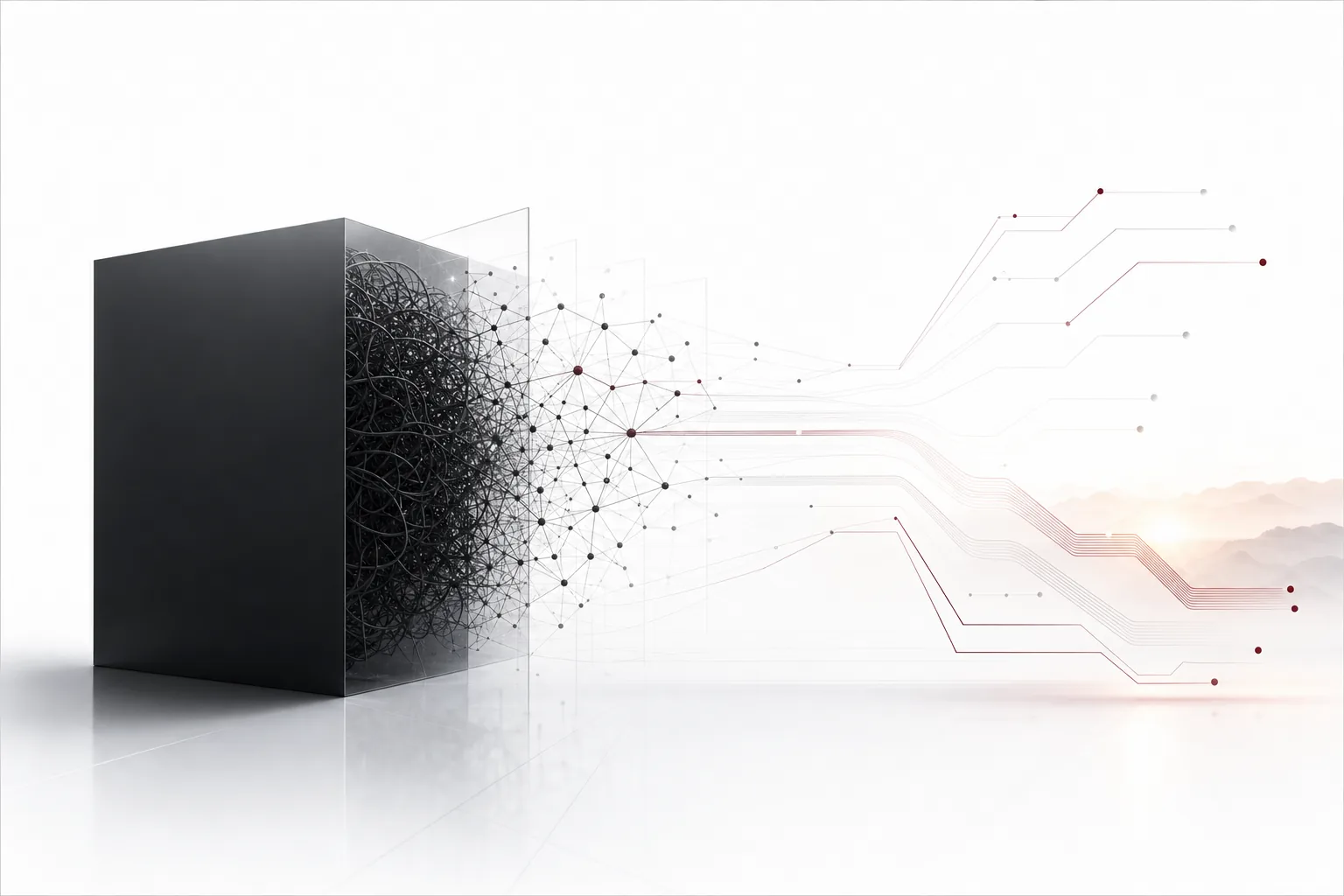 Visualizing the core concept of the article.
The Tangled Knot Was Simpler Than We Thought
The starting point is the research of Nick Cammarata, an AI interpretability researcher. The existing academic consensus held that the internal weights of neural networks were like what is called tangled knots. On the premise that the information is too much and too intertwined to read any single point, the term “black box” has been in use for a decade.
The recognition that the inside could not be opened was also the starting point of the safety debate. If a model cannot explain why it gave a certain answer, the grounds for trusting that answer weaken, and weak grounds slow down deployment. The black box was a property of the technology, but it was also a constraint that shaped how organizations made decisions.
But the result of this research is different. Analysis of models with up to one trillion parameters confirmed that the tangled knots inside are far simpler than the prior scientific assumption. This is a confirmation that the inside of AI models can be read, that is, a confirmation of legibility. It also overturns the existing academic consensus.
This is not an incremental improvement. It is a story that the knot itself was shallower than we imagined. The object that carried the “black box” descriptor for a decade is now having the premise of that descriptor itself refuted. It has newly been confirmed that the inside is open.
The Questions Legibility Changes
The questions built on the premise that the inside cannot be read must be rebuilt. The first to shake among them is safety. For a while, “we do not know what the model is doing inside” was a defensive sentence. When an incident happened, “we could not know the cause” became the last argument. But once the inside starts to become readable, that argument no longer holds, because “we did it because we did not know” no longer remains as the final word.
What takes that place is the question of engineering. In what state does the model make what judgment, where does that judgment deviate, and when it deviates, what does it use as a reference. Legibility moves the safety problem from the seat of philosophy to the seat of engineering. When what could not be understood becomes understandable, what remains is how to control what has been understood.
The second to shake is the cost of error diagnosis. If errors are mixed into a model’s output, finding the cause of those errors had been close to impossible, because when the inside cannot be read, the only option was to guess from the result alone. The cause of errors becomes an object of verification. This is exactly where the cost of evaluating reliability goes down. Knowing what was wrong with a given model puts you in the position to choose whether to reuse it, fix it, or take it down.
The third to shake is the speed of decision-making. In the black box era, adopting a new model always meant carrying uncertainty. As long as the inside could not be read, the time it took to judge whether a model fit your work had to be long. The moment legibility appears, that judgment becomes a matter of quick verification. Choosing a model changes from waiting on the act of trusting a model to the act of getting to know a model.
Organizations Are Opening Their Doors Too
Opening does not happen only on the research side. On the same morning, Anthropic granted employee-level access to six METR evaluators. The METR team now enters Anthropic’s internal systems and frontier models with the same authority as Anthropic’s own risk assessment staff. The purpose of this access is an independent safety audit.
This is a movement in which the organization hands the key to a third party. It lets an outside person look into the inside. The internal legibility confirmed in research and the external access the organization allowed point in the same direction. The inside of AI is opening from the domain of research to the domain of operation. After becoming able to read the inside, the practice of looking into the inside together is now taking its place.
The form of an independent audit is also worth noting. METR is an institution that has done evaluations from the outside. Here it is a structure that looks into the inside with an internal view and the same authority as an employee. It shows that legibility is extending beyond individual insight to organizational procedure.
The Targets to Be Read Are Already Abundant
The targets this opening applies to are already in a state of oversupply. NVIDIA has released Nemotron 3.5 Super VL. It is an open 120B-parameter-scale agent model, a multimodal system designed to run autonomous agents that natively interpret images, video, and documents by combining reasoning and tool use.
PrismML’s Bonsai 2 is at the other pole. It is a ternary model starting at 0.43GB, aimed at placing advanced reasoning and visual understanding on the smartphone or wearable device itself to reduce dependence on external servers. Meta’s Muse AI is back at 816B-parameter scale; the Muse Spark Open system provides a one-million-token context window and is designed for complex software engineering and multi-step reasoning tasks. This release also draws the eye for being announced as part of the first Apple deal since 2017.
When 120B, 0.43GB, and 816B are placed side by side on one page, the question “how big is the model and where is it” naturally steps back. In its place comes “where do we run these models, and for what.” At the point where models become readable, the place where readability has value is the seat of execution. The more models that open their insides, the more important becomes the hand that decides where to place them.
What stands out here is that these three models are open. Nemotron, Bonsai, and Muse all publish their weights. In an age where models with published weights are pouring out, legibility is no longer the exclusive domain of a few researchers. Everyone can now hold in their hands an object whose inside can be read.
The New Division of Labor Made by Opening
Legibility also creates a division of labor in the industry. Before, the work of “making a model” and the work of “using a model” were attached, because the company that made the model knew it best, and that company placed the model best. But once the inside becomes readable, a new seat of “knowing the model” arises between the two.
That seat is the work of reading a model’s internal structure and judging what model fits what task. Both the making company and the using company come to rely on this seat. Legibility is, in effect, adding a new layer to the middle of the industry. The thicker that layer is, the more a capability different from simply “buying a model” or “bringing one in to use” becomes necessary.
This division of labor is also the thread for reading today’s entire digest. It is no coincidence that the day models pour out, the day organizations open their doors, and the day the inside becomes readable came on the same morning. Because once legibility matures, a hand to operate legibility becomes necessary, and the seat where that hand stands is precisely the seat of the platform.
The Day the Black Box Opens, Understanding Becomes an Asset
At this point, ThakiCloud’s Paxis can be brought in as a lens. Paxis is the formal product (v1.1 GA) of Agent-Native Cloud. It handles Skills, Tools, Policies, and Audit Logs as first-class resources and designs governance for autonomy from L0 to L3. It includes policy gates and audit logs, isolated sandbox execution, MCP connectors and a skill market, sovereign and on-prem K8s, and CostRouter, which handles per-task model selection.
Today’s three signals share one outcome. Understanding finally has a place where it is used. Until now, “understanding a model” had remained an achievement of research. The fact that the inside can be read, by itself, could not be used in organizational decisions unless it was decided where to connect it.
Paxis is that connection point. First, it connects to safety. Agents run only inside isolated sandboxes, and every action must pass through a policy gate. Autonomy levels L0 through L3 each define what each agent can touch, and Audit Logs leave every path in a form that can be reviewed again. Once models start to become readable, this gate is no longer a barrier premised on ignorance. It becomes a rule premised on understanding. At the place where the inside is visible, a rule stands that is defined by what is happening inside.
Next, it connects to cost. When Nemotron 120B, Bonsai 0.43GB, and Muse 816B stand side by side, the question is what degree fits what task. CostRouter picks a model per task and mixes model grades within the same flow. Because models are readable and it is known where each degree can be placed, expensive models are attached only where they are needed.
Finally, it connects to sovereignty. Nemotron, Bonsai, and Muse are all open. Because they are open, their weights and execution records can be served and verified inside the enterprise’s own domain, without going through an external API. Paxis’s sovereign and on-prem K8s sets up the whole platform inside the enterprise, letting the enterprise itself decide where the readability happens and inside whose domain, during this period when models are becoming readable.
The black box is opening. The competition that follows does not happen at the seat that argues how smart the model is. It happens at the seat that argues which organization first turned “understanding” into execution that is safe, cheap, and inside its own domain. It becomes the premise of operation.
References
This article was written by synthesizing the news below.
- HuggingNews, Meta Releases 816B Parameter Muse AI in First Apple Deal Since 2017
- HuggingNews, Nvidia Launches Nemotron 3.5 Super VL Open 120B Agent Model
- HuggingNews, Nick Cammarata Finds AI Models Legible Reversing Prior Consensus
- HuggingNews, PrismML Releases Bonsai 2 Local AI Models Starting at 0.43 GB
- HuggingNews, Anthropic Grants 6 METR Researchers Employee Level Access for Safety Audit