The Culling Dividend: When shrinking a self-evolving 2,200-skill registry, which skills you keep determines precision before how many you do, and break-even is set by the operational gate
This post is for Korean cloud/AI engineers who run a self-evolving agent harness with a registry of over 2,000 skills and must decide how to pick out the skills no one uses. The registry edits itself overnight. Skills are born and die, but dead skills keep riding on the index. Every skill on the index, as long as no query routes to it, pays a tax of re-embedding, routing, and serialized catalog payload. ThakiCloud’s analytical paper The Culling Dividend turns retirement into a controlled intervention. At a fixed target size K, it compares usage-ranked culling (removing the least-used first) and random down-sizing (removing the same count at random), and answers two questions: whether it is which skills remain, rather than how many you keep, that determines the retrieval precision of the hybrid router; and at what registry size break-even, where the savings in re-embedding and routing overhead offset the precision loss, arrives. Read it and you will have the basis for how deep, and in what order, you can cut your own registry while still meeting the precision gate.
First, its nature. This is an analytical paper. It reports no new measurements. The census values and the 1,440.3 token bill per decision are real measurements cited from the earlier Skill Graveyard and The Router’s Toll. Every other number in the body is a model prediction under the stated assumptions A1-A5. The two figures are outputs of the same model.
 A visual metaphor for the article’s key idea.
The problem: entry and size and survivors had prices, but the exit side had none
Marketplace-style skill counts have already passed 230,000. The bottleneck is not making skills but selecting them. When an agent grows to the scale of thousands of capabilities, the distractor pool alone reaches tens of thousands. In a self-evolving registry, this growth problem overlaps with a dead-weight term: mass that is unused but still rides on the index. Re-embedding, routing, and catalog payload costs are charged even for skills no one routes to.
ThakiCloud’s earlier research priced three of the four sides of the skill lifecycle. Skill Graveyard measured survivor economics and bounded the graveyard tax imposed by dead mass riding on the index. But it did not run a controlled intervention that actually cuts the long tail. The census 1,285-manifest bulk purge is a mechanical re-indexing event. It cannot price usage-based culling. Mint Frontier priced the entry side: the cost-quality break-even of minting a new skill, routing to an existing one, and declaring abandonment. Selection Break-Even priced the size side: the crossover point where retrieval-based routing beats in-context selection. The remaining side is exit. There was no price on which skills to remove and how deep to remove.
This paper prices that exit. At a fixed target size K, it contrasts three arms (comparison groups). Usage-ranked culling removes the least-used first, leaving the top-K by usage count u. Random down-sizing leaves a K-subset drawn uniformly. The demand-ranked oracle (an ideal arm that knows true demand) leaves the top-K by true demand w. All of it is sealed inside that proxy protocol. The culling and random arms end at the same final size. What differs is only composition (the makeup of the surviving skills). That is what makes this a clean controlled experiment separating “which skills remain” from “how many remain”.
Design: a frozen hybrid router, five assumptions, the same K
The analysis target is an active working set of N = 2,200 skills. The harness census is as follows: 2,287 registry entries, 1,789 live manifests, 2,351 added distinct manifest paths, 1,322 removal events, a 1,285-manifest bulk purge (2026-05-13), 14,749 logged routing events from 2026-06-10 through 2026-09-22, a sealed gate suite of 63 cases, and 49 off-index shelf items. Usage telemetry is the set of logged injection events. Every time the router injects a skill into a prompt, one routing event is recorded for that skill.
The routing stack is a hybrid retriever. It fuses the BM25 and TF-IDF cosine terms over the corpus with equal weight under per-query max-normalization, producing a top-5 shortlist over survivors. The literature has confirmed this configuration stays competitive at skill scale. By freezing the router, composition becomes the clean variable.
The assumptions are A1 through A5. A1 is near-Zipf demand: w_i ∝ r_i^(-α), headline α = 1.1, band α ∈ [0.7, 1.5]. At the headline value, the top 10% of demand-ranked skills carry 79.9% of demand mass. Across the band, that share moves from 45.6% to 96.4%. A2 is rank fidelity: κ is the probability that the culling set matches the demand set, with the rest a uniform K-subset. The prediction band is κ ∈ [0.5, 0.9]. Mechanical noise, such as stale usage spikes or partial observation windows for newly entered skills, is summarized by this single κ. A3 is that the hybrid fusion described above is fixed. A4 is distractor-demand monotonicity: for a query targeting skill i, the expected component-wise score of a skill j with strictly lower demand is lower than i’s, so the tail is filled with weak distractors. A5 is that maintenance cost is linear, C(K) = c_0 + c_1·K. It is metered across four dimensions: re-indexing build time, serialized index bytes, average scoring latency per query, and catalog word count.
| The model formalizes culling as a controlled intervention. The survivor set R_K has | R_K | = K. Precision is r_5(R_K) = Σ_i w_i·p_5(i | R_K). p_5 is the indicator that a query targeting i lands in the fusion top-5. |
What separates precision is composition: the coverage x discrimination decomposition and the culling dividend ΔK(β)
The first result is the decomposition identity (P1). r_5(R_K) = A(R_K)·B(R_K). Coverage A is the share of remaining demand mass. Discrimination B is the average precision conditional on the remaining mass. The gap between arms splits into these two terms.
Two results push discrimination B out of first order on the frontier. The rank-safe lemma shows that if skill j is scored below target i in every fusion component, removing j cannot lower i’s fusion rank. Per-query max-normalization is invariant over the survivor set as long as j is not the component maximum. A vacated slot for j can only move i’s rank upward. The second-order corollary follows from A4: culling removes mostly weak distractors against surviving high-demand targets, so B stays near B_full minus the fusion re-normalization term δ. δ vanishes as the removed tail fraction (N-K)/N approaches 0. The leading-order frontier difference lies entirely in coverage. This is the part that closes the fusion-tax channel. In the fusion-tax literature, fusion is harmful when strong distractors get re-ranked. Tail culling does not reopen that channel.
The coverage sandwich (P2) puts numbers on it. The expected coverage of random down-sizing is exactly E[A_rand(K)] = K/N, for any demand distribution. Under the κ mixture, culling’s coverage is A_cull(K) = κ·H_K/H_N + (1-κ)·K/N. H_K is the truncated Zipf sum, and H_N = 5.9527 at the headline. The expected composition dividend is ΔA(K) = κ·(H_K/H_N - K/N), which is non-negative and 0 only when κ = 0. Usage is a noisy positive signal of demand (E[u_i] is increasing in w_i). Culling does not go below random in expected coverage.
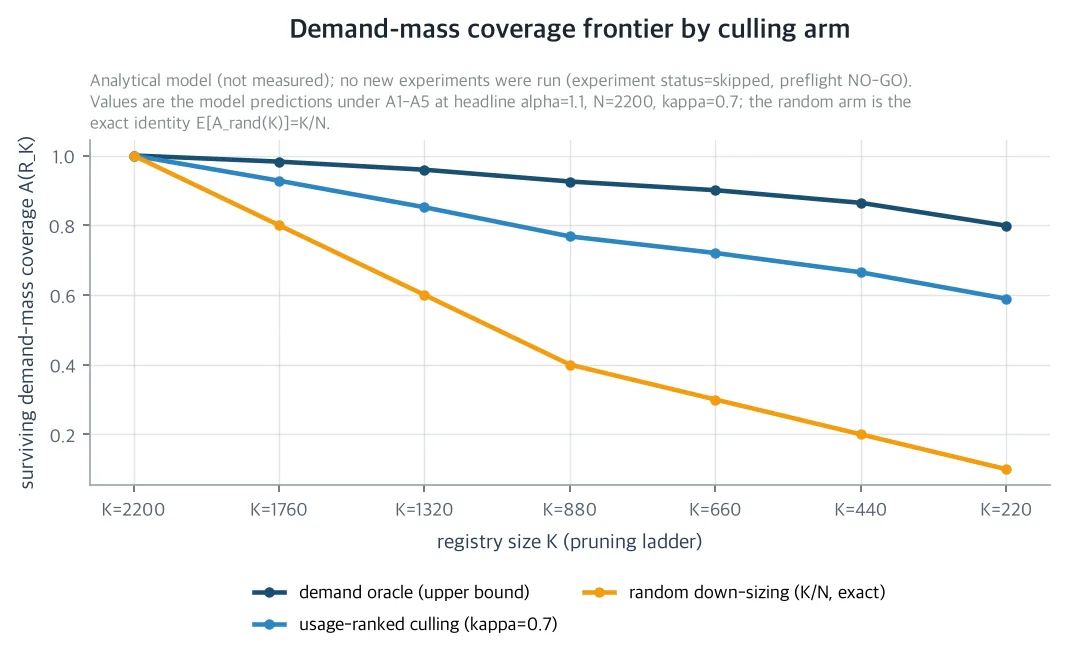 Survivor demand-mass coverage A(R_K) per arm on the pruning ladder K = 2,200 down to 220. At the same registry size, usage-ranked culling (κ=0.7) preserves more demand mass than random down-sizing of the same size (K/N, exact). The demand oracle is the upper bound. A prediction of the analytical model under assumptions A1-A5, not measurements.
Frontier dominance (P3) comes next. The expected precision difference between culling and random is B_full·κ·(H_K/H_N - K/N) + o(1). It is non-negative for every K, and strictly positive when κ > 0 and K < N. With a fixed relative precision budget β (coverage of 1 - β or more), K_arm(β) is the smallest ladder size that meets the budget. The sandwich gives K_oracle ≤ K_cull ≤ K_rand. The culling dividend is ΔK(β) = K_rand(β) - K_cull(β) ≥ 0. Literally: the registry size random down-sizing must maintain is the size usage-ranked culling can afford to drop.
In numbers: at the primary budget β = 0.10, the random arm’s K* is 2,200, meaning no culling meets the budget. The culling arm (κ = 0.7) meets it at K = 1,760, and the oracle at K = 660. The dividend ΔK is 440 at β = 0.10 and grows to 1,100 from β = 0.30 to 0.50 (κ = 0.7). At the deepest ladder K = 220, coverage is 0.5891 for culling (κ = 0.7) and 0.100 for random. At the same size, the remaining demand mass differs by roughly 5.9x. This is where near-Zipf head-heavy mass makes composition the first-order variable of precision.
Break-even depth K_be(ρ) ≲ 100: the gate binds across the entire pre-registered price band
The net benefit of culling down to K is NB(K) = π·c_1·(N-K) - μ·B_full·(1 - A_cull(K)). π is the price per cost unit made of re-embedding and routing overhead, and μ is the price per unit of precision loss, the miss multiplier. Setting ρ = μ·B_full/(π·c_1), solving the marginal condition ∂NB/∂K = 0 gives the break-even depth (P4): K_be(ρ) = [H_N/κ·(1/ρ - (1-κ)/N)]^(-1/α). It exists only when ρ < N/(1-κ). The marginal precision cost of one cull is κ·K^(-α)/H_N + (1-κ)/N, and break-even is where it equals the marginal saving π·c_1.
The binding-gate corollary is the conclusion. Under A1 (α = 1.1, N = 2,200), K_be(ρ) increases in ρ. Across the entire pre-registered price-ratio band ρ ∈ [0.5, 10^3], the break-even depth is K_be ≲ 100 skills, at most 99.94 (ρ = 10^3, κ = 0.9). This sits below the operational precision-maintenance gate depth K* ≥ 220 in every pre-registered budget. As ρ approaches 0+, break-even shrinks to 0. In that limit, economics never binds. Divergence comes only as ρ approaches the no-cull threshold N/(1-κ). At κ = 0.9, 0.7, 0.5, the thresholds are 22,000, 7,333, 4,400 respectively. The pre-registered band does not reach them.
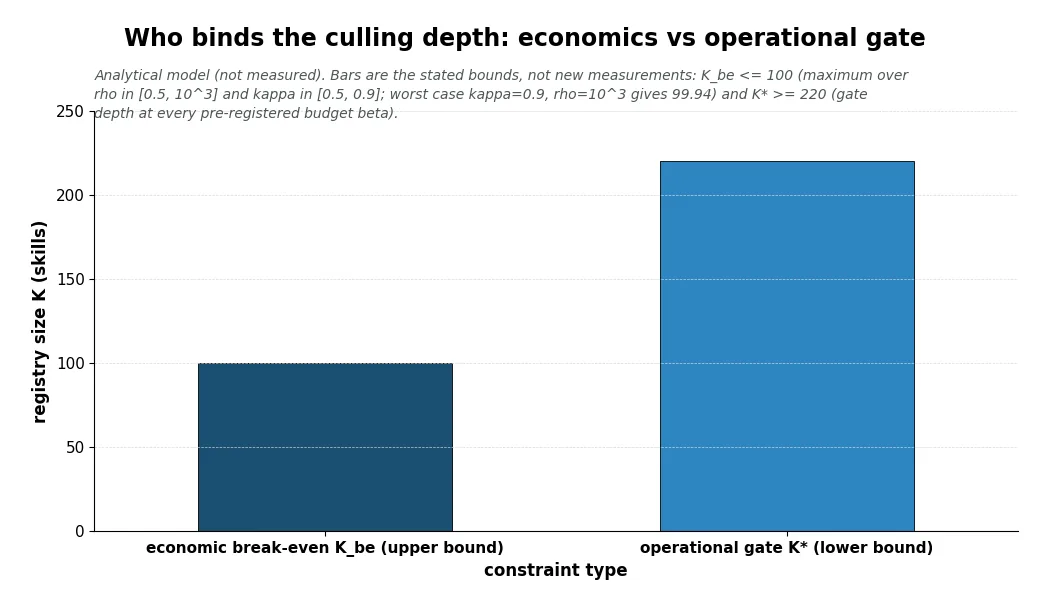 Across the entire pre-registered price band, the economic break-even depth K_be (upper bound ≲ 100 skills) stays below the operational precision-maintenance gate K (lower bound ≥ 220 skills), so the gate is what binds the culling depth. A prediction of the analytical model under assumptions A1-A5, not measurements.*
The mechanism is that even at depths near the gate, the precision loss per cull is small. At the headline κ = 0.7, the marginal loss per cull at depth K = 1,760 is 1.7×10^(-4)·B_full, at K = 880 it is 2.0×10^(-4)·B_full, and at K = 220 it is 4.5×10^(-4)·B_full. As K shrinks, the marginal tail demand mass κ·K^(-α)/H_N grows. The random mixture lower bound (1-κ)/N is constant, so the loss stays O(10^(-4)) across the gate range K ≥ 220. What binds culling depth is the precision gate. The dividend is captured in full. What sets the depth of the cut is not the price ratio but how much precision loss you are willing to tolerate.
So what does it deliver: companies, society, science
For companies, this paper gives a metered culling policy for a skill ecosystem that self-evolves overnight. It draws the frontier of how deep, and in what order, to cut the low-use long tail of a 2,200-skill registry without losing recall@5 and top-1 on the sealed SRA audit (sra_bench). Along that frontier, re-embedding·routing overhead·retrieval noise costs fall. The fixed cost of the token factory drops directly. The K-dependent retrieval and catalog components in the router’s 1,440.3 token bill per decision also shrink via culling. Index cost is the product of skill count x dimensions x payload. The only lever that removes distractor mass among them is culling. Quantization (dimensions per skill) and description budget (payload per skill) leave the count alone. Culling moves the operating point toward the structural break-even N*, and below it. Where in-context selection becomes competitive, the net benefit must be re-compared against the structural arm. The comparison target is not the routing bill alone.
For society, this paper turns the dead weight of always-on autonomous agent infrastructure into numbers. It quantifies the compute and energy burden carried by skills no one routes to. The binding-gate regime and the pre-registered falsification conditions become an operational safety gate for undertaking capability reduction in unattended automation safely. Since the gate is the binding constraint, “cut down to the gate, and economics decides how much cheaper within it” becomes an executable rule.
For science, this paper is the first controlled experiment that separates a registry’s composition from its cardinality. By contrasting usage-ranked culling and random down-sizing at the same final size, it establishes a long-tail law for agent skill ecosystems. It lifts the two lineages of survivor economics and registry-size break-even one step up into intervention experiments. This paper is exactly the extension of Skill Graveyard’s lifecycle economics from survivor accounting to controlled exit-side intervention. The culling gate pairs with the entry price of the mint frontier. In the steady state of the corpus-growth identity, entry rates and exit rates mesh. The controlled variable is N(t).
The paper ships with a frozen factorial measurement protocol and falsification conditions F1-F6. This is the measurement instrument. The protocol has four arms: the full registry 2,200, usage-ranked culling over a 90-day logged usage window, random down-sizing with one seed draw per size, and a demand proxy ranked by a sealed 30-day holdout usage period that ends only after the culling window is closed. The last one prevents self-leakage. The ladder is K ∈ {2,200, 1,760, 1,320, 880, 660, 440, 220}. For each (arm, K), the index is rebuilt once and the four cost dimensions of A5 are metered. Precision is measured with two suites: the sealed 63-case SRA audit (recall@5, top-1, MRR, survivor-conditioned and unconditioned) and a 500-query demand-proportional suite. In the latter, 40% name a skill’s unique token directly and 60% paraphrase task attributes. The κ estimate, κ-hat, is the mean top-K overlap between the culling set and the sealed holdout demand set across the ladder. 0 means no information, 1 means oracle. The six falsification conditions are the following. F1: for all K < N, culling’s r_5 does not go below random’s. A regression of 2 points or more in any cell falsifies P3 in that cell. F2: at the primary budget β = 0.10, K_cull < K_rand, i.e. ΔK > 0. F3: for all K, the coverage sandwich K/N ≤ A_cull ≤ A_oracle holds. If κ-hat falls outside [0.5, 0.9], re-anchor the break-even table. F4: rank safety B_cull ≥ B_full - 0.01 and B_cull ≥ B_rand - 0.01. If violated, inspect the component-maximum cell. F5: in no sealed split does the culling arm regress by more than 2 points against the full-registry arm. F6: each cost dimension is monotonically non-increasing in K, and C(K) = c_0 + c_1·K fits within a factor of 2. The first number the sealed measurements will pin down is κ.
Limits: what this paper does not claim
First, this is an analytical paper. It uses no new measurements at all. κ is a prediction band, not measured here. F3 pins down κ, and the coverage sandwich gives its range. Second, near-Zipf α = 1.1 is a chosen value, not a fitted one. The band [0.7, 1.5] moves head mass (the top 10% from 45.6% to 96.4%) but not the regime conclusion, because the binding-gate corollary holds for any α > 1 with finite H_N. Third, the leading-order corollary pins discrimination B under A4. The fusion-tax channel is bounded but not measured here. F4 designates that location. Fourth, the demand proxy is the sealed holdout usage period. It is not true latent demand. Fifth, the 63-case sealed suite is a stable house standard across the lineage but small in absolute size. The 500-query suite exists precisely to stabilize that estimate. Sixth, the random arm is one seed draw per size. The sandwich holds in expectation. The multi-draw version is a pre-specified amendment.
Goodhart exposure is handled inside the design. Usage count is the loop’s own observables, so a culling rule that ranks by self-reported usage is gameable. Skills could inflate their own numbers to avoid being culled. That is why this paper ranks culling by logged routing decisions. They are the router’s decisions, not the skills’ self-reports. The budget β and the sealed holdout sit outside the writable surface.
The graveyard tax has a bound. The culling dividend has a price. The next measurements, F1-F6, are sealed. The first number is κ.
The paper’s original text and accompanying materials are available on Hugging Face.
https://huggingface.co/datasets/thaki-AI/daily-paper-2026-10-24-usage-culling-precision-maintenance-frontier
Every number in the body is a prediction of the analytical model under assumptions A1-A5, not a measurement. The two figures are outputs of the same model.