Teaching an 8B When to Hand Work to Someone Else

If you are distilling agent behaviour into a small model, delegation does not come along for the ride. Our 8B had learned which agent it is. It had not learned when to hand a task to a different one. We spent a day measuring twelve arms against the same holdout, and exactly one of them bought delegation without giving back what the model already did well.
| previous default | new default | ||
|---|---|---|---|
| regression holdout, 349 cases | 329 | 326 | statistically not separable (p=0.7111) |
| delegation accuracy | 63.8% | 78.8% | +15.0pp |
| delegation recall | 53.3% | 76.5% | +23.2pp |
| restraint | 75.0% | 81.2% | +6.2pp |
And we only found the real obstacle after eight arms had already run. It was neither the model nor the data mix ratio. The code that assembles training trajectories was pinning the final answer to the first turn.
Delegation is usually a trade
Two behaviours have to move together. Handing off when a task needs it (recall), and not handing off work you should just do yourself (restraint). Lifting either one alone is easy. Add delegation examples and recall climbs, and the model starts handing off everything.
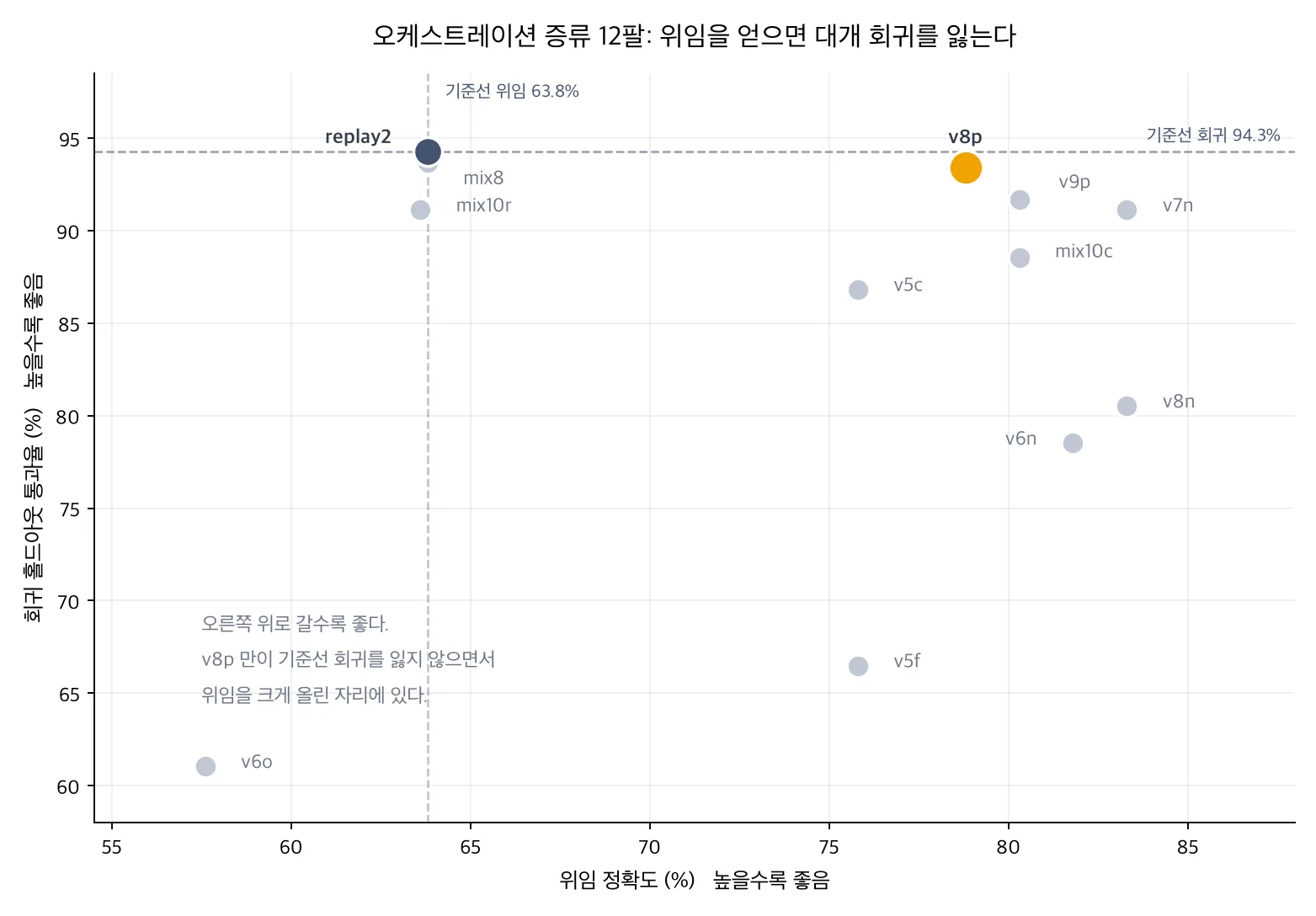
Horizontal axis is delegation accuracy, vertical axis is how much of the model’s prior ability survives. Up and to the right is where you want to be, and most arms move right by falling down. They bought delegation by breaking things the model already had, like answering in the requested language or picking the right tool.
The most extreme case was a delegation-only adapter. Train a separate LoRA on 118 orchestration rows and route to it at serving time. It is an attractive idea. It scored 213 on regression, 0/66 on language, and 18.8% on restraint.
What not to do is only learnable among examples of doing. Restraint emerges from balance against ordinary task data, so isolating the delegation rows removes the very signal you are after. Multi-LoRA serving is a technique for reducing serving cost, not for mixing behaviours.
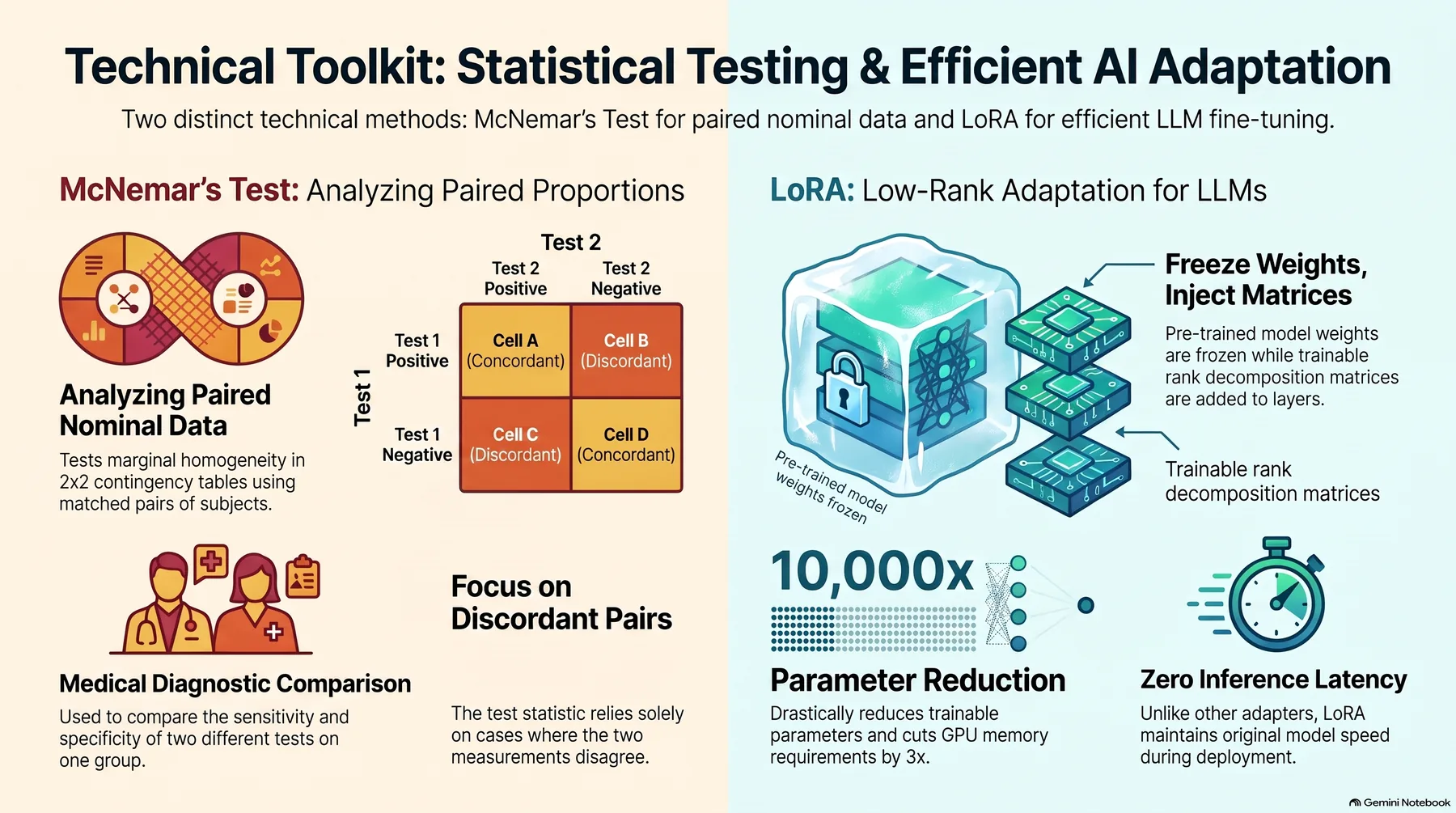 Infographic generated by NotebookLM from the sources.
Eight arms ran on broken data
We had swept the mix ratio from 7.8% to 21.9%, plotted the curve, built contrastive pairs of delegate and restrain cases from the same persona, and were starting to suspect training dynamics because restraint still would not stick.
The cause was in the data, not the training.
The code that turns agent execution records into training trajectories paired stored response bodies to trace steps by index, from the front. But a streaming orchestration run persists exactly one response row, the final answer, while the trace holds one step per turn.
flowchart TB
    subgraph A["LLM steps left in the trace"]
        S1["step 1<br/>delegation decision"]
        S2["step 2<br/>tool call"]
        S3["step 3<br/>tool result arrives"]
        S4["step 4<br/>final answer written"]
        S1 --> S2 --> S3 --> S4
    end
    B["stored response bodies<br/>final answer only, one row"]
    B -->|"paired by index from the front"| S1
    S1 --> WRONG["turn 1 already states<br/>error rate 6.8%"]
    S3 --> ORIGIN["where that number<br/>first appears"]
    ORIGIN -.->|"happens later in time"| WRONG
    WRONG --> LEARN["what the student learns<br/>invent facts not in context"]
The measurement: 200 out of 200 orchestration runs placed the final answer ahead of the tool call, and 118 of those had that first turn quoting numbers that exist only in a later tool result. A first turn says “error rate 6.8%, p99 latency 2,400ms” when those values first appear in step three.
Train on those trajectories and the student learns to state facts that are not in its context. It was a dataset that taught confabulation on purpose, and not one of our metrics caught it.
The fix is close to a single line. Align the response bodies from the back instead of the front, and keep the old behaviour when the counts happen to match. After re-exporting, runs with prose in first position went from 200 to 0, and answers landing after their tool result went from 0 to 195.
If a regression test passes against the buggy code, the fixture is wrong
Writing the test caught us once more. The first fixture passed, and it kept passing after we reverted the fix. It had left the tool-call message as a response row, so there were two bodies, the offset was zero, and the bug never fired.
Only after querying the real database and confirming that a session holds exactly one response row did the fixture reproduce the incident. A regression test is not finished until you revert the fix and watch it fail.
Two more were rotting where the metrics do not look
The first was a conditioning mismatch. Evaluation exposes 24 tool schemas to the model. Training rows carried none. We were teaching the student under one condition and testing it under another. Attaching the schemas took language leakage from 39/66 to 66/66.
Then we overshot in the other direction. Attaching schemas to every row collapsed tool use to 0 of 64. Matching the condition and drowning the signal turned out to be different acts.
| schema attachment | prose to tool ratio | regression | tool selection |
|---|---|---|---|
| every row | 59.7 to 1 | 274 | 0/64 |
| prose kinds only | 43.4 to 1 | 281 | 8/64 |
| label-correct rows only | 4.6 to 1 | 326 | 52/64 |
The second was quieter. The parser storing teacher responses kept tool-call names and discarded the arguments. 93 of 103 targets carried empty arguments. Nobody noticed for weeks for a simple reason: our grader scores tool names only.
We fixed the parser and re-asked the teacher for 92 rows. Two minutes at eight-way parallelism, 93% recovered real arguments. And that arm lost, 320 against 326. Policy judgement recovered from 4/9 to 6/9 exactly as predicted, and tool selection fell from 52 to 44. The two arms differ at p=0.3075, so read honestly, the arguments made no reliable difference and may have hurt.
We wrote the gate as an absolute number, and that was the mistake
We pre-registered a pass threshold: regression at 327 or above. The final candidate scored 326.
One case. But one case out of 349 paired comparisons is noise. Put 326 against 329 in a McNemar test and you get p=0.7111, which means the test cannot tell the two models apart. What we actually wanted to protect was “not significantly worse than baseline,” and we had written it as an absolute floor.
We did not rewrite the gate after seeing the result. Rewriting it would make it not a gate. We recorded the candidate as failing and filed the mis-specification separately. The next pre-registration uses a paired test against baseline, plus per-kind floors. One arm scored 274 overall with tool selection at 0/64, and the total alone does not show you that an entire kind collapsed.
Three predictions missed
Worth recording.
First, we thought the targets were wrong and that was causing the language leakage. Fixing the targets made the leakage more accurate. It moved from calling an irrelevant tool to calling a plausible one, and the total stayed put.
Second, we thought the intervention was too broad. Narrowing it made tool selection worse, 8/64, which confirmed the opposite diagnosis: there were too few positive examples.
Third, we thought real arguments would restore policy judgement. They did, and lost more elsewhere.
All three were plausible mechanisms and all three were overturned by measurement. Measuring twelve arms against a single holdout is itself a way to select on noise, and our top three arms do not separate from each other at any p below 0.2. We picked the final arm not because it scored highest but because it was the only one that lifted all three delegation metrics while its regression stayed indistinguishable from baseline.
The ThakiCloud angle
This experiment ran on Paxis, our agent control plane, and went back into it.
Paxis treats skills, tools, policies and audit logs as first-class resources. When a user builds an agent, its execution trajectory is retained in an auditable form, and we turn those trajectories into training data. In this round the new default model was registered in the catalog, the serving endpoint was swapped, and it was wired in as the sub-agent model inside Paxis. Putting what you made back inside itself is what closes the cycle.
Auditable trajectories were the concrete win here. We found the confabulation defect not by inspecting the model but by counting, in the assembled trajectories, how many runs answered before their tool result arrived. Had execution been retained as anything less than ordered events, that defect would have stayed invisible to every metric we had.
Serving runs on Metis. Every arm was measured under identical serving settings, which is a requirement rather than a preference. We have measured up to an 18.8x throughput gap between the platform default and a tuned configuration. If serving settings differ per arm, the comparison measures the configuration rather than the model.
The two products being adjacent was the premise of the experiment. Trajectories have to be retained before you can train (Paxis), and serving has to be identical before you can compare (Metis). The same structure runs on-premises and in sovereign environments.
What we still cannot do
The holdout is small. Nine cases for policy judgement, six for step order, six for citation. You cannot claim anything at that size. The “policy judgement recovered from 4/9 to 6/9” above is, in truth, two cases.
The grader only looks at tool names. Whether the handoff reached the right sub-agent with the right arguments is measured by nobody. That is why empty arguments survived for weeks.
We could not measure the teacher axis. We issued requests across three models and all 149 resulting training rows came from the same one. The model field in the request body is ignored, and a value pinned on the agent wins. The workaround is implemented and has never been run.
One seed, one run per arm.
So the next step is not more arms. Adding arms while the top three do not separate is tuning on noise. Growing the holdout and teaching the grader to look at arguments and targets comes first, and the gate gets rewritten as a paired test.
Fix the measuring instrument before scaling the measurement.
References
Definitions of the LoRA and McNemar’s test used in the body.