Where a Model That Never Saw the Data Beat the One That Did
We have released two Korean regional dialect models on Hugging Face. One learned from real dialect recordings. The other learned without a single character of them. If you have ever been blocked from publishing a result because the data underneath it was licence-restricted, this post is for you.
 It visualizes the core concept of the article.
The headline first. The synthetic model recovered roughly nine points out of ten of the real-data training gain. But that score split sharply depending on which ability we measured, and on sentences we wrote ourselves the ranking flipped.
In plain terms
Picture two students learning a regional dialect. One travelled to the region and listened to older residents talking. The other never went, and received only a phrasebook compiled from those same recordings, which they practised by applying to sentences somebody else wrote.
We will call the first the resident student and the second the phrasebook student for the rest of this post. The experiment is simply putting both through the same exam.
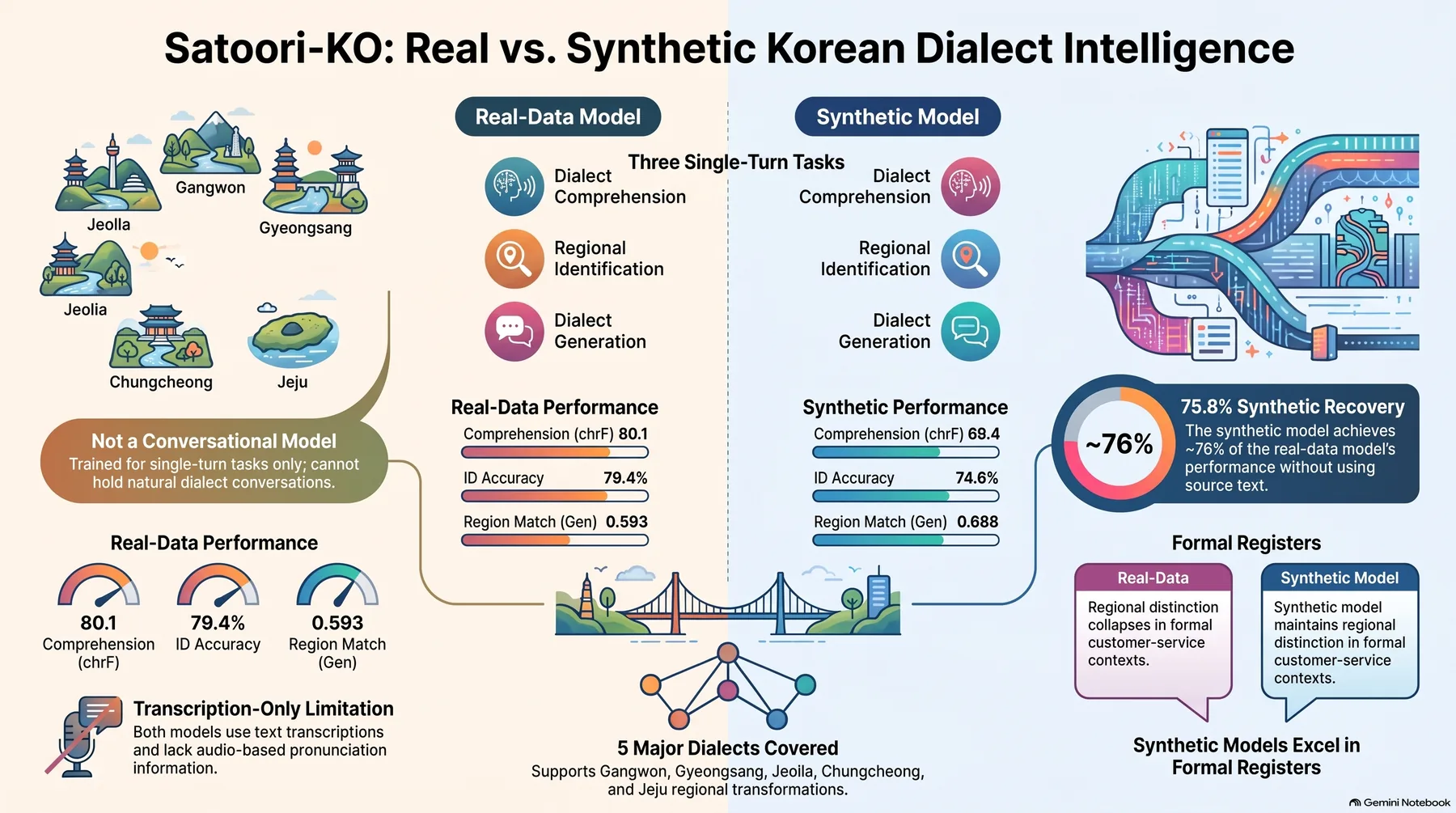 Infographic generated by NotebookLM from the sources.
What we did
Dialect work is not short of data. It is short of usable data. Korean has five regional conversation corpora at the national AI Hub, but redistribution and export are restricted, so a model built from them is hard to publish alongside a paper.
We built the exam first. It holds 1,000 questions, 200 for each of five regions, and it scores three abilities separately. Turning dialect into standard Korean is comprehension. Naming which region a sentence comes from is identification. Turning standard Korean into dialect is generation.
The exam itself falls under the same licence. So instead of the question text we published a one-way transformation of each question number along with the scoring code. Anyone can reconstruct the same 1,000 questions from their own licensed copy and score against them.
Then we raised the two students from the same base model. The resident student learned from real paired sentences. The phrasebook student learned only from synthetic sentences, made by running a rule-based converter over standard Korean utterances our own model wrote.
What came out
We call the recovered share the recovery rate. Take the resident student’s gain as 100 and ask how much of it the phrasebook student reached.
Broken down by ability the story changes completely. Identification reached 91.2 percent and comprehension stopped at 52.7 percent. Generation depends on which ruler you use. Measured with the word list we built, it reached 105.6 percent and passed real data. Measured against a human reference that uses none of that list, it reached 72.4 percent and did not.
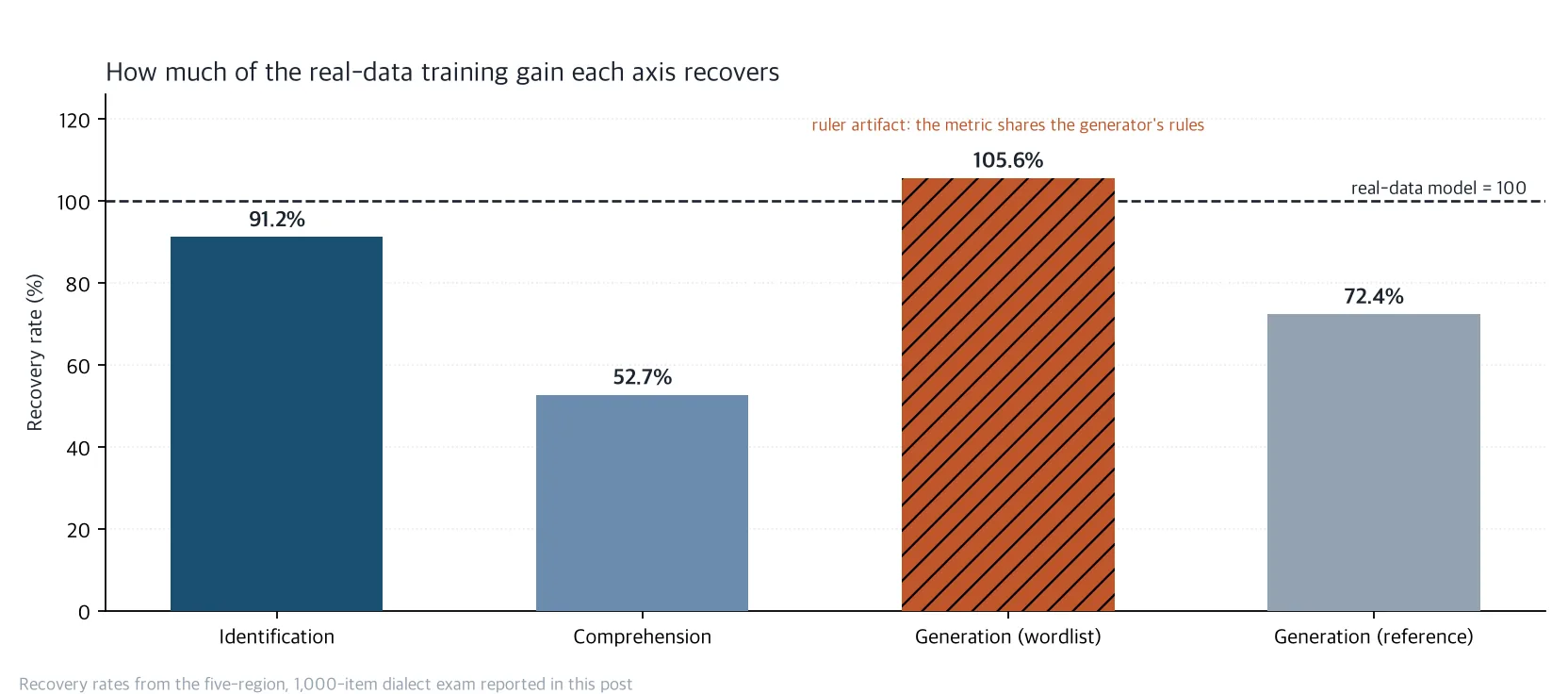 Recovery rate by axis. Identification 91.2 percent, comprehension 52.7 percent, generation 105.6 percent on the wordlist metric and 72.4 percent on the reference metric. One hundred is the real-data model baseline.
Put simply, the ability to produce dialect transferred almost fully through a phrasebook, while the ability to understand it transferred only halfway.
One thing needs flagging here. The score above 100 was not skill, it was the wrong ruler. The word list used for scoring came from the same place as the rules used to build the dialect. When we removed from that list every form the rules can produce, not one word survived in any of the five regions. Rescored against a human reference that shares none of that vocabulary, generation fell to 72.4 percent, and no synthetic model passed real data.
Separately, the synthetic data made the regions more distinct from each other than they really are. Real dialects bleed into their neighbours, and the synthetic ones did not reproduce that overlap.
On our own sentences the ranking flipped
The exam questions came from the same source the resident student studied. That favours the resident student. So we measured what happens outside the exam.
We wrote six scenes ourselves, covering customer service, a public notice, a tourism description, drama dialogue, game dialogue, and everyday speech. We ran both models over all five regions for each. No source material was used.
The resident student produced genuinely different output per region about eight times in ten. The phrasebook student managed close to ten in ten. On the formal customer-service sentence in particular, the resident student returned one identical sentence for all five regions, ignoring the requested region completely.
Put simply, the resident student led inside the exam, and the phrasebook student held up better outside it.
The reason is not hard to guess. The phrasebook student practised on sentences our model wrote, which spanned a wide range of registers. The resident student heard relaxed conversation among older speakers, which contains almost no formal announcement register.
What the output actually looks like
Here is the phrasebook student on one sentence, “it rained a lot yesterday so the road got soaked.”
| Region | Output |
|---|---|
| Gangwon | 어재 비가 마이 와가주 길이 다 젖었더라 |
| Gyeongsang | 어제 비가 마이 와가꼬 길이 다 젖었더라 |
| Jeolla | 어제 비가 많이 와가꼬 길이 다 젖었더라 |
| Jeju | 어제 비가 하영 와가주 길이 다 젖었더라 |
The Jeju form “하영” means “a lot” and is specific to that island. The Gangwon “와가주” and Gyeongsang “와가꼬” genuinely diverge. But a Chungcheong request also produced “와가꼬”, which belongs to Gyeongsang and Jeolla. The model separates the regions without always separating them correctly.
What to change because of this
If dialect data is locked behind a licence, generation work can start on synthetic data. Rewriting register, writing lines with regional colour, and giving characters distinct voices all sit in that bucket.
Understanding, by contrast, is hard to fill in synthetically. Summarising a dialect support call into standard Korean needs the real thing. Of the two models we released, that use case wants the real-data one.
And if you are planning to build synthetic data, one thing is worth knowing in advance. We refined the conversion rules three times and the score did not move. Switching the source from written prose to spoken utterances doubled the rate at which rules found somewhere to apply. But that doubling did not turn into capability. Measured with metrics that do not lean on our own word list, all three axes moved less than the wobble we get from simply changing the training seed.
Put simply, widening where the rules can land and making the model actually better turned out to be different problems.
Tripling the training set lifted only the ability to name the region. Comprehension and reference-based generation again stayed inside the wobble.
Both models are available here.
- Real-data model: ThakiCloud/Qwen3.8-27B-Satoori-KO
- Synthetic model: ThakiCloud/Qwen3.8-27B-Satoori-KO-Synth
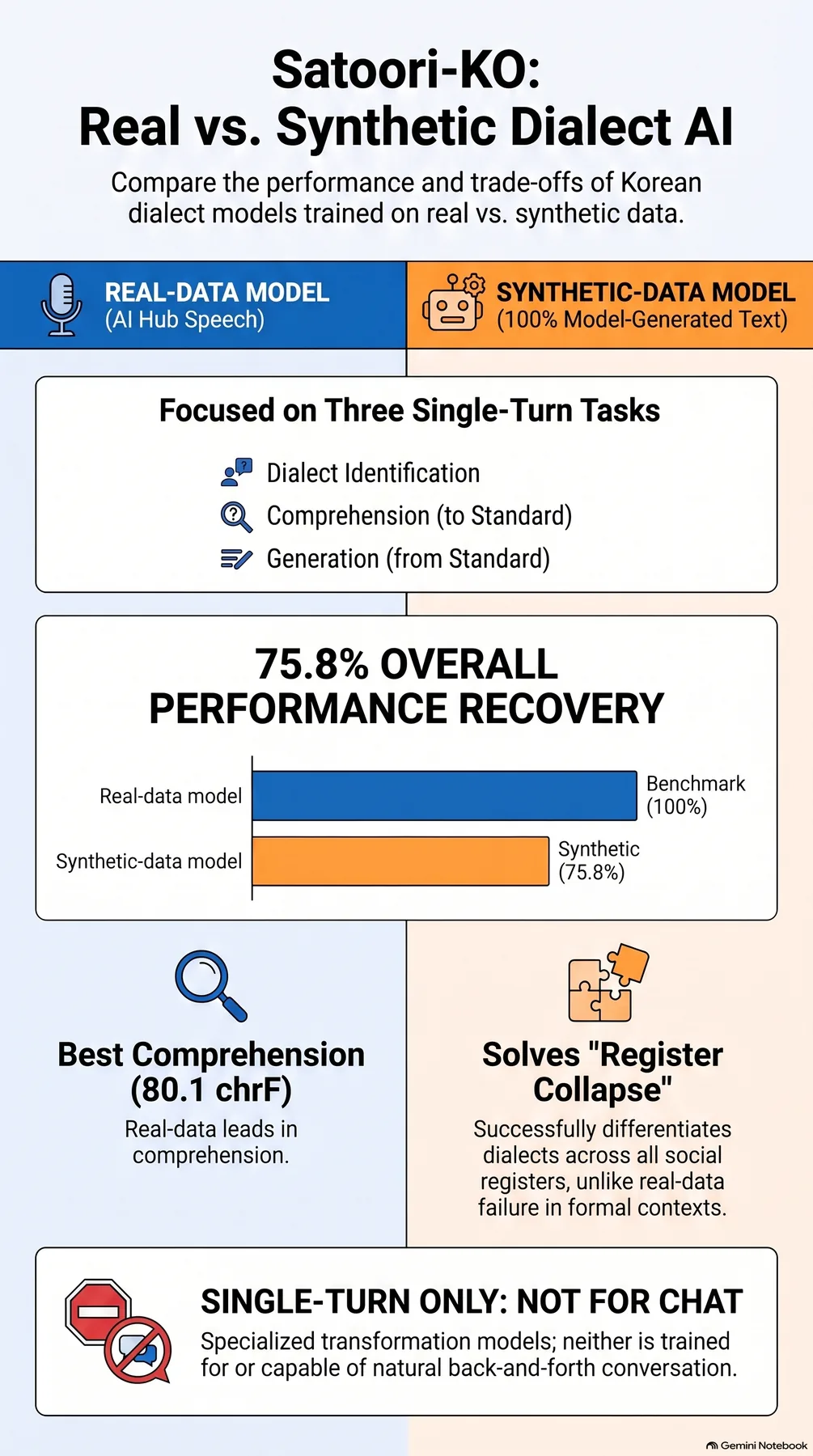 Infographic generated by NotebookLM from the sources.
What not to trust
These are not conversational models. All training was single-turn transformation and classification. Holding a conversation in dialect was neither trained nor measured.
Each arm was trained once. A small score gap between the two is not yet distinguishable from ordinary training noise. A repeat run under identical settings is in progress.
The out-of-exam measurement covers six scenes. It is a demonstration, not a benchmark. Please do not rank the two models on those numbers.
The dialectness score is a lower bound. It counts only words that match a lexicon we mined. Dialect phenomena outside that lexicon, such as intonation and word order, are invisible to it.
Neither model heard any audio. Both learned from transcription alone, so they carry no pronunciation information.
The training data came from AI Hub’s Korean dialect speech corpora and its corpora for middle-aged and elderly speakers. Neither repository contains the source data or any dialect-to-standard correspondence lexicon; we published weights only.