The winner used 8-bit in the right place, not 4-bit in more places
If you serve a 27B-class model on Blackwell and 4-bit did not buy you what you expected, the thing to change is probably not the bit width but which layers sit at which precision. Changing only the recipe on the same model moved our saturation throughput from 1.488x to 1.675x over bf16, and the checkpoint went from 30.14 GB to 22.90 GB. On a paired MMMU comparison it stayed indistinguishable from the original.
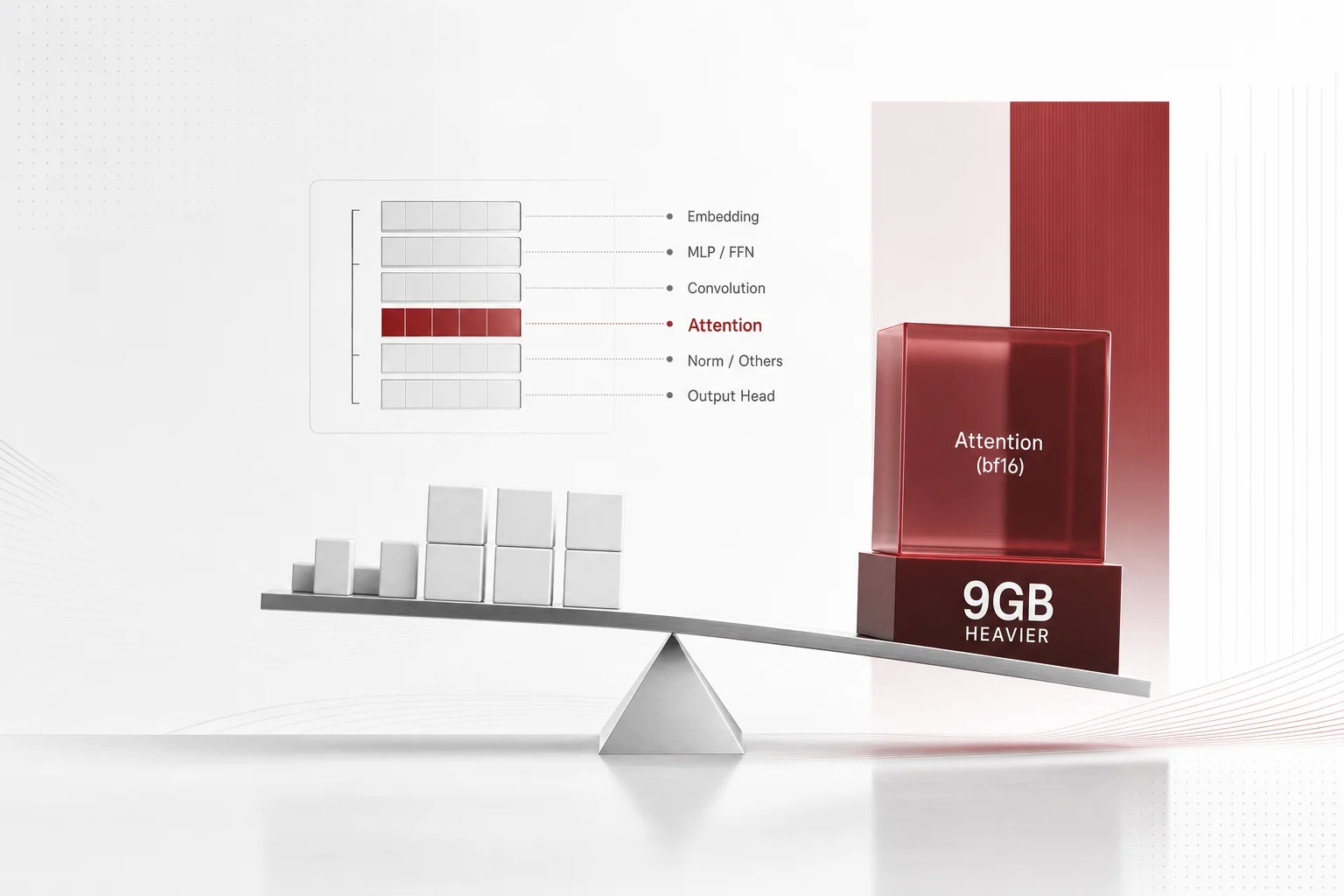 A visual take on splitting precision layer by layer.
Excluding is not “leaving it alone”, it is “leaving it at 16-bit”
Our quantization script excluded attention with --extra-ignore. The reasoning was that
4-bit might hurt attention quality, and that worry is reasonable on its own.
The problem is what exclusion means. Removing a layer from the quantization target does not mean not touching it; it means keeping it at bf16. When the menu offers 4-bit, 8-bit and 16-bit and you pick nothing, the most expensive option stays.
Qwen3.8-27B has 48 linear-attention layers out of 64, with the other 16 being full attention. Excluding attention wholesale leaves 401 attention projections in the language model at 16-bit. Our ignore list had 511 entries; only 110 of them were the vision tower, and the remaining 401 were all attention.
The public checkpoint of the same model put FP8 in that slot. Same “NVFP4” on the label, a different recipe underneath.
Where the two recipes diverge
flowchart TB
    A["Qwen3.8-27B<br/>64 layers · 55.59 GB"] --> B["MLP stack<br/>gate / up / down"]
    A --> C["401 attention projections<br/>linear_attn 336 + self_attn 64"]
    A --> D["Vision tower, 110 modules"]

    B --> E["NVFP4 4-bit<br/>group_size 16"]

    C --> F["Recipe 1: exclude<br/>stays bf16"]
    C --> G["Recipe 2: FP8<br/>8-bit W8A8"]

    D --> H["kept at bf16<br/>same in both"]

    E --> I["Checkpoint A<br/>30.14 GB · saturation 1.488x"]
    F --> I
    H --> I

    E --> J["Checkpoint B<br/>22.90 GB · saturation 1.641x"]
    G --> J
    H --> J

    style F fill:#ffd6d6,stroke:#d64545
    style G fill:#d6f0e0,stroke:#2f9e6e
    style J fill:#e8e0ff,stroke:#7c4dff
MLP and the vision tower are identical across both recipes. The only fork is those 401 attention projections, and that one choice decided 7.24 GB and the saturation figure.
What we checked in the source before building
One quantization run takes 47 minutes. If the path is closed you find out after burning those 47 minutes, so we read the code first.
We started with whether llm-compressor can express different precisions per module. The
scheme argument turned out to accept a dictionary, not only a string. When targets
overlap, an exact name beats a regex and a regex beats a class name, which means a regex
naming attention automatically wins over a blanket Linear target. On the serving side,
vLLM reads a per-group format field and handles mixed-precision checkpoints.
All three were open, so a recipe that puts NVFP4 on the MLP and FP8 on attention held up.
We opened the tensors, not the config
After the build we read the saved weights directly.
linear_attn.weight    F8_E4M3     ← previously all BF16
self_attn.weight      F8_E4M3
mlp.weight_packed     U8          ← NVFP4, unchanged
A config file saying “mixed precision” and the tensors actually being FP8 are two different claims. To say you verified it, you have to look at the second one.
We nearly drew the opposite conclusion
The first size measurement came back at 49.37 GiB. Against a 51.77 GiB original that reads as “compression barely did anything”.
What actually happened was that the uploader did not clear the destination, so seven shards from the previous build and five from the new one shared one directory. The index file pointed at the new ones and the real size was 21.34 GiB.
Directory size is not build size. And overwriting the same path changes the checkpoint that is being served. We changed the build script so a different recipe lands on a different path.
Throughput has to be measured this way to be quotable
A smaller checkpoint does not entitle you to say it is faster. And with serving throughput, how you measure changes the result.
Measure one concurrency level and the number you get is single-stream decode latency, not
serving throughput. Whether the advantage survives at saturation only shows up when you walk
the ladder. And if you do not set --max-num-seqs, vLLM never prints it, which means there
is no way to prove afterwards what you measured under. A measurement that cannot name its
knobs has no standing to attribute a difference between arms to anything.
So we walked concurrency 1, 8, 32 and 128, three repeats per level, taking medians. The
serving config (max_num_seqs=256, max_model_len=32768, gpu_memory_utilization=0.90,
CompilationMode.VLLM_COMPILE) was identical across arms, and rather than trusting that we
passed it, we compared the config line each engine printed for itself.
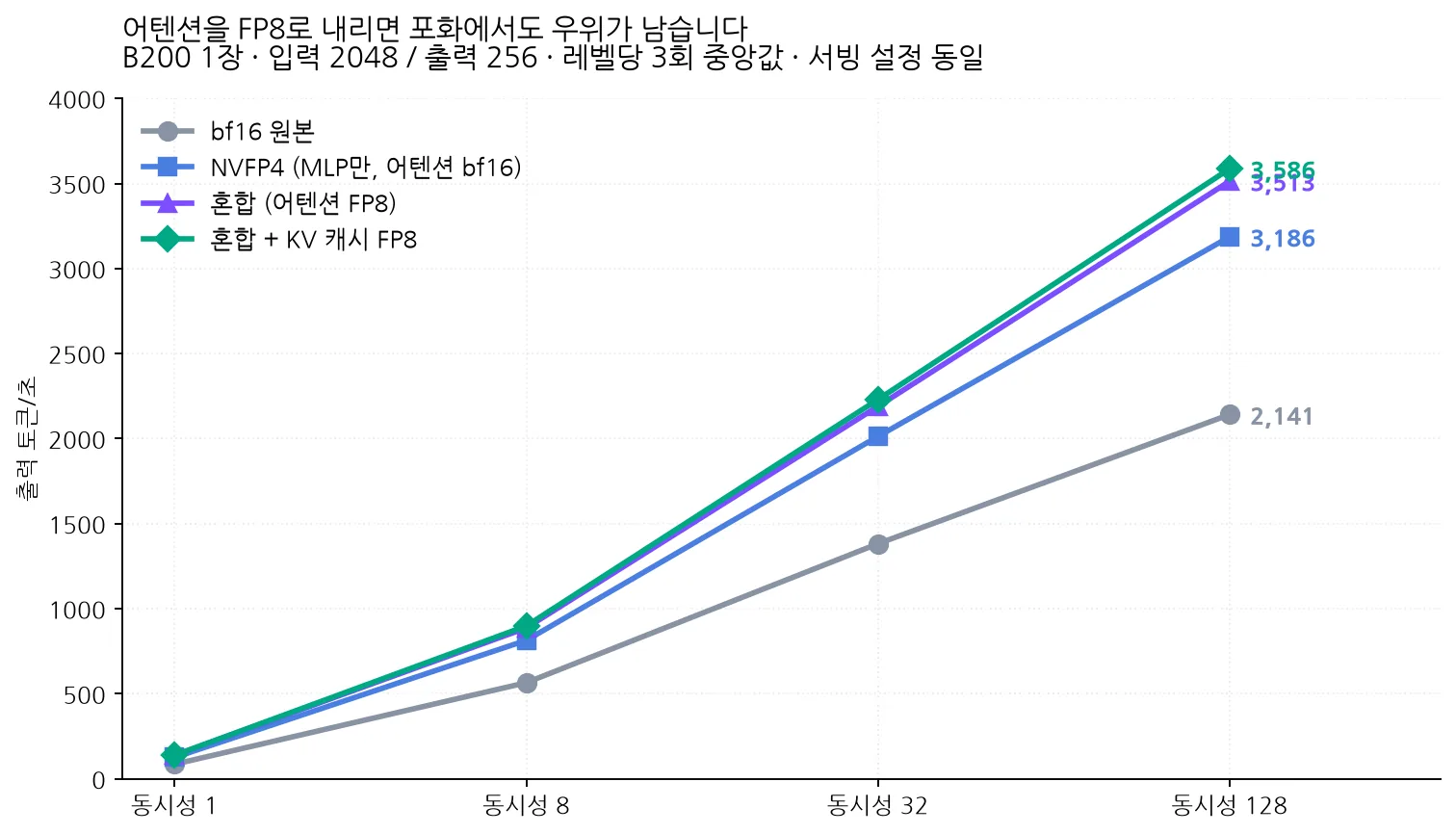 The mixed recipe leads at every level, and the gap widens as concurrency rises.
| Concurrency | bf16 original | NVFP4 (MLP only) | Mixed (attention FP8) | Mixed + KV FP8 |
|---|---|---|---|---|
| 1 | 86.5 | 126.3 | 138.8 | 138.9 |
| 8 | 565.4 | 814.4 | 887.4 | 899.1 |
| 32 | 1,382.4 | 2,013.1 | 2,189.8 | 2,230.2 |
| 128 | 2,141.4 | 3,186.2 | 3,513.3 | 3,586.3 |
| Saturation ratio | baseline | 1.488x | 1.641x | 1.675x |
Output tokens per second, 2,048 in / 256 out, one B200.
The advantage survives at saturation. A single-stream figure cannot tell you that, and serving does not live at concurrency 1.
The FP8 KV cache gain has a different shape. At concurrency 1 it moves 1.605x to 1.606x, effectively nothing, and at concurrency 128 it takes 1.641x to 1.675x. A KV cache is only a bottleneck when many sequences are in flight, so that is the shape it should have. Getting the predicted shape is itself a sign the measurement was sound.
The arithmetic explains why attention was holding so much. During batch-1 decode a GPU spends its time fetching weights, not computing. With 401 attention projections still at 16-bit, those bytes have to cross from memory to the compute units on every token, and shrinking only the MLP to 4-bit leaves that traffic untouched. Moving them to FP8 halves the bytes for those layers, and on Blackwell that slot is also an FP8 tensor-core path. The 7.24 GB of size and the 0.15 of saturation ratio have the same cause.
The same recipe produces the same number
We measured the public checkpoint separately on our serverless path in the same week. Under a tuned configuration its single-stream figure was 138.9 tokens/sec. Our mixed build is 138.9 tokens/sec.
What put our published build behind the reference checkpoint was recipe selection, not quantization quality. Matching the recipe made the numbers line up to the first decimal.
At concurrency 128 they do separate, 3,845 on their side against our 3,586. Theirs bakes calibrated static FP8 KV scales into the checkpoint while ours are dynamic at serve time. That may be the cause, but we have not isolated it, so we will not call it the cause.
Quality is indistinguishable from the original
Speed alone is not enough to ship on. We scored six arms together on the multiple-choice items of MMMU validation, with a 16,384-token generation budget, temperature 0, and one prompt shared across arms.
Arms lose different items to truncation. Subtracting accuracies directly would therefore compare different subsets, which is why we restricted to the 232 items that produced a verdict in all six arms.
| Build | MMMU multiple-choice (232 items) | McNemar | Discordant pairs |
|---|---|---|---|
| bf16 original | 0.8836 | baseline | baseline |
| NVFP4 (MLP only) | 0.8922 | p = 0.688 | 6 |
| Mixed (attention FP8) | 0.8707 | p = 0.581 | 13 |
| Mixed + KV FP8 | 0.9009 | p = 0.344 | 10 |
No arm separates from bf16. While moving attention to FP8 and the KV cache to FP8 pushed saturation throughput to 1.675x, no measurable quality loss appeared.
Do not read this as “quantization won”. Four-bit does not add knowledge, and at 232 items a gap this size sits inside the noise. What the table says is that it did not break.
One thing is worth stating plainly. The mixed arms have verdict rates between 0.896 and 0.899 against 0.953 for the original: 21 to 22 items failed to finish reasoning within 16,384 tokens, against 13 for the original. The pairing absorbs that difference, so the comparison above holds, but we cannot explain why it reasons longer. We are leaving that open.
Why we wrote our own scorer
We started with a standard evaluation tool and could not trust the result. The
mmmu_val_reasoning task scores through an LLM judge, and when the judge call fails it
swallows the exception and writes a zero. With no judge server every item scores zero,
and nothing surfaces beyond one log line.
On that same path a benchmark once returned exactly 0.0. Exactly 0.0 is not a value a model can produce. We still read it as the model’s fault for a day.
So we built a scorer where code owns the verdict and no judge is involved. It scores
multiple choice only and skips the 53 open-ended items rather than guessing at them. It
gives the same 16,384-token budget the official task gives, extracts answers with the same
<answer> tag and trailing-letter rules, and reports accuracy and verdict rate
separately so a budget problem cannot pose as a quality difference. Extraction failed on
zero items across all six arms.
Worth adding: with a short budget this model looked like it could not answer. It reasons for more than 12,000 characters before answering, so the output was simply being cut. A short budget measures the budget, not the model.
What this means for the ThakiCloud platform
The result maps straight onto Metis, our AI inference and token factory layer. A 1.675x saturation figure on the same single B200 means that much more request volume on the same hardware, and a 22.90 GB checkpoint leaves room on the card for longer context or more concurrent sequences. Our serverless endpoint runs this checkpoint at the model’s native 262,144 context, and even at that length the KV cache holds 1.91M tokens, admitting 7.29 maximum-length requests at once.
Agent workflows in Paxis, where a run loops through many tool calls, are far more sensitive to throughput at saturation than to single-response latency. That is why the number we cared about here was not 138.9 at concurrency 1 but 3,586 at concurrency 128.
Context length taught us something too. We first stood this endpoint up at 131,072. That value is not a serving recommendation; it is a control pinned across arms in a different experiment to hold the axis fixed, and it followed along when we copied the configuration. The model’s native length is 262,144, and since only 16 of 64 layers grow KV on this hybrid, 256k costs around 8.6 GB. After rebuilding, the engine reported 1.91M KV tokens and 7.29 concurrent maximum-length requests. Moving a control value into a production setting is how you reproduce the defect you just reported yourself.
What we did not measure
Quality was only examined on 232 multiple-choice MMMU items. That can show the absence of a large effect but not of a small one at this sample size. Code, long context, multilingual behaviour and video were not measured.
Throughput was measured at one shape only, 2,048 in and 256 out. Prefill-heavy or decode-heavy workloads may look different.
The FP8 KV cache uses dynamic scales set at serve time. It is not the calibrated static scales the reference checkpoint bakes in, so that axis remains uncontrolled.
The remaining size gap against the public checkpoint is lm_head and the vision tower. They
quantize both and we left both alone. lm_head sits on a 150,000-entry vocabulary and feeds
logit quality directly, and matching pass rates alone did not seem like grounds to take it
to 4-bit.
What we published
The mixed build is out as ThakiCloud/Qwen3.8-27B-NVFP4-FP8ATTN. The earlier MLP-only builds (-GPTQ-mm and -GPTQ-txt) are still up, because they are the evidence that calibration data made no difference on this benchmark. For serving, take the mixed build.
vllm serve ThakiCloud/Qwen3.8-27B-NVFP4-FP8ATTN \
  --max-model-len 262144 --max-num-seqs 256 --kv-cache-dtype fp8
References
- vLLM: the serving engine whose mixed-precision checkpoint support we verified here.
- LLM Compressor: the tool used to assign different precisions per module.
- NVFP4: A 4-Bit Floating Point Format for AI Inference: NVIDIA’s own description of the 4-bit floating point format introduced on Blackwell.
- FP8 Primer: NVIDIA Transformer Engine documentation on 8-bit floating point scaling.
- MMMU: the multimodal evaluation dataset used for the quality comparison.
The throughput and quality figures in this post were measured on a single B200 on 2026-08-19, and the ledger and per-item scoring results are preserved together in our internal repository.