Measuring the Real Cost Gap Between Cron Polling and Event Triggers in Unattended Agent Automation
This is useful if you run an unattended agent automation system and have been picking your polling interval by feel, one minute versus five minutes, with no real measurement behind the choice. It matters even more if your organization runs infrastructure with multiple cron-based skill runners. This research actually measures the tug-of-war between latency and wasted cost that a single polling interval creates, and puts numbers on the idempotency design that has to travel alongside any move to event-based triggering.
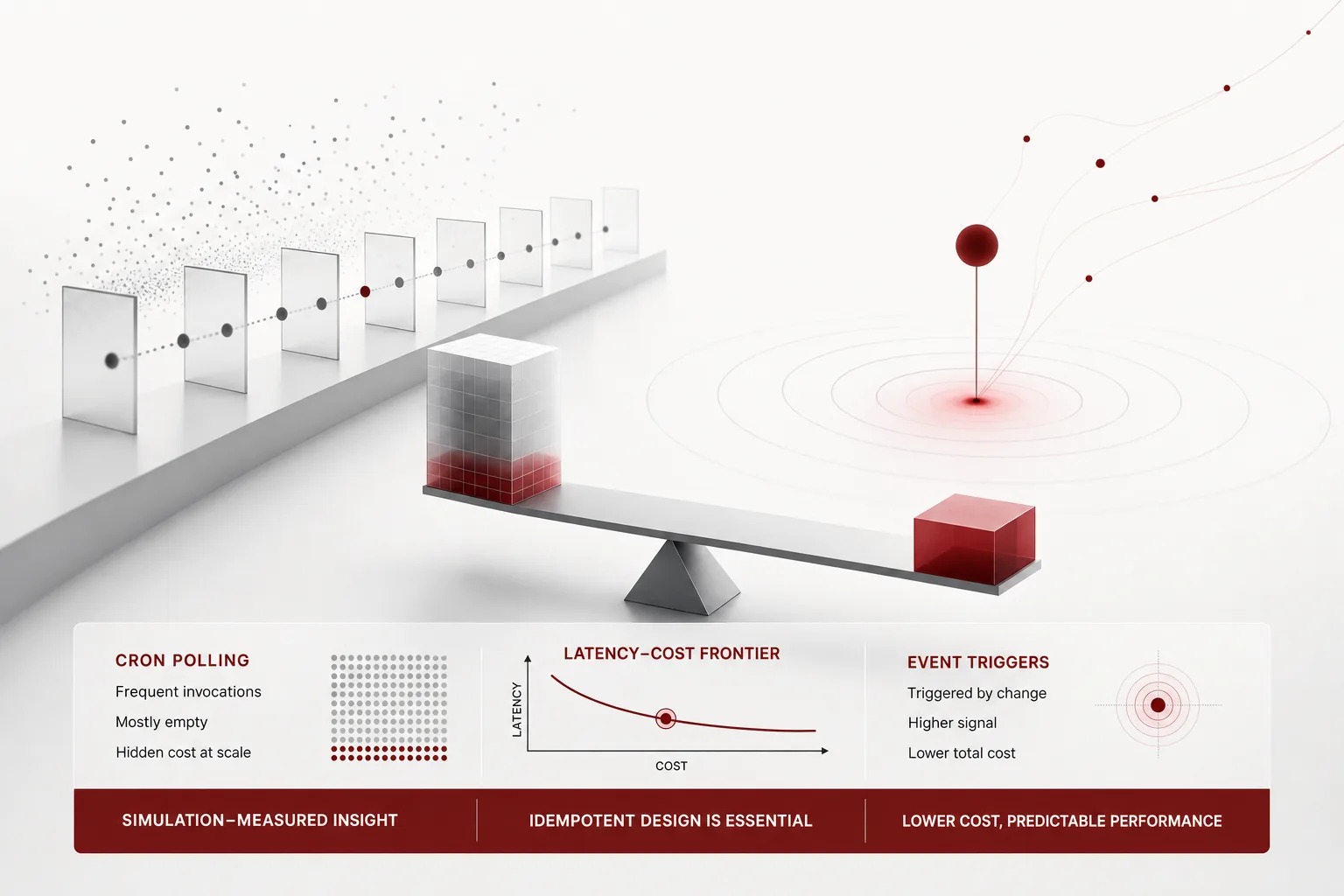 A visual metaphor for the article’s key idea.
The Problem: Why Polling Intervals Are Always a Guess
Automation systems that run without a human watching are usually built to wake up on a fixed schedule, check state, act if something changed, and go back to sleep if nothing did. The reason is simple. Polling has exactly one parameter, there is no risk of waiting forever for a message that never arrives, worst-case behavior is bounded by the interval, and none of it requires push infrastructure, an externally exposed endpoint, a message broker, or deduplication logic. Polling is the default not because it is optimal, but because it is the path of least engineering resistance.
The problem is that most operators never actually measure the trade-off this choice creates. Shorten the interval and detection time drops, but so does the fraction of invocations that wake up, find nothing, and simply exit. Lengthen the interval and that waste shrinks, but detection latency can drift outside what the workload can tolerate. A signal processed fifty minutes late may be technically handled and still be useless. In practice, teams pick an interval by feel: five minutes feels responsive enough, an hour feels cheap enough, and the value rarely gets revisited even after the event rate changes by an order of magnitude. On the other side sits event-based triggering, where the observed system pushes a notification and the harness reacts, and it tends to get treated as a large migration cost with vague, unquantified upside.
What We Measured and How: A Controlled Simulation Design
Instead of deploying a real system and measuring live traffic, this research measures the trade-off with a controlled, reproducible discrete-event simulation. No webhook or queue infrastructure was actually built, and every number reported below is a simulation output. That choice is deliberate. Making both trigger mechanisms observe exactly the same event stream is what lets the latency and cost differences be attributed purely to the trigger mechanism itself, with workload variation ruled out.
A Poisson process generating four state changes per hour was simulated over a 24-hour window with seed 42, producing 98 events in total. That same event stream feeds both arms identically. One arm tries ten fixed polling intervals in sequence, from 10 seconds up to 7200 seconds (two hours), and every invocation consumes exactly one unit of cost whether it finds something or not. The other arm attempts push delivery for every event with a Gaussian delay averaging 2.0 seconds and a standard deviation of 0.5 seconds. To mimic at-least-once delivery semantics, each event has a 3% chance of duplicate delivery, every delivery runs an idempotency-key check (0.02 units) before the handler executes (0.1 units), and a 5% failure chance triggers up to three retries before the item is routed to a dead letter.
Key Finding: No Polling Interval Beats Event Triggering on Both Axes at Once
A shorter polling interval feels safer, but the measured results show the opposite picture. At a 10-second interval, 8543 of 8640 invocations, 98.88%, wake up, find nothing, and simply exit. Even the 60-second interval common in practice runs a 93.61% waste rate. Bringing the waste rate below 20% requires stretching the interval to 1800 seconds or more, and by then average detection latency has already widened to nearly 16 minutes.
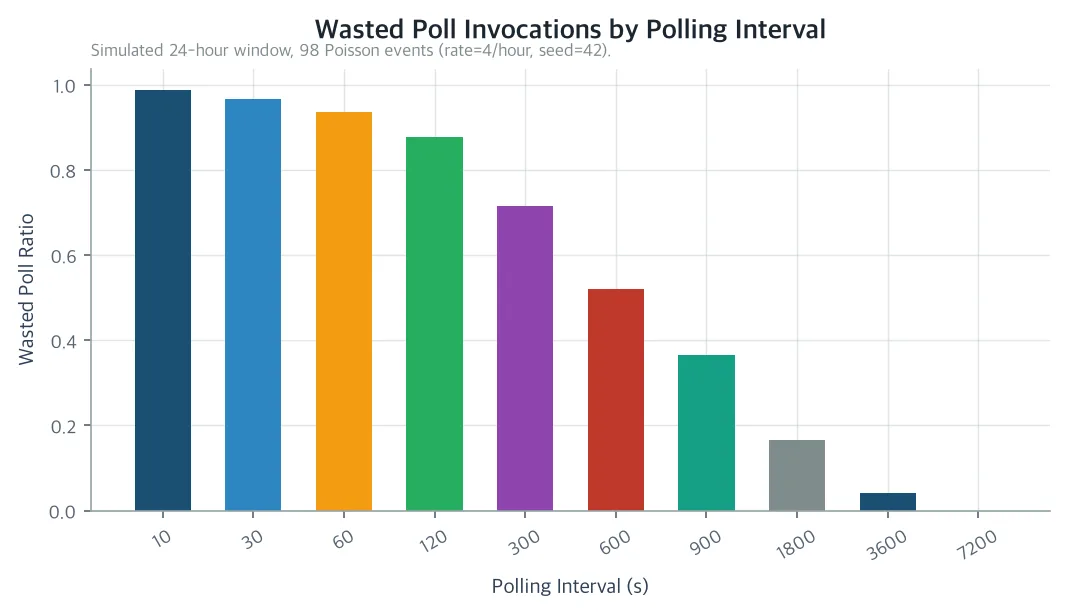 A figure showing the simulation results. Over a 24-hour window with 98 Poisson events at a rate of four per hour (seed 42), 98.88% of invocations are wasted at a 10-second interval and 93.61% even at a 60-second interval. The waste rate drops below 20% only at intervals of 1800 seconds or more, at the cost of average latency growing to roughly 16 minutes.
Processing the same 98-event stream with event-driven push produces an entirely different picture. Average latency is 1.997 seconds, p95 is 2.902 seconds, the maximum is 3.582 seconds, and total cost is 12.12 units. The fastest polling interval, 10 seconds, spends 8640 units and still lands at 5.086 seconds average latency, worse than push. In other words, it burns 713 times more compute and still delivers latency 2.5 times worse. The cheapest interval, 7200 seconds, costs 12.0 units, roughly matching push, but average latency reaches 3318.250 seconds, about 1661 times slower. None of the ten polling intervals tested beat push on both latency and cost at the same time.
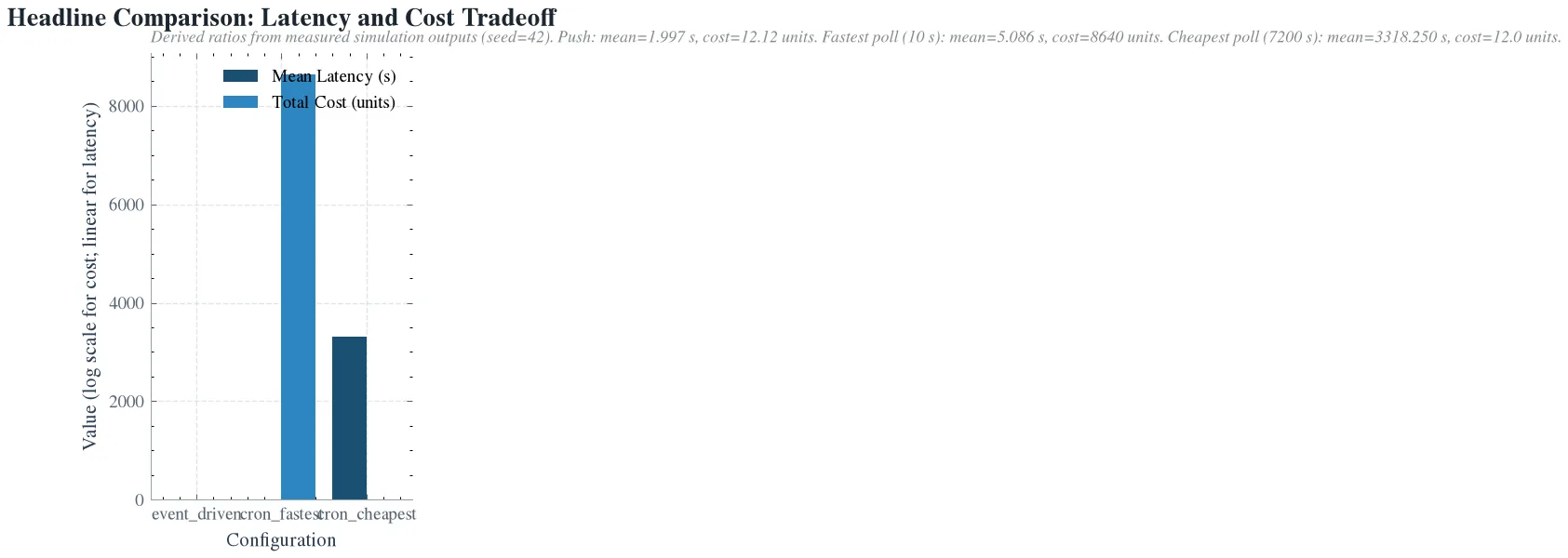 A figure summarizing the ratios derived from the simulation (seed 42). Push shows average latency of 1.997 seconds at a cost of 12.12 units. The fastest polling interval (10 seconds) shows an average of 5.086 seconds at 8640 units. The cheapest polling interval (7200 seconds) shows an average of 3318.250 seconds at 12.0 units. Push has 2.5x lower latency than the fastest polling while using 713x less compute, and the cheapest polling roughly matches push on cost but is 1661x worse on latency.
There is a structural reason for this. In polling, invocation count is proportional to the observation window divided by the interval, and average latency is proportional to half the interval, so the two values can only move along a hyperbola where their product stays roughly constant. Shrinking one necessarily grows the other. In push, by contrast, cost is proportional to the event rate itself rather than the inverse of a sampling interval, and latency is set by the delivery mechanism rather than sampling. The two values are decoupled. This advantage is most pronounced for workloads where events are relatively rare, though; once the event rate climbs high enough to rival the polling interval, the waste ratio itself approaches zero and the gap narrows accordingly.
Idempotency Is Not Optional: What a 3.9% Duplicate Delivery Rate Tells You
There is a question as important as latency and cost: what happens when an event is delivered twice? In this experiment, which assumes at-least-once delivery, removing the idempotency-key check while holding everything else constant caused 4 of 102 delivery attempts, about 3.9%, to fire a downstream action twice by mistake. In the original experiment, the idempotency check caught exactly those 3 duplicates, so 98 events produced exactly 98 actions and zero dead letters.
That 3.9% figure should not be read as an edge case that only shows up under load spikes or a flaky network. The moment you adopt at-least-once delivery, duplicate delivery stops being an exception and becomes normal, guaranteed behavior of the transport layer. Duplicate writes to a database can be made harmless with an upsert, but actions an agent takes are a different matter. It can send a message twice, place an order twice, open an issue twice, or fire an expensive downstream workflow twice, and many of these actions have no way to be made idempotent after the fact. That is why deduplication has to happen before the handler runs, at the trigger boundary. A retry policy with no termination condition is either an infinite loop or a silent loss, and both are worse than an explicit dead-letter queue a human can inspect. The zero dead letters observed in this experiment simply reflect the model’s assumption that failures are independent of each other. Real outages cluster and correlate. When one downstream dependency goes down, every attempt within that window fails together, and when a credential expires, every call fails identically until it is rotated. Under this kind of correlated failure, retries provide almost no independent benefit, and the dead-letter queue becomes the only mechanism that catches what retries could not fix.
What This Leaves for Company, Society, and Science
The practical implications split into three strands. At the company level, an outer-loop registry running many cron-based launchd skills gets a quantitative basis, a polling-interval sweep against measured event latency, for deciding whether investing in event automation is worth it. At the society level, this offers a way to cut the compute and the resulting energy cost wasted by idle polling loops, leaving a decision criterion that other unattended-automation operators facing the same problem can reuse. At the science level, it leaves a reproducible A/B methodology that fills a gap explicitly left open in the framework that splits a production agent harness into five axes (loop, harness, evaluation, tracing, memory): triggering. Tool routing, self-verification, and scaffolding structure have already been covered by plenty of research, but how a harness first notices that there is work to do has never really been measured.
The classic τ/2 residual-wait-time result is also practically useful. Using the relationship that sampling a Poisson arrival process at interval τ makes average detection latency converge to τ/2, an operator who knows their latency budget can roughly estimate the maximum tolerable polling interval as twice that budget, then price it by dividing the observation window by that interval to get the invocation count. If that price is unaffordable, the only option left is push. That said, this paper does not say “always switch to events.” If the observed system offers no push channel to begin with, if the state changes themselves happen far slower than the latency requirement, or if the workload does not yet justify building event infrastructure, polling remains the right choice.
Limits
The first limit worth stating is that every number here comes from simulation, not a real deployment. No webhook endpoint, message broker, queue, or event handler was actually built and run with live traffic. The measurement also rests on a single seed (42), a single event rate (four per hour), and a failure model that assumes i.i.d., mutually independent failures. That i.i.d. failure assumption is unrealistic in the direction that matters most. Real outages cluster and correlate, this model does not produce that, so the observed zero dead letters should not be generalized. The cost model also leaves out cold-start latency and the standing operational cost of a broker, a deduplication store, and monitoring, and factoring those in would likely narrow push’s advantage by roughly that much. The most natural next step is field measurement: record signal-generation traces from a real unattended automation system, replay them through this simulation, and deploy an actual push path alongside the existing polling path to validate latency, cost, duplicate rate, and dead-letter rate against live traffic.
Full paper details are available at the following link: https://huggingface.co/datasets/thaki-AI/daily-paper-2026-08-04-event-vs-cron-agent-automation