The Draft Skill: An Analytical Paper That Pre-Executes lite-confidence Candidates in Parallel While the Hybrid Router’s LLM-rerank Stage Picks the Skill and Measures the Acceptance Frontier
This post is for cloud/AI engineers in Korea who run an unattended agent harness with more than 2,000 skills on a self-hosted H200, or who have bolted a skill-router onto that harness’s loop. In an unattended loop, every incoming task passes through one routing decision before execution: which skill, and how fast. ThakiCloud’s analytical paper, The Draft Skill, asks about the time it takes to reach that decision. If you pre-execute candidate skills with high lite-confidence while the LLM-rerank stage deliberates, how much does the end-to-end wall time shrink at fixed routing accuracy, and at what acceptance rate does the wasted compute of rejected drafts cross break-even? This paper is written in analysis. It reports no new measurements, and every number is a closed-form prediction under the declared nominal assumptions. The three figures are values drawn from the same analytical model. By the end, you will have grounds for which skills to draft on your harness’s spare workers and which pool sizes to avoid.
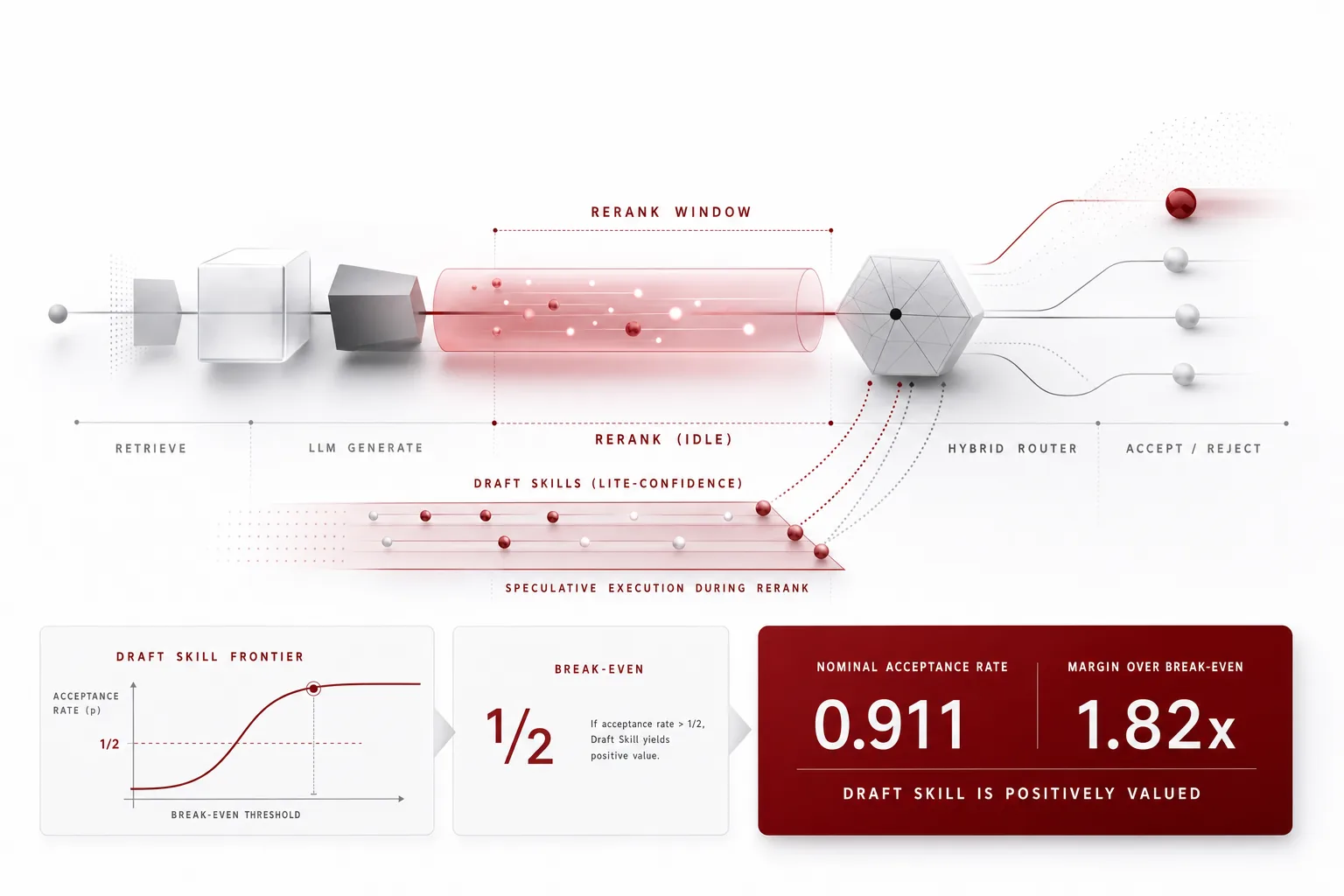 A visual metaphor for the article’s key idea.
Motivation: While Rerank Deliberates, No Skill Runs
The object of measurement is a two-stage hybrid skill router. The lite stage retrieves candidates with a BM25 index and injects the fixed manifests of the top k=8 skills into the context. It returns a ranked list with per-candidate lite-confidence scores in time T_L. The LLM-rerank stage scores those injected candidates and extracts the final skill. That takes T_R. The selected skill executes on a worker only after that. The registry is a frozen 2,293-entry registry, deployed to a 2,200-skill unattended agent harness on a self-hosted H200. The router’s token bill (full at 1,440.3 per decision versus lite at 409.6) and the 8.9pp hybrid-over-BM25 top-1 lift are measured values from the earlier paper, The Router’s Toll, and this paper reuses them as declared constants.
The core observation is simple. While the LLM deliberates which skill to run, no skill runs. The rerank stage is an idle window on the execution path. The toll paper priced this window only in tokens, not in wall time. This paper spends that window in wall time.
Speculative execution for agents already has a lane. One family runs future trajectory steps out-of-order inside a copy-on-write sandbox, and another has a weak model draft and a strong model verify with a single prefill. But there, the unit of the draft is a ‘future step’ and the verifier is a second paid LLM review. The LLM routing literature decides where to send, but execution waits for the decision to finish. Neither side pre-executes during the decision. The Draft Skill is orthogonal. It executes during the decision. The unit of the draft is the current skill execution, the prediction source is the lite stage of the production hybrid router, and the verifier is the router’s own final decision, which is already being computed. The LLM cost added by verification is 0 except for deterministic checks.
Design: The Draft/Verify Policy, Losslessness, Two Regimes
The policy has five steps. First, run the lite stage to get the ranked candidates and their lite-confidence scores. That is T_L. Next, start the LLM-rerank stage. That is T_R. In parallel, draft, that is pre-execute, each candidate whose lite-confidence exceeds the threshold τ, on spare workers in descending order. That takes T_D. It stops when the spare workers are used up or the eligible set is exhausted. When the rerank emits the final skill, find the draft of that skill. Accept the draft only if the final skill equals the drafted skill and the deterministic verifier (schema validity, idempotency, read-side-only effects) passes. If accepted, write the draft’s output as the result and skip re-execution. If rejected, discard the draft and run the final skill as is.
Because the verifier is deterministic and read-side only, a rejected draft has no observable effect. The final skill executes exactly the same whether or not a draft existed. That is where losslessness comes from. Acceptance is defined by the router’s own final decision, and rejection is always a fallback that executes that decision as is. The distribution over final skills is identical with or without drafting. Only two quantities move: wall time (a hidden draft can save T_E) and wasted compute (a rejected draft is λT_D per worker). Speculation changes the cost of the decision, not the outcome.
Safety boundaries are also built into the design. Write-side (side-effecting) skills are excluded from drafting. Only idempotent read-side skills can be drafted, and the deterministic verifier runs on every draft before acceptance is counted.
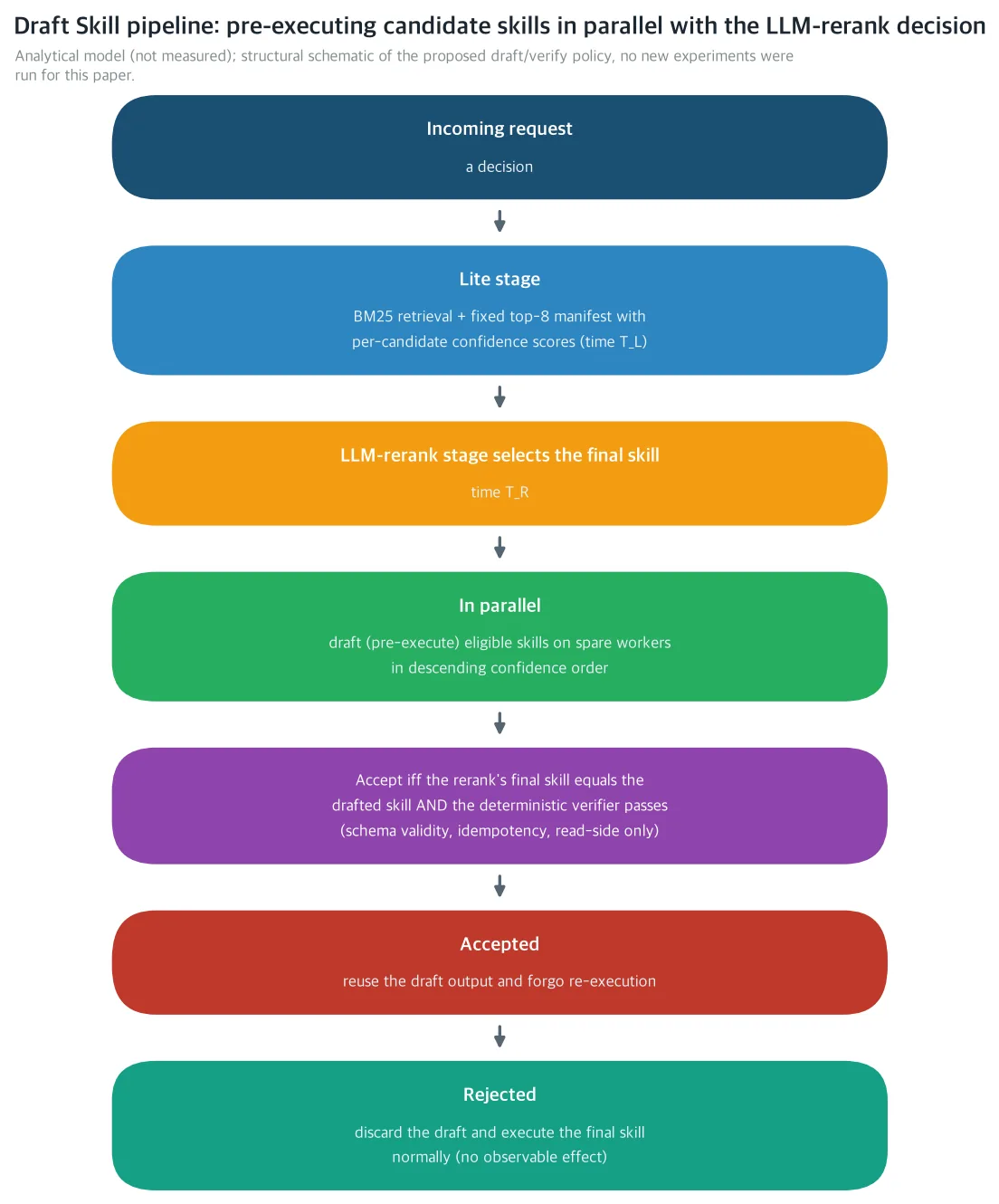 While the rerank stage computes the final skill, spare workers draft lite-confidence candidates, and the router’s own decision plus the deterministic verifier accept or discard each draft. This figure is a shape of the analytical model, not a measurement.
There are two regimes per decision, depending on whether the draft fits inside the rerank window. If the draft is hidden (T_D ≤ T_R), it starts at the end of the lite stage and finishes no later than the rerank decision. If accepted, the entire execution is absorbed by the window and the savings are all of T_E; if rejected, the savings are 0 and the draft is pure discarded compute. Either way, the rerank wall time is unchanged. If the draft is exposed (T_D > T_R), the rerank decision lands before the draft completes. At T_D = T_E, the tail of the execution can no longer be hidden, and the savings shrink to T_R.
Core Contributions: Four Results and the Action-Level Draft Law
The four results hold for within-class drafting: the case where, inside a cost class, the draft is the skill execution itself (T_D = T_E).
T1 is the single-draft break-even. In the hidden regime, the net economic gain per decision is B = λ(pT_E − (1−p)T_D), and speculation is net positive (+) only when p ≥ p* := T_D/(T_D+T_E). When T_D = T_E, p* = 1/2, independent of cost class, rerank latency, or threshold. Token-level speculation has a low bar because the per-token draft cost ratio is much smaller than 1. An action-level draft produces the whole execution, so the bar is not a thin overhead but half.
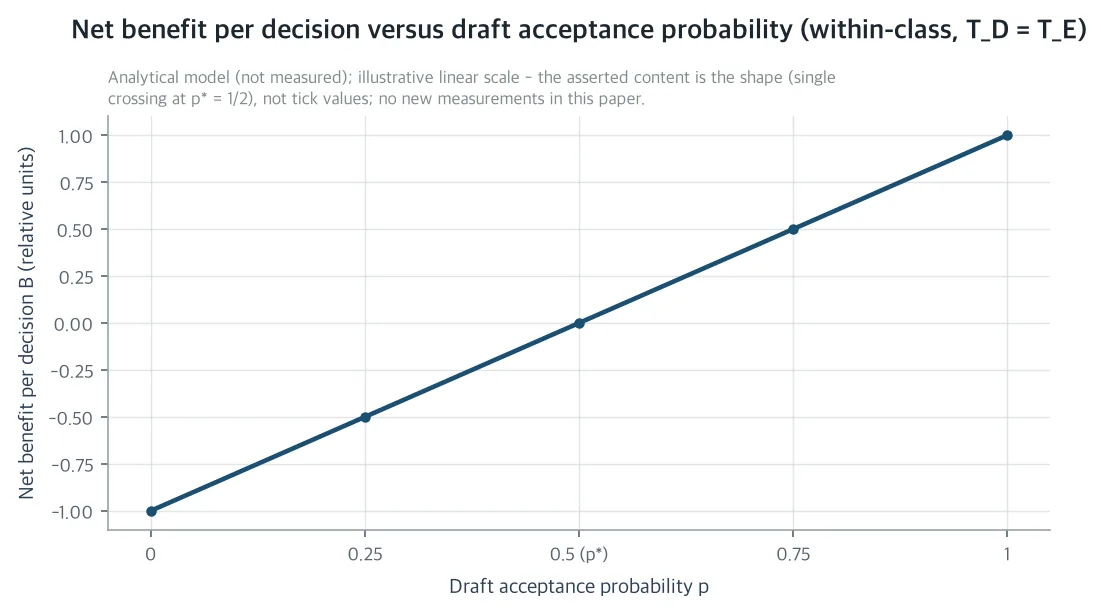 The within-class net gain is linear in the acceptance rate, with a unique zero crossing at the break-even p. The confidence threshold only tunes the size of the gain; it cannot flip the sign. This figure is a shape of the analytical model, not a measurement.*
T2 is hidden-regime invariance. When T_D ≤ T_R, (a) E[wall] = T_L + T_R + (1−p)T_E ≤ T_L + T_R + T_E, so speculation never makes wall time worse; (b) the expected savings pT_E are the same for all T_R ≥ T_D, and p does not depend on T_R; and (c) in within-class drafting, the discard-to-savings ratio is (1−p)/p, independent of class, T_R, and τ. In the exposed regime, the savings are p(T_E + T_R − T_D), and at T_D = T_E they drop to pT_R.
T3 is threshold sign-independence. Under the declared shapes (g(τ) decreasing in τ, p(τ) increasing, frontier B(τ) unimodal in τ), if p(τ) ≥ p* at all eligible τ, then B(τ) is non-negative at every τ. The job of the threshold gate is to adjust the size of the gain, that is the coverage, not to flip the sign. Within-class, B(τ) = λg(τ)T_E(2p(τ)−1) and is non-negative (+) at every τ where p(τ) ≥ 1/2.
T4 is the m-pool greedy rule. The net gain of an m-candidate pool (m parallel workers, each draft costing T_D) is B_m = p_mT_E − (m−p_m)T_D, which is net positive (+) only when p_m ≥ mT_D/(T_E+T_D). For the marginal m-th draft to pay, p_m − p_{m−1} ≥ T_D/(T_E+T_D) is required. At T_D = T_E, the pool break-even is m/2, and if coverage is not perfect it is reached only at m=1. That is, a single top-1 draft strictly dominates every larger pool. For a 2-draft pool to pay, T_E/T_D ≥ (2−p_2)/p_2 is required; for a 3-draft pool, T_E/T_D ≥ (3−p_3)/p_3. Multi-draft speculation is, in the end, a class-skew instrument: draft the cheap, decide the expensive.
The action-level Draft Law is the law that ties the four results together. Acceptance decomposes as p = 1 − (1−q)·r. q is the lite-stage top-1 accuracy, and r is the verifier repair probability conditional on a lite miss, that is, the probability that the rerank stage fixes that miss. The shape corresponds exactly to the token-level law. Only, since the unit of the draft is the whole execution and the verifier is the router’s already-computed decision, the bar is 1/2 and the verification cost is 0. The fact that the marginal verification cost is 0 is exactly what makes action-level speculation affordable in the first place.
Frontier of the Declared Nominal: Acceptance Margin 1.82x, Speedup 1.09~1.82x
The rate card is as follows. T_L = 0.05 s, T_R = 2.0 s (sweep {1, 2, 4, 8}), T_D = T_E = 0.3/2.0/20.0 s across the cost classes cheap/medium/expensive, lite top-1 accuracy q_L = 0.80, hybrid top-1 0.889, cited 8.9pp lift, verifier repair probability r = 0.445, top-1 acceptance p̄ = 1 − (1−q_L)·r = 0.911, pool agreement coverage p_2 = 0.960, p_3 = 0.985, discard-to-savings odds 0.0977. All of it is assumption, not measurement.
The top-1 draft frontier, by cost class: cheap (0.3 s, hidden) saves 0.2733 s, discards 0.0267 s, nets 0.2466 λ-s, and takes wall from 2.35 s to 2.0767 s, a 1.132x speedup. medium (2.0 s, hidden boundary) saves 1.822 s, discards 0.178 s, nets 1.644 λ-s, and takes wall from 4.05 s to 2.228 s, a 1.818x speedup. expensive (20.0 s, exposed) saves 1.822 s, discards 0.178 s, nets 1.644 λ-s, and takes wall from 22.05 s to 20.228 s, a 1.090x speedup. The equal net gain of medium and expensive is an accident of the nominal, not a theorem. The exposed savings are pT_R, and they equal the hidden within-class savings pT_E = 0.911 × 2.0 s only because the boundary class time overlaps the declared T_R = 2.0 s. At any other T_R, the two rows diverge.
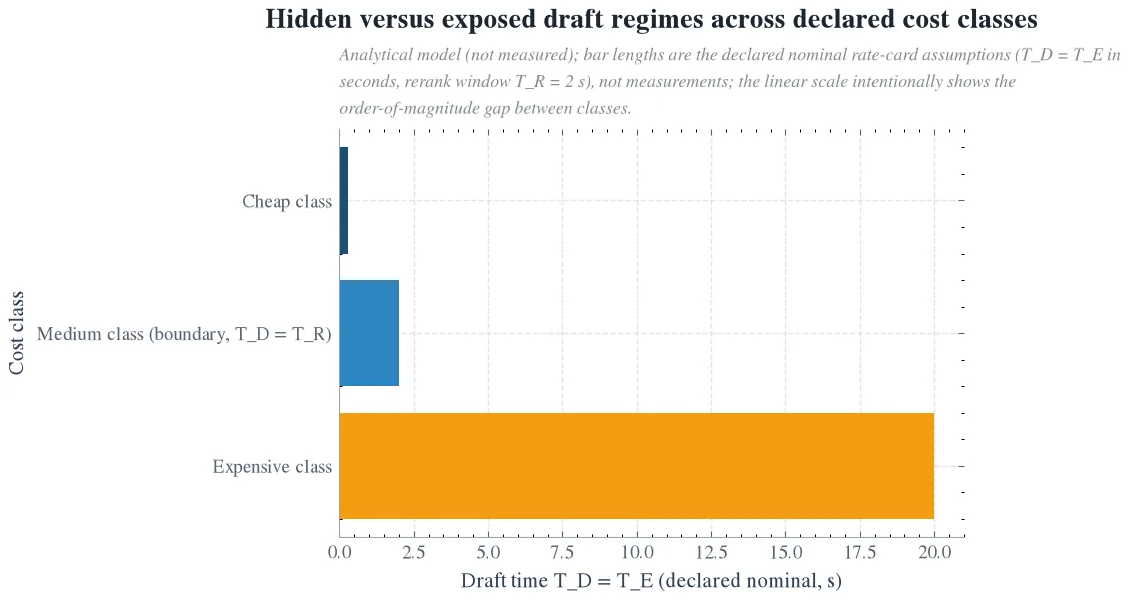 A draft whose execution time fits inside the rerank window is hidden and saves the whole execution. Only the expensive class is exposed, with savings capped by the window. This is a closed form of the declared nominal, not a measurement.
Along the rerank latency axis, the hidden frontier is flat in T_R. No term, savings pT_E, discard (1−p)T_D, or net gain B, contains T_R. The cheap row holds at every swept T_R, and the medium row holds at every T_R ≥ 2.0 s. The speedup ratio dilutes as the base wall grows, but the seconds saved do not move. The exposed expensive class saves pT_R, so at the sweep endpoint T_R = 1 s the net gain is 0.822 λ-s, exactly half of the T_R = 2 s value. The value of speculation concentrates where the rerank window is long relative to the draft. The window the toll gate selects is exactly that.
On the threshold axis, the nominal acceptance of 0.911 clears the 1/2 bar by 0.411, and since p(τ) increases in τ, the sign of B(τ) is positive (+) at every τ for as long as the declared shape holds. The gate’s job is scale, not sign. Lowering τ raises expected savings and expected discard together, and the declared unimodal shape of g(τ)p(τ) fixes the point where the scale peaks.
With a class-skew margin, at the declared coverage p_2 = 0.960 a 2-draft pool pays when T_E/T_D ≥ 1.083, that is under modest skew, and at p_3 = 0.985 a 3-draft pool pays when T_E/T_D ≥ 2.046, that is under strong skew. Within-class drafting (ratio 1) clears neither. So the pool row is negative (−) beyond m=1, and at T_D = T_E the only net positive (+) pool is the single top-1 draft. The pool frontier of the medium class (T_D = T_E = 2.0 s) is as follows. At m=1, p_1 = 0.911, pool break-even 0.5, B_1 = +1.644 λ-s. At m=2, p_2 = 0.960 is below the pool break-even of 1.0, and the marginal Δp_2 = 0.049 does not clear 0.5, so B_2 = −0.160 λ-s. At m=3, p_3 = 0.985 is below 1.5, Δp_3 = 0.025 is below 0.5, and B_3 = −2.060 λ-s is the largest.
Pre-Registered Measurement Protocol: 216 Strata, Falsification Criteria R1-R4
The paper declares a measurement protocol but does not run or report it in this paper. It is a two-arm comparison. The off arm has the rerank stage as the only decision path; the on arm is the draft/verify of the design section. The two arms share the same frozen decision set, the same 2,293-entry registry, and a single H200 node, so differences between strata are attributed to the draft stage. There are four sweep axes. The gate τ ∈ {0, 2, 4, 6, 8, 10} on the lite-confidence scale; cost class {cheap, medium, expensive} (T_D = T_E = 0.3, 2.0, 20.0 s); rerank latency T_R ∈ {1, 2, 4, 8} s under declared model/batch controls; and pool size m ∈ {1, 2, 3}. The design yields 6 × 3 × 4 × 3 = 216 strata, 432 arm-strata.
Each stratum reports four metrics: observed acceptance rate, wall p50/p95 per decision, discarded worker-seconds, and the net gain B evaluated under the stratum estimate (p̂T_E − (1−p̂)T_D in the hidden regime, or its exposed counterpart otherwise). The acceptance metric is agreement-based: the drafted skill equals the final rerank skill, and the deterministic verifier passes. That is the structure under which R1 directly puts the nominal p̄ = 0.911 against the 1/2 bar. Safety, as set up earlier, is the exclusion of write-side skills, the restriction to idempotent read-side, and the verifier running ahead of every draft.
There are four falsification criteria, and each names the result it falsifies. R1: if in any nominal stratum the observed top-1 acceptance of the cheap class falls below 0.5, that falsifies the nominal clearance claim that the agreement model of the declared rate card (p̄ = 0.911) exceeds the break-even p* = 0.5. The theorem only sets the bar; what observation verifies is the nominal. R2: if in a hidden-regime stratum the spec-arm wall exceeds the off-arm wall, then T2’s wall identity (a) is falsified as a prediction for that stratum. R3: if the observed discard-to-savings ratio departs from the predicted odds (1−p̂)/p̂ by more than the 95% binomial CI of the stratum acceptance, invariance (c) breaks. R4: if at fixed τ and class the observed acceptance depends on T_R, the acceptance invariance (b) is falsified.
What It Gives: Company, Society, Science
For the company, an unattended agent harness is charged the full decision latency of the LLM-rerank router before it runs any skill. This paper computes, on a self-hosted H200, the wall-time and wasted-compute frontier of speculative pre-execution that pre-runs cheap deterministic skills in parallel with the rerank stage and accepts or discards them with the router’s own decision plus a deterministic verifier, and hands over an operational lever that directly cuts the latency of 2,200-skill routing. The composition with the earlier family is clean. The toll gate decides which decisions get a verification window, and speculation monetizes that window. Speculation is accuracy-neutral, so the miss economics are invariant, and the token-level lever composes by reducing T_R itself. The hidden savings are invariant to that reduction, so the two levers price different terms.
For society, speculative execution at the action level, not the token level, turns routing decision latency into free parallel work. Small organizations can run always-on autonomous automation at lower compute and energy cost. That the acceptance judgment is a deterministic verifier rather than an LLM judge lowers the cost barrier of trustworthy unmanned automation. What the result gives is not a speedup number but a lower entry cost: the small operator running a 24/7 decision loop on a single H200 can afford that loop, because the speculation budget is a window already paid for and the verification budget is 0.
For science, this paper lifts the token-level speculative-decoding acceptance law (the Draft Law family) to the skill and action level. In the regime where the verifier is the router’s final routing decision and the draft cost is the entire skill execution, it sets the first closed-form acceptance, wall-time, and wasted-compute frontier and break-even conditions. It fills the ‘pre-decision execution’ gap that the decision-caching, post-execution routine-compilation, and post-decision parallelization families do not cover. The structural content is the zero-cost-verifier property, and it generalizes beyond skill routing. Any serving system that (a) has already computed the final decision and (b) has a stage taking T_R > 0 has a verification window. The unit of the draft only needs to be cheap, deterministic, and verifiable losslessly by the decision itself. The planner stage of an agent loop overlaps in-flight tool execution, and cache-invalidation windows and index rebuilds have the same shape. A reasoning router that spends T_R on deliberation instead of lookup widens the window and makes this property more valuable.
Limits: What This Paper Does Not Claim
There are four caveats. First, the declared nominal (q_L = 0.80, r = 0.445, p̄ = 0.911, coverage 0.911/0.960/0.985) must be calibrated before deployment. The results are closed form in it, but a stratum where observed acceptance drops below the bar loses its guarantee. Second, within-class T_D = T_E is an assumption that fails when the draft candidate costs differently from the final skill. T4’s skew condition covers part of it (at the declared coverage, a 2-draft pool needs T_E/T_D ≥ 1.083, a 3-draft pool 2.046). Within-class drafting at a non-1 ratio loses in every pool beyond m=1. Third, the model prices a single decision window. Chained speculation, drafting inside a draft, is out of scope, and the hiding condition must be re-verified for every window. Fourth, scale. The cited 8.9pp hybrid-over-BM25 lift and the endorsement model (if the rerank cannot fix a lite miss, it does not fall back to the second candidate but endorses the wrong lite top-1; a declared assumption of this paper) are used as declared constants at the 2,293-entry scale, and both can move with registry growth.
This paper contains no new measurements at all. Every number is either a closed-form prediction under the declared nominal assumptions or a result belonging to the cited references. The pre-registered protocol with R1-R4 is declared, and its follow-up run will be the pre-specified test of the four results. Until then, the acceptance margin of 1.82x and the per-decision speedup of 1.09~1.82x remain model predictions.
The paper and its accompanying materials are available on Hugging Face.
https://huggingface.co/datasets/thaki-AI/daily-paper-2026-10-25-draft-skill-speculative-execution-frontier