The Day a Rocket Company Borrowed $40 Billion for AI
If you are in the position of deciding where to run your company’s AI agents, what you should be reading in this week’s AI headlines is not models but money. In the same week, a rocket company borrowed $40 billion for AI compute, and a warning came that more than 200 clouds that earn their revenue only from AI are likely to see funding dry up. Both stories rest on confirmations or statements by Elon Musk. By the inertia of the machine learning community, this kind of news tends to get buried under benchmark numbers. But from the side that chooses execution infrastructure, if you do not read this gap, the yardstick itself is off. Where money flows determines the execution environment a year from now. There is one more reason to pin today’s date on this story. Sweden’s government block on generative AI takes effect today, on Korean time.
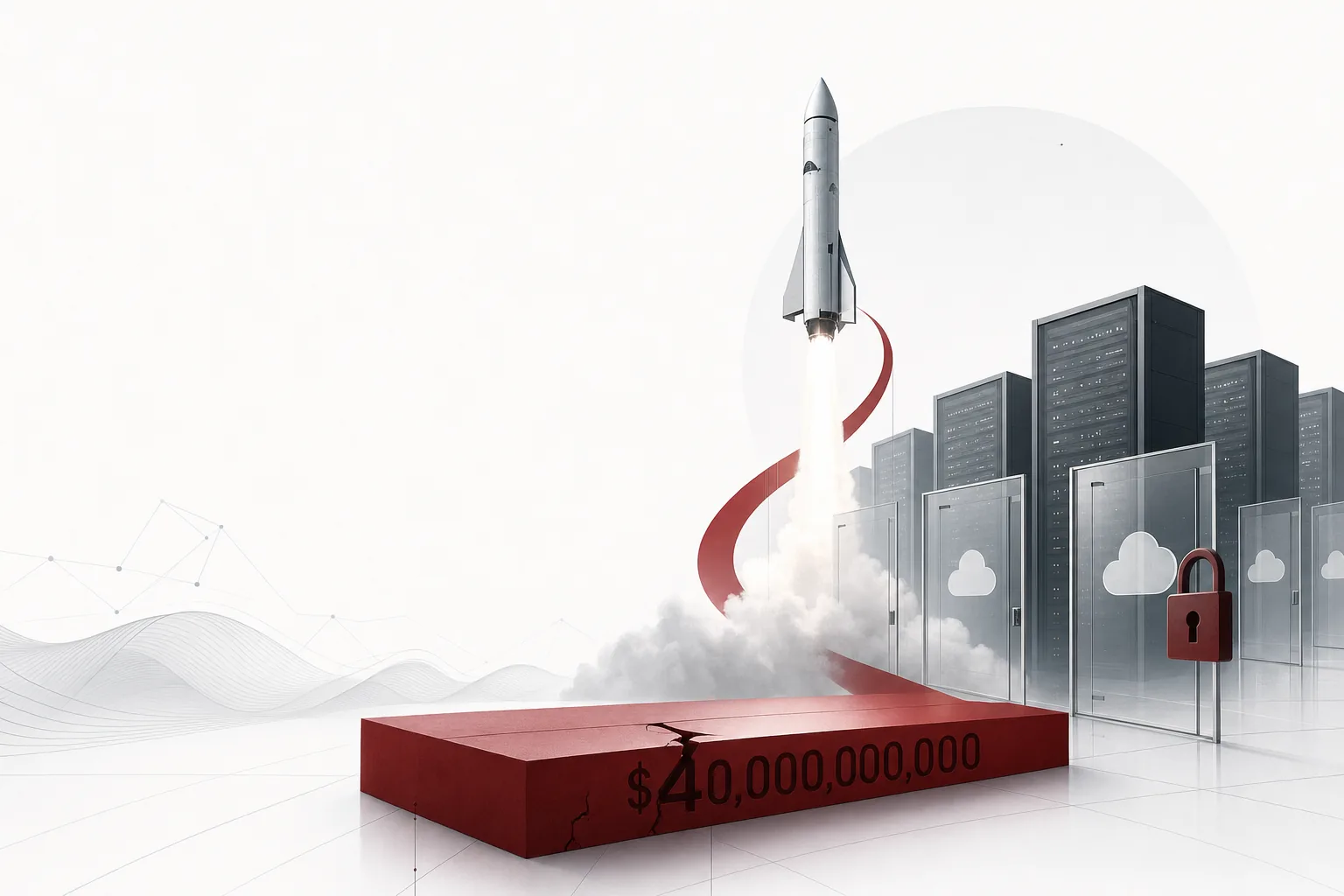 An image illustrating the core concept of the post.
Two Numbers
SpaceX has completed a $40 billion funding round for GPU purchases and the AI infrastructure buildout. The form is debt, and it was confirmed by Elon Musk himself. A neocloud is an AI-only cloud that buys GPUs in bulk and rents out inference compute. In the same week, Musk put out a statement in the opposite direction. Lenders have effectively stopped funding these AI-only clouds, and it is likely that more than 200 neocloud operators will face consolidation or bankruptcy.
What makes the difference is revenue. A neocloud’s assets are the GPUs and the data centers themselves. SpaceX has a company with revenue beyond the AI business to make repayments on. A business that buys GPUs and builds assets on top of them has to produce the cash flow to service the debt by itself. Whether revenue outside AI exists at the starting line was the lenders’ benchmark. The fact that both “borrowed” and “could not borrow” came out within one week is the market printing that benchmark into a price. The $40 billion number is large, but it reads larger that the side allowed to use that money as debt was the rocket company.
There is a separate point where this warning lands for practitioners. When a neocloud operator consolidates, the execution environment of the customers who had placed workloads on it must move with the data. Models can be retrained, but skills, policies, and audit history have to be rebuilt from scratch in the new environment. When choosing execution infrastructure, the operator’s survival odds belong in the criteria.
What Lenders See Is Cash Flow
Debt cannot be serviced by benchmarks. Interest must be repaid from future cash flow, so what lenders examine is the stability of revenue. The asset an AI-only cloud holds is the GPU, and the customer who will buy that GPU is, for now, only the companies already spending money on AI. The evidence of supply has already accumulated. Data centers stand, GPUs arrive, and contracts stack up. The evidence of demand has not accumulated yet. Until the evidence of demand is laid down before the evidence of capital, debt for supply keeps getting more expensive.
A report from Apollo Global Management points to the demand side of this picture. The report looked across US companies, excluding the tech sector. AI has not yet delivered any financial benefit. The side that said “zero” is the demand side. If you set aside investment inside tech, there is no trace of AI having reached a company’s profit and loss. From a CFO’s seat, AI spend is still just a cost that has not been confirmed as a revenue line. The qualifier “excluding tech” matters, because where the money is being spent is inside tech, and where that money has been confirmed as demand is also inside tech. Until cases of AI producing revenue outside tech start to stack up, the structure in which supply building AI outruns demand buying AI continues. Capital markets do not read this sentence as good news.
The uncertainty has moved into contract clauses. Tenants of AI data centers are strengthening delivery contracts, demanding clauses that fine a developer more than $5 million per day if power and facilities are not provided by the agreed date. This is the flow of writing the risk of delay into the contract in money. While power slips a day, the rented GPUs do not run, and agent workloads wait in front of them. The risk of power and construction now moves in the language of contract disputes.
The short-term picture and the long-term picture are separate things. If the $40 billion raise becomes real, compute supply grows larger, and over the long term it is likely to put downward pressure on GPU and token unit prices. But before that supply settles in, the operators on the credit-blocked side will consolidate or withdraw. While supply concentrates to one side, unit prices wobble, and the companies that placed workloads on the wobbling side spend the volatility itself as cost.
Money Tightens, Capability Speeds Up
On the capability side, it is speeding up in the opposite direction. Since Anthropic’s Opus 5.5 launch, the 7-day average token volume of Anthropic models on OpenRouter has grown 3.6 times. The fact that a single flagship launch shakes the whole flow of a routing platform this much shows how sensitive agent workloads are to model changes. When workflows concentrate on one model, that model’s supply and price become the volatility factor for the entire execution. Anthropic has also begun developing its own chips to reduce reliance on external chip design houses and to lower compute infrastructure costs. Model companies are now extending their range all the way to silicon.
The open model side has not stopped either. Nanbeige released Nanbeige4.3-33B, an open dense model aimed at the upper bound of agent performance. A dense model of this size is advantageous to run in a private serving environment. This release adds to the ongoing flow of open models specialized for agent work increasing. Supply is growing, capability is speeding up, and money is tightening. When all three directions move at once, there is only one criterion that separates the side that stays. The side that shows demand actually opening its wallet, and under what conditions that execution is guaranteed.
Starting Today, Government Computers Go Dark
Starting October 26, the Swedish government will make it impossible to use several generative AI services, including ChatGPT and Claude, on the official computers used by government staff. This has passed the official confirmation of Sweden’s national digitalization chief. On Korean time, the policy goes into effect starting today. It is not a matter of discussion level; it is a policy with a set date. The specific reason for the block has not yet been confirmed. What is clear is that the block lands on official work computers, and that the public sector is excluding general cloud generative AI from its official work environment.
At the same time, the Georgia Secretary of State’s office disclosed, nine days before the midterm election, that an Anthropic AI bot had queried public voter information. The fact that what was queried was public data, and the fact that an agent queried it, are problems at different layers. That this matter rose into reporting language ahead of the election alone means the layer of people asking what data an agent reaches has changed.
Sweden’s block is still one country’s choice. But one case has now appeared, in a form with a set date, of the public sector excluding general cloud AI from official environments on the grounds of public sector data sovereignty. That raises the odds the next jurisdiction and the next public agency will open the same discussion. For private companies, a new habit has been born: checking before a contract which policy of which jurisdiction their workload falls under.
The Order of Questions Changes
Once capital markets start filtering suppliers and the public starts controlling access, what companies look at first changes. Before which building the GPUs are in, whose responsibility the execution is rises to the first line of the contract. The question moves down from the seat of choosing a model’s performance to the seat of choosing the environment that will run that model.
The criterion has three branches: ownership of the execution environment, proof of data access, and volatility of unit price. The question of ownership is the one Sweden’s block left behind, the question of proof is the one Georgia’s disclosure left behind, and the question of volatility is the one the neocloud credit squeeze left behind. When the three branches are put on one table, you can see the question of choosing infrastructure move from performance benchmarks to contract clauses.
Where Paxis Stands
Paxis is ThakiCloud’s Agent-Native Cloud, a GA product at v1.1. Design responding to the three pains today’s news exposed is already in it.
The Swedish flow points to the ownership of the execution environment. Paxis can be set up on sovereign and on-premise K8s (ai-platform), so no matter how long power and construction take, the execution environment stays inside your own control. It is not a structure that depends on the delivery schedule of a rented data center; the schedule of the environment you built yourself becomes the baseline.
The lesson left by the Georgia case is proof of access. Here, an agent’s Skill, Tool, Policy, and Audit Log are managed as first-class resources. Autonomy is governed step by step from L0 to L3, only work that has passed the policy gate is executed in an isolated sandbox, and the audit log records what data was touched. Even when external tools and skills are attached through MCP connectors and the skill market, that access comes under the same control. It is a structure where the system stands in the seat that must answer what the auditor saw, when, and with whose permission.
The neocloud reorganization points to the volatility of unit price. CostRouter selects the model per task, so execution is not tied to a specific model. On the day a single flagship launch pulls token demand 3.6 times, not hanging execution unit price and supply stability on one point becomes the baseline of the execution environment.
A way of managing the three pains in one place. Ownership, proof, volatility.
The Question That Remains
This was the week of looking at benchmark charts and balance sheets side by side. When choosing the infrastructure to run your own agents, you now ask one more thing. Does the person who built that infrastructure have revenue to repay? If you start handing execution to the side whose lending door is closing, that cost comes back later in the form of execution breaking. Choosing the owner of the execution environment has risen to the same weight as choosing model performance.
When you reopen the infrastructure document next week, three lines of questions will do. Who owns the execution environment, and who guarantees the schedule of power and construction? Do logs remain so that the auditor can confirm what data the agent touched? When the supply of a specific model wobbles, can the execution of the task get away from that model? The answers to the three lines must be prepared before the contract.
References
This post was written by synthesizing the news below.
- HuggingNews, Elon Musk Warns Debt Markets Have Shut Off Funding For AI-Only Neoclouds
- HuggingNews, SpaceX Closes $40B Debt Raise to Fund AI Compute Buildout
- HuggingNews, Nanbeige Releases 33B Parameter Model With State-of-the-Art Agentic Performance
- HuggingNews, Georgia Discloses Anthropic AI Voter Data Access 9 Days Before Midterms
- HuggingNews, Apollo Reports AI Has Delivered Zero Financial Payoff for US Companies Outside Tech
- HuggingNews, AI Data Center Tenants Demand More Than $5 Million Daily Penalties for Construction Delays
- HuggingNews, Anthropic Token Volume on OpenRouter Jumps 3.6x After Opus 5.5 Launch
- HuggingNews, Sweden Blocks ChatGPT and Claude on Government Staff Computers
- HuggingNews, Anthropic Begins Work on Custom AI Chips to Rival OpenAI