It Wasn’t the Model That Was Worth $8 Billion. It Was the Router.
Today’s most expensive price tag in AI news didn’t attach to a model. It attached to the layer that picks the model. Stripe acquired OpenRouter for over $8 billion, the fastest large-scale AI acquisition on record. On the same day, the top spot on the open-model intelligence leaderboard changed hands again, and a local coding model that had held the number one position for four months lost it to a newcomer in just four days. Put these two facts side by side and it becomes clear what the market priced today.
 Models come and go like consumables, while the layer that manages between them remains as structure. An image of what today’s news priced.
A Throne That Changes Hands Every Four Days Is Hard to Price
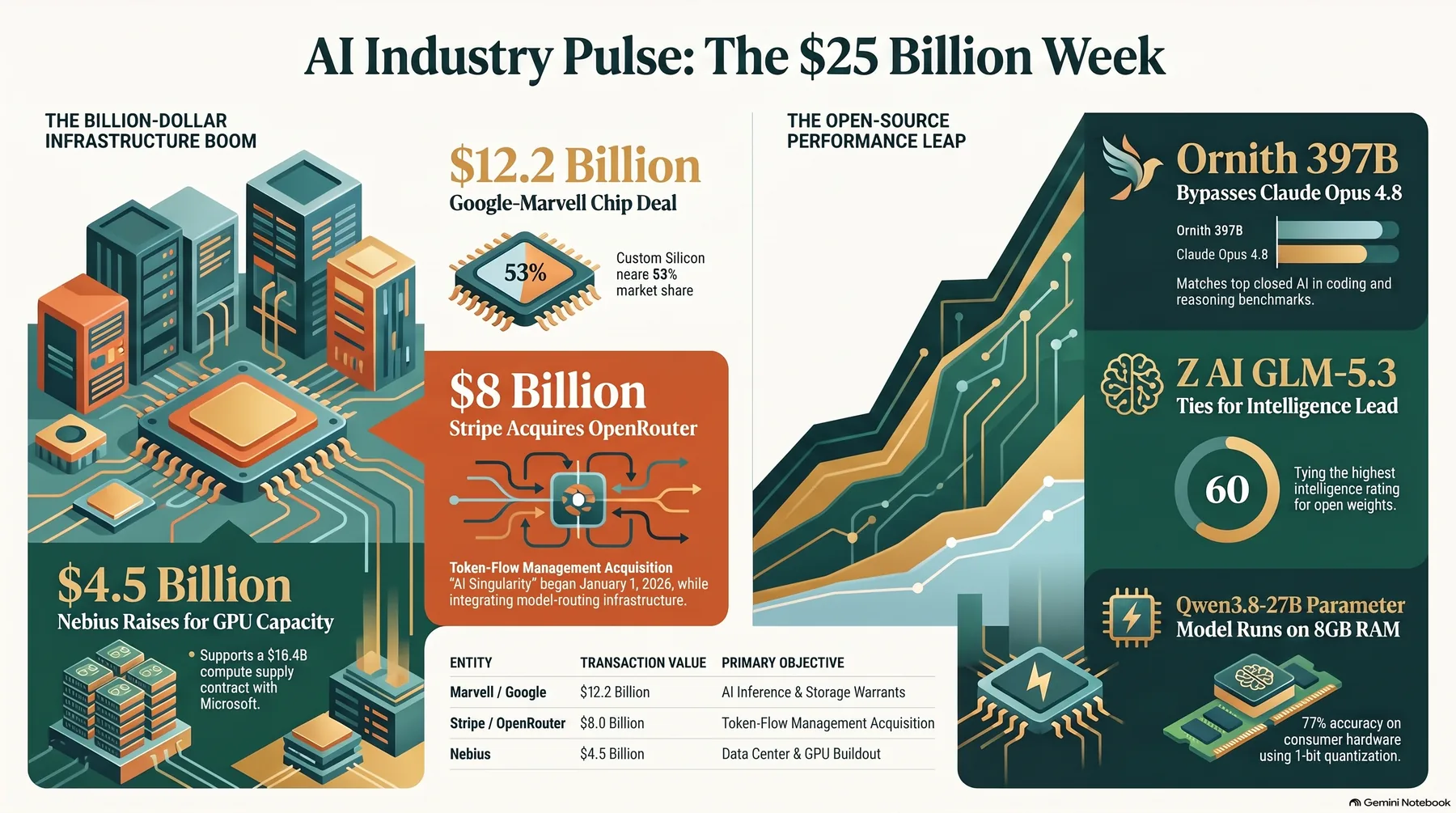
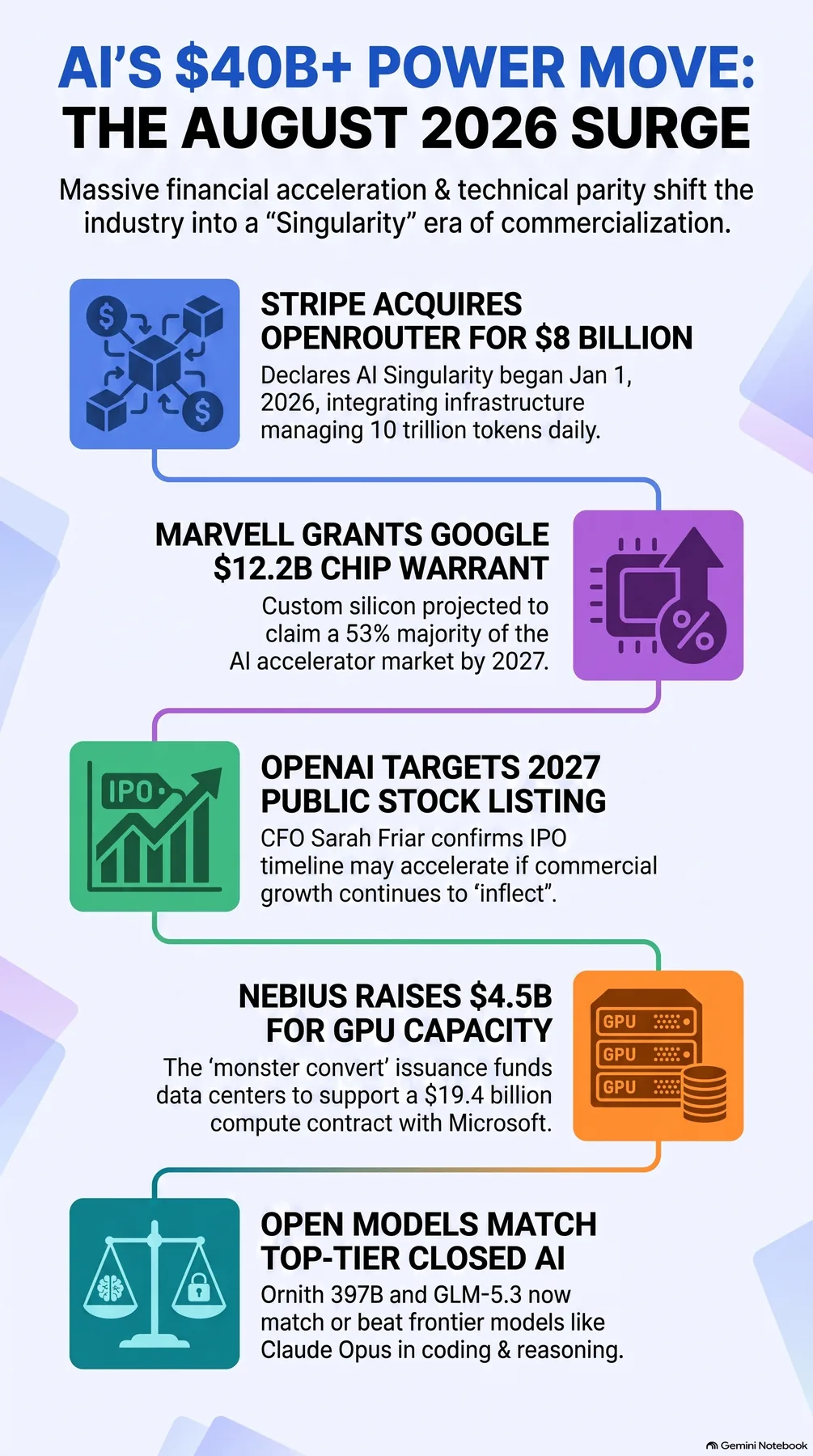
Let’s start with the model news, in order. Z AI released GLM-5.3 via API, matching Kimi K3 with an intelligence score of 60. The model specializes in defensive cybersecurity, coding, and complex agentic tasks, and the striking part is that it reached that score without changing its base model. At the same time, Alibaba’s Qwen3.8-27B became the top local model on the Cline platform just four days after launch, ending Qwen2.5-Coder-7B’s four-month reign. It also took the top spot on Harvey simultaneously. Meanwhile, Ornith released its Ornith-1.5 lineup, spanning a 9B dense model, a 35B MoE model, and a 397B MoE model, with the 397B variant outperforming Claude Opus 4.8 on coding benchmarks.
What these three stories share isn’t performance. It’s cadence. We’ve reached a market where a four-month run at number one is now newsworthy for lasting that long. It’s hard to sign a long-term contract around an asset whose throne turns over in four days. The moment a company writes a specific model name into a contract or into its codebase, that sentence turns into a liability the next quarter.
The Ornith news adds another layer here. When an open model becomes competitive with the top closed models on coding, one of the standard arguments for delaying open-model adoption, the performance gap, disappears. Once performance stops being the deciding factor, other criteria take its place: where can you run it, where does your data go, can you keep custody of the weights. For regulated industries and air-gapped customers, these were already the top priorities, and now there’s less room to be talked out of them by a performance argument. This is exactly the shape a single benchmark line takes when it starts reshaping procurement criteria.
One caveat is worth stating plainly. Topping a benchmark and being the best fit for your own workload are two different events. Ranking first on Cline and Harvey doesn’t guarantee it’s the best choice for your codebase. That’s why organizations that match model swaps to the pace of the news cycle usually come out behind. What’s needed isn’t faster swapping, it’s a structure that makes swapping cheap. The two are often confused, but they carry opposite cost structures.
 Infographic generated by NotebookLM from the sources.
The Same Model, Three Doors
The GLM-5.3 story carries a second, less flashy but more structural fact than the score itself. This model is accessible anonymously through the Venice platform, available on OpenRouter, and also offered directly through Z AI’s own first-party channel. One model, three doors.
Having multiple doors looks like more choice to end users, but from an operations standpoint it means three things to manage instead of one. Each channel has its own auth method, its own rates, its own data-handling policy, some allow anonymous access and some don’t. Until yesterday, the question was which model is smartest. Today, the question is which channel of which model should this particular task go through. The latter isn’t a question of model capability, it’s a question of policy.
Cost accounting gets harder in the same spot. Route one model through three channels and you get three separate bills. Figuring out which team’s which workflow spent how much doesn’t come out of channel-level totals. It gets worse when the entity spending tokens isn’t a human but an agent. Agents call far more often than people do, retry on failure, and those retries get billed too. If you can’t roll usage up by task, cost management ends up being a series of after-the-fact surprises.
This is precisely the layer Stripe bought. The acquisition announcement itself didn’t lead with a model, it led with 10 million developers and enterprise-level token flow. Managing flow is essentially the definition of what a payments company has done for a long time: pick a channel, fail over to another one when it breaks, log what moved, settle it later. It’s more accurate to say the payments company arrived first at the point where routing starts to resemble payments, than to say a payments company bought an AI company. In the same announcement, Stripe reported 41% year-over-year revenue growth and 43% growth in free cash flow for the first half, and added a declaration that the “AI singularity” began on January 1. The declaration is marketing. The price tag is not.
Under the Router, There’s Still Metal
Stopping the discussion at routing alone would miss half of today’s news. Nebius launched a $4.5 billion convertible note offering, with proceeds earmarked for accelerating construction of large-scale compute sites. The market’s reaction wasn’t a warm one: shares fell 7% premarket on the news. It’s a signal that the race to expand compute is now being read not just as a growth story but as dilution risk.
The supply side got another layer of complexity too. Marvell expanded its chip agreement by granting Google an AI chip warrant worth $12.2 billion, covering inference accelerators and memory and storage controllers for Google’s TPUs. Marvell’s shares rose 13%. It’s a sign that the supply of inference compute isn’t converging on a single lane of general-purpose GPUs, it’s branching.
At the opposite end, hardware requirements themselves are shrinking. Unsloth released new GGUF and quantized weights for Qwen3.8-27B, saying that 1-bit quantization lets the 27B model run on consumer-grade hardware with as little as 8GB of RAM while retaining roughly 77% accuracy. A 27B model running on a laptop and a $12.2 billion dedicated accelerator deal show up in the news on the same day. It’s hard to make the point more clearly that the optimal place to run a workload differs from one workload to the next.
That 77% figure deserves to be read at face value. It’s a trade that gives up 23% of accuracy in exchange for a big drop in hardware requirements, and whether that trade makes sense depends entirely on the task. For classification, extraction, or draft generation, work with a verification step downstream, it’s a good deal. For work whose output goes straight to a customer or feeds directly into the next stage, 23% is not a cheap price. Because the answer differs by workload even within the same organization, picking one standard model company-wide is increasingly a losing move.
Stack these two stories together and the shape of procurement itself changes. Neoclouds are building large sites on debt, hyperscalers are expanding their own inference chips, and a path down to small hardware is opening up at the same time. Betting everything on any one of these three is risky. What’s needed now isn’t the ability to pick the optimal hardware, it’s mobility, the ability for a workload to move when the hardware underneath it changes.
The Router Ends Up Being Someone’s Asset Too
Here’s a common assumption worth flipping. The conclusion that “model lock-in is risky, so wrap it in a router” is only half right. The moment a specific company owns that router, the router becomes the new lock-in point. A layer that looked neutral yesterday became one payments company’s asset today. Add to this OpenAI’s target of a 2027 IPO, with CFO Sarah Friar saying the listing timeline depends on how fast commercial performance accelerates, and the whole supply side starts moving under monetization pressure. A supplier with a listing timeline has reasons to adjust its pricing and its policies.
We’ve seen this scene play out before: what happens after neutral infrastructure gets acquired. At first, nothing changes. Over time, the features closest to the acquirer’s core business get better first, and the features further away get deprioritized. For a router owned by a payments company, settlement and billing are the likely areas to sharpen fastest. If that direction happens to align with your team’s direction, great. If it doesn’t, you end up waiting on someone else’s roadmap. There’s no reason to treat the acquisition itself as bad news, but the fact that roadmap authority has moved outside your organization needs to be factored in.
So the real defense isn’t whether you use a router. It’s whether you own the routing rules. Which task goes to which model, which data is allowed through which channel, who can change those rules, and what gets logged when they change, all of that needs to be your asset. If those rules live only in someone else’s console, you’ve avoided model lock-in by trading it for router lock-in.
Why We Designed Paxis This Way
This is the reasoning behind ThakiCloud making Skills, Tools, Policies, and Audit Logs first-class resources in Paxis. We treat the model as a swappable part, and made the rules for swapping it, and the record of that swapping, the backbone of the product. In a market where the top spot changes hands every four days, what determines operating cost isn’t which model you plugged in, it’s what doesn’t break when you swap it out. Our CostRouter handles per-task model selection, and autonomy levels from L0 to L3 pass through policy gates and audit logs, and that structure comes from the same judgment. Running agents in isolated sandboxes and attaching tools through MCP connectors is likewise a choice made on the assumption that tools and models will keep changing.
We didn’t fix the execution location to one place either. As long as models running on small hardware via 1-bit quantization coexist with models running on dedicated accelerators, the requirement becomes running the same policy everywhere, including sovereign environments and on-prem Kubernetes. Run everywhere, optimize deeply on ThakiCloud isn’t a slogan. It’s an answer to exactly the kind of news we saw today.
Summary
There are three things worth checking right away. First, count how many places the model name you’re using today is hardcoded into your code and prompts. That count is your switching cost. Second, check whether last month’s token spend can be broken down by task. If all you get is channel-level totals, what you have is a receipt, not accounting. Third, check whether you have a regression eval set that tells you what broke when you swapped models. Without one, every swap decision gets made by gut feel. All three are more tedious than picking a model, but they’re the ones that actually make a difference the next time the throne changes hands.
There’s one sentence worth taking away from today’s digest. Models are becoming commodities, and the price landed on the layer between the model and the work. Hand that layer over entirely to someone else, and all you’ve done is rename your lock-in. The question your team needs right now isn’t which model to use. It’s what has to change in your workflow when the model changes. The shorter that list, the more the next throne change stays just a headline.
 Infographic generated by NotebookLM from the sources.
References
This article was compiled from the following news sources.
- HuggingNews, Stripe Buys OpenRouter for $8B in Fastest Large Scale AI Acquisition
- HuggingNews, Stripe Buys OpenRouter for $8B and Declares AI Singularity Began Jan 1
- HuggingNews, Z AI GLM-5.3 Ties Kimi K3 as Most Intelligent Open Model With 60 Score
- HuggingNews, Z AI’s GLM 5.3 Ties Kimi K3 Intelligence Score Using Unchanged Base Model
- HuggingNews, Qwen3.8-27B Hits No 1 on Cline and Harvey to End 4 Month Model Streak
- HuggingNews, Qwen3.8-27B Model Runs on 8GB RAM via 1-Bit Quants Retaining 77% Accuracy
- HuggingNews, Ornith 397B Open Model Beats Claude Opus 4.8, Matching Top Closed AI in Coding
- HuggingNews, Nebius Raises $4.5B in Convertible Notes, Shares Fall 7% Premarket
- HuggingNews, Marvell Grants Google $12.2 Billion AI Chip Warrant, Lifts Shares 13%
- HuggingNews, OpenAI Targets 2027 IPO, Potential Earlier Listing if Business Inflects