Models Are Going Free. So Why Is Compute Borrowing $36 Billion?
If your team runs in-house AI on a handful of H200s, this week’s news boils down to a single takeaway. Getting your hands on a frontier model is becoming close to free, but actually running that model cheaply and safely on your own infrastructure has become more expensive and more scarce than ever. As models become commodities, the center of gravity in this competition shifts from “which model are you using” to “where and how are you running it.”
That contrast is not an abstraction. On the same day, Alibaba announced it would give away, for free, a 2.4-trillion-parameter frontier model the following week, while Anthropic signed a $10 billion contract just to secure compute. Models are getting cheaper while compute gets more expensive, and buried in that mismatch is the thread that in-house AI strategy needs to pull on.
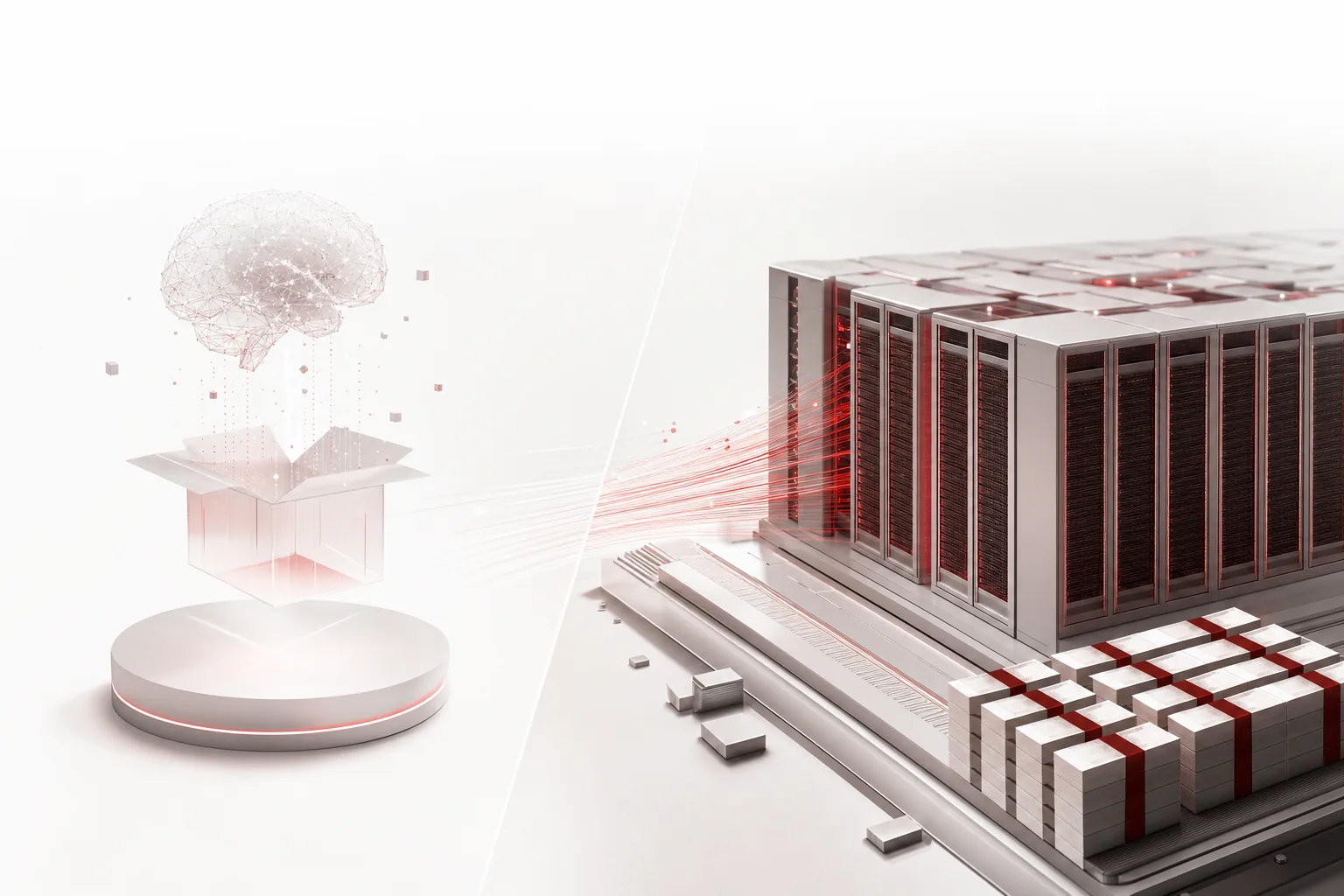 An illustration of the core idea behind this piece.
Two scenes that played out on the same day
The first scene is about models. Alibaba unveiled Qwen3.8-Max, a 2.4-trillion-parameter model it says will compete with the leading models from OpenAI and Anthropic, and announced it would release the weights for free the following week. Around the same time, DeepSeek launched V4 Flash for coding and agentic work at an industry-low $0.14 per million tokens. The fact that demand was so overwhelming it triggered server capacity failures is, ironically, proof of just how disruptive that price point is. Just days earlier, frontier-level performance was locked behind a handful of closed APIs. Now it is being handed out as free weights and tokens priced close to cost.
The second scene runs in the opposite direction. Anthropic signed a six-year, $10 billion compute deal with Volta, an Nvidia-backed infrastructure startup, and Blackstone is discussing a second debt package of at least $36 billion to fund custom AI chip usage, surpassing the previous $35 billion facility. In a world where models are being handed out for free, the compute needed to actually run them is pulling in capital on the scale of a national budget.
The scarce resource has moved from models to compute
Put the two scenes side by side and the question becomes obvious. If models are free, why is compute being financed with tens of billions of dollars in debt? The answer is that scarcity has changed location. The cost of copying a set of weights approaches zero, but the GPUs and electricity needed to serve those weights to thousands of requests per second cannot be copied. As models become products, the real bottleneck moves to compute itself.
That shift is already showing up in physical and geopolitical form. SpaceX and Nvidia are putting a 250-kilowatt compute payload called Starmind AI1 into orbit, aiming to build the first data center in space. Power and land on the ground have run into limits severe enough that orbit is now a candidate site. Meanwhile, the Trump administration is preparing federal rules to block new imports of Chinese optical transceivers for AI data centers by the end of the year. Even a single networking component that links data centers together is now treated as a matter of national security. Once compute becomes both a capital question and a geopolitical one, deciding where and with what hardware to build infrastructure becomes an exercise in risk management.
The fact that a single component can become a regulatory target is not someone else’s problem for teams planning infrastructure. Supply-chain restrictions on networking parts like optical transceivers translate directly into cost and schedule risk for building data centers. Focus too narrowly on securing GPUs, and the bottleneck can end up in the parts that connect those GPUs instead. With compute now sitting at the intersection of capital and geopolitics, cloud providers and in-house infrastructure teams alike are better off building regulatory variables into their hardware procurement plans ahead of time.
The bill for free models arrives from serving, not licensing
This creates a real trap for in-house AI teams. Free weights and rock-bottom API pricing make it look like the cost problem has been solved, but the actual bill arrives from serving, not from the model itself. The server outages caused by demand overwhelming DeepSeek’s ultra-cheap API are a warning that any workload sitting on someone else’s infrastructure can spiral out of control at any time. Actually running a 2.4-trillion-parameter open model on premises requires multi-node serving, precise GPU scheduling, and a fresh cost-versus-performance evaluation for every model, all at once.
This is exactly where the flood of open weights turns from a burden into an opportunity. When several strong models are released for free, it means you have more options to pick the cheapest, most suitable model for each task and run it on your own infrastructure. What matters is the operational capability to automate that selection, allocate limited GPUs fairly across workloads, and avoid leaving spare capacity idle. As ultra-cheap APIs push the cost baseline lower, the math on bringing in-house workloads back to private serving needs to get sharper, not simpler.
More benchmarks make the choice harder, not easier
More options also means a harder choice. On the same day, Alibaba announced it had integrated Qwen3.8-Max into the Hermes Agent platform, where it scored 1,668 on the Frontend Code Arena and placed fourth. That it landed in fourth place, rather than first, is the more important detail. The question on the ground is no longer “which model is smartest” but “is fourth place good enough for this task, and how much does that save us.” Nvidia’s own release that day, an autonomous-driving reasoning model called Alpamayo 2 Super, tops out at 34 billion parameters, and that fits the same pattern. When the domain is well defined, a mid-sized specialized model is often the right answer, not a giant general-purpose one.
This diversity leaves operators with two jobs. First, you need your own eval harness to verify how each model actually performs on your specific tasks, since public arena scores are a starting point and no guarantee of performance on your data. Second, you need routing that automatically swaps in the right model for each task based on those results. Send simple requests to a cheap open model and reserve the harder judgment calls for a top-tier model, and you can get the same outcome at a fraction of the cost. In an era where models are commoditized, the edge does not come from using the best model. It comes from the judgment to deploy the right model cheaply for each task.
Regulation and leaks add a third axis
Compute is not the only thing tightening. Governance became heavier as a third axis this same week. The EU began enforcing transparency obligations under the AI Act, granting its AI Office the power to fine companies up to 3 percent of global revenue. Obligations like deepfake labeling are no longer recommendations, they are now enforceable rules with real penalties. On top of that, Apple filed for an emergency injunction alleging that thousands of pages of hardware secrets were leaked to OpenAI through 14 former employees. The risk of model and infrastructure technology walking out the door with people has now turned into a court case.
Regulatory enforcement and technology leaks look like unrelated events, but for anyone operating in-house AI they converge on the same requirement: you need to be able to prove, after the fact, what ran under which policy and who accessed which data. Control over where a model runs, audit logs for every single execution, and least-privilege access all become your defense on both the regulatory and security fronts at once.
What to prepare for
If you had to sum up this week’s news in one line, it is that models are becoming a commodity and differentiation has moved down into operations. The moat going forward is the ability to run free weights cheaply on your own infrastructure, schedule limited GPUs without waste, and govern execution through policy and audit.
This is exactly why ThakiCloud built Paxis and ai-platform on these three pillars. Paxis, our GA product, uses CostRouter to handle per-task model selection, automatically picking the cheapest suitable model for the job, while ai-platform relies on Kueue-based GPU scheduling to sustain on-premises multi-model serving of large open models. At the same time, policy gates, audit logs, and isolated sandboxed execution leave a trail of evidence against regulatory and leak risk. As models become commodities, the only asset that cannot be copied is the infrastructure and governance that let you run them sovereignly and cheaply. This week’s news is a signal that the time to prepare that asset is now.
References
This post synthesizes the news items below.
- HuggingNews, Alibaba Launches Largest AI Model With 2.4 Trillion Parameters To Rival OpenAI And Releases Model Weights For Free Next Week
- HuggingNews, DeepSeek Launches V4 Flash Coding Model With Record Low $0.14 Price Per Million Tokens To Trigger Server Capacity Failures
- HuggingNews, Alibaba Launches Coding AI Qwen3.8 Max On Hermes Agent With Fourth Place Score Of 1,668 On Frontend Code Arena
- HuggingNews, Nvidia Launches Alpamayo 2 Super Reasoning Model With 34B Parameters To Improve Complex Decision Making For Autonomous Vehicles
- HuggingNews, Anthropic Signs $10 Billion Compute Deal With Nvidia Backed Volta To Scale Claude AI Using Norway Data Center
- HuggingNews, Blackstone Leads Second Debt Deal Of $36 Billion For Anthropic Google Chip Use To Surpass Previous $35 Billion Facility
- HuggingNews, SpaceX And Nvidia Build Starmind AI1 Space Compute Payload With 250 Kilowatt Power Capacity To Launch First Data Centers In Orbit
- HuggingNews, Trump Administration Drafts Ban On New Chinese Optical Transceivers To Block Imports This Year And Secure US AI Infrastructure
- HuggingNews, European Union Launches AI Act Enforcement To Label Deepfakes And Fine Tech Firms Up To 3% Of Global Revenue
- HuggingNews, Apple Files For Emergency Injunction To Block OpenAI From Using Thousands Of Stolen Hardware Secrets From 14 Former Employees