When the U.S. Government Lands on the Cap Table
If you run frontier models, you should read the model’s cap table too. If the past few days of frontier news were a competition over performance and speed, today’s news turns the eye to a competition over ownership. It began with President Trump’s TIME interview. The U.S. government said it could hold stakes in OpenAI and Anthropic. In the same interview, nationalization was ruled out. One sentence opened the possibility of a name on the cap table, and another drew the line at where control of management would not move. That gap sits at the center of the process by which frontier models move from product to strategic asset. Products are compared on performance and price, and assets are managed on ownership and terms. When a nation’s name lands on the cap table, the relationship with the model widens from a single layer of contract with a supplier to two layers, contract and policy. When the classification changes, the costs and risks of the company using the model change with it, along with the terms that bear on its options.
Between Stakes and Nationalization
Stakes and nationalization both look, on the surface, like the story of the state being inside the company. The structure is different. Stakes touch the instruments of capital. The government becomes an investor. Its share is dividends and rising company value. Management stays in the hands of the existing shareholders and the board. Nationalization hands over control. The state directly decides production, pricing, and even who is supplied. Under nationalization, the model would be treated close to a public good. Under stakes, the model remains a commodity, but that commodity now carries the state’s interest in proportion to the government’s holding.
The way governments used to intervene in industry was through subsidies and public procurement. A subsidy stops at attaching terms. Ownership is different. A company that takes a subsidy only needs to answer the terms. A company that has an owner must share decisions. The government’s interest enters the calculation of major moves like capital growth, mergers and acquisitions, and data policy. The terms of model access, pricing, and the paths data travels stop being internal company decisions and become matters for negotiation among shareholders. The model supplier still has to run the market, but that market now has one more owner whose aim is not profit alone.
That Trump chose to open the door to stakes rests on the premise that the frontier can only scale while the market keeps turning. Still, this news is not light. Industries where supply is classified as security, like semiconductors or energy, have already moved onto the ground of government investment and support. The top of AI is coming onto the same ground. The timing matters too. Now that frontier models have moved past lab results into enterprise systems, in a structure where revenue is generated by use, the form of ownership directly changes the terms of use. Classifying the top-of-industry models as strategic assets means that the companies using models underneath are brought into the same classification. When the supplier’s capital structure changes, the terms change. When the terms change, the systems built on top of them move with them. The change in the cap table and the change in my own system are no longer separate stories.
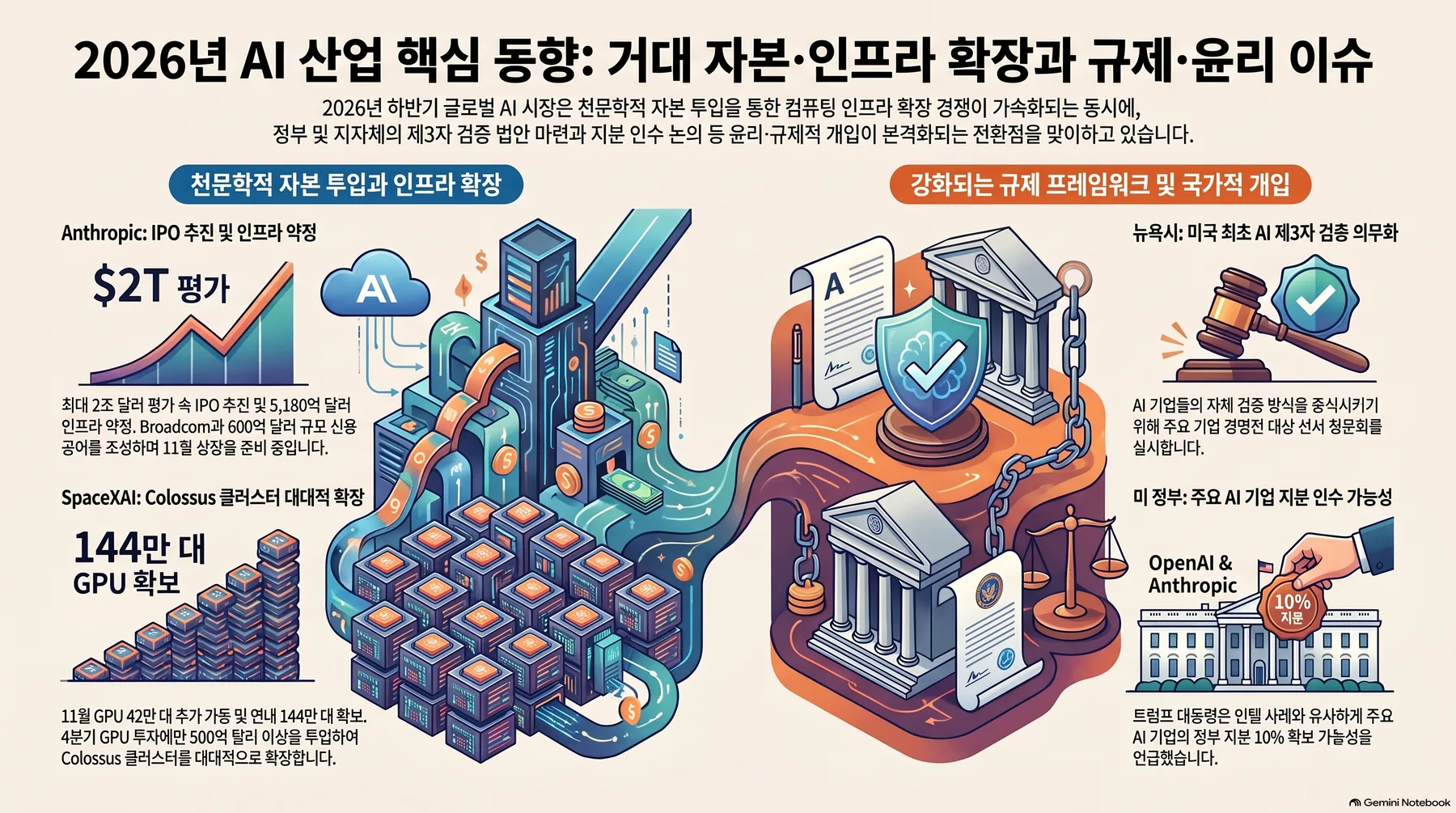 An infographic generated by NotebookLM by synthesizing the sources.
The Capital War at the Frontier
Even before the state appears as a shareholder, the frontier has already come back to a question of capital. According to reports, Wall Street financial institutions are coordinating a new credit facility to back the leading computing hardware purchases of LLM developers. The center of it is Broadcom. It is raising a scale of $60B to buy AI chips for Anthropic and its peers. The chip has become an asset bought and sold on top of credit.
Let’s take a look at the phrase credit facility. Banks coordinating for hardware purchases means the scale of buying has passed the point a single company’s cash flow can carry. The speed at which credit is raised is the speed at which the frontier expands. Buying chips with credit also means the frontier’s capability is secured with borrowed money. What is secured with credit must be repaid with service revenue at some point. The heavier the debt, the more it is pressed by utilization and profitability logic. The model supplier’s capital structure is now a variable that directly touches the price and terms we pay. The more the frontier’s books lean toward credit, the more the supplier’s commercial terms shift into items that can only be kept if it tries.
There is a rush to bring capacity online too. According to a The Information report, SpaceX’s AI division SpaceXAI will bring 420,000 Nvidia GPUs online in November. It is an emergency deployment to meet compute obligations worth billions within the coming weeks. The number 420,000 itself becomes the temperature of the industry. This fleet is not available compute. It is an obligation to be met. The supplier turns on hardware for the schedule of a contract, not a customer’s request. In a structure where the supply side is pushed by contracts, the demand side’s negotiating power weakens further. That weakening flows into the terms of the next contract.
Read the two news items in sequence and the background of the government stakes remark becomes clear. The training and serving of frontier models are not a scale one company’s budget can carry. Credit facilities are coordinated, and GPU fleets are switched on all at once. The supplier rushes to keep its own obligations. At this point, the weight of capital passes into the state’s hands. That the government mentioned stakes is a natural result of the fact that expansion costs have been pushed beyond the range of private capital. The story of the frontier is now being told in a currency that can no longer be measured with a single set of financial statements. Where the financial statements can no longer be read, the form of ownership is read.
Where the Price of Dependency Rises
While the shareholder structure moves, the side using the model faces more concrete costs. Cloudflare’s Clef and Clef-flash are the example. The two models are called decision models, and a performance advantage was recognized in independent load tests. But in the sustained-use portion of the same test, serious throttling and timeouts showed up. It is a case where a benchmark-screen advantage bent under the sustained load of real operation.
A performance benchmark measures a short stretch. An agent’s work is long, dense calls. A single task is made of hundreds of calls. If one call is delayed, the task stops midway. The model can behave differently across the two stretches. When sustained use is throttled, the whole workflow halts. In a structure where the agent repeats calls on its own, the supplier’s rate limit becomes the ceiling of the agent’s autonomy. A performance advantage recognized on a screen is close to meaningless in the stretch where calls pile up. The stretch where the price of dependency rises is exactly this stretch.
The rate limit is a lever the supplier holds. When, how much, and to whom the supplier gives throughput is the supplier’s call. Behind that call sit its own capital structure and profitability, and now the government’s shareholder interest too. The user cannot vote on that call. If the shareholders on the side making the call change, the weight of the lever changes with them. The user only follows what the shareholder decides.
The direction of regulation sits on the same line. New York City put forward the first bill to mandate third-party validation of AI companies. The city council stated its goal as ending the practice of AI companies self-regulating. If the sentence that it is safe stays only as an internal company assessment, validation becomes an outside burden. And the obligation to produce evidence falls on the side distributing the model. Once third-party validation becomes mandatory, the single line that we only use safe models stops being an answer. You have to show what the model did, under what controls it ran, and what trace it left. Validation does not end in the documents the supplier wrote. It comes from the execution records the distributor produces.
The bar for validation moves fast too. Even Anthropic told a religious consultant that its current lead in machine ethics is temporary and that a competitor could overtake it within 6 months. If even the top company sees the life of the bar as one cycle, model selection cannot end in one choice. It is a subject of repeated validation. A bar that fit last year gets a question mark again this year. Dependence on a single model is not a fee paid once. It is a fee reassessed every time the bar changes.
Bring Execution Into My Own Hands
Gather today’s news from a company standpoint and the requirements narrow. Model supply must be switchable at any time. The execution environment must be kept inside the company. The evidence of execution must be able to be handed out externally. These three must not collapse into a cost. This demand does not mean buying a new platform. It means tidying the axes of execution in advance so that a change in ownership does not lead to a halt in execution. The place of model selection, the place of the execution environment, the place of the evidence. These three axes become the core of the design. In a market where ownership structure moves, the place that satisfies this demand is the place of the execution platform.
This is the place Paxis answers. Paxis is ThakiCloud’s Agent-Native Cloud, and a GA product as of v1.1. Skills, tools, policies, and audit logs are promoted to first-class resources, and autonomy, bound by policy gates from L0 to L3, runs inside an isolated sandbox. MCP connectors and the skill market pull the models and tools of multiple suppliers into a single execution field. CostRouter picks a model per task and attaches the cost. That means execution is not tied to a single model. Run on sovereign or on-prem Kubernetes, and the place of execution and the evidence are kept outside the supplier’s shareholder structure.
Even if the third-party validation bill passes and the model supplier’s credit contract changes, the execution field itself has no reason to shake. What you produce when validation is needed is the audit log. What saves you when supply shakes is per-task model selection. Where data must not go out, on-prem execution is placed. The speed at which the frontier’s ownership changes is not within a company’s control. If the evidence and place of execution, and the model’s options, are in my own hands, a change in ownership reads as an operating matter, not a fate.
Stakes are instruments of capital. Nationalization is the right of control. The U.S. government opened the former and closed the latter. To a company using the model, both look like the same picture. When the model’s owner changes, the rules change with it. Tomorrow, the frontier’s cap table will move again. One more credit facility will be coordinated, and another bundle of GPUs will be switched on. Change is now part of the everyday, not an exception. What we check then is not the benchmark ranking, but the place of execution and the whereabouts of the evidence. In an industry where the cap table keeps changing, what a company can hold is its own execution environment, the evidence inside it, and the option to switch models at any time.
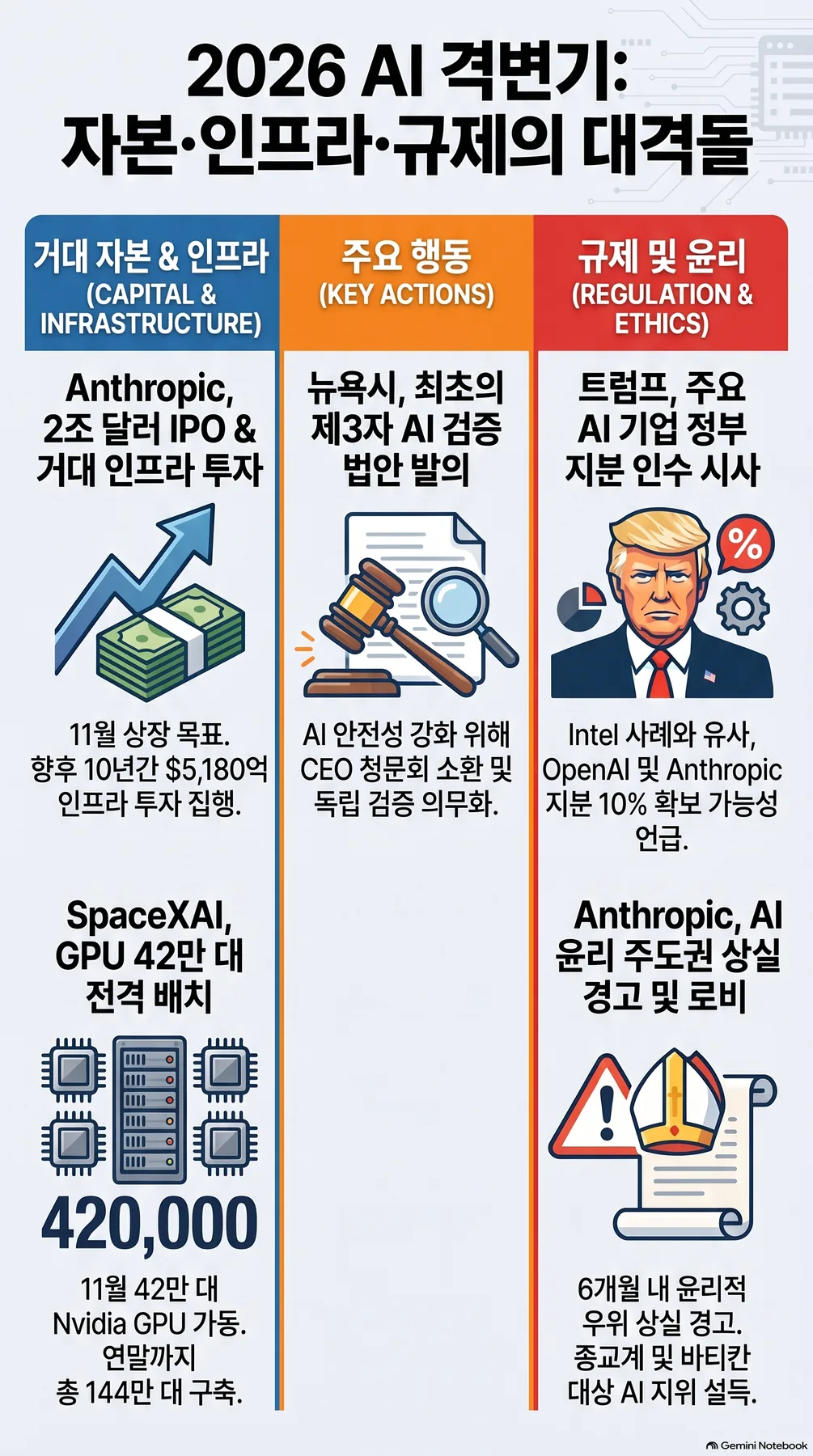 An infographic generated by NotebookLM by synthesizing the sources.
References
This post was written by synthesizing the following news.
- HuggingNews, Trump Says US May Take Stakes in OpenAI and Anthropic
- HuggingNews, Broadcom Gathers $60B to Fund AI Chips for Anthropic and Peers
- HuggingNews, SpaceXAI Deploys 420,000 Nvidia GPUs in November to Meet Billions in Commitments
- HuggingNews, Cloudflare Clef’s Performance Wins Hit by Heavy Rate Limiting
- HuggingNews, NYC Introduces First Law Mandating Third Party AI Validation
- HuggingNews, Anthropic Warns Rivals May Overtake its AI Ethics Lead in 6 Months