AI Ages Faster Than the Building
- The year a 2GW datacenter bond in Louisiana must still be alive. The issuance was $27 billion, the largest single investment-grade corporate bond in US history. Yet the lease contract on the same building is cut in four-year increments only. Even after the tenant arrives in 2029, the bond will still be waiting more than 20 years to be repaid. Pointing at the same facility, the age of the money, the age of the building, and the age of the machines are all different. The hidden structure of AI infrastructure that this morning’s news overlaid to show us is exactly this drift of time. What cost that drift comes back as, and who can avoid paying it, is what this post walks through in order. The conclusion is not today’s news, it is what tomorrow’s contracts will reveal.
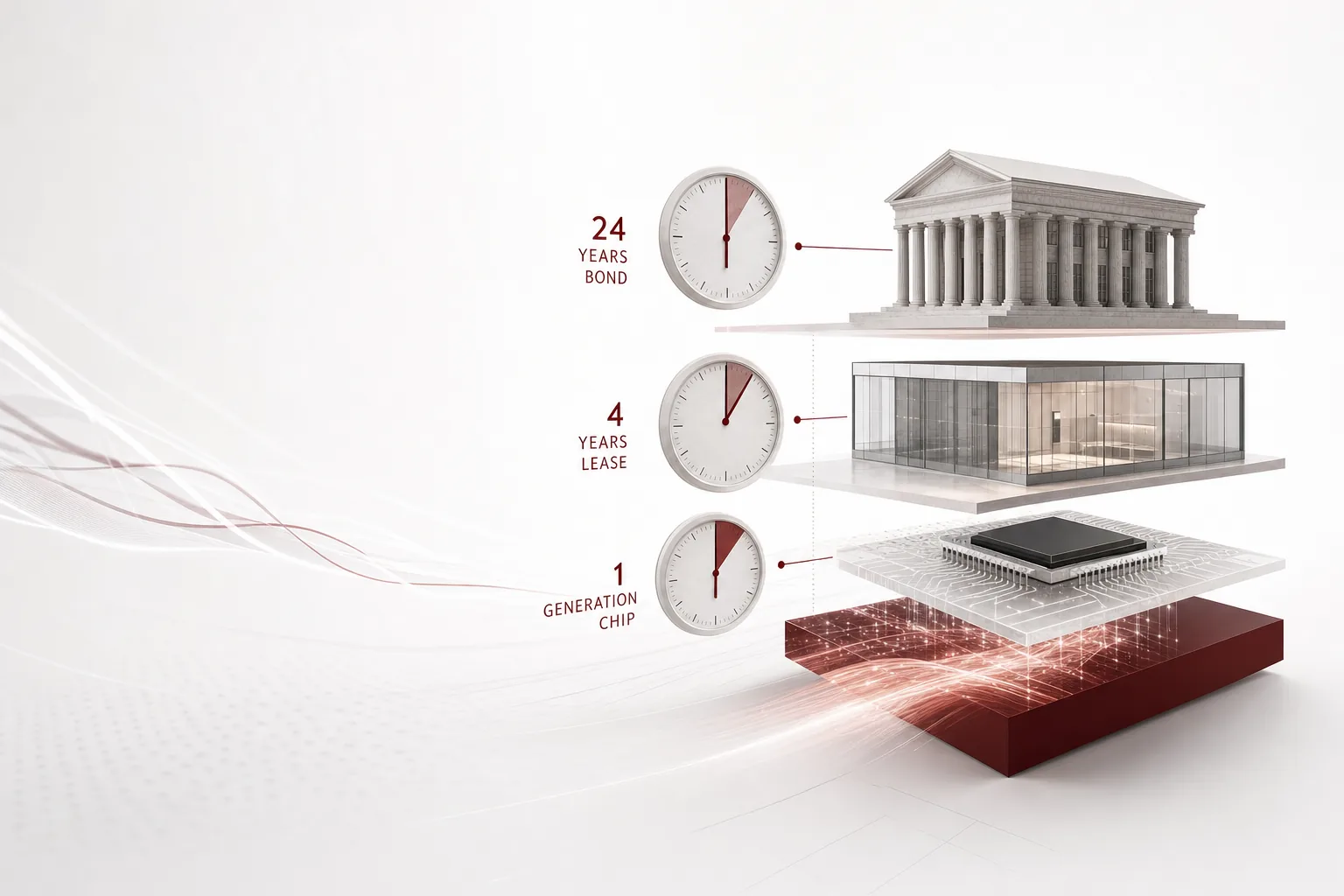 The core concept of the post, pictured.
Old money, rising rates
The drift is already being priced in numbers. That Meta bond: the yield moved from 6.58% at issuance to 7.55%, and the price fell into the low 91-cent range. The market has started stacking a risk premium on the structure of putting 24-year money into 4-year machines. The follow-up El Paso bonds on the same asset demanded a 0.4-point higher spread. Moody’s estimates the hyperscalers’ off-balance-sheet tenancy commitments at $660 billion, a number that does not appear anywhere on a company’s balance sheet, which is exactly what makes it dangerous. Borrow, fail to repay, and the machines inside move to the next generation in the meantime.
The IMF warning points the same direction. Its estimate is that sustaining today’s AI compute demand through 2031 requires $6 trillion in revenue a year, while the existing use cases hold $1.2 to $1.8 trillion of that. The remaining $4.2 trillion has to come from businesses that do not have revenue yet: AI search, autonomous driving, robotics, drug discovery. The hyperscalers’ share of bond issuance jumping from under 1% to 10% in a single year is, in the end, the same story: they are building with debt, not their own money.
The numbers show how fast that debt is cooling. Morgan Stanley notes AI-related debt issuance fell from $113 billion in June to $23 billion in September. Oracle posted operating cash flow of $23 billion in its fiscal first quarter, yet free cash flow went to negative $5 billion after funding cloud infrastructure investment. Meanwhile Nvidia recorded $96.2 billion in revenue and $63.7 billion in operating profit in its fiscal second quarter. The side selling chips is still hot, and the side building the buildings to hold them, on borrowed money, is cooling. A signal that the trust in the money, not the speed of it, is what shakes first.
Concrete is slow
Buildings are slower than money. GS Construction has joined with LG Electronics and GRC to co-develop liquid cooling for AI datacenters, immersing servers directly in special coolant to pull heat out, targeting a power usage effectiveness of 1.05. A heat density that air cooling simply cannot follow, cooled with oil. The global liquid cooling and CDU market is estimated to grow at a compound annual rate between 18% and 32%. Once built, a facility that runs for decades is designed on the premise of outlasting from day one. Every additional gigawatt of GPUs forces the building’s design and maintenance space to change with it.
There is a reason GS Construction does not stop at cooling. From power equipment in August to modular datacenters in September, it is laying a cooperation network that connects cooling, power, and structure all at once. An AI datacenter, the moment it is built, shares decades with that building. Changing one cooling method means redesigning the maintenance space along with it. That slowness is the price of turning the facility into an asset.
SK Hynix is putting more than $4 billion into Indiana to build the US’s first HBM packaging site, hiring 1,000 regular employees. The cleanroom completes in 2028, mass production starts in 2029. Wafers made in Korea are handed over for back-end vertical stacking, so it takes several years from the year the building lands to the year production begins. The hands that build datacenters cannot be faster than that. One memory site brings the building, the power, and the workforce with it. A structure that changes even the electricity tariff and the jobs of the country a site lands in.
The layer that carries the data is similar. NetApp unveiled storage handling more than 100TB per second, and pointed at the problem that if GPUs do not get their data on time, infrastructure utilization collapses below 30%. Machines, cooling, storage: all three share the property of being old, expensive, and hard to replace once built. The more that slow layer stacks up, the wider the gap grows with the fast layer on top of it.
In between, the chips change
Here the speed diverges. The reason all that concrete exists is, in the end, the chips, and chips age fast. 4F2 DRAM cuts the cell area roughly 33% below the existing 6F2, pulling more bits from the same wafer. China’s CXMT has previewed a release within the year, and Samsung and SK answer with HBM4E, 3D stacking, and HBF. The DRAM share race shows how hot it is: in Q2, Samsung 39.4%, SK Hynix 24.9%, Micron 23.3%, and CXMT jumping from 7.6% to 9.6% in a single quarter.
That is why the industry reads yield, reliability, and actual customer wins, not technology announcements, as the markers of the chase. However good a chip is, when the next generation arrives, today’s best becomes tomorrow’s average. The number four years is tuned to exactly this generation gap. If memory slows, GPUs idle; if GPUs stop, the agents working on top of them stop with them. CXMT’s global push, meanwhile, is blocked by US restraint. So the test of whether the technology is real narrows to whether Chinese big tech like Huawei actually buys it and uses it.
Memory is already most of the chip cost. Industry outlooks put it at over 60% of the cost of Nvidia’s latest platforms. SK Hynix’s chairman sees AI infrastructure performance growing roughly 20x from this year to 2030, and what absorbs that growth is memory that changes faster and in greater quantity. The fact that a machine’s economic life is shorter than a building’s physical life is the real reason for the four-year lease.
When the clocks drift, the enterprise pays
Three clocks: money, building, chip. When the three do not agree, the cost lands, in the end, on the enterprise using the infrastructure. The IMF flags the speed gap between equipment and revenue as a global risk. While hyperscalers lock 20-year-plus money into massive permanent facilities, ordinary enterprises have no reason to ride that wave as it comes. The cost of the massive facility divides, in the end, across every company working on top of it. The more you ride, the more that is left when the next generation of chips appears: the residual value of the building.
The position of domestic enterprises becomes sharper here. Most do not have the capital to issue 24-year bonds or raise decades-long facilities. Finance, public sector, and manufacturing, which must put AI into sovereign or on-premises environments, are among them. Telling them to buy a 24-year building is a demand that ignores the reality of machines changing in four. That is why enterprise AI contracts this year put total cost of ownership and supply-chain duplication on the table before performance numbers.
And the gap widens with time. When the tenancy starts in 2029 and HBM mass production turns in the same year, the slow clock slows and the fast clock speeds up. Enterprises that have not bought a building by then must match the speed with the execution layer alone.
The only clock that speed can change
Building, bond, chip: none of the three speeds is one that a company can change alone. Yet on the other side of the news, a company appears that actually changed the speed. Japan’s Mizuho Group is converting thousands of office workers into technical roles doing AI development. Starting in November at its bank and securities subsidiaries, the AI takes over the repetitive document checks and data organization, and people return to sales and customer service. It has already announced a plan to cut office roles by a third over ten years, roughly 5,000 people.
The core is separate. Instead of handing AI development to external vendors, it has front-line employees build the agents themselves. In May it rolled an agent-building platform out across the whole group so non-engineers can shape workflows by hand, and in the corporate finance pilot, work time fell 41.8%. Work that took 60 minutes now takes 35. The three clocks are slow and solid. But the fourth clock, people’s work, can be turned or stopped today. That clock is the variable that can save, or wreck, the drifted infrastructure. So what an enterprise should buy is not the 24-year bond, but the execution layer that actually works on top of it.
The execution layer moves that clock
ThakiCloud’s Paxis sits exactly in this spot. Paxis is a formal product of the agent-native cloud, and it designs the environment where agents work at the speed of work, not the speed of money. There is no need to tear up the execution environment every time the chips change.
The clock of the fast chips is absorbed as cost. CostRouter picks the cheapest model per task and assigns it, lowering the model cost per execution by that much. The MCP connectors and skill marketplace bind tools and functions as first-class resources, raising the speed at which new chips and new models attach to the execution layer. The more the machines change, the lighter the execution layer moves.
The risk made by the old money is isolated. Skills, tools, policies, audit logs: as long as these four are governed as first-class resources, the structure moves only as far as it is delegated. Isolation sandboxes draw the boundary when agents actually move, and policy gates plus audit logs record who did what. Autonomy is divided into governance levels L0 through L3, acting only as far as delegated, and on sovereign or on-premises K8s the enterprise can place the execution environment itself. A way out of the grid of that speed without buying the building. In the end, even without owning the building, you work inside it. The same chips, the same models. But the enterprise uses them lighter and faster.
The bond that must live 24 years, the four-year lease, the chip that ages in a generation, and people’s work, which can still be turned today. Between these four clocks, what is left for the enterprise is not buying the massive building, but choosing the execution layer that crosses the drift smoothly. The clocks will keep drifting, and who first holds the speed of the work on top of them is what separates next year. Paxis is exactly that bridge.
References
This post synthesizes the news below.
- Etnews, 넷앱, AI 스토리지 ‘노버스’ 공개…GPU 데이터 병목 해소 나서
- NewsPim, [AI 비용 vs 회수 전쟁④] 빚은 24년, 임차는 4년…만기 불일치 리스크
- News1, 日 미즈호, 사무직 수천 명 기술직 전환…”실무 맞춤형 AI 개발하라”
- The Daily, 테라데이타 “AI 가치 높이는 열쇠는 ‘맥락’…한국 PoC 지원 강화”
- News1, ‘노동·탄소 한계’ 부딪힌 K-조선…선박 전기화와 조선소 AX가 생존 열쇠
- Business Plus, [요즘 테크+/⑧]’모두의 AI’ 본격화…사업자 준비 속 정책 일관성 시험대
- Digital Today, “모델 넘어 반도체 잇는 인프라SW 역량 갖춰야 소버린AI 구현”
- Maeil Business, 앤트로픽 3분기 매출 168억달러…전 분기 대비 50% 성장