The Bill for 1,000 Tool Calls Traces All the Way Back to the Bond Market
If you’re evaluating agent adoption, put today’s two numbers side by side. One is 1,000. The other is $15 billion. The first is how many tool calls Meta’s Muse Code, its first coding agent released in beta, uses to finish a single task. The second is the size of the corporate bond a bank consortium led by Morgan Stanley is issuing to refinance the loan on an Anthropic-linked Texas data center. Two numbers that look unrelated are actually two ends of the same chain. Here’s today’s conclusion up front: the price of running an agent is set not by a model price sheet but by three layers, capital, supply chain, and regulation. So the starting point for an adoption strategy isn’t picking a model. It’s figuring out which segment of those three layers your company can actually control.
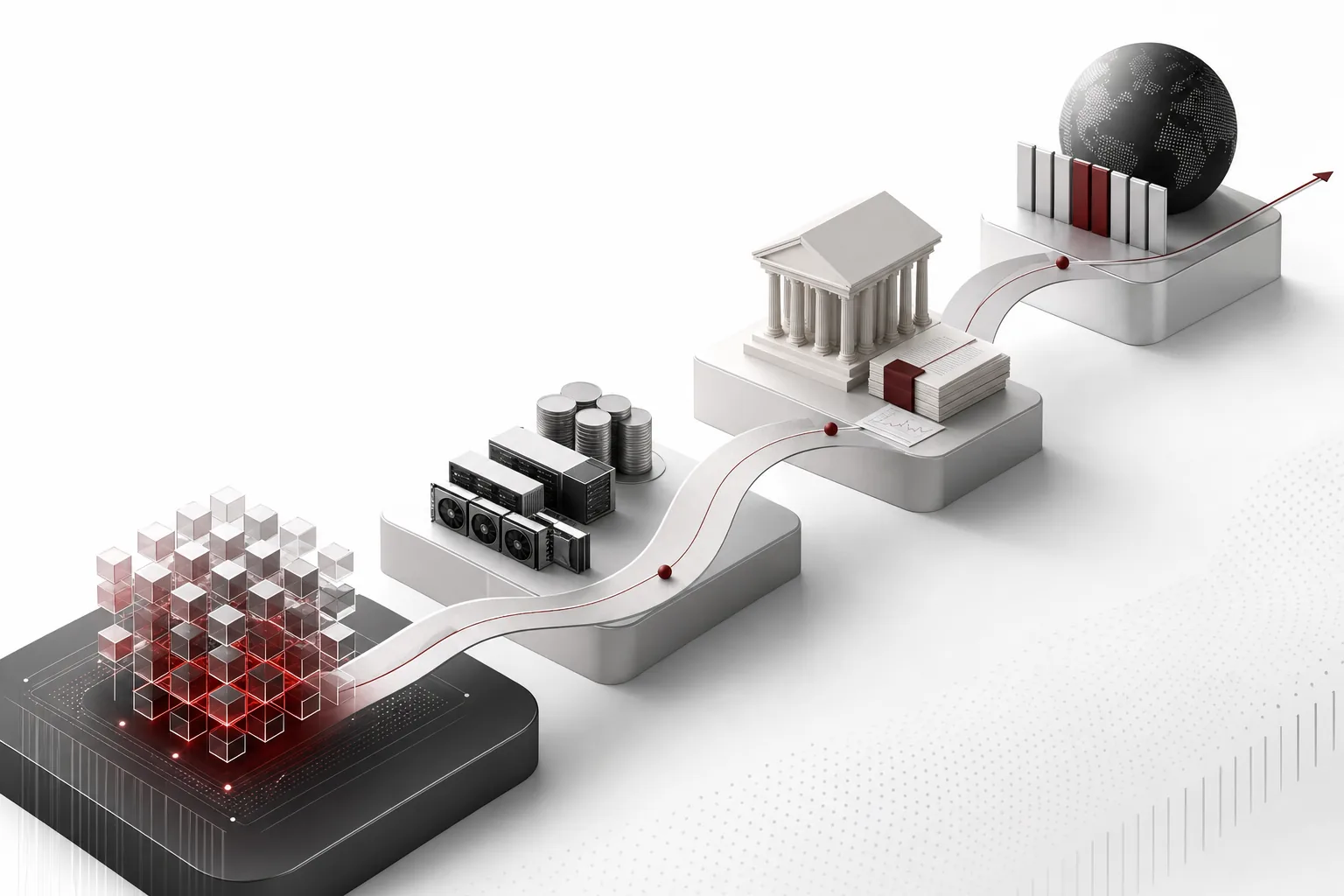 Visualizing the core idea of this piece.
Demand moved the decimal point first
Muse Code runs on a new model, Spark 1.2, and automates complex engineering work across large code repositories. What’s worth watching here isn’t the performance claim, it’s the execution profile. Saying a single task can use up to 1,000 tool calls means the compute structure itself is different from the old query-and-answer usage pattern. One chat message is one round trip; one agent run is a loop that reads files, runs tests, watches failures, and fixes again, repeated hundreds of times.
This shift changes three things at once. First, the unit of cost moves from per-conversation to per-task. Second, the cost of failure grows: if one bad judgment surfaces at call 900, the preceding 899 calls are sunk. Third, and most important, a tool call is write access to an external system. If you can’t reconstruct after the fact which of the 1,000 calls touched a database and which touched a deployment pipeline, that agent can succeed technically and still be undeployable inside an organization.
It’s also worth noting that Meta aimed this product at large code repositories. The bigger the repository, the more an agent reads and the more it fails, and the more calls it makes. In other words, the place where automation’s payoff is biggest is also where execution cost balloons fastest. That’s the common reason an agent that ran fine in a pilot sees its budget curve bend the moment it touches the real repository.
Trace the invoice back and you land in the bond market
When demand moves a decimal point, supply changes how it’s financed. This week’s news showed that path unusually clearly. Anthropic signed a $10 billion computing-capacity deal with a new cloud operator, Volta Infra, and Volta took out a $4.7 billion lease at a Bitdeer facility to back that capacity. Volta then raised $300 million in venture funding to expand its processing capacity further, at a valuation of $2.4 billion in that round, backing a supply contract worth four times its own valuation.
Go up one more rung and you reach Wall Street. A bank syndicate led by Morgan Stanley is issuing a $15 billion corporate bond to refinance the loan on a 2,000-acre Texas AI data center. Put together, it reads like this: one execution button a developer presses turns into a tool call, the tool call becomes tokens, tokens become GPU time, GPU time becomes a long-term compute contract, and that contract is backed by a real-estate lease and a corporate bond. An AI data center is no longer a piece of technology infrastructure, it’s a capital-intensive asset priced in the bond market.
What stands out is that the links holding this chain together don’t match in size. For a $2.4 billion company to fulfill a $10 billion contract, a real-estate lease, venture funding, and a corporate bond all have to line up in exactly the right order. If financing terms sour at any single link, the fallout runs past the model company that’s the counterparty and down to the end user’s available capacity. Contrary to the assumption that a big long-term contract means stability, a bigger contract can also mean dependence concentrated in fewer links.
What this structure means for users is clear. Inference pricing reflects not just the size of model weights but the capital cost sitting behind it. Interest rates, lease terms, and depreciation schedules all end up baked into your monthly bill. That’s why an organization trying to manage per-workload cost can’t control it by switching models alone. Which infrastructure layer you attach your execution to carries just as much weight.
Borders are being drawn across that chain
A regulatory signal on the same day layers a different kind of risk onto this chain. The Trump administration is preparing a ban on imports of new Chinese optical transceivers, framed as protecting AI data centers from espionage. Innolight, the market leader with 27% global share, sits directly in the crosshairs. Optical transceivers connect rack to rack, a part nobody usually talks about, but if procurement gets blocked, the cluster build-out schedule itself slips. It’s a path where a component-level restriction transfers straight into a service-availability promise.
There’s a new door on the model side too. The US government finalized a security framework that gives it a 30-day national-review window before a developer of a high-performing closed model can release it. It’s described as voluntary, but in practice a government calendar has entered the model release schedule. Five Democratic senators warned that inconsistent, secretive rules could push global users toward Chinese models instead, and framed it as a national-security risk. It’s a warning that regulation can move users in the opposite direction from what it intends.
The two stories look like they point in opposite directions, but they load the same burden onto a company. The component restriction shakes the infrastructure build-out schedule, and the model-review regime shakes the software release schedule. A political variable has entered the lead time on both the hardware and software side. Neither is something a technical organization can resolve through negotiation.
There’s one implication companies need to take from this. Which model to use going forward isn’t a pure performance comparison anymore, it’s a geopolitical choice. The model that’s optimal today could have its supply blocked or turn politically awkward next quarter. So skill at using one particular model well is worth far less, in the long run, than a structure where work keeps running when the model underneath it changes.
Model companies are heading down a layer too
This pressure shows up in what model providers are doing, too. Anthropic assembled an in-house silicon team to design a custom processor for Claude, with recruiting engineer salaries reaching as high as $485,000. A software company reaching down to silicon is a sign that the token-price competition is now being fought at the architecture layer. Meanwhile, Microsoft posted $24.1 billion in revenue from its OpenAI partnership in fiscal 2026, roughly 70% of its total AI revenue, meaning a hyperscaler’s AI earnings now effectively rest on a single model partnership.
The organizational layer is shaking too. Alphabet overhauled its AI leadership, elevating DeepMind CEO Demis Hassabis to chairman and chief scientist, while Jeff Dean left to found a startup called Discovery Loop. The market answered with a 5% drop in the stock. Investors priced in the fact that the person deciding the model roadmap can change on a quarterly basis. Pinning your workload to a segment shaking at the silicon layer below and the organizational layer above is riskier than it looks.
So what should you actually measure
For teams preparing to adopt agents in this environment, what I’d recommend isn’t comparing benchmark scores, it’s your own instrumentation. Measure at least four things: how many tool calls a single task actually needs to finish, what share of those were burned on retries, how much time was spent waiting on human approval, and what the resulting per-task cost comes out to.
No model provider will give you these four numbers, because they only come from your own repository, your own tools, your own approval process. At the same time, these numbers are also a gauge of how much slack you have to absorb the swings in the three layers described above. A workflow with a high retry rate flips into the red the moment token prices tick up even slightly. If you’ve instrumented it, you can decide to switch models or move infrastructure by the numbers instead of by feel.
Better to secure the layer you can control first
Of the three layers, capital and geopolitics aren’t things an individual company can change. But there’s one layer you can control: the execution layer, which decides what an agent can do, how far it can decide on its own, and where that decision gets recorded.
ThakiCloud’s Paxis is an Agent-Native Cloud built to take on this exact point. Because it treats Skills, Tools, Policies, and Audit Logs as first-class resources, whether a task uses 1,000 tool calls or 10,000, each call leaves a record of which policy gate it passed and under whose authority it ran. Operating autonomy on a scale from L0 to L3 speaks directly to the failure-cost problem raised earlier: an organization can draw its own line, delegating repetitive work while requiring human approval only for destructive actions, and execution happens inside an isolated sandbox. MCP connectors and the skill marketplace are the channel that brings external tools inside that controlled boundary.
The cost and sovereignty axes fit into the same picture. CostRouter, which handles per-task model selection, attaches different tiers of models to exploratory work versus judgment-heavy work, cutting into the segment where the capital cost described above gets passed straight through. An organization with sovereignty requirements or a closed-network condition can stand up the same execution environment on-premises on Kubernetes. In a period when a 30-day review and import restrictions are making headlines, keeping the execution environment inside your own boundary becomes a negotiating card.
Today’s news boils down to one sentence: the industry as a whole has moved into a phase where it issues bonds and restricts component imports just to run an agent once. Most of that chain sits outside our hands, but the point where the chain ends, the layer where an agent actually does the work, is something we can design right now. That’s where I’d start.
References
This piece was written by synthesizing the news below.
- HuggingNews, Meta Launches First AI Coding Agent Muse Code With Spark 1.2 Model To Automate Software Tasks Using 1,000 Tool Calls
- HuggingNews, Volta Raises $300 Million To Fund GPU Capacity For $10 Billion Anthropic Compute Contract With $2.4 Billion Valuation
- HuggingNews, Anthropic Signs $10 Billion Computing Capacity Deal With Cloud Startup Volta Using $4.7 Billion Lease At Bitdeer Facility
- HuggingNews, Wall Street Banks Led By Morgan Stanley Issue $15 Billion Bond Deal To Refinance Texas AI Data Center For Anthropic
- HuggingNews, Trump Administration Drafts Ban On New Chinese Optical Transceivers To Secure AI Infrastructure Blocking 27% Global Market Leader Innolight
- HuggingNews, Trump Administration Completes Secret AI Security Framework Requiring 30 Day Review For Closed Models Before Release
- HuggingNews, Five US Senators Warn Trump Administration AI Security Policies Drive Users To Chinese Models With National Security Risk
- HuggingNews, Anthropic Launches Custom AI Chip Design Team To Boost Claude Model Performance And Recruits New Engineers With Salaries Up To $485,000
- HuggingNews, Microsoft AI Revenue From OpenAI Hits $24.1 Billion For Fiscal 2026 To Account For 70% Of Total AI Sales
- HuggingNews, Alphabet Shares Drop 5% As DeepMind CEO Demis Hassabis Becomes Chair And Chief Scientist Jeff Dean Launches Discovery Loop Startup