The 24 Hours V4-Pro Failed to Stay V4-Pro
If your team plugs in external model APIs as they come, this 24-hour stretch should not be read as a cost story. It is a contract story. Token unit prices came down, but what actually moved was the model standing behind the same name.
A launch announcement, a redirect plan, and the reversal of that plan followed in sequence. For a full day, every seat at the table that decided the contents of the same endpoint belonged to the model vendor, and the only seat the customer was given was the one that receives the notice.
 A visualization of the post’s core concept.
The Redirect, and the Reversal
On September 11, DeepSeek released V4.1-Flash as the replacement for V4-Pro. API pricing is $0.30 per million input tokens and $1.20 per million output tokens, with half that price applied during off-peak hours. The plan announced alongside the launch was bigger. Starting September 14 at 04:00 UTC, all V4-Pro API requests would move to V4.1-Flash, and those requests would be billed at Flash prices until V4.1-Pro shipped.
The structure is one where the request keeps the name V4-Pro while execution and billing pass to V4.1-Flash. There was no plan for when V4.1-Pro would launch. A request labeled Pro would run on Flash, and the moment it switched back to a Pro-class model was left to the vendor’s schedule.
That plan was reversed within hours. DeepSeek said it would continue providing V4-Pro API access after September 14 as well, and that billing would stay the same as before. User demand was mentioned as the reason for the reversal. It took less than a day from the announcement to the reversal. In that short window, the way of ordering V4-Pro stayed the same, but the model standing behind it and the billing rules attached to it changed once and returned to where they started.
What deserves attention in this sequence is that what the vendor moved was not the model but the endpoint’s pointer. The name V4-Pro was kept, the model coming behind it was swapped to Flash, and then put back on the grounds of demand. Customers have ordered by name and paid by name. When the contents of that name change and revert at the vendor’s operational discretion, the question arises of what exactly the customer contracted. This 24-hour stretch was the case where it was backed down. If a week follows where the change goes through without reversal, the only thing left for the customer is confirming the identity in the logs.
It is also worth reading that “user demand” was named as the reason for the reversal. Here, demand is both a demand for performance and a demand for the quality expected from the name. The vendor walking the plan back within hours reads as a signal that model names are already being treated as assets on the customer side. There is a reason customers call it V4-Pro. That reason is the expectation of quality the name points to. When the pointer of a name wobbles, the side that wobbles is the customer.
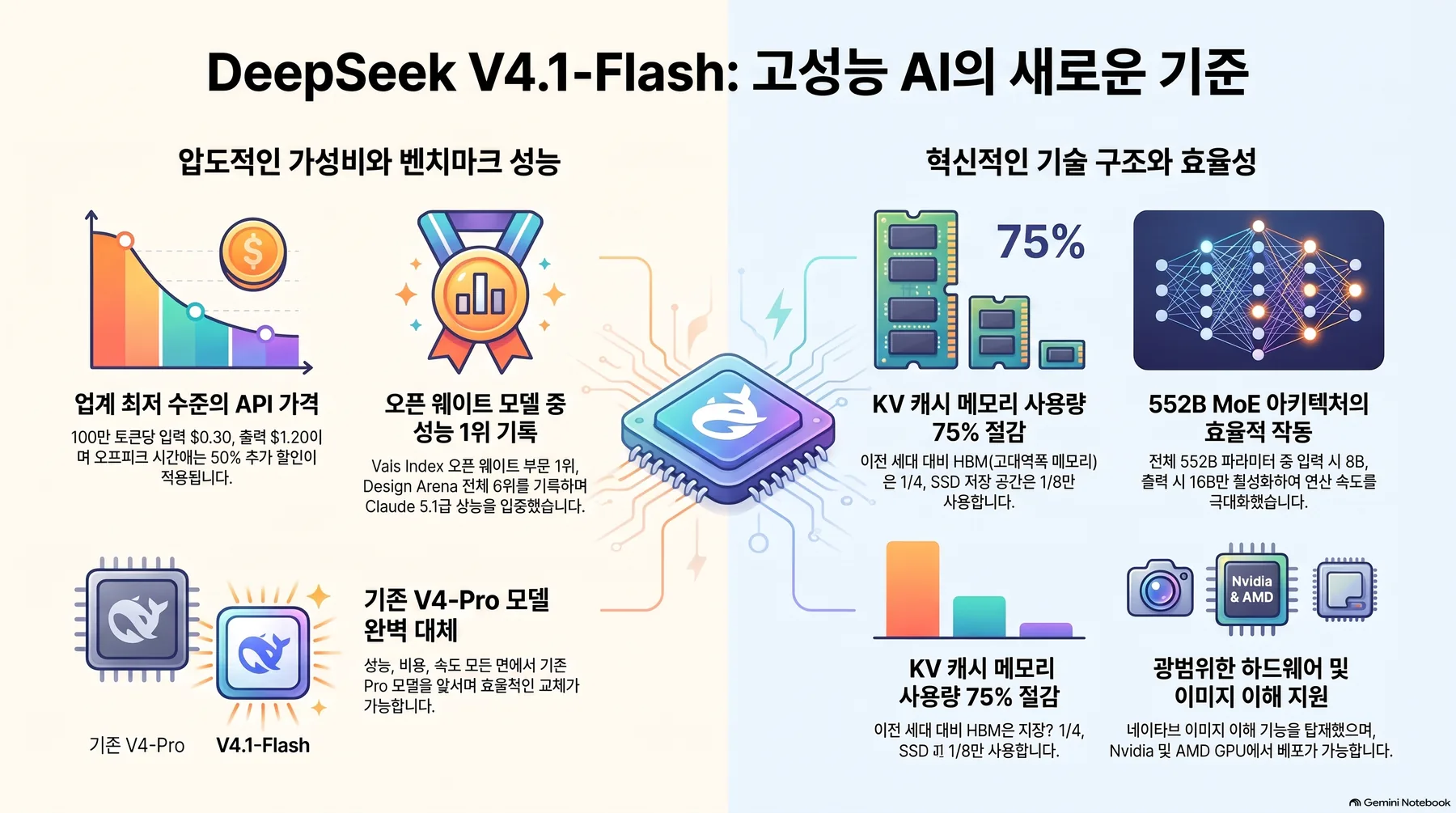 An infographic generated by NotebookLM from the source material.
The Week Unit Price Met Time
The Flash price list gained one new variable over its predecessor. It is a clause making the price half during off-peak hours. The same request now carries a unit price that differs by a factor of two depending on the time of day. Token unit price has become a function of time.
This clause changes the nature of batch-style agent work. Jobs run overnight and in off-peak hours are executed at structurally lower cost. The unit-price gap between teams that treat the job schedule as one axis of cost design and teams that treat scheduling as a mere operational convenience opens up directly on the Flash price list. Agent work repeats countless model calls per job. When the price of a single call varies by time of day, when during the day to run becomes a variable of total cost. As the vendor attached time of day to price, the customer’s job schedule also became an object of cost design. In an environment where the Flash tier, cheaper than Pro, rises to the default path, which job goes to which model tier becomes a standing operational decision.
In front of a price list that carries both an off-peak discount and tier differences, the object of cost optimization is not model selection alone. When to run it and at which tier to run it are both configuration values read off the same price list.
Why 75% Moved the Stock Price
Another piece of news reached the Korean memory industry the same day. SK Hynix and Samsung Electronics made the list of the biggest decliners on September 11. Cited as the backdrop was the fact that V4.1-Flash cut by 75% the HBM, that is, high-bandwidth memory, it requires for the AI cache.
The 75% is a scene where a software decision directly presses down hardware demand. In inference serving, memory is the bottleneck resource. It is memory that determines how many sessions can be seated at once and how long a context can be held. A model company cutting the memory required per unit of cache by 75% means running more sessions on the same equipment, or the same number of sessions on less equipment.
The stock price converted that meaning into price within a day. In a rally fueled by the outlook that AI inference would pull up the memory demand curve, a design change in a single model amounted to a declaration that it would push the demand curve itself down. The fact that the two centers of global memory supply moved in the same market for the same reason means the debate table of the memory supercycle has moved from data centers to the design stage of model companies.
For those who operate serving directly, this 75% is the same sentence. When memory demand per session drops, serving density rises, and when density rises, the fixed cost that can be spread per session shrinks. Token unit price declines are starting to arrive as changes in the serving structure itself.
The same sentence applies to an enterprise’s equipment planning. If you buy GPUs and memory sized by today’s model density, the next design change returns as a planning error. This is the week where “the model company’s next design” entered the risk factors of hardware investment. Even in domestic discussions of GPU cluster and memory-based AI infrastructure investment, this 75% becomes a new premise. A new variable, “the model company’s design change cycle,” appeared in a cell of the table that calculates equipment life. It is now a point where the direction of memory prices and the direction of model design are read tied together in the same table.
When the Model Behind the Name Changes
What the endpoint called “V4-Pro” originally promised was a stable spec. It was a promise that a request sent under the same name would come back with the same quality and the same billing. This 24-hour stretch showed the validity period of that promise. The vendor can change the target model of a name, and it can also decide not to change it.
The original plan held one more trap. The name was V4-Pro while the billing switched to V4.1-Flash. Had the switch actually happened, users would have been consuming a model that differs in both quality and unit price under the label V4-Pro. The log would read V4-Pro. What actually ran would have been Flash. If you run an A/B comparison chasing a quality regression, the two results under the same name may be the results of different models. It is a structure where the premise of comparison quietly collapses.
Billing records carry the same problem. If the invoice says V4-Pro while what was actually consumed was Flash, the numbers stop matching the moment you reconcile the cost ledger by name.
The quality baseline is also bound to the name. An eval result that passed last month on V4-Pro needs re-verification if the name stays the same but a different model stands behind it. While the standard of the quality gate wavers under the vendor’s redirect, the side keeping quality must start by fixing its own records.
This leads to a question about the identity of the audit record. The moment the target changes, a log recorded by name alone cannot evidence the facts of execution. When an incident occurs, you must trace which model was attached to which request. If the record is nothing more than a transcription of the vendor’s announcement, there is nothing to trace.
It is also a matter of responsibility. If an agent takes a wrong action through a request named V4-Pro, what must explain that action is the model that name was pointing to. If the record only transcribed the name, you must first confirm what the subject of the explanation was. This is the week where the first step of incident response becomes re-confirming the identity in the logs.
The reversal’s citing of demand is another signal. From the vendor’s standpoint, an endpoint is an object of inventory management. When demand builds up, it is kept; when cost becomes necessary, it switches to the cheaper model. The fact that an API is inventory rather than contract was, this time, demonstrated by the vendor itself.
Teams That Keep the Slot in Their Own Hands
The conditions this 24-hour stretch leaves with the enterprise reduce to four.
Do not couple tightly to model names. Instead of plugging the V4-Pro endpoint into work as is, which quality tier of model goes to which job should be handled as a configuration in your own layer. The unit of an incident is the quality requirement of the work. Even if the vendor moves the slot, the quality standard and cost standard of the work stay on your side.
Fallback and routing must be ready at all times so that movement between Pro and Flash becomes an operational decision. The Flash price that halves at off-peak gives a practical reason for a configuration that puts the default path of batch work on Flash. In a week where the tier changes, the response cost of teams with their own routing and teams without it diverges widely.
Audit logs must record the model that was executed. A log that only carries the name without confirming the identity becomes guesswork the moment the target changes. A model change is an event that should pass through a policy gate. In a week where the vendor changed the contents of a name and reversed it, as this time, you must know which call reached which model in order to match the cost and quality ledgers. Building an operating system on the premise that the model can change remains the common assignment of teams that lived through this week.
Design variables must go into the plan. The 75% HBM reduction showed that a model company can change memory density through design. If you pin equipment planning and unit cost forecasts to today’s model values, the next design change breaks the forecast.
Paxis Holds Those Conditions as First-Class Resources
ThakiCloud’s Paxis is in operation as the formal product v1.1 of the Agent-Native Cloud. CostRouter picks a model per job and attaches it to execution. That is where work is separated into what goes to Pro, what goes to Flash, and what batch runs at off-peak. The vendor’s slot fluctuation becomes an input value of the routing, and the quality and cost standards of the work stay on the Paxis side. Skills, Tools, Policies, and Audit Logs are first-class resources. It records which model was actually executed and controls model changes through a policy gate. Autonomy is graded from L0 to L3, and execution runs inside an isolated sandbox. You can attach tools through MCP connectors and the skill marketplace, and bring the execution environment in-house through on-prem and sovereign K8s (ai-platform).
Models getting cheaper is now only half the news. In a week where the first question is what rises behind the name, the execution layer is where that question is answered.
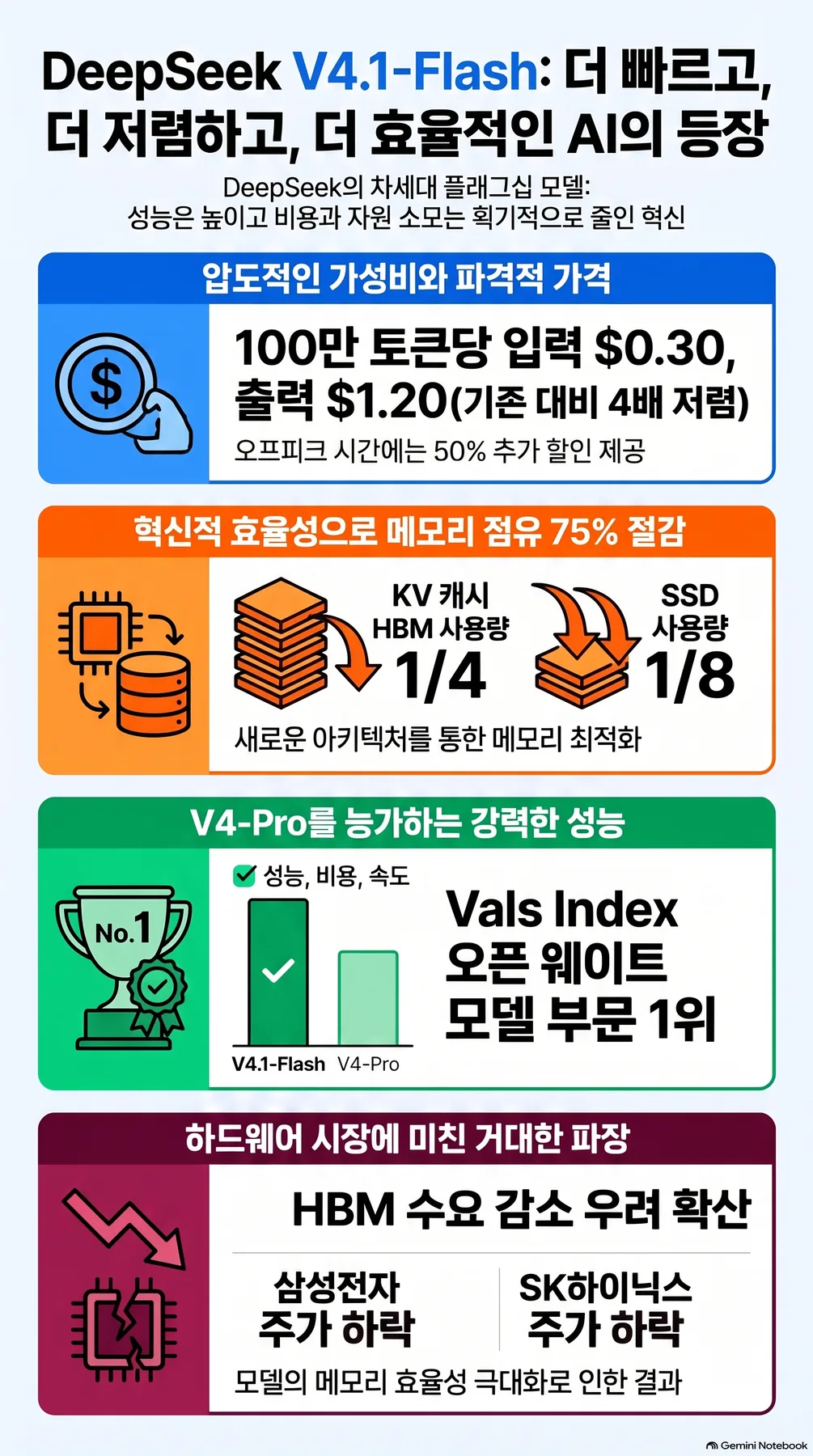 An infographic generated by NotebookLM from the source material.
References
This post was written by synthesizing the news below.