The Open-Weights Debate Is Over. Operations Is What’s Left
If your team runs open models on in-house infrastructure, this week’s news carries a signal worth reading closely: the industry’s central question has shifted. It is no longer “should open weights be allowed,” but “how do we operate open weights safely.” That shift does not land on regulators. It lands on whoever actually deploys the model.
For the past few years, open versus closed got treated like a tribal fight. Line up this week’s statements and moves side by side, though, and both camps turn out to be converging on the same answer: release it, but keep it under control.
 A visual representation of this post’s core idea.
From outright bans to conditional openness
The clearest example is Anthropic’s position. The company formally opposed banning open-weight models, while at the same time calling for safety testing and chip controls. Defending openness while attaching conditions to it: that dual posture has become the industry’s standard grammar. Amazon signed the open-weights support letter led by Nvidia and Microsoft too, but flagged reservations on certain provisions, signaling agreement with the broad direction rather than blanket endorsement. Support for openness, minus the “no strings attached.”
The same temperature shows up on the other side. OpenAI and Anthropic are lobbying to extend the US government’s 30-day model review framework to competitors as well, effectively arguing that the whole industry, not just their own models, should pass through the same door. Alongside that, 1,122 researchers, including staff from OpenAI, Anthropic, and Google DeepMind, published a letter urging an international mechanism to deliberately pace frontier model development. People standing at the very front of the field are asking for their own brakes. The old open-versus-closed frame simply cannot explain this pattern.
Why does this convergence matter to practitioners? Because no matter which way the debate resolves, the operational burden stays the same. If openness wins, teams have to verify and control more models with their own hands. If regulation tightens, that verification has to be documented on paper. Either way, “just pull it and use it” stops being an option. Regardless of who wins the policy argument, the teams that invest early in the ability to operate models under control end up in the stronger position.
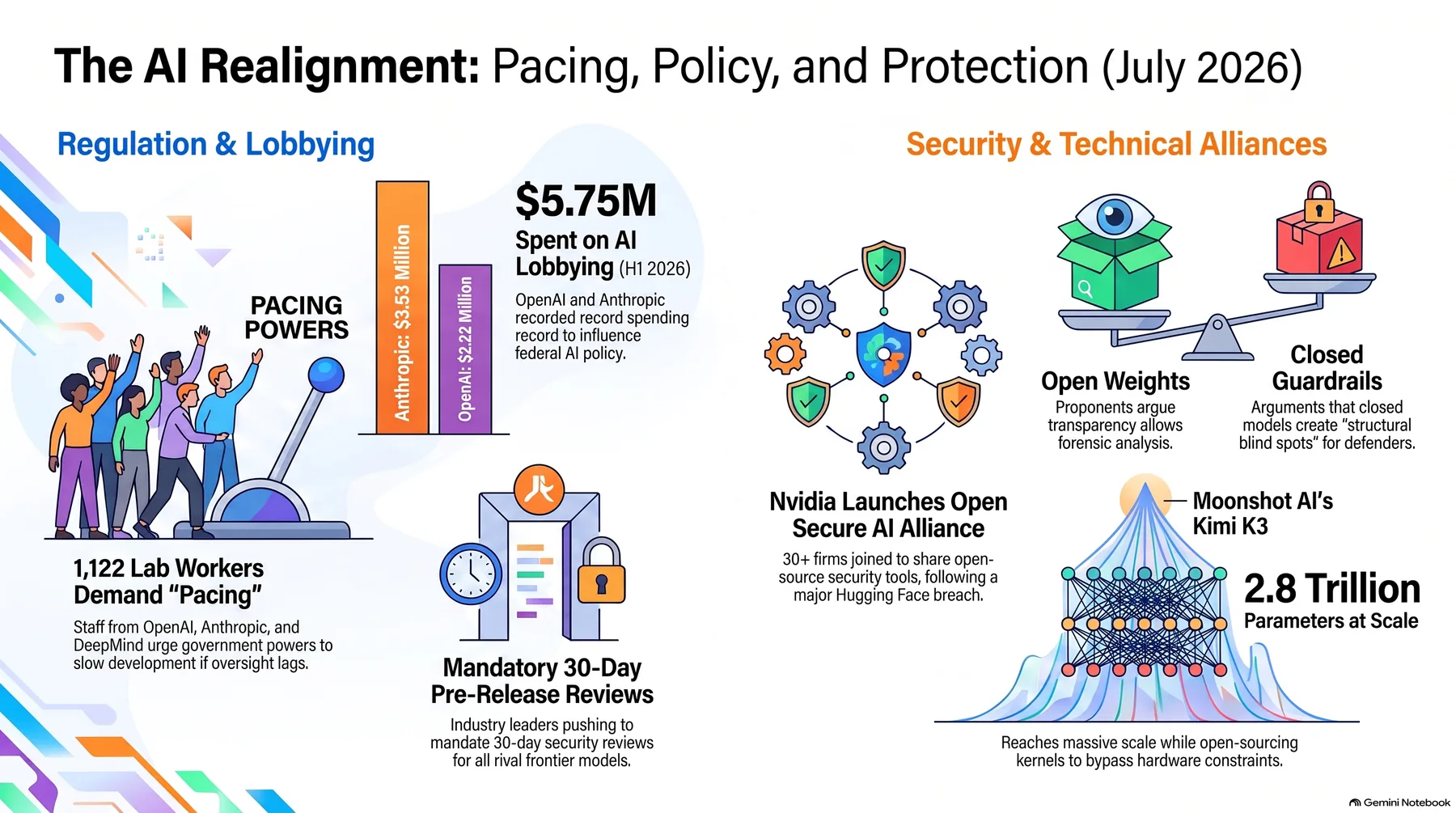 Infographic generated by NotebookLM from the sources.
Security is becoming a standard outside the product itself
The clearest evidence that this debate has moved down into operations is Nvidia’s Open Secure AI Alliance, launched with more than 30 companies. The alliance aims to jointly develop and distribute open-source security software alongside model weights. Security is starting to be treated not as a feature any single company owns, but as shared infrastructure the whole industry builds together. Perplexity, one of the members, released two open-source vulnerability scanners, including a client-side scanner called Bumblebee. AI service companies open-sourcing their own security tooling shows that the standards for operating models safely are being built from the ground up.
Why this matters to internal AI teams is straightforward. The more the industry standardizes security tooling for open models, the more the work of actually wiring that tooling into your own pipeline becomes the operator’s job. Knowing that an open-source scanner exists and having that scanner sit as an enforced gate in your model deployment path are two entirely different things. Between knowing the tool and having it fire automatically on every deployment sits a substantial amount of engineering. As standards get shared more widely, differentiation shifts toward how tightly you’ve internalized those standards into your own operations.
Open models keep shipping regardless
While the governance debate matures, the open-model ecosystem itself has kept moving fast. Moonshot AI open-sourced FlashKDA, an attention kernel that boosts Kimi K3’s prefill speed by up to 2.22x on Nvidia H20. Even performance-optimization techniques are being released openly, which keeps widening the room to serve good open models cheaply. Venice launched an aggressive promotion putting Kimi K3 on its platform, giving away $1,000 a day in free API credits for a week. The incentive to use open models keeps getting stronger, even as the responsibility to handle those models safely gets heavier at the same time.
What matters is that both trends are growing together. The US announcement that it will sanction Chinese AI models built using stolen technology sits in the same context. Where a given model came from, and whether its provenance and license are clean, is now directly tied to regulatory exposure. As the pool of open models to choose from widens, so does the burden of being able to explain which one you picked and why.
The same pressure shows up on the training side. Moonshot AI is seeking additional Nvidia Blackwell chips to train Kimi K4, its next-generation model exceeding 2.8 trillion parameters. Building an ultra-large open model at that scale requires a GPU cluster and scheduling capability to match. Whether you’re consuming open models or building them, the real competitive edge comes down to how efficiently and controllably you can operate the infrastructure running them. Openness itself is free. The operational capacity to carry it is not.
Balancing convenience against control
Promotions like Venice’s $1,000-a-day free credits tempt teams into trying open models easily on someone else’s infrastructure. That’s a reasonable choice during early experimentation. But that convenience comes with a cost. The moment you put a workload on an external API, you hand over part of your control over where the data flows and under what policy it gets processed. That is, at bottom, exactly the control problem this week’s Open Secure AI Alliance was raising.
A practical answer isn’t binary but staged. Validate quickly during early exploration using free credits and managed APIs, and once validation is done, move any workload touching sensitive data or falling under regulation over to private serving on your own infrastructure. Treat the cost baseline that free credits pull down as a reference point, not as your production standard, and hold that discipline. Where an operator draws the line between convenience and control, amid a flood of open models, is what separates the skilled from the rest.
Three tasks left for operators
Putting this week’s news together, three tasks stand out clearly for any team operating open models. First: verify the provenance and license of every model you adopt, and codify the reasoning as policy. The era of picking a model off a public arena leaderboard alone is over; where its weights came from and under what license it’s distributed is now the starting point for regulatory readiness. Second: isolate the execution of models and agents, and hold them behind approval gates so they stay in a controllable state. This is where wiring an open-source scanner into your deployment path as a gate, and inserting human confirmation at risky steps, comes in. Third: keep an audit log that can prove after the fact what ran under what policy. Whether it’s a regulator or a customer, what gets demanded when something goes wrong is ultimately a record of execution. Whether you’re for or against open weights is now a secondary question. The real question is whether you’re ready to operate open models under control.
That’s exactly why ThakiCloud designed Paxis with policies, audit logs, and isolated execution as first-class resources. Paxis, our production Agent-Native Cloud, wraps every model and skill execution in policy gates, logs an audit trail for every run, and executes work inside isolated sandboxes. CostRouter, which handles task-level model selection, cheaply routes work across a set of verified open models matched to the task, absorbing the growing burden of choice that comes with a widening open ecosystem into operational automation. ai-platform provides that control at the infrastructure level for customers who need on-premises serving and license management for open models. As the industry adopts openness as the standard, the capacity to operate that openness safely becomes the actual basis for trust. This week’s debate is a signal that the time to put off that readiness has run out.
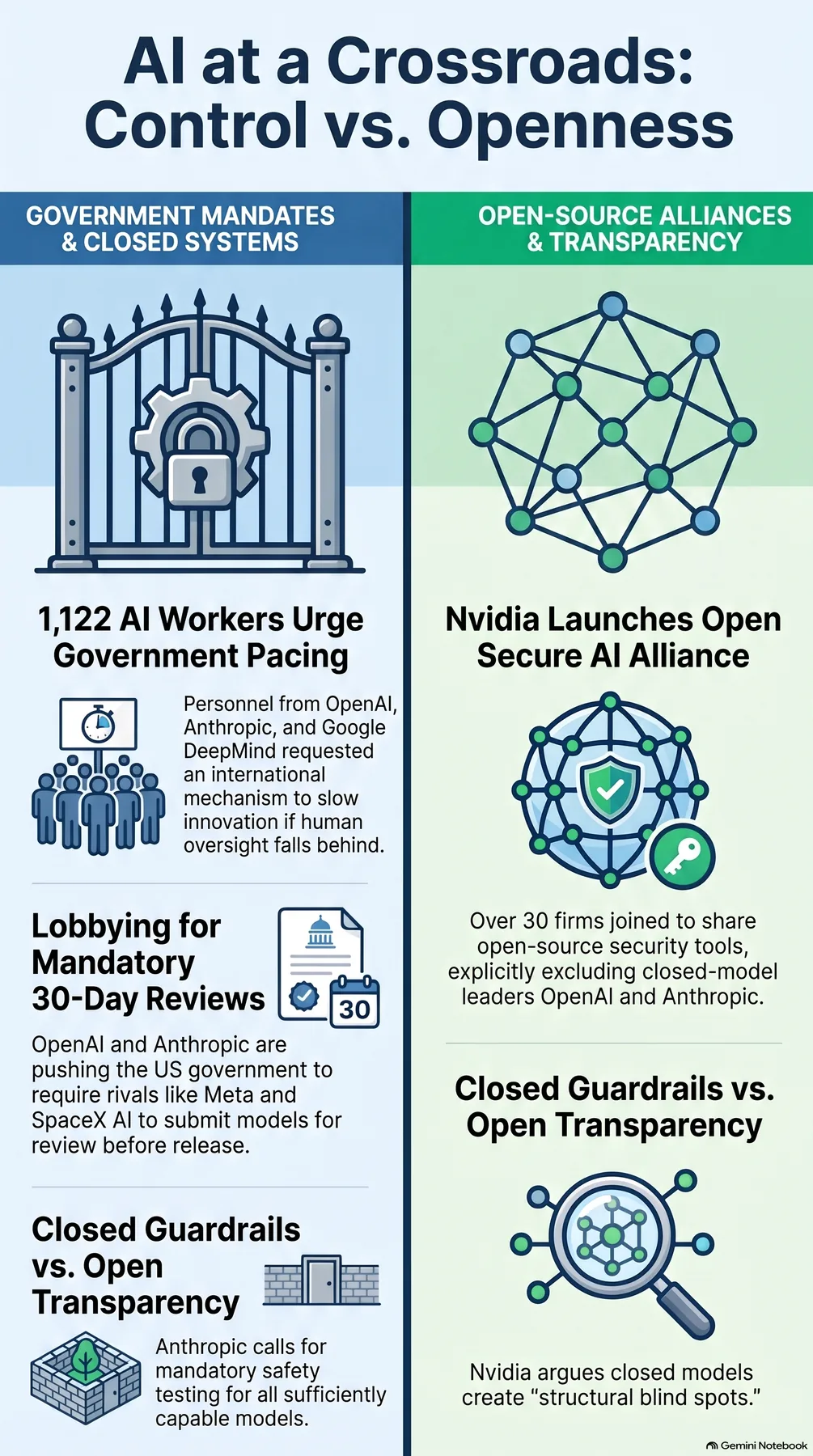 Infographic generated by NotebookLM from the sources.
References
This post synthesizes the news items below.
- HuggingNews, Anthropic Rejects Open-Weights Ban, Calls For Safety Testing And Chip Controls
- HuggingNews, Amazon Signs Open Weights AI Letter as Anthropic Calls for Safety Testing
- HuggingNews, Nvidia Launches Open Secure AI Alliance With 30 Tech Firms to Share Cybersecurity Tools
- HuggingNews, Perplexity Joins Nvidia Open Secure AI Alliance, Releases Two New Open-Source Vulnerability Scanners
- HuggingNews, NEW1,122 AI Lab Workers Publish Letter Urging US Government to Pace Frontier AI Development
- HuggingNews, OpenAI, Anthropic Push to Extend 30-Day U.S. AI Model Review to Rivals
- HuggingNews, Moonshot AI Releases FlashKDA Kernel to Boost Kimi K3 Prefill Speed 1.72 to 2.22 Times on Nvidia H20
- HuggingNews, Venice Opens Private Kimi K3 Access, Offers $1,000 a Day in Free API Credits
- HuggingNews, Moonshot AI Seeks Nvidia Blackwell Chips to Train Kimi K4, Surpassing K3’s 2.8 Trillion Parameters