A 5-Second Video in 1.6 Seconds: How NVIDIA Accelerated MiniMax-H3 Video Generation
 This model produces frames and audio together. The unit of serving cost is on a different axis.
Why read this
This post is for people who serve image or video generation models, or who are evaluating open-weight video models on their own infrastructure. The headline first: with NVIDIA’s Sol team open-sourcing two acceleration stacks for MiniMax-H3, video generation serving has moved from “minutes per clip” to “faster than playback.” Two caveats travel with the numbers: the 1.653-seconds-per-5-second-clip result is an 8× B300 result, and “open weights” here means a community license that excludes local deployment in South Korea among other regions. Serving design and adoption decisions should start from those two facts.
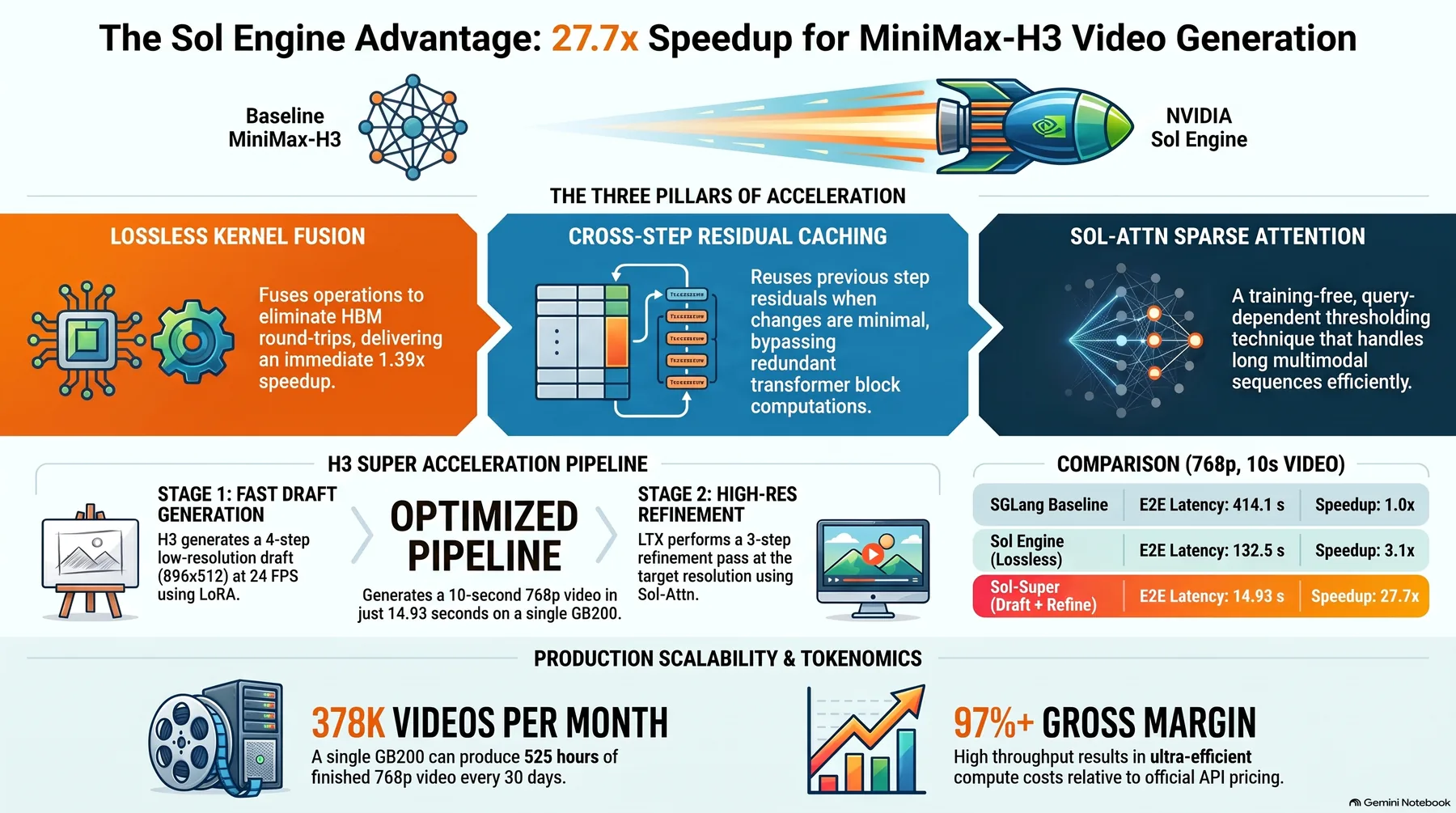 Infographic generated by NotebookLM from the sources.
Overview
On September 7, 2026, MiniMax’s official account announced the MiniMax-H3 video generation acceleration open-sourced by NVIDIA’s Sol team. The headline: “Faster than playback, fully open-sourced.” The model itself deserves attention too. MiniMax-H3 is a 33B multimodal video model published on Hugging Face that produces video and audio in one pass.
MiniMax-H3: what the model does, and how much
MiniMax-H3 is built on the H3-Omni Transformer, a dense single-stream architecture that predicts video and audio latents jointly. It accepts text, images, video, and audio in one context (up to roughly nine reference images for subject and style, video clips for motion, plus audio clips) and covers text-to-video, image-to-video, first-and-last-frame animation, reference-guided generation, and video editing.
| Item | Spec |
|---|---|
| Parameters | 33B (dense, single stream) |
| Output | video + native stereo audio (~32 kHz) |
| Resolution / frame rate | up to 2K, 24 fps |
| Clip length | roughly 4-15 seconds |
| Aspect ratios | 16:9, 9:16, 1:1, 21:9, 4:3 |
| 2K path | in-context regeneration of the model’s own lower-res result |
| Local deployment | primarily ~768p |
From a serving standpoint, the most meaningful fact is that audio is in the same pass, not a separate pipeline. When a soundtrack is a post-production stage, generation time and GPU occupancy double. H3 emits video and 32 kHz stereo together, so the per-second-of-video GPU-second cost already includes the audio.
The same structure is what makes serving harder. A model that emits two modalities in one pass treats their synchronization as part of output quality: if frames and audio drift, the video is finished but the artifact is defective. When an inference engine cuts or parallelizes diffusion steps, the design variable is where that synchronization unit lands, which tensors must be processed together. The Sol team’s sparse attention and token pruning carrying a “near-lossless” qualifier means they cut time without breaking those cross-modal dependencies.
The license deserves the same attention. H3’s open form is the “MiniMax H3 Community License Agreement,” which is not an OSI open source license. Under it, local deployment is excluded for the US, EU, UK, and South Korea: organizations in those regions need MiniMax’s separate written authorization to run the weights locally. The hosted API remains available globally, including in Korea. Independently of location, commercial products crossing roughly $20M in annual revenue require prior written authorization, and the UI must display “MiniMax H3.” The authoritative text is the LICENSE file in the HF repository. The marketing phrase “open weights” only reaches as far as that file says it does.
How NVIDIA accelerated it
The Sol team’s work splits into three layers.
flowchart TB
    A[Input: text / image / video / audio<br/>up to ~9 reference images] --> B[H3-Omni Transformer 33B<br/>dense single-stream]
    B --> C[Joint video + audio latent prediction]
    C --> D[Video + native 32 kHz stereo<br/>in one pass]
    D --> E{NVIDIA Sol acceleration layers}
    E --> F[Video Inference Engine<br/>caching / sparse attention / token pruning<br/>quantization / kernel fusion]
    F --> G[2x+ end-to-end, near-lossless quality]
    E --> H[Super Acceleration, two stages]
    H --> I[Stage 1: H3+LoRA low-res draft]
    I --> J[Stage 2: LTX+Sol-Attn high-res refine]
    J --> K["Single GB200, vs SGLang baseline<br/>22.2x (5s) / 27.7x (10s)"]
    E --> L[Sol-H3 end-to-end stack]
    L --> M[5-second 1344x768 video in 1.653s<br/>on 8x B300]
The first layer is the Video Inference Engine. A training-free, agent-native acceleration framework built from cache optimization, sparse attention, token pruning, quantization, and kernel fusion, delivering 2x+ end-to-end speedup with near-lossless quality. It is not a per-model tuning job; it is a reusable optimization bundle for the video diffusion family.
The second layer is H3 Super Acceleration, and this is where the pattern shows. Instead of generating the final resolution in one go, stage 1 produces a low-resolution draft quickly with H3 plus a LoRA, and stage 2 refines it to high resolution using LTX (a different video model) with Sol-Attn. On a single GB200 it claims 22.2x for 5-second videos and 27.7x for 10-second videos versus an SGLang baseline. “Faster than playback” is what this two-stage pipeline does.
The third layer is the Sol-H3 model-specific end-to-end stack. On an 8× B300 Blackwell system it renders a 5-second 1344×768 video in 1.653 seconds: more than three times faster than the 5 seconds of playback it produces.
| Work | Hardware | Result |
|---|---|---|
| Sol-H3 | 8× B300 | 5-second 1344×768 video in 1.653 s |
| Super Acceleration | single GB200 | 22.2× (5 s) / 27.7× (10 s) vs SGLang |
| Video Inference Engine | (per model) | 2×+ end-to-end, near-lossless |
What the pattern means for serving design
Draft-then-refine is the video version of a pattern already validated in LLM inference. Speculative decoding has a cheap drafter go first and the expensive model verify; here a low-resolution model goes first and a high-resolution model refines. The difference is the unit of verification: a token, or an entire frame. At token scale a rejection costs one token; at frame scale the draft has to point in roughly the right direction for the refinement to mean anything. That is why the LoRA is attached to stage 1. The draft must not merely be low resolution; it must be low resolution that is close to the target.
Second, the stack now serves two models. Super Acceleration puts H3 and LTX in one pipeline: two weight sets, two kernel sets, two memory profiles. For teams used to single-model serving, that is a new operational unit.
Third, the realtime regime creates a market. A 5-second video in 1.6 seconds means generation can move from batch work to interactive work: an editor that shows instant previews, or a system that swaps a cut a few seconds after a user asks for it. 1.6 seconds per 5 would still feel slow for text. For video, it is a regime change.
Implications for ThakiCloud products
From the ai-platform side, this is a signal that video models have entered the serving infrastructure’s domain. The way Metis deals with text inference engines like vLLM and SGLang, video generation now has engine-level components: Sol-Attn, LTX refinement, draft LoRAs. On the Telox/Velox side, a new cost unit appears: GPU-seconds per second of video. Where “dollars per million tokens” is the economic unit for LLMs, “GPU-seconds per video second” is the economic unit for generative multimodal.
The license question matters more in practice. The moment Aegis recommends an “open-weight” model to a customer with on-prem, air-gapped, or data-sovereignty requirements, you must check whether that customer’s jurisdiction is excluded by the community license. H3 excludes local deployment in South Korea. Two models can both be “open weights” and carry different regional deployment rights; for on-prem adoption, a separate authorization (or the hosted API) becomes a precondition. Tagging a model “open weights” in a catalog without reading the license clauses is no longer acceptable. From this model on, it is baseline work for a serving engineer.
Limits and counterarguments
First, the hardware preconditions. 1.653 s is an 8× B300 result; 22.2×/27.7× is a single-GB200 result. Porting the same numbers to B200 or other generations is our job, and this was a conceptual analysis with no local replication. The cited numbers are NVIDIA’s project-page claims as written.
Second, the identity of the baseline. Super Acceleration’s speedups are versus SGLang. Unless the page states that SGLang is serving H3 in an optimized configuration, the multiples should be read as “versus SGLang defaults.”
Third, the quality ceiling of draft-refine. If the stage-2 refine model (LTX) cannot exceed the quality of the stage-1 draft, the pipeline’s quality is bounded by the refiner. The “near-lossless” phrasing applies to the Video Inference Engine layer; the Super Acceleration layer’s quality comparison needs separate verification on the page.
Fourth, the local resolution. Open-weight local deployment centers on ~768p, and 2K goes through the in-context regeneration path. “A 2K model” needs the “768p local” footnote attached.
Fifth, and the most practical: the license. Even where it is technically runnable, a Korean organization like ours cannot deploy H3 locally under the community license. Separate authorization or the hosted API is the precondition. “The acceleration stack is open source” and “I can run it in my infrastructure” are different facts.
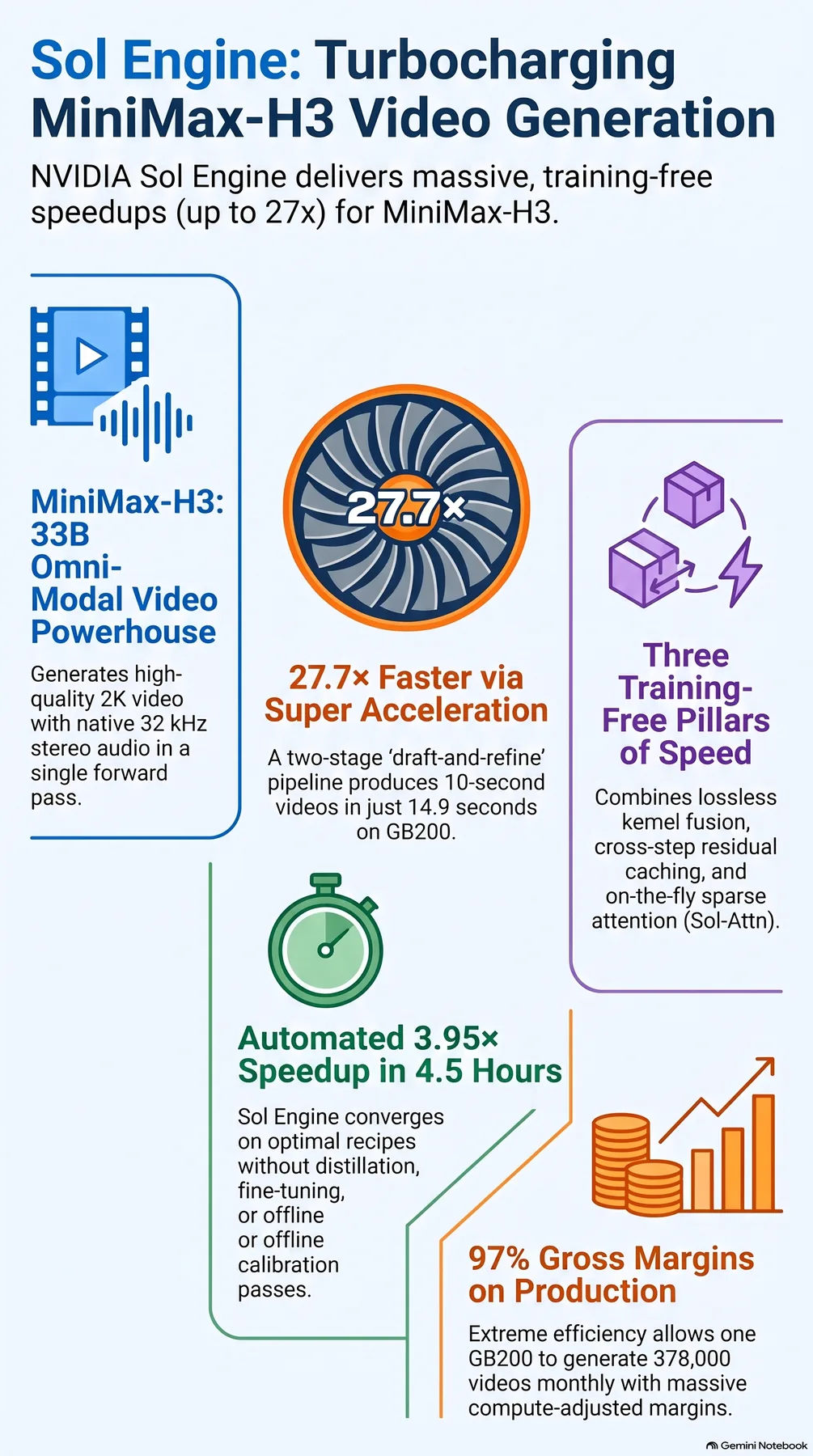 Infographic generated by NotebookLM from the sources.
In summary
NVIDIA’s Sol team leaves three things behind. A proof that video serving has crossed into faster-than-realtime (a 5-second video in 1.653 s on 8× B300), a design showing that draft-then-refine works for video (22.2 to 27.7× versus SGLang on a single GB200), and the training-free optimization bundle of the Video Inference Engine.
Two actions follow. If you plan video-model serving, rebuild your cost model in GPU-seconds per video second. And if you are evaluating “open weights,” read the LICENSE file in the HF repository first and check whether your jurisdiction is excluded. For H3, South Korea is excluded from local deployment, and the preconditions are the hosted API or MiniMax’s separate authorization. Between a technical news item and an adoption decision stands one license file.
Sources
- MiniMax AI X post (2026-09-07): https://x.com/hjguyhan/status/2097083392265462177
- NVIDIA Sol-H3: https://nvlabs.github.io/Sana/Sol-Engine/H3/
- NVIDIA H3 Super Acceleration: https://nvlabs.github.io/Sana/Sol-Engine/H3-Super-Acceleration/
- NVIDIA Sol Engine (Video Inference Engine): https://nvlabs.github.io/Sana/Sol-Engine/
- Hugging Face MiniMax-H3 (incl. LICENSE): https://huggingface.co/MiniMaxAI/MiniMax-H3