Your LLM Integration Isn’t Breaking Because of Bad Prompts. It’s Breaking Because You Never Wrote a Contract
If you have ever run a pipeline that parses an LLM response and writes it to a database, you already know the failure mode this post is about. It is 3am, the pipeline has been silently down for six hours, and when you finally dig into the logs the cause is almost never a bad prompt. It is that nobody ever defined what happens when the model does not behave.
Most teams treat LLM integration problems as a prompting problem. The output looks wrong, so someone rewrites the instructions. The format breaks, so someone adds another few-shot example. This instinct is not wrong exactly, it just aims at the wrong layer. A language model is not a function, it is a remote service, and remote services are slow sometimes, they fail sometimes, and they occasionally ignore the format you asked for. This post covers five design principles that put an explicit contract at that boundary instead of asking the prompt to carry all the weight.
 A visual metaphor for the article’s key idea.
An LLM Is a Remote Service, Not a Function
A traditional function call is deterministic. Give it the same input and it returns the same output, every time, which is exactly what makes it testable and debuggable when something goes wrong. An LLM call is not built that way. Feed it the identical prompt twice and you can get two different outputs, because temperature, internal model state, and load on the serving infrastructure all leave their fingerprints on the response. That is not a defect to be engineered away. It is the nature of a probabilistic system, and any design that pretends otherwise will eventually be surprised by it in production.
What matters just as much is the path the request travels. The moment a prompt leaves your process, it is exposed to network latency, transient provider-side outages, rate limits, and quota exhaustion. This is precisely the risk profile of any REST call to a third-party service, yet a surprising number of teams write LLM integration code as if they were calling a local function. The response comes back, gets parsed immediately, and gets handed to the next stage. Failure gets swallowed in a generic catch block, if it is handled at all.
Here is the failure scenario that plays out constantly in real systems. A pipeline asks a model to return JSON and stores the parsed result in a database. For weeks the model returns clean JSON every time. Then, without any code change on your side, it starts prepending a short sentence of explanation before the JSON block. The parser breaks on the spot, and if the surrounding error handling is thin, the entire pipeline halts. A contract would have specified the output format up front and routed anything that deviated from it down a separate path instead of letting it take the whole system down with it.
This reframing is the foundation everything else in this post builds on. Once you start treating an LLM call as a remote service, the resilience patterns you already know from distributed systems work, timeouts, retries, circuit breakers, fallbacks, apply directly. None of this needs to be invented from scratch. It needs to be moved to a boundary most teams have left unguarded.
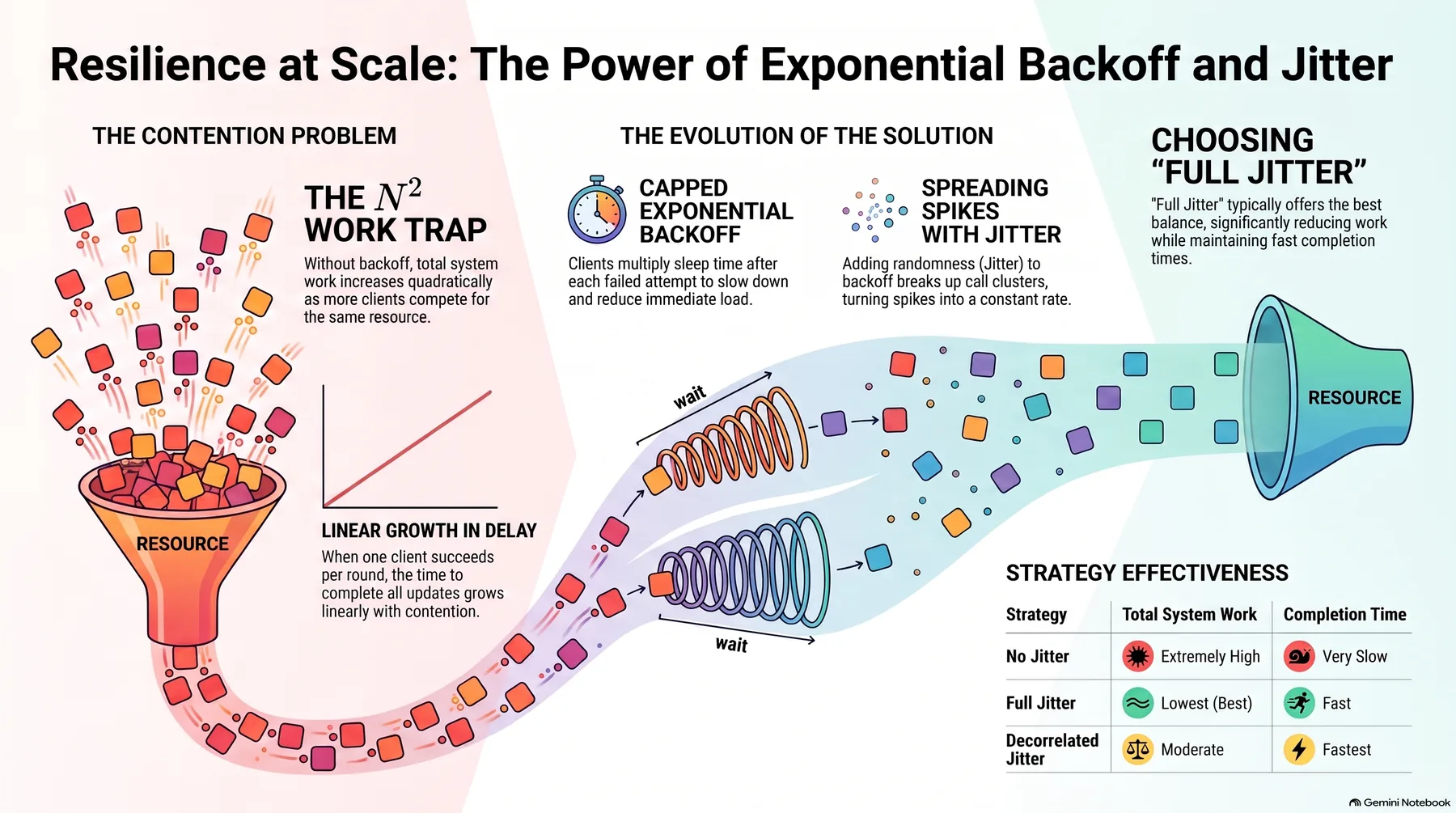 Infographic generated by NotebookLM from the sources.
Never Hand the Model an Input You Have Not Gated
The core idea of an input contract is that you validate the input before it ever reaches the model, not after the model has already produced something confusing from it. This validation step is worth calling a gate explicitly, because that framing makes the failure mode visible: input that fails the gate gets rejected or redirected immediately, and only input that passes ever reaches the model.
A prompt looks like free-form text but functions as a structured composition of distinct messages. The system message defines behavioral rules, the user input carries the actual problem to solve, and context fills the gap created by the fact that the model has no memory of anything outside the current call. How you combine these three pieces determines how consistent the model’s responses are going to be.
The mistake teams make most often here is skipping validation on the user input before it gets stuffed into context. Too much unvalidated context and the model starts forgetting information buried in the middle, while token cost climbs for no benefit. Skip validation on required fields and the model will happily guess at whatever is missing, producing an answer that reads as confident and is quietly wrong.
Effective input validation works best as layers rather than a single check. The first layer is schema validation: does every required field exist, is the data typed correctly, does every string fall inside an acceptable length range. The second layer is semantic validation: values that are structurally fine but violate a business rule get caught here even though they would sail past a schema check. Once a request clears both layers before it ever reaches the model, a large share of the output quality problems teams normally chase never happen in the first place.
Design the Output With a Fallback Already Built In
The model’s output is the entry point to everything downstream of it, the parsing logic, the database write, the next API call, the screen a user is looking at. The problem is that this output is not deterministic by construction. Give it the same input twice and you can get subtly different shapes back, and how you handle that variability is the entire substance of output contract design.
There are broadly three ways to structure model output. Forced structuring makes the model produce output that conforms to a specific schema, with the format spelled out explicitly in the system message or enforced through structured output tooling. This makes parsing trivial, but the moment the model fails to follow the schema, parsing fails immediately and completely. Guided structuring lets the model respond more freely and then runs a transformation step afterward to shape the result into structure, whether through the model itself or a separate parsing pass. This is more flexible than forced structuring but introduces a real risk of information loss or subtle error during the transformation. Post-hoc structuring interprets whatever free-form text the model returns using regex or custom parsing logic applied after the fact. It is the most flexible option and also the most fragile: a small shift in how the model phrases its answer can break the parser outright.
| Strategy | Strength | Risk | Best fit |
|---|---|---|---|
| Forced structuring | Parsing is simple and predictable | Any format deviation fails immediately | Fixed-schema API responses, form autofill |
| Guided structuring | Flexible while still producing structure | Transformation step can lose or distort information | Long free-form answers that need to become structured data |
| Post-hoc structuring | Maximum flexibility, minimal constraint on the model | Parser breaks on small phrasing shifts | Early prototypes, low-reliability tolerance zones |
In practice, combining forced and guided structuring tends to work best. Ask the model to follow structure as closely as it can, but build the fallback logic assuming it eventually will not. A real fallback is more than logging an error and moving on. It routes a failed parse toward a retry, substitutes the last known-good cached response, or falls back to a minimal safe default that keeps the system answering rather than throwing an exception into a user’s face. An output contract without a fallback path is not really a contract. It is a hope dressed up as a design.
Failure Is a Precondition, Not an Exception
No matter how carefully you design the surrounding system, calls will fail. Network partitions happen, provider infrastructure hits transient overload, rate limits get exceeded, model servers restart at inconvenient moments. What actually matters is what the system does the instant one of these happens. Leave that undefined and a single failed call has a real chance of taking down everything downstream of it.
Retrying is the most basic resilience mechanism available, but retrying without any condition attached can make things worse rather than better. Hammering a struggling server with unconditional retries adds load precisely when it can least absorb it and raises the odds of tripping a rate limit. A fixed-interval retry is trivial to implement but does nothing to account for the possibility that the server is already overloaded. Exponential backoff is the better default: each retry doubles the wait time, so the first retry lands at one second, the second at two, the third at four. This buys the server room to recover on its own while naturally reducing the total number of retry attempts fired at it.
Designing a real retry strategy means being explicit about a maximum retry count, an initial wait time, a maximum wait time, and which exception types are even eligible for a retry. Skip the maximum count and you have built infinite retry into your system without meaning to. Set the initial wait too long and you have added latency users will notice; set it too short and you concentrate load right back onto a server that was already struggling. The exception type question deserves particular care too, since a transient failure like a network drop or a 500-class server error is worth retrying, while a malformed request that produced a 400-class error will fail identically on every single retry attempt.
Retries alone are not always enough. When a server is fully down or repeatedly hitting rate limits, what you need is a circuit breaker. Once consecutive failures cross a threshold, the breaker blocks further calls for a cooldown window and routes traffic straight to a fallback path instead. This stops the system from repeatedly hammering a service that is already failing and lets everything downstream keep responding, even in a degraded state, instead of cascading into a full outage.
Cost Should Be Blocked Upfront, Not Discovered on the Invoice
LLM API cost is calculated on tokens. Input tokens and output tokens are billed separately, and the per-token rate varies by model. The tricky part is that this cost accumulates in a way that is genuinely hard to see happening in real time. It grows quietly as context windows get longer, as retries stack up, and as conversations run longer than anyone planned for.
The most reliable countermeasure is logging actual token usage on every single call. Most LLM API providers return the real token count consumed in a response header or a usage field. Accumulate that number over time and you get day-by-day or week-by-week cost tracking based on measured reality instead of a rough estimate, which is the only foundation a budget should actually be built on.
The core of cost management is detecting and reacting before a budget gets exceeded, not after. Set a budget ceiling, and fire an alert as usage approaches it. But there is a step past alerting that a lot of teams stop short of: an alert alone is often too late. When usage spikes abnormally, say several times the normal token volume compressed into a short window, the system needs to be able to throttle itself before a human ever sees the alert. That spike could be an infinite loop from a bug, or it could be a malicious actor probing your endpoint. Either way, finding out from the invoice is proof that no contract existed at all.
The Model Version Is Part of the Contract Too
LLM providers update their models on their own schedule, not yours. A new version frequently behaves differently from the one before it, and a prompt that has run flawlessly for months can suddenly start returning a different output shape overnight. Trying to fix this by rewriting the prompt fails almost every time, because the root cause is not the prompt at all. It is an external variable, the model version, that just shifted underneath you.
The first principle of version management is pinning the model version explicitly wherever the provider allows it. An alias that silently tracks the latest release removes your ability to control when a version change hits your system; a pinned version at least lets you decide when that transition happens. This obviously cannot last forever, since eventually a migration to a new version becomes necessary. What you need at that point is a regression test set: a representative collection of input samples paired with the output shape you expect, run against the new version before the switch to confirm the output contract still holds.
Version transitions are safer done gradually than all at once. Route a small slice of traffic to the new version first, watch output quality and failure rate, and only widen that slice once nothing looks wrong. None of this works without the input gates, output fallbacks, and retry logic described earlier already running underneath it. With that contract already in place, a version migration stops being a gamble and becomes an ordinary, manageable operational task.
The Contract Is the Reliability
The five principles this post walked through, gating input, building output fallbacks, retrying with a circuit breaker behind it, watching cost in real time, and pinning model versions, are not five independent tips. They all fall out of a single stance: treat the LLM as an unreliable service on the other side of a network call, and absorb that unreliability in code at the boundary rather than hoping the prompt handles it.
Writing a good prompt still matters. But a prompt only improves the model’s average behavior. It does nothing for the tail cases, and the outages that actually wake people up almost always start in the tail. The tool that handles tail cases was never a better prompt. It was always an explicit contract.
It is worth opening whatever LLM integration code you are currently running in production and checking five things directly. Is there input validation immediately before the call and an output fallback immediately after the parse. Does the retry logic wrapping the call have both a backoff and a hard cap. Is token usage being logged anywhere at all. Is the model version pinned explicitly rather than tracking latest. If you can answer yes to all five, you have a contract. Wherever the answer is no, that is exactly where the next outage is going to start.
References
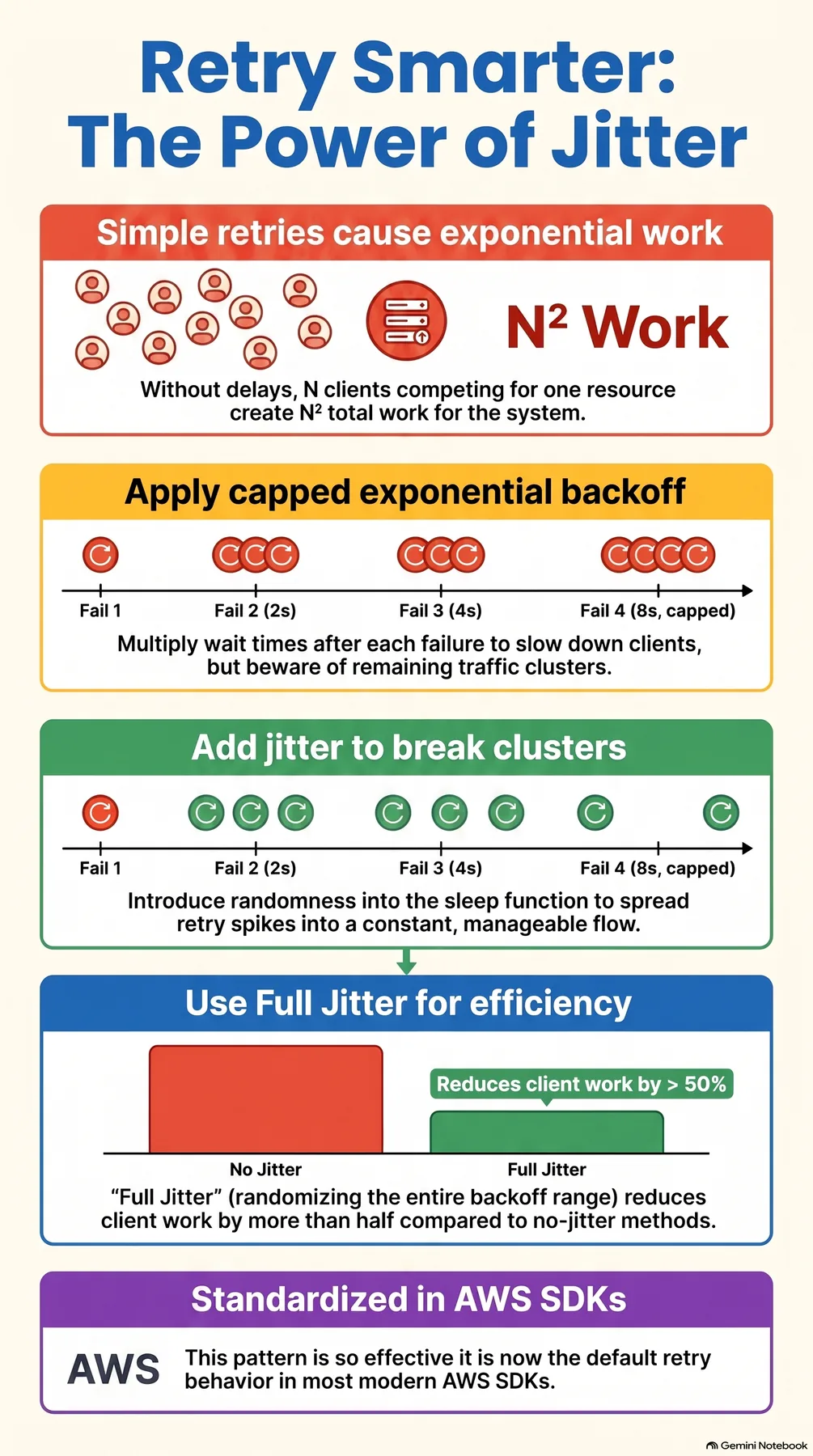 Infographic generated by NotebookLM from the sources.
Chapter Illustrations