The week the door widened, the week the ticket was rewritten
If you run agents in production, read this week’s news not as model news but as tickets. The variable that changes execution cost has moved from token price to the terms of access. Here, a ticket is a rate card. Which model, through which route, in what quantity, at what price. Every term under which an agent can use a model is written on that ticket. This week’s digest splits into two lists. One is the list of what got bigger. The other is the list of what got smaller. On the bigger side sit the general release of Grok 4.6, the opening of partner access to Astra, an open-source model that climbed to the top of agent benchmarks, and robot orders printing one every 5 seconds. On the smaller side sit a coding assistant’s weekly limit cut by 17%, and a model access that ends on November 12. The door widened, and the ticket was rewritten. Both point to the same sentence. When terms move, the impact on agent workloads is not even.
 A visualization of the core concept of the post.
Two ways to shrink the ticket
The first ticket shrink is a change of quantity. Anthropic changes usage limits for paid Claude Code users starting September 14. The 50% temporary increase is replaced by a 25% permanent increase. Add the two numbers together and the increase looks larger than the cut. Yet the headline frames it as a 17% cut on a weekly-limit basis. When the temporary measure ended, the permanent measure landed at a lower level. 17% sounds like a small number when you hear it once. But agents do not stop mid-task the way people do. When a limit shrinks, a person feels it at the tail end of the day. An agent feels it across the whole day. A limit change attached to a workflow that repeats daily is simpler to calculate than a price change. So it rewrites budgets faster.
The second ticket shrink is a change of existence. OpenAI announced it will end direct access to its GPT series from the coding tool Cursor on November 12. The termination covers scheduled-release models such as Astra. It pulls back even the models that are still on the roadmap. The planning horizon changes. An execution plan built on the assumption that a model will arrive loses that assumption on November 12. OpenAI cited a history of contract violations, and the headline reports the move is linked to the SpaceX acquisition. One is an event where the quantity on the ticket shrank. The other is an event where the ticket itself is being pulled back. Both changes happened in the same week, and both were decided unilaterally by model providers. What they share is that both events point at coding agents. Coding assistants are the category that burns the most tokens. Limits and channels are the variables that act on that category first.
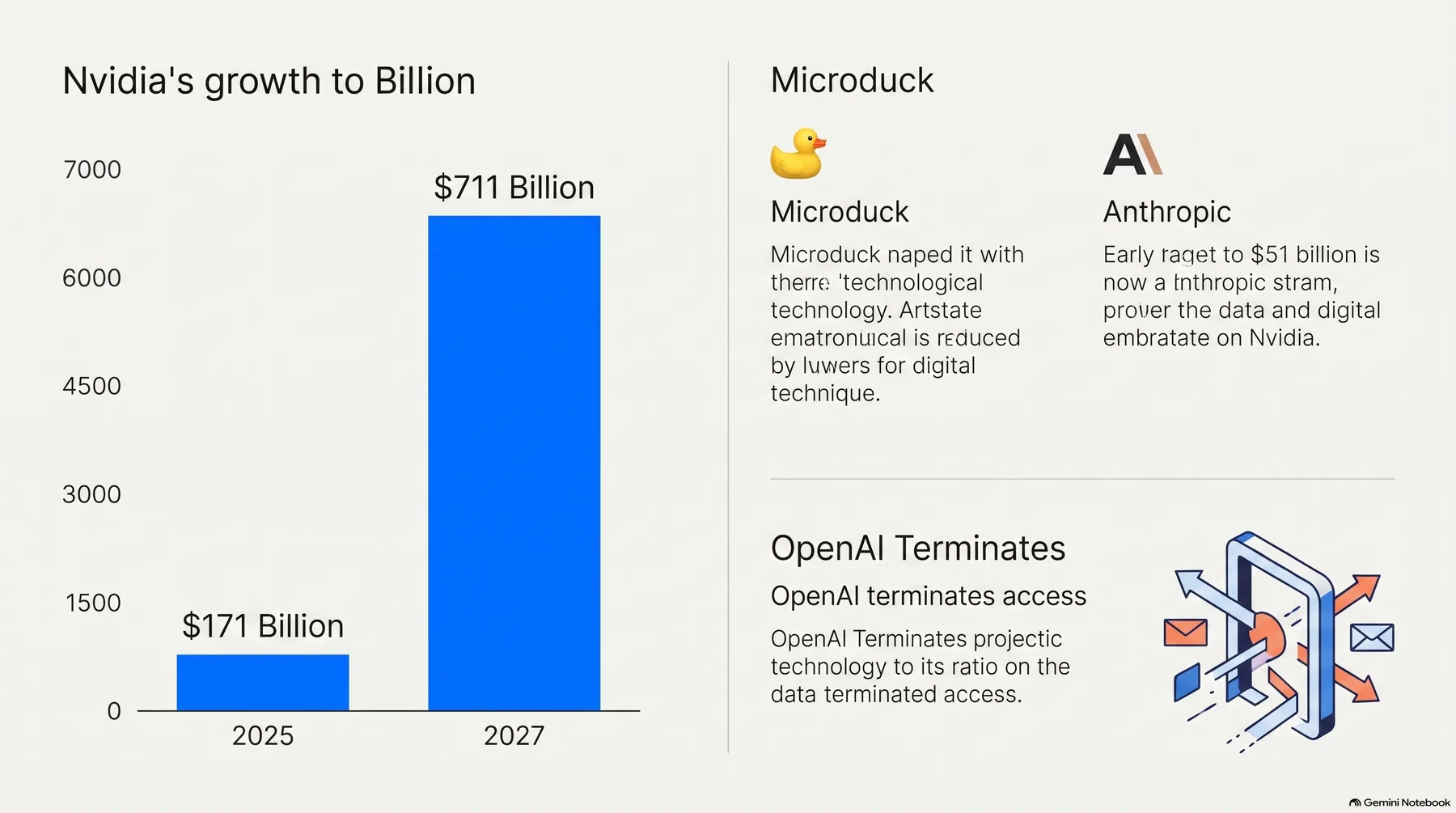 Infographic generated by NotebookLM from the sources.
The floor price the benchmark changed
While tickets shrank, alternatives grew. On the independent performance test Terminal-Bench 4.0, open-source GLM-5.3 Max beat GPT-5.6 Max and Sol to take 3rd place. The headline reported that GLM-5.3 has moved ahead even of OpenAI’s top model, and the digest reads it as a shift in the competitive layout between proprietary and local models. More important than the number 3rd is the subject in which it came 3rd. A test like Terminal-Bench measures subjects where an agent works directly in the terminal and finishes the job. The subject of that exam is execution ability. The layout itself, with proprietary and local models taking the same exam, was drawn this week. A model that can be served on its own stepping into the top of this exam means the boundary of the candidate pool for agent models has moved. Once open-source models start getting verified on agent tasks, the terms of API access are no longer the only option. The moment an alternative is verified, the ticket becomes something to negotiate, and the floor price changes.
In the same week, the option set widened on the proprietary side too. SpaceXAI shipped Grok 4.6 as its first general release, applying it across all four modes, Fast, Expert, Heavy, and Build, on web, iOS, and Android. One vendor selling four grades inside the same model. A mode is a cell on the ticket. The more cells there are, the more the same work can differ depending on which cell it sits in. The digest reports this release turned a previously narrow, coding-first focus toward wider uses. OpenAI opened partner access to Astra ahead of its September 3 launch. The internal dogfood stage has ended. The codename is ultima-alpha. A small group of partners gets it first, and the early-access program is planned to expand. More models arrive, and each one comes with its own ticket. The question that arises is which model to attach to which workflow. That question does not end at once. It is a question that reappears every time a ticket changes.
Supply moves in rack units
The hardware side is rewriting its terms too. According to TrendForce’s projection, combined shipments of NVIDIA’s next-generation rack systems will exceed $71 billion in 2027. The headline frames it as $711 billion, an 8x increase versus 2025, with a 214% annual growth rate. The supply of inference capacity expands in rack units, faster than any contract. The API price a company pays is a number riding on that curve. When the curve itself moves 8x, the ticket becomes a negotiable number. There is an asymmetry here. Software-side terms shrank this week, and hardware-side supply is eight times larger. This is terrain where the bottleneck is moving from chips to terms.
The execution surface has widened downward too. Hugging Face and Pollen Robotics released Microduck, an open-source robot at $399. Per Thom Wolf, demand right after release was running at one unit every 5 seconds, and orders worth $2.6 million came in during the first 24 hours. A $399 price tag is a low entry point for agents that execute physically. The execution surface is widening in a direction that opens up to the design itself. The hardware entry point is $399, while the software terms were rewritten this week into cells called 17% and November 12. The surface widens, and the terms change at a different scale. The gap in between becomes the place for an execution layer to stand. The era when an agent’s only place to execute was a single cloud API is over. The wider the surface, the sooner orders arrive, ahead of the terms. A market where demand outruns terms is a market where the execution layer has to be standing in advance.
Two kinds of teams
This week’s news lands differently on two kinds of teams. One buys API access and uses models through it. What reached that team were limits and channels. The 17% weekly-limit cut was a budget-change notice, and Cursor’s access ending was a plan-cancellation notice. The other serves its own models. What reached that team were benchmarks and racks. Open-source models are now verified on agent tasks. The option pool has thickened. The rack projection is a signal that the cost curve under the price is going down. They felt different cells on the same week’s rate card. The cells they felt are different, but the list to check is one. It is seeing which terms change tomorrow, and which workflow wobbles first when they do. Yet the direction of the conclusion is the same. When terms move, standing on only one side is the only risk. A team that uses only the API is exposed to quantity and existence. A team that only serves is exposed to verification and operations. What covers both exposures at once is not model performance but a structure that handles terms at its own layer. The structure that remains is the one that can hold both sides at once.
The ticket is not the price
The conventional response to the statement that execution costs have risen is to negotiate the unit price. Token price, discount rate, pre-purchase. Those are the cells people look at on a rate card. But all four things that moved this week happened outside the price cell. In one week, four different cells on the same rate card were touched. The quantity of limits, the existence of channels, the alternatives of benchmarks, the supply of racks. Price moves slowly, terms move fast. Terms move by unilateral announcement, without going through a negotiating table. That is why the impact on agent workloads is not even when terms move. Workflows with fixed models and fixed limits break first. In workflows where policy decides which model is attached to which task, a movement becomes a decision. So this week’s news is a story about tickets.
The door widened, and the ticket was rewritten. The list of jobs a company must execute did not change. What changed is where the variables that decide whether those jobs get executed sit.
When terms move, who decides
To answer that question, it helps to see which resources in the execution layer today’s four movements touch.
Paxis is ThakiCloud’s Agent-Native Cloud, the formal product at v1.1 GA. It treats Skills, Tools, Policies, and Audit Logs as first-class resources. It governs autonomy from L0 to L3 with policy gates and audit logs. It runs execution in isolated sandboxes. It connects to enterprise systems through MCP connectors and a skill marketplace, and provides sovereign and on-premises K8s deployment. CostRouter picks the model for each task.
This week’s four movements pointed at different resources. The 17% limit cut and the end of Cursor access are events that Policies must respond to. When the terms for a specific model change, which workflow stays on which model is a policy decision, not an incident. CostRouter’s per-task model selection turns the widened option set into a variable of execution cost. Models verified on benchmarks go to tasks where cost matters. Frontier models go to tasks where capability matters. Sovereign and on-premises K8s deployment is the answer to channel risk. As the open-source candidate pool grows, a self-serving structure stops depending on the terms of a single access point. Audit Logs record which skill ran on which model, under which policy. On the day a ticket changes, the first thing you check is that record, and the first thing you respond with is that record. Isolated sandboxes define the range in which new models can be tested, and the skill marketplace is the path by which policy-verified skills are distributed inward.
The door will widen again next week, and the ticket will be rewritten. The list of jobs does not change. The remaining question is where the terms that decide the jobs sit. If you stand on a rate card someone else printed, the ticket is a notice. If it sits inside your own policy layer, the ticket is a variable.
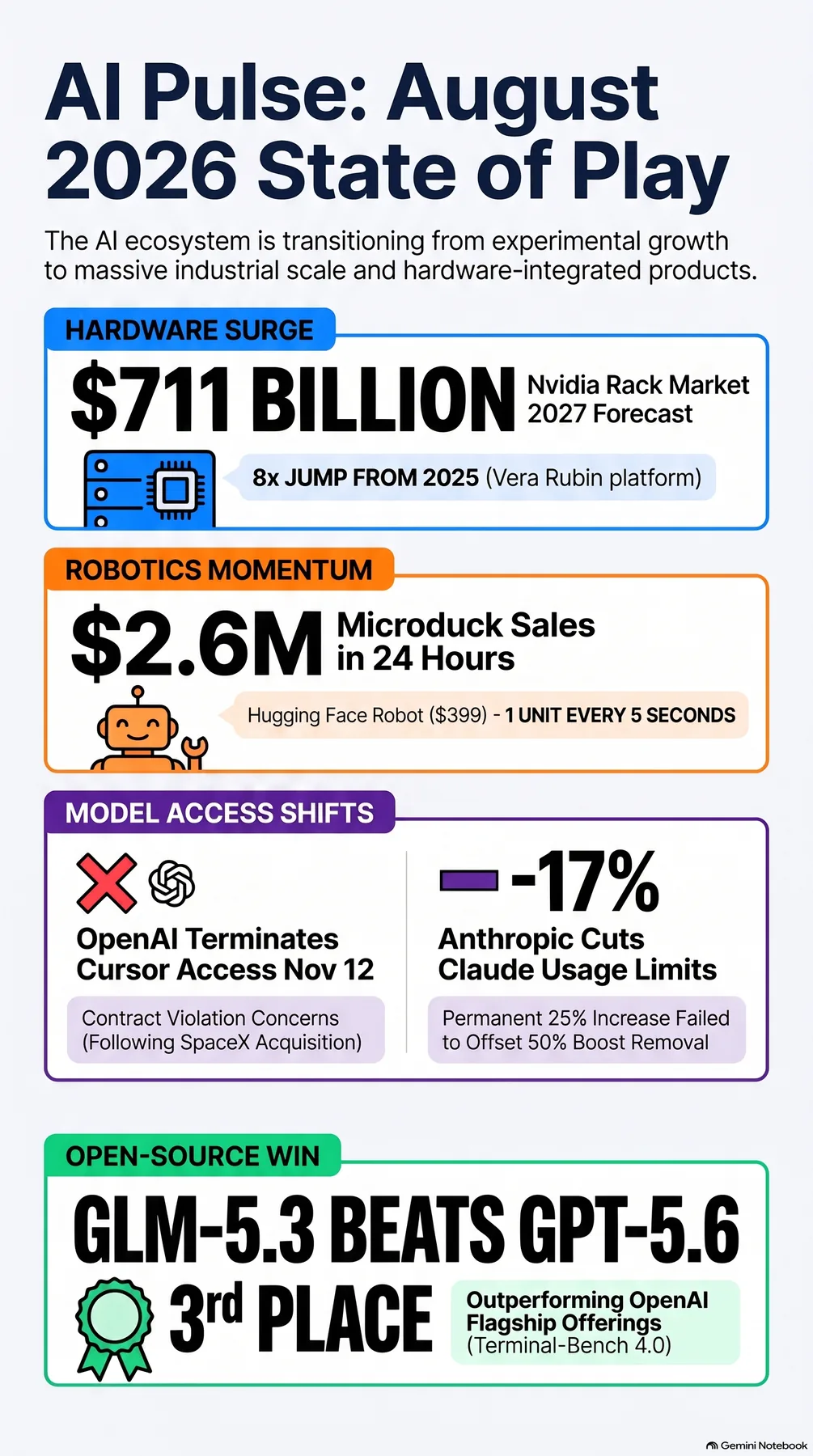 Infographic generated by NotebookLM from the sources.
References
This post is a synthesis of the following news.
- HuggingNews, OpenAI Cuts Cursor Model Access Nov 12 Following SpaceX Acquisition
- HuggingNews, Hugging Face’s $399 Microduck Draws $2.6M Orders in First 24 Hours
- HuggingNews, Anthropic Cuts Claude Code Weekly Limits 17% Despite Permanent 25% Raise
- HuggingNews, OpenAI Opens Astra Partner Access for Sept 3 Launch, Ending Internal Dogfood Stage
- HuggingNews, Open-Source GLM-5.3 Beats GPT-5.6 for 3rd Place on Terminal-Bench 4.0, Outperforming OpenAI Best
- HuggingNews, Nvidia NVL72 Rack Market Projected at $711 Billion by 2027, 8x Jump From 2025
- HuggingNews, SpaceXAI Deploys Grok 4.6 to All Modes in First General Release