Two paychecks: OpenAI at $500, Meta at $0
Let me set the receipts down first. One autonomous AI agent, $500 a month. Dozens of business tools integrated, $0. 24-hour background execution, billed by usage. This week, the industry began printing paychecks for AI employees. The largest numbers were written on the 29th (local time). OpenAI unveiled Dots, a 24-hour autonomous agent, at its developer conference DevDay, and Meta announced a major expansion of the small-business integrations for its agent Muse. One priced a single agent at $500. The other priced most of its functions at $0. This post reads this week’s news in the form of a paycheck. Unit price, depreciation, audit, location. Four lines. The reason this week is called the watershed for agent commercialization is that this is precisely the moment an agent first became a thing you can count in a price column.
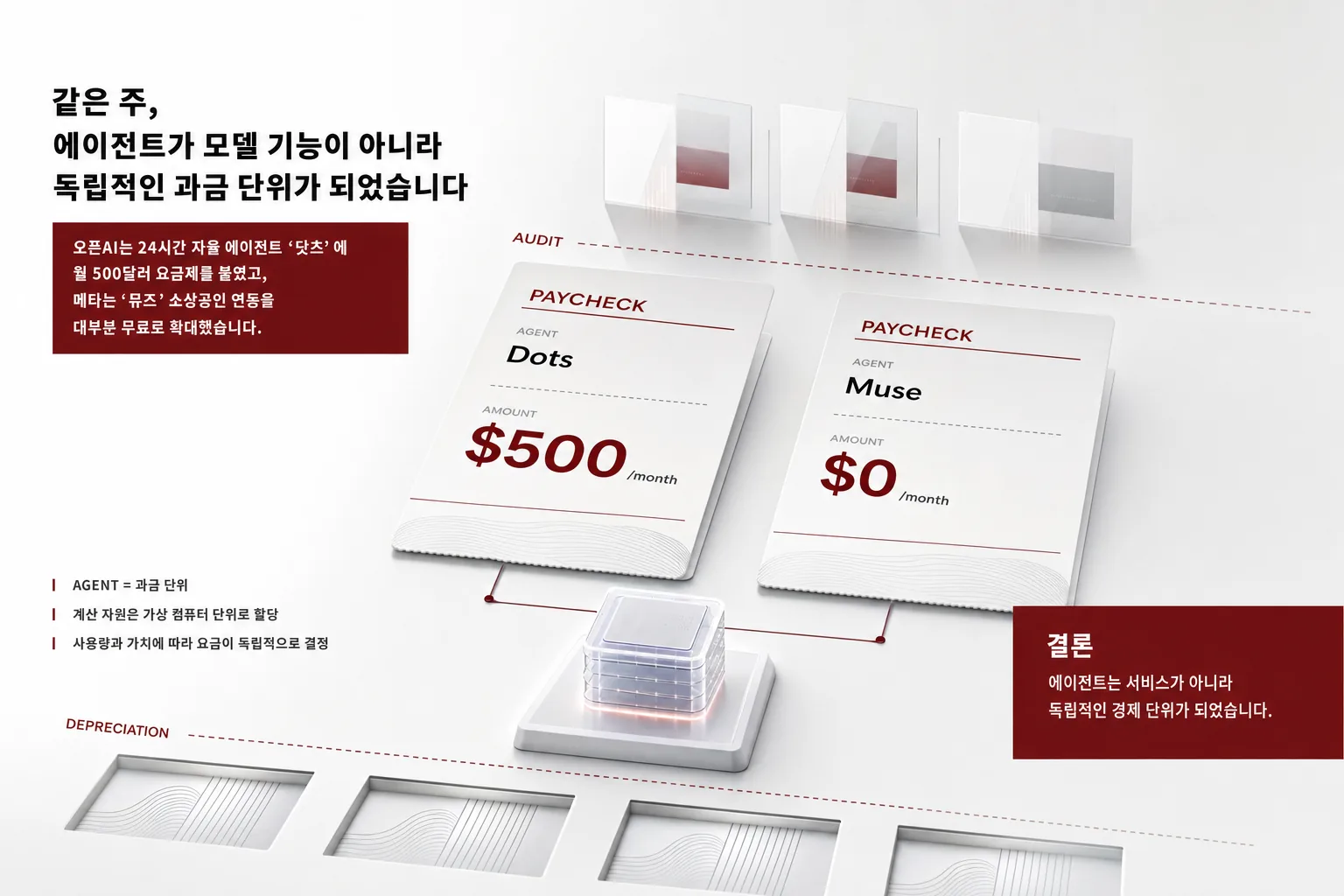 An image visualizing the core concept of this post.
Line 1, unit price: $500 and $0
OpenAI’s Dots is built on GPT-6 Astra. It works on an isolated cloud virtual computer with no screen, holding the background until the goal is met and performing research, data analysis, document writing, and development. Until now, ChatGPT agents and Codex centered on a mode where the user directs the work from in front of a screen. What sets Dots apart is that it is not tied to a specific device or interface and is an agent that works continuously once given a goal. It integrates with more than 4,000 apps and can take work instructions over Slack, Teams, and text messages. The billing is new as well. One Dots is included by default for Pro and Business Premium subscribers paying $100 or more a month, and a new $500-per-month Pro tier is being added. Pay-per-use is appended on top for heavy loads. Sensitive operations such as password changes, permanent deletions, and payments require explicit approval, and OpenAI is pushing integration with Microsoft Agent 365 security controls. The target, in other words, is not chat but real work. Procurement, invoice processing, customer support, contract review. This is the point of contrast with Meta’s Muse, which aims at the consumer and small-business markets.
On the other side, Meta’s Muse is priced at $0. It integrates with dozens of business tools, including Shopify, QuickBooks, Stripe, Canva, Slack, Notion, and Zoom, and connects all the way to Instagram professional account analysis, Facebook pages, and Meta ad accounts. Most functions are free with usage limits, and heavier usage sits on subscription plans. Here, too, posting, message sending, and purchases do not execute without user approval. There are numbers I have counted. In the first two weeks after its consumer launch in early September, about 2.8 million downloads, a Sensor Tower estimate, and No. 1 on the app charts in the US and Canada. Meta expanded it for small businesses, and a day earlier announced enterprise platform plans as well. Behind it is also a move to lower dependence on advertising, and with a former MongoDB CEO on board, there is a setup to grow it into a work agent that understands the context of stores, finances, and customer inquiries.
The two paychecks are different. But they point to the same fact. That an agent has begun to settle as an independent product and billing unit, not as a feature that comes bundled inside a model. OpenAI charges per agent. Meta bundles usage at $0. The difference is where the entry direction points. From the enterprise’s work, or from the register’s bills. The signal that the billing unit itself has separated out may be a more important change than any new model release.
Line 2, depreciation: an asset that loses two-thirds of its value in a year
$500 is only the front of the paycheck. The cost of running an agent around the clock is below the paycheck. As autonomous execution grows, it consumes more tokens and uses more virtual computer time. The bill ultimately heads to GPUs. And what this week’s news from the GPU side says is that they are now an asset you buy with borrowed money and then depreciate.
Neo-clouds have thinner capital than the Big Tech, so they often take out loans using GPUs as collateral to buy equipment. The problem is that GPUs turn over generations faster than aircraft or ships and have less liquidity in the used market, so in a default the collateral sale can come up short of the loan. Nvidia is in talks with insurance companies and hedge funds to pass this risk along. It is early, but the direction is clear. In August, it launched a $500 billion-scale AI finance platform with Goldman Sachs, Apollo, and others, offering residual-value guarantees in a band of up to 25 percent, and together with insurance broker Howden it is sharing chip depreciation and compute pricing data with insurers. The depreciation curve came down steeper than expected. According to Barker AI, an H100 8-GPU system worth about $320,000 today could be worth about two-thirds as much in a year, and about $30,000 in six years. On the other side, there is also a concern that in a systemic failure the liquidation discount could greatly exceed the model’s assumptions.
If depreciation is this steep, one question arises on the agent’s paycheck. For a $500 salary to hold, the value of the work the agent completes must exceed the compute it consumes. The bottleneck moved in the same time band as well. Global hyperscaler AI datacenter investment has entered a phase where securing power, not securing GPUs, is the bottleneck, and this week six Samsung affiliates decided to invest a total of $1 billion in the US AI infrastructure firm Helix. Helix is a company KKR launched in June that integrates the supply of datacenters with power, transmission and distribution, and optical communication networks. Former AWS CEO Adam Selipski leads it, and Nvidia and the power company Vistra are co-founding investors, with reports that capital commitments have reached more than $11 billion. Samsung SDS takes on datacenter operations and the expansion of the GPU cloud. In Busan, on the 29th, the Busan-Jinhae Free Economic Zone Authority and the head of Microsoft Korea, Cho Won-woo, discussed a cooperation plan for additional datacenter investment, and the agenda was power supply and regional industrial electricity rate plans. Microsoft has already completed its first datacenter in Busan’s Gangseo District in 2020 and its second AI cloud datacenter in 2024.
Line 3, audit: the four stages signed the same day
The third line is evidence that someone was watching. Two audits went out the same day. One aimed at the people running the agents. The other aimed at which model.
In the US, the audit was signed at the White House. At a lunch on the 29th, President Trump invited about 20 figures from the AI industry, including Musk, Huang, Zuckerberg, Pichai, Brockman, Amodei, Bezos, and Nadella. Emphasizing an enormous level of self-regulation, he drew a line against introducing new federal regulation, and the attending companies signed a four-stage voluntary agreement. Internal controls, an internal verification team, independent external audits, oversight by a board’s independent committee. The agreement spells out the possibility of future legislation, and maintaining an AI competitive edge over China was given as the stated reason. In December 2025, the US issued an executive order that weakened the states’ AI laws, and this time it appears to be closing the regulatory discussion through the industry’s voluntary agreement. This four-stage oversight system is likely to become the de facto industry-standard governance framework and is expected to affect the compliance cost structure of global AI operators as well. It was also reported that the voices in Congress demanding mandatory rules remain loud, and that even corporate CEOs are issuing warnings about AI that has broken free of human control, and that the policy direction is fluid.
In China, the audit is installed before the model is distributed. Z.ai (Zhipu AI) and Concordia AI released a Frontier Open-Weight AI Risk Management Framework at the end of September. Six stages. Risk identification, threshold, analysis, assessment, mitigation, governance. Models are classified into three zones: green, full release; yellow, restricted or staged release; red, stop. Data filtering that screens out chemical and biological hazard information, and malicious code and extremist content, before pre-training was cited as the core defense. Z.ai applies a practice of releasing weights only after security partners have pre-tested them, in the GLM series. Since an open-weight model, once distributed, can be neither monitored nor recalled, pre-distribution audit means there is only one line.
One governs the side that runs the agents. The other governs the model that gets called. The two receipts look different. But they were issued in the same week. The industry has begun to assume that the side paying the salary also bears the audit cost.
Line 4, location: where the virtual computer sits
The last line is where the virtual computer sits. Dots runs on a US cloud virtual computer. If an enterprise’s procurement data, invoices, and contracts flow into that machine, the location of the paycheck is decided by the provider, not the customer. For organizations facing network isolation or data sovereignty requirements, this is the first question that comes before unit price.
In Korea, location is being decided separately. On the 30th, Deputy Prime Minister Baek Kyung-hoon announced that Dokpamo is proceeding as scheduled through its third phase, and that the Frontier AI challenge is also moving forward together as a separate national strategy. The establishment of a special purpose company (SPC) is under consideration, and it carried a direction to widen computing resources to startups and small and medium-sized enterprises. After two rounds of evaluation, the teams still standing are three: LG AI Research Institute, SKT, and Upstage. Model competition is heading toward being decided by the state, and the question of execution location stays with each company. The Busan-Jinhae Free Economic Zone Authority putting forward power and industrial infrastructure as its core card for attracting investment is in the same direction.
In the meantime, the Korean company that clocked in its AI employee first is a mid-sized security firm. Genians, No. 1 domestically in network access control (NAC), was selected as a 2026 Korea Top Job-Creating Company and has been running the Gyeonggi Province 4.5-day workweek pilot since August. Repetitive, rule-based work is being automated with AI, and the work is being redesigned so that employees focus on judgment, planning, and problem-solving. In the first half of 2026, consolidated revenue of 24.9 billion won and operating profit of 4.3 billion won marked the company’s best first half since founding, with operating profit up about 294 percent from the previous year. While Big Tech is printing paychecks, at mid-sized companies overtime is coming back to people.
The last line of the paycheck: who reads it
The question of hiring an AI employee changes. From can it do the work, to can it read the four lines of that paycheck. Unit price, depreciation, audit, location. The four lines this week’s news filled in.
ThakiCloud’s Paxis is an agent-native cloud designed on the premise of these four lines. It is a formal product (v1.1 GA). Skills, Tools, Policies, and Audit Logs are managed as first-class resources, and the agent’s autonomy is governed in stages from L0 to L3. Execution opens only after passing the policy gate, and an audit log is left. The agent works inside an isolated sandbox and is extended with MCP connectors and a skill marketplace. The depreciation line is answered by the per-task model selection CostRouter, and the location line by the sovereign, on-prem K8s (ai-platform) execution environment.
Big Tech has already sent the paycheck. A company using AI employees will be distinguished by how much of the paycheck’s lines it can read.
References
This post was written by synthesizing the news below.
- Chosun Ilbo, OpenAI Unveils Autonomous AI Agent ‘Dots’… Research, Development, Even Work, All on Its Own
- Yonhap Infomax, Meta Greatly Expands Small-Business Integrations for AI Agent ‘Muse’
- SmartBiz, Nvidia Expands AI Chip ‘Funding Source’ to Insurance Companies… Diversifying GPU Collateral Loan Risk
- Seoul Economic Daily, Eyes on Microsoft’s Additional Datacenter Investment… Busan-Jinhae Free Economic Zone Authority Discusses Power and Infrastructure Support
- The Daily Post, Six Samsung Affiliates Decide to Invest $1 Billion in US AI Infrastructure Firm ‘Helix’
- ETNews, Deputy PM Baek Kyung-hoon: ‘Dokpamo Continues… Also Challenging Frontier AI’
- eToday, Trump Gathers About 20 AI Big Shots… ‘Self-Regulation’ Instead of Regulation
- Global Economic, China’s Open-Source AI, Six-Stage Safety Framework Including ‘Pre-Training Data Filtering’
- DataNews, Genians Selected as ‘Top Job-Creating Company’… AI Work Innovation and 4.5-Day Workweek Experiment