The Day AI Moved in Two Directions at Once
Line up the two headlines from the same day, side by side. On one side: “OpenAI finishes 10-trillion-parameter pretraining.” On the other: “An entire agent runtime runs on a small computer on your desk.” Read separately, each is a familiar story in the AI industry. Read together, they point to a single question. Where is the best place to run an agent, and who gets to decide that. This post is for the engineers who have to answer it. It shows, by contrasting facts from both directions, that today’s news is not a forecast but a set of options that has actually arrived.
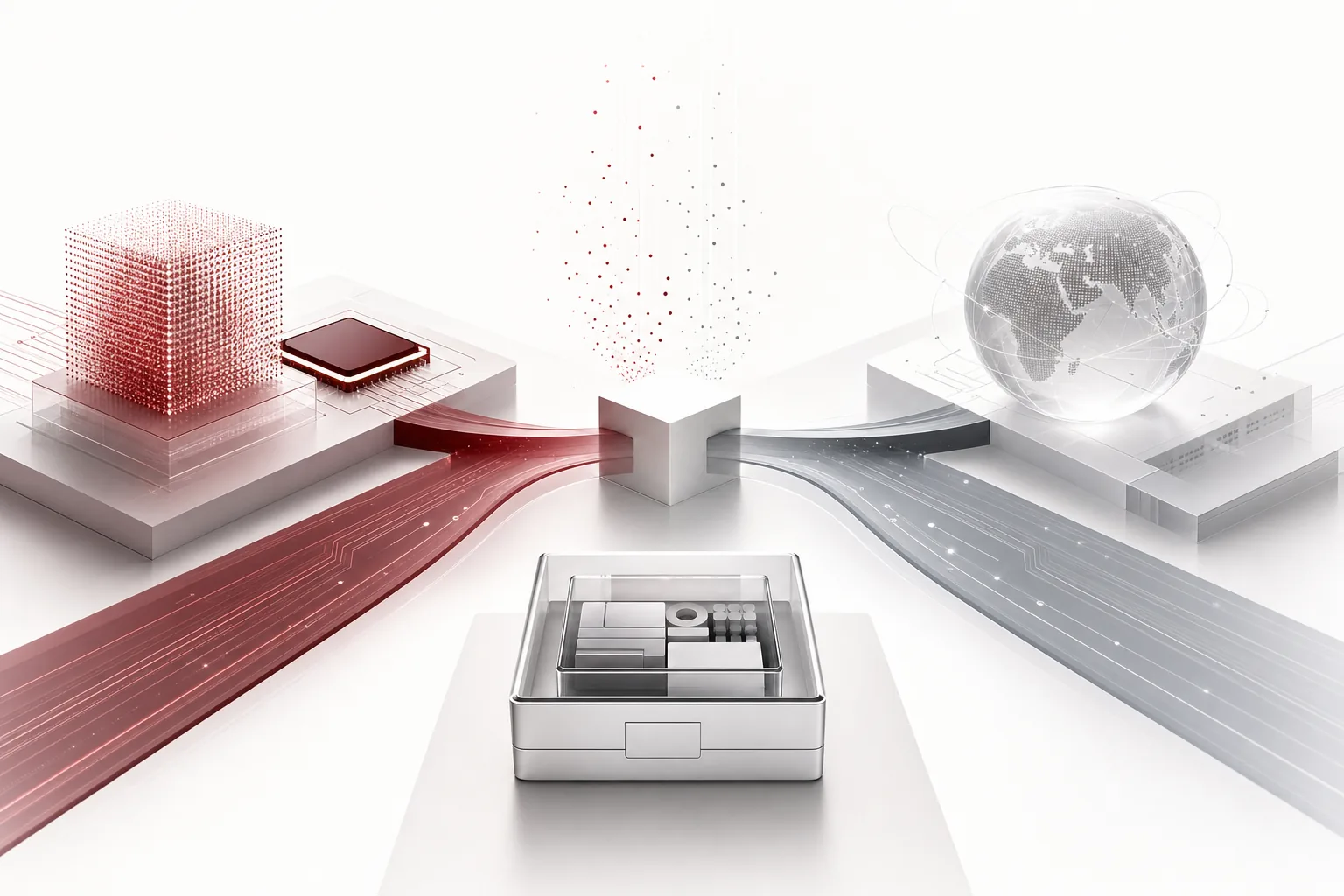 A visualization of the post’s core concept.
Up: 10 Trillion, a Custom Chip, a $30 Trillion Market
OpenAI has finished pretraining a model called Bel. It is 10 trillion parameters, and it follows the Doug project. Reporting said it will form the base layer of the planned Astra and GPT-6 systems, and some read it as the end of Anthropic’s compute lead.
At the same time, OpenAI’s first custom inference chip appeared. It is called Jalapeño, and it was rated at 1.9x the power efficiency of Nvidia’s GB300. OpenAI plans to start installing it in its own compute infrastructure by the end of the year.
Growing a model, building a chip, and capturing power efficiency in the same quarter is not technology news. It is closer to a declaration that the economics of inference is moving from GPU count to power per token. A company that can lower its own token price gains the room to lower prices, and that room determines how fast the market widens.
The end of this direction is the cost curve. Once pretraining reaches 10 trillion parameters, inference needs to run longer and more than training does. Inference unit price and power efficiency become a separate axis of competition from model performance. The moment a company puts chips that produce the same output with less power into its own infrastructure, its token price touches a competitor’s cost structure directly. A company that makes its own hardware and saves its own power becomes a player qualified to open the inference market on price.
Capital follows right behind. Anthropic pitched a $30 trillion AI market forecast, a figure that tops even SpaceX’s estimate. Q2 revenue more than doubled to $11.6 billion, and reports continued that the company is considering raising up to $100 billion at a $2 trillion valuation. The shape of the compute arms race has changed. The argument of who trains faster moved to who secures more money and power. The side growing up grew into a question of money on this day, and the side shrinking down arrived on the same day. That is the real news in today’s headlines.
Down: The Day an Entire Agent Fit in One Box
On the same day, Perplexity shipped a product moving in the opposite direction. It is called Portable Computer, a local agent stack. The interesting point is not the word local. Running models locally is nothing new. The important fact is that the entire runtime executes on device.
An orchestrator LLM, sub-agent LLMs, and the agent harness. All three run on an Nvidia DGX Spark. The benchmark score was reported at 73%.
Until now, agent runtimes were assumed to be something the cloud provides. The model was in the cloud, the orchestrator was in the cloud, and the sub-agents were in the cloud. The harness, the part that determines the quality of agent work, was an invisible asset inside the cloud. Because it was invisible, nobody asked where it lived.
Portable Computer is the act of pulling that invisible asset out and putting it on the desk. It is also a declaration. A declaration that the execution plane of an agent does not have to be the cloud. The part that had been treated as the inside of the cloud is actually separable and portable. Once that becomes visible, the next question follows naturally. If a runtime is portable, where should we put it?
The 73% benchmark score is worth reading on its own. An on-device runtime holding 70%-range performance on agent workloads does not mean every job should move local. It means the opposite. Some jobs run in the cloud, some run locally, and mixing the two is now possible. Before, the runtime was bound to the cloud, so there was one option. Now there are two, and the cost of moving between them is lower. What emerges when a runtime becomes separable is neither an advantage nor a constraint. It is freedom. And freedom creates an architecture question. That question is not for the company selling models to answer. It is for the organization that actually runs agents.
Why “Running Small” Holds Today
This direction holds because its prerequisite arrived on the same day. The prerequisite is a model small enough to fit in one machine, but capable.
Alibaba released Qwen3.8-Flash-Next, a 12-billion-parameter multimodal MoE model. It is being read as the first piece of the next-generation Qwen4 architecture, and open-weight downloads begin today, August 26. Capital is flowing in the same direction. Jack Ma bought HK$600 million worth of Alibaba shares. Reports tied this to the first new issuance since 2019 and an expansion of AI investment, and said the chairman and CEO also joined in increasing stakes.
Here the MoE structure enters as a variable. One reason Qwen3.8-Flash-Next can hold 12 billion parameters and still run on one machine is that MoE does not move the full parameter count per token. It carries large weights and runs only the parts it needs in the actual computation. When this becomes possible, model size and execution cost are no longer tied 1:1. A 12-billion-parameter multimodal model running on a desktop box, and an open weight you can freely pull starting today, look like separate facts. In reality they are the front and back of the same story. Size grows, computation gets thinner, distribution opens. All three happened in the same week.
Put together, this means: capable models that fit in one machine are no longer exceptions. They are becoming weekly releases. When a model you can run locally arrives, the value of the question “where should it run” rises with it. Until now, local runtimes were close to demos. They could not run capable models, so they were not practical. But once capable models start arriving weekly, a runtime on the desk becomes something you can actually use. The 73% benchmark of Portable Computer is the first signal of that. The signal that running small has become an option, not a toy.
Execution Location Is Now an Architecture Decision
So what should a company do? If you read today’s news as a choice between cloud and local, pick one, you will get it wrong. Both directions are real at the same time. Frontier models grow to 10 trillion parameters, and agent runtimes shrink to one box on a desk. This is not an opposition where each side tries to beat the other. They are two facts of the same industry.
So the question to ask is not which side wins, but which jobs run best where. Jobs that need the largest models should run on large clouds. Jobs that need fast responses, and jobs that handle data that cannot leave the building, move to the local box. In between, air-gapped and sovereign environments each have their own answers. What matters is making this choice at the architecture layer, not at the habit layer. Because the answer changes for each job, each dataset, each regulation.
This decision brings operational load. A team that ran one cloud now runs local boxes too, and the execution plane becomes two. Each plane has different failure patterns, cost curves, and audit requirements. The same agent fails in different ways depending on where it runs. Choosing an execution location is, in the end, more than choosing a model. It is choosing the number of planes to operate. If the plane that was one last year becomes two this year, the organization has to learn again how to run both well. That is the second task today’s news hands to companies.
In the end, the message today’s news leaves for companies is one. Compute grows up, and agent execution moves down. These two are not contradictions. They have separated into an upper layer and a lower layer within one system. The upper layer runs larger models more cheaply, and the lower layer runs the same agents closer by. The organization that has to design both layers at once becomes the execution subject of the agent era.
A team that decided where to run agents last year in a single meeting has to decide this year, in a design document, where to run each agent. The unit of the decision changes from one to many, and the place of the decision moves from the meeting room to the document. That is the change today’s two directions force on companies.
A Runtime That Runs Everywhere and Optimizes Deeply
ThakiCloud’s Paxis takes exactly this question as its core design. Paxis is an Agent-Native Cloud, and it is already shipping as a formal product. Its operating principle is Run everywhere, Optimize deeply on ThakiCloud. Run agents where their jobs have to run, and optimize deeply there.
The spectrum is wide. On device and air-gapped networks, sovereign and on-prem K8s environments, and dedicated cloud. It contains both ends of the two directions. What makes this possible is first-class resources: Skills, Tools, Policies, Audit Logs. These four are not optional add-ons. They are basic components of the execution environment.
Autonomy comes in stages from L0 to L3, and each stage is controlled by policy gates and audit logs. Execution happens inside isolated sandboxes. Models are selected per job, and CostRouter decides which model attaches to which job.
When there are multiple execution planes, the question is what to put in each plane and how. Paxis answers this with resources. MCP connectors and the skill market make the act of attaching itself a subject of policy and audit when an agent attaches a new tool or new capability. It is the consolidation of what each plane used to build on its own into one execution plane.
Where to run, how much autonomy to give, which model to use. Paxis’s execution plane is where these three forks of decisions are nailed down not as developer habits but as resources the platform should determine. Today, when both directions are real at once, the execution plane that designs those two layers as one is where Paxis stands.
If you tie today’s two directions into one sentence, it is this. Compute moves to where the work is. And the side that designs the execution plane, that is, the runtime, for that movement, owns the agent era.
References
This post was written by synthesizing the news below.
- HuggingNews, OpenAI’s First Custom AI Chip Beats Nvidia GB300 by 1.9x on Power Efficiency
- HuggingNews, Anthropic Pitches $30 Trillion AI Market, Topping SpaceX Estimate
- HuggingNews, OpenAI Finishes 10T Parameter Bel Pretrain, Ending Anthropic’s Compute Lead
- HuggingNews, Jack Ma Buys HK$600 Million Alibaba Shares Following First New Issuance Since 2019
- HuggingNews, Perplexity Ships First Local AI Agent Runtime for Nvidia DGX Spark to Hit 73% Bench Score
- HuggingNews, Alibaba Ships 120B Qwen3.8-Flash-Next, First Glimpse of Qwen4 Architecture