The Floor Says 80, the P&L Says 37
One page in a report keeps catching the eye. It is the McKinsey “2026 State of AI: The Journey to ROI” report, cited in today’s Ajou Economics coverage. The report tracks whether companies’ AI journeys have actually reached the ROI stage. The summary of that journey is held by two numbers sitting side by side on the same page. 80% of companies say they feel an improvement from using AI. Only 37% of them show it in EBIT, on the income statement. By the report’s own bar, a high performer is a company with EBIT up 5% or more. The gap is not small. But today’s question goes one step further. Why do the two numbers disagree, and what is wedged inside the companies where the perception is rising and the books are slow?
Today’s digest, 18 selected articles in all, splits across semiconductor chips and cloud infrastructure, AI models and agents, policy and sovereign AI, big-tech investment, and domestic enterprise AI adoption. Sweep the enterprise-adoption stories and mismatching number pairs are everywhere. Adoption has split, speed and governance are running on separate tracks, and there is exactly one place where the numbers agree. Let’s take the pairs one by one.
 A visual metaphor for the article’s key idea.
Two Koreas hiding inside the adoption rate
The adoption rate splits by revenue size. 40% of companies above USD 1 billion, roughly KRW 1.38 trillion, now run at least one AI agent, up 13 percentage points from 27% a year earlier. The same report’s sample also covers companies below that line, the small and mid-sized ones. Under USD 1 billion, the figure is 22%, flat. The stages are just as distinct. “Enterprise-wide rollout” is the most common among large enterprises at 40%, while “not adopted yet” leads among small and mid-sized companies at 41%. Perceived benefit splits the same way, 54% for large, 33% for small.
The work agents take on is not routine clerical work. Coding, marketing, supply chain, inventory. It is moving into the core jobs where the money is, and borrowing the report’s own phrase, enterprise AI has crossed from the experimentation stage onto the “journey to ROI.” Tool-level usage points the same direction. AI chatbots lead at 47%, and AI agents and software coding agents have each climbed to around 20%. After the chatbot that answers questions became ubiquitous, the agents that actually handle work have moved up to the next layer.
One more number. One in five companies now builds software directly with coding agents instead of buying it. And 32% answer that they have gone without purchasing even a single piece of software. That is why people argue AI is turning software-consuming companies into software producers.
And yet the gap is not closing. It is a structure where large enterprises expand and small ones freeze. When a large company’s agent requirements travel down the supply chain to its partners, the side that must operate without heavy investment is precisely the side that cannot invest. The moment the early-adopting large company hands its agent requirements to partners as the standard, the small company’s question flips. It moves from “should we adopt?” to “how long can we hold out?” The configuration the report calls “polarization” is a structural problem, not a matter of time.
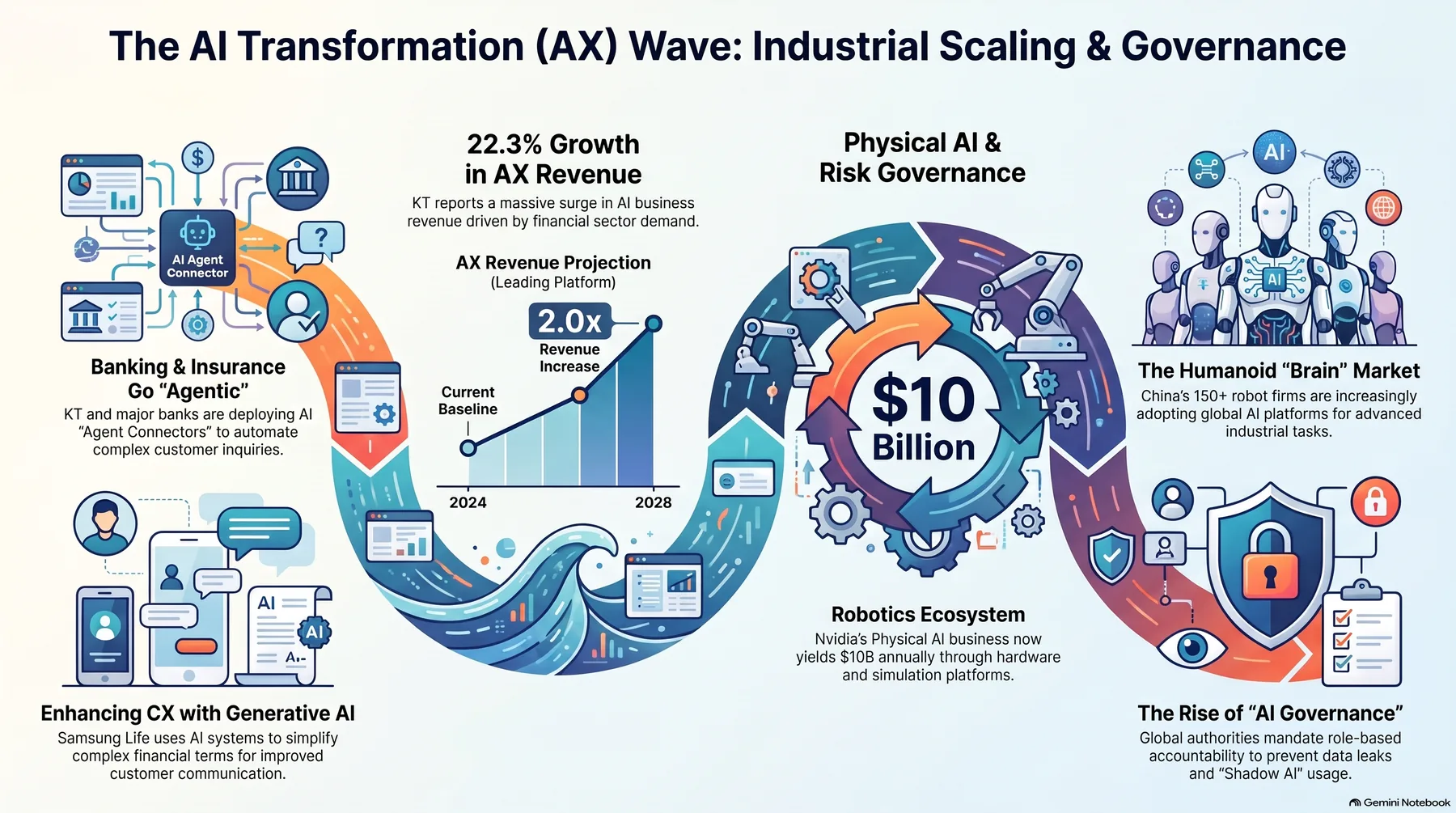 Infographic generated by NotebookLM from the sources.
The front line runs, the handrails lag
The second mismatching pair shows up clearest in the insurance industry. EBN’s question is blunt: the innovation is fast, but are the risk controls in place? Fubon Hyundai Life has run “AI vibe-coding training” since July, from executives down to front-line staff, the CEO included. At the same time it opened an internal competition on GPT-service usage. Samsung Life’s AI customer-experience writing system took the grand prize in the AX-innovation category of ICT Award Korea 2026, plus the ministerial award from the Ministry of Science and ICT. The front line is clearly moving.
What stands out is Singapore’s guideline. The standard that agent-AI risk should be integrated into enterprise-wide risk management is cited in the industry as the reference case for supervision in the agentic-AI era. The baseline for “how do we control agents?” is being set first, from outside.
The regulators’ pace is fast too. The United Kingdom is putting the high-impact personal-finance domain at the center of AI-governance supervision, and Singapore’s MAS has issued a guideline integrating agent-AI risk into the enterprise risk-management system. Australia’s APRA and ASIC are pressing third-party and external-solution risk controls. Korea’s “AI Guidelines for the Financial Sector” likewise give three recommendations. Management divides roles and responsibility across the entire AI lifecycle. The board checks the adequacy of internal controls. And a dedicated risk-management body is functionally separated from the development department to block conflicts of interest. In short, do not let the team that builds it overlap with the team that controls it.
The danger is the difference between those two speeds. The Korea Financial Research Institute warns of three side effects. Usage strangled and innovation slowed by heavy pre-verification and approval processes. A box-ticking control culture that confirms the checklist without inspecting the real risk. And the spread of “shadow AI”, unapproved external AI tools used around the controls. The faster the front line runs, the larger the agent usage moving without control behind it grows.
This is where the picture completes. As shadow AI spreads, the field accumulates perceived benefit from tools outside management, and only risk and cost remain in the books. The 80 is the perception that grows larger as more is used; the 37 is the number that remains when only proper use counts. Improvement is felt, but because it is neither measured nor controlled, it does not come down into the P&L and instead accumulates in the form of risk. The gap between 80 and 37 is not a difference born of missing tools. It is the difference between where AI is used and where it is controlled.
Where was the matching pair hiding
There is one company in today’s digest where the two numbers match. KT. According to Shinailbo, half a year after CEO Park Yun-young took the helm, KT made its choice. In the middle of the race from telecom to AI platform, it rewrote the very center of its AI contact center, the AICC. The center of the agentic AICC moved from conversation, that is question and answer, to task handling, the applications and processing after the conversation. The newly applied “Agent Connector” connects channels and services that used to stand apart: chatbots, contact bots, AI bankers, AI agents. It carries the context and information of a customer conversation over organically. When the contact bot ends the conversation, the next-stage application is handled with that context still alive. That customers no longer have to re-explain from the start in every channel means the work of answering has become the work of handling.
This is not a story of adding one more tool. It is a story of rewiring the workflow. Consecutive wins in finance are the backing for it. On August 10, KT finished building the next-generation AICC for NH Bank, and was then selected as the builder for Woori Bank’s AI chatbot and contact bot rebuild. Its deployed AICC references now total 34: 24 in finance, 10 outside it. And the number: Q2 AX revenue rose 22.3% year on year. The blueprint that comes with it targets doubled AX revenue by 2028 and a 9% operating margin. Also visible is the plan to extend references beyond finance into manufacturing, distribution, and hospitals. Where “answering became handling,” the P&L followed, and the intent now is to copy that pattern to other industries.
Meanwhile, the state sets up the control tower first. According to MoneyToday, the second National AI Strategy Committee has finished taking shape. Ha Jeong-woo, the former presidential AI chief of staff, returns as resident vice-chair. That closes the leadership gap of about four months that had followed the April by-election. The triple structure is in place. The presidential office plans and coordinates. The government carries the budget and execution. And the National AI Strategy Committee binds industry, academia, and research. The AI data-center special act and the national mega project are the fuel being fed in. Alongside the sprint to “leap into the global AI top three,” three domestic frontier models, including Dokkapmo and models from SKT, LG, and Upstage, passed the second gate. Vice-chair Ha Jeong-woo stressed building frontier self-reliance in preparation for an era of export controls, and the year-end “AI for all” launch will be the first test. A national-level race sets up coordination, budget, and governance before it starts running. That is the starkest contrast with the polarization on the corporate ground.
The problem is not the tool, it is the operation
Bring the three pairs together. Adoption split into 40 and 41. Speed split into innovation and governance. And the numbers matched only where the workflow was rewired. The conclusion the report’s numbers point to is the same. The advantage lies not in how many tools you have brought in, but in workflow redesign and performance measurement. And the biggest burden is the cost of AI operation, tokens included. Two in ten companies report constraints on usage. But six in ten plan to expand AI investment within a year, so this is not a story of money being pulled back. Budgets are actually growing while the books stay put, so what is tightening is not the budget, it is the operation.
What fills the space between the 80 on the floor and the 37 on the P&L is an unglamorous middle layer. Which agent may do what, under which policy. What happened at execution, and whether it can be brought before the board. Which model was used for which job, and at what cost. Whether the execution environment is an air-gapped network or the cloud. The answers to these four questions are not in any tool evaluation. They exist only in the layer of operation.
This is where ThakiCloud’s Paxis comes into the lens. Paxis is the formal product of the Agent-Native Cloud, at v1.1 GA. Skills, Tools, Policies, and Audit Logs are managed as first-class resources, not as attachments. Autonomy, too, is written as policy under an L0-to-L3 governance that asks “how far do we leave the agent alone?” The policy gate stands in front of execution and stops it, and the audit log leaves records that can be brought before the board. Execution happens inside isolated sandboxes, jobs connect through MCP connectors and the skill marketplace, and CostRouter picks the model for each job to absorb the operating-cost burden. One in five companies now turns software purchases into in-house development. The loop in which that output returns as a reusable asset in the skill marketplace is work of the same layer. For sectors that must keep the execution environment on their own territory, such as finance and the public sector, the answer is the sovereign, on-premises K8s ai-platform. Shadow AI, too, is ultimately solved not by prohibition but by management. Execution inside policy becomes audit, and audit is what shows up in the books.
The 80 on the floor and the 37 on the P&L do not match. But they can. The moment agent operation becomes measurable, controllable, and auditable. Where the two numbers already match, KT’s P&L is following. The question each company has to answer next is not “do we put in one more tool?” It is “what do we build in the middle layer?”
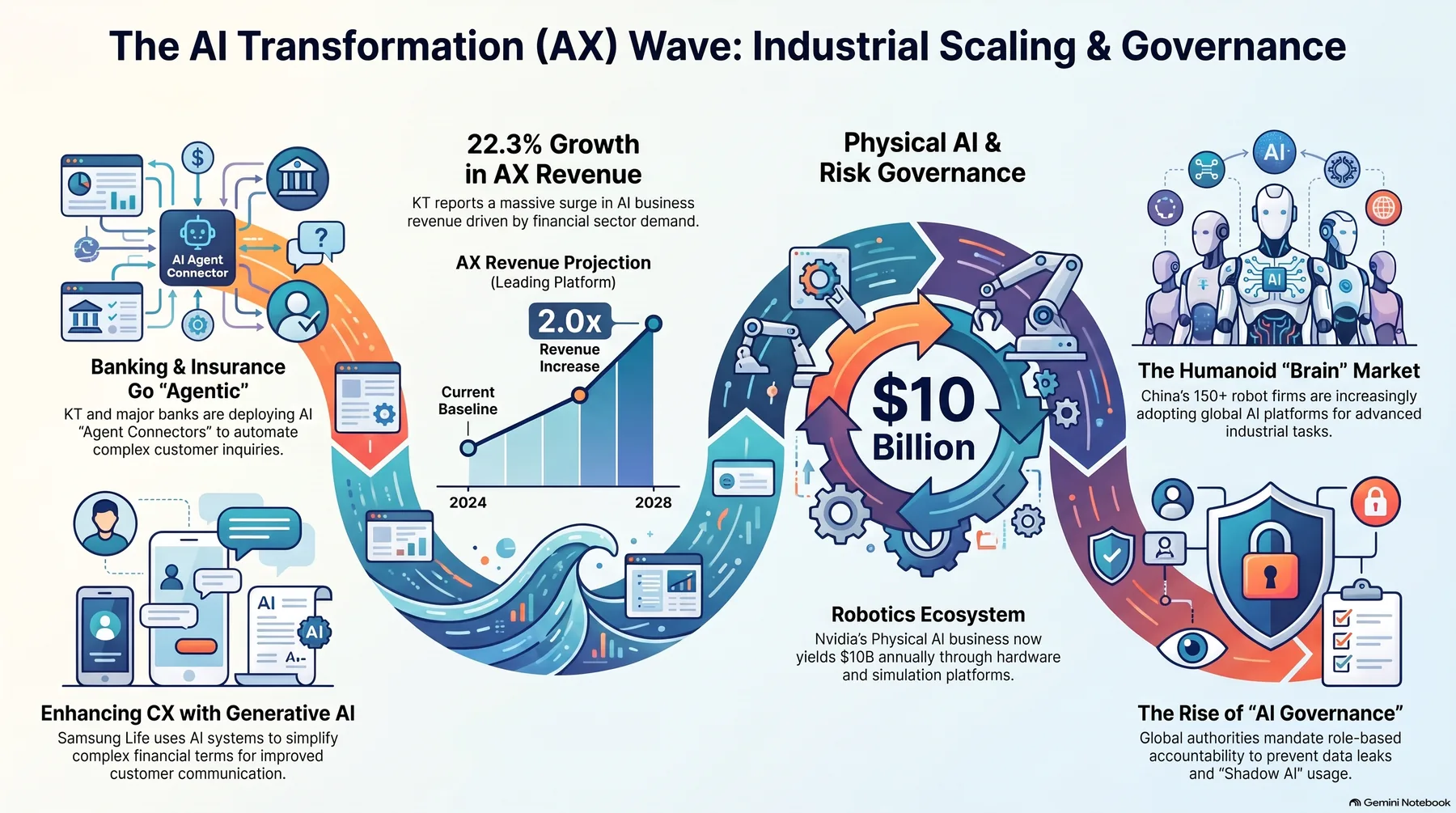 Infographic generated by NotebookLM from the sources.
References
This article was written by synthesizing the news below.
- AI Times, August 31: Nvidia’s Physical AI moves from “future strategy” to business, with China at the core
- MoneyToday, The Lee administration fills in the AI control tower, “top-3 leap” sprint on
- Shinailbo, CEO pick: half a year in, KT’s Park Yun-young expands the agentic AICC territory
- EBN, Insurance takes wing on AI: fast innovation, but are the risk controls in place?