The Day AI Learned Division of Labor on a Factory Floor
The annual product quality review report that used to take 12 hours now takes one. Chong Kun Dang’s APQR (annual product quality review report) fell to one-twelfth of its former size after it introduced a multi-AI-agent service built with LG CNS. Measured across roughly 500 products a year, that returns about 5,500 hours of engineering time. The interesting part is not the speed itself but the structure behind it. In the 12 hours a human used to do end to end, what the AI did, what the code did, and who pressed the final approval button is the real subject of this article. Today’s digest carries, side by side, stories from four different industries: pharma, venture, banking, and security. All of them are converging on the same structure. It is worth reading them together.
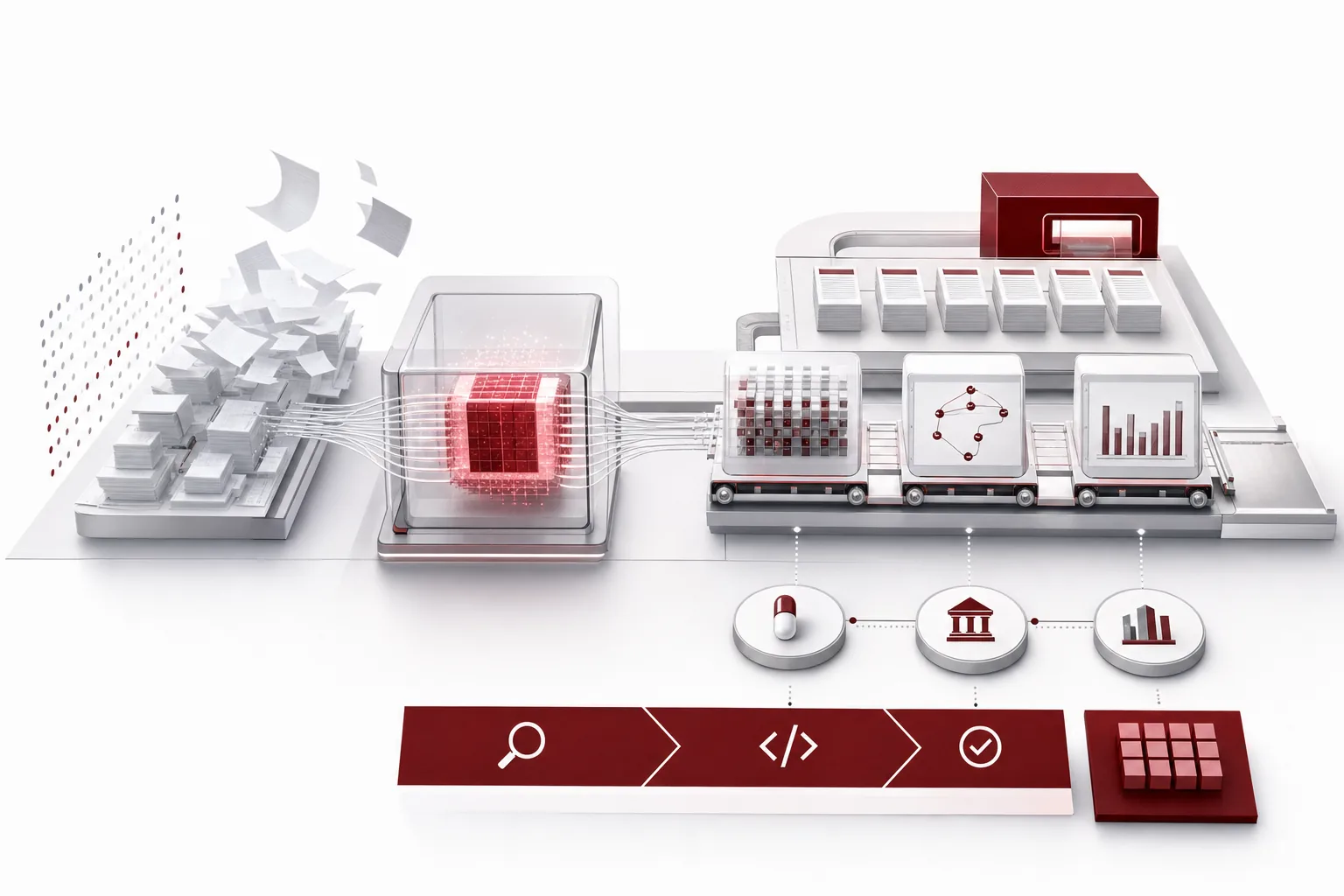 A visual of the article’s core concept.
The Day AI’s First Job Became a Factory
In pharma, the place where AI has always been photographed first was the drug-discovery lab. This time it has moved down to the production floor. A Medical Observer article that lays out the state of AI adoption on pharma production floors lists, oddly enough, four different answers. GC Green Cross cut the time to write product quality reports by more than 80% with an AI document system built with MeGzCloud, and is pushing a site-by-site automation and intelligence roadmap for its Ochang, Hwaseon, and Eumseong production bases through 2030. Daewoong Pharmaceutical’s Osong plant adopted AI predictive maintenance that learns vibration patterns, and cut the QC team’s microbial-identification data processing time from 416 hours to 52. Samsung Biologics applied digital twins and AI to its Plant 5 to analyze bioreactor fluid flow and predict quality deviations from multivariate data.
What stands out in the four stories is the premise. Drug manufacturing is bound by GMP regulation, so data reliability, on-site validation, and a human final-review structure are preconditions for adoption. The factories that take AI most seriously are the same ones that place the strongest limits on it. A division of labor, code does the numerical computation, generative AI does the interpretation, and the responsible person gives final approval, has settled into the common answer for this industry. It is spreading as the standard structure for making AI take hold on the floor.
Behind it is the market competition this year, in which AX specialists have kept publishing results. As LG CNS and MeGzCloud disclosed results in pharma quality-document automation, the competition picked up, and not only the large players but also mid-sized pharma companies such as Samjin Pharmaceutical, Handok, and Yuyu Pharmaceutical have moved to deploy on production floors. A new segment of enterprise AI is hardening. And this industry has one clear rule. Data must not cross the factory boundary. Quality records made on the floor are the most sensitive information, and once they leave for an external service they cannot be brought back. So the pharma adoption question was never “what can AI do” but “can we run it without sending data out.”
VCs and Banks Wrote the Same Answer
It is not a story only about factories. Ttongtong, a subsidiary of DSC Investment, launched on the 19th of this month DDWorks, an AI work agent that reads investment contracts. It was announced alongside IMWorks, its integrated investment-management service, which links the ERP investment ledger and fund ledger to contracts and investment-committee minutes to support document review and report drafting. The demand for reading contracts spiked suddenly because of the structure of the venture market. In the VC industry, the formation of co-GP funds and contributions to private mother funds have grown, and this year’s revised venture-investment standard contract introduced a separated system that splits the contract from the shareholders’ agreement, so the work of reviewing multiple contracts at once has surged. That is why the ability to structure each investor’s rights and obligations, and whether an answer cites the source text, became the verification standard for AI adoption.
Even so, the AI’s share is clearly bounded. On checking a commercial AI model, simple clause summaries were more than 90% accurate, but a limit was confirmed in contextual detection, filtering the difference between the main text and attached special terms into poison-pill clauses. So quantitative figures such as equity stakes and investment amounts are aggregated by ERP database computation to block hallucination, and the AI only handles document-context exploration and drafting. Results are split into three boxes: needs change, human review, no problem. Uncertain matters are handed to the human, the investment officer. Security policies were conveyed alongside, such as a dedicated environment separation per operator, permission-scoped queries by the logged-in owner, and masking of sensitive information before sending to external AI models.
The direction of the banking sector is the same. The Financial Services Commission released the revised AI guidelines for the financial sector in June, and they took effect on the 22nd of the same month. Under seven principles including governance, an assistive role, and reliability, the structure defines AI at this stage as a work assistant and keeps the final responsible party as a human. In fact, bank AI conversation has evolved in stages. Woori Bank’s “Sori” in 2017 and NH’s “Nugu”-based voice banking in 2019 were the stage where voice commands were recognized to run preset tasks. The core of today’s generative AI agent is that even if a customer does not know a menu name or command, it grasps the context of the sentence, finds and connects the function, and actually performs a transfer. But each bank differs on the range of transactions the AI performs directly, how it connects to legacy financial-system screens, and on safety devices such as identity verification and transaction-info confirmation. So the banking sector has chosen a strategy of starting with relatively simple tasks and widening the service scope step by step. KB Kookmin Bank launched KB AI in KB Star Banking in September, letting customers complete real transfers, from balance checks to small remittances, by voice, and Shinhan’s SuperSOL supports roughly 50 tasks conversationally, including transfers and limit changes. Woori Bank is rebuilding its AI chatbot and is set to roll out stage 1 in December, and NH Agri Bank is expanding AI Loan Rate Care, where the AI files a rate-reduction request on the customer’s behalf.
Pharma, VC, banking. Three industries whose customers and work do not overlap chose an architecture that can be stated in one sentence. AI explores, code computes, and people decide. It is hardening into a design principle for enterprise AI itself.
How the Word “Assurance” Became the Keyword
Academia is starting to name this phenomenon. The Korea Information Security Society (KIISC) held its sixth AI x RMF workshop of 2026 on October 22 at the Samsung SDS West Campus in Songpa, Seoul. The change the workshop shows is that AI is moving past simple adoption and use, with its center of gravity shifting to continuous risk management and verification across the full development and operations lifecycle. Professor Kwon Jin of Ajou University, chair of the RMF study group, presented as the core message a paradigm shift toward AI assurance, continuously verifying the security, safety, reliability, and cyber resilience of AI across the full lifecycle. The continuously assured structure is the point. A move from the age of AI adoption to the age of AI assurance.
The workshop agenda itself was the signal. Across three sessions, security for AI, AI for security, and cybersecurity-specialized AI models, the authority, approval, and audit systems of enterprise AI agents and agentic AI supply-chain security were the core topics. Keynotes followed from Professor Kim Seung-joo of Korea University, No Kyung-hoon, a leader at AWS Korea, and Lee Won-tae, the special security commissioner of the National AI Strategy Committee.
If you ask why now, the answer is the overlap of a global standard and domestic incidents. NIST’s AI Risk Management Framework, the RMF, is already established as a global standard. With this framework, built on the four functions of govern, map, measure, and manage, as its axis, domestic discussion has reached the stage of continuous verification of AI systems. And as a recent major personal-data breach, the data theft from a domestic network-security firm, and AI geopolitics risk all overlapped, the sovereign security ecosystem and the securing of an independent domestic security AI model and training datasets rose to the policy agenda. The repeated appearance of the topics of an independent domestic security AI model and training datasets shows that the pressure for self-reliance is growing on the current AI stack, which depends heavily on open source and external APIs. The biggest change is that as agent adoption becomes universal, governance demand such as auditing agent behavior, minimizing permissions, and ensuring supply-chain integrity is turning into real demand. The core is that the discussion of agents has moved from the “can it do it” stage to the “can it prove it” stage.
A Division-of-Labor Contract Requires an Operating System
Taken together, the enterprise AI market is moving toward a structure where a division-of-labor contract and evidence are the standard. AI does only what is permitted, and only as much as the task requires, but leaves a record at every stage. It is a new contract being made with AI. A company does not hand a new employee all the keys from the start. The role is set, minimal permissions are granted, and the record of actions is reviewed. Enterprise AI is moving in the same direction, and this contract needs an operating system to execute it.
Paxis from ThakiCloud is a product officially launched as an Agent-Native Cloud, and it defines Skills, Tools, Policies, and Audit Logs as four first-class resources. It divides agent autonomy into four levels from L0 to L3 and hangs governance on them, and every action passes a policy gate and is recorded in the audit log. It runs inside an isolated sandbox, and a CostRouter that picks a model per task is attached. With MCP connectors and a skill marketplace in place, the division of labor can extend not only to internal agents but also to external integrations. It is a structure that writes each role of the division-of-labor contract straight into the system: what is permitted is Policies, as much as the task requires is the model and tools selected per task, and the evidence is the audit log. The dedicated environment separation per operator and permission-scoped queries that Ttongtong emphasized are realized in Paxis in the form of isolated-sandbox execution and policy management. The authority, approval, and audit system, the core topic of the RMF workshop, is implemented as Paxis’s operational functions. The requirement that a pharma company’s data must not cross the factory boundary is answered by a design that runs inside the customer’s fence in a sovereign on-premises Kubernetes environment.
The 11 hours on Chong Kun Dang’s production floor was a story about speed. But the more important story in the end was who is responsible for the remaining 1 hour. In industries moving into the age of assurance, the enterprise AI question is shifting from “what can AI do” to “what did AI do, who approved it, and where is the evidence.” It is probably no accident that today’s four stories all wrote down the same answer.
References
This article was written by summarizing the following news.
- News1, “AI that reads investment contracts”… a test of understanding VC trade secrets and complex investment structures
- Medical Observer, Pharma company AI: diverse adoption beyond drug development, into production floors
- News Watch, [The future of finance ①] Transfers and balance checks with a single word… AI that has moved into banking apps
- DailySecu, “From the age of AI adoption to the age of AI assurance”… Korea Information Security Society, ‘2026 AI x RMF Workshop’