Build the body everywhere, buy the brain in one place
This morning, I sorted today’s 18 AI news items into two piles. One pile is “building the body.” Memory, cooling, data centers, chips. I counted them by hand: seven items. The other pile is the “brain.” And the heaviest item in the brain pile had a place name attached: Paris. This week in the AI industry, in one line, goes like this. Build the body everywhere, buy the brain in one place. The body pile comes with the question of how much capacity to secure, and the brain pile comes with the question of whose hand to hold. Let me look at the two piles in turn.
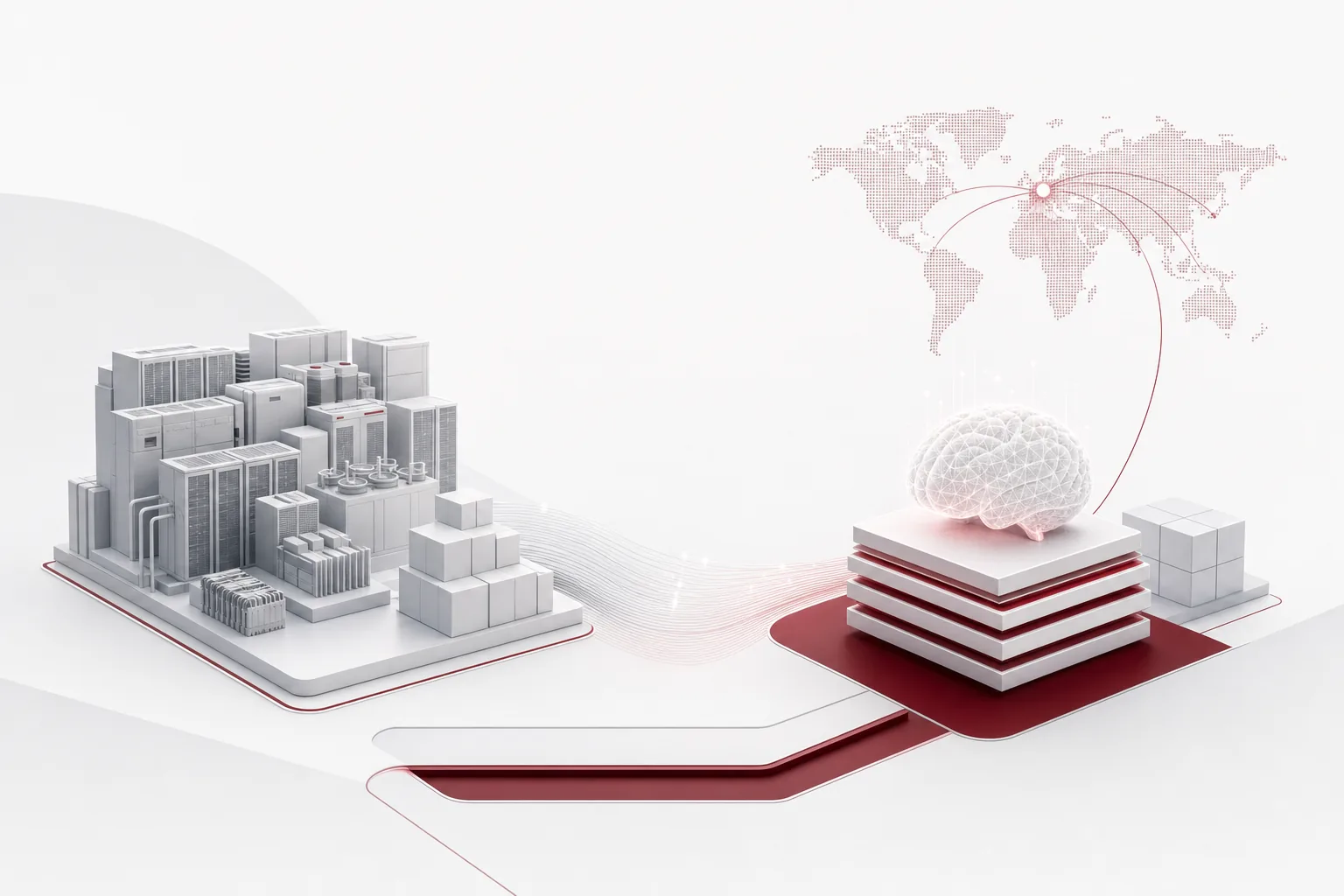 It visualizes the core concept of the article.
The body-building pile, seven capacity stories
Let me read the roster of the body pile first. SK Hynix CEO Jeong Seok-geun said in an interview, “For AI data centers, securing capacity is the top priority.” The idea is that HBM and DRAM, memory, is the capacity of the AI era. Alongside it is a story that the DRAM market broke past $154.7 billion and, once Samsung cemented its number one position, scarcity spread to general-purpose memory as well. Supply has tightened beyond AI-specialized memory to general memory too, a signal that the memory supercycle is spreading. Last year, the story would have ended with rising memory prices and stiff supply. But this year, the same story gained a new character: the data center. It means the place coming to buy memory has moved from smartphone and PC factories to server rooms running AI.
Qualcomm and Amazon will jointly develop AI data center chips at a scale of up to 80 trillion won, roughly $60 billion. The company long called a mobile powerhouse is making its move into the data center. It is read as an attempt to form supply that breaks the existing lineup of giant chip makers. Naver’s 10 trillion won AI data center investment structure was also revealed, a form where financial capital holds the asset and operations are handed to a separate party. It is a structure that separates the one who puts in money from the one who runs it, meaning that building the body now includes the design of capital markets. What is worth noting is that this separation of capital and operations takes the same shape as the brain called the model standing apart from the body called the data center. The industry is splitting into layers, each handed to a different owner: money, operations, and execution.
Meanwhile, the bottleneck is moving inside the body. As cooling becomes a necessity in high-power AI data centers, the race to take the lead in liquid cooling solutions is fierce. It is a story of an era where temperature runs short before electricity does. KAIST and Meta presented a new structure that runs the entire data center like “one giant chip,” an experiment that goes beyond the practice of matching individual equipment to treat the whole building as one circuit. It is a research direction beyond efficiency, to the point that the building itself must be handled as a single component. On one side, Chinese semiconductors are approaching Korean industry with a combination of low price and usable performance. Every story in the body pile shares one common denominator. Build more, and build faster. But the era where just building decided the outcome seems to be over. Now, what determines the completeness of the body is where the bottleneck lands.
Buying the brain, €3 billion in Paris
Now the brain pile. This week, the lead story is the deal between Samsung Electronics and Mistral AI. Samsung led Mistral’s €3 billion investment round and, alongside the equity investment, agreed to jointly develop a “semiconductor-specialized AI model and platform.” Media described it as “internalizing the brain of semiconductor AI” as well. In short, the company that has made chips now wants to own a brain that understands chips.
The form is unusual too. It is not at the level of buying and using a model; it led the financing round. The side that leads a round does not stop at putting in money. It puts its name in the seat that decides the company’s technology and data strategy. This capital is closer to a ticket to governance than to financial profit. On top of that, the door of joint development is open. Because it is not a deal that ends at investment but one that builds the model and platform together. The scene of Korean strategic capital entering Mistral, a leading figure in European sovereign AI, also means the model market has widened into the domain of equity and alliance.
The timing is no accident. At the France-Korea summit in Paris, expanded research, development, and investment in AI and advanced industries were called for, along with the words that “working together shortens the development period.” The same wave is visible at home. The National Assembly’s AI Strategy Committee answered the debate over effectiveness by saying the basis of its cross-ministry AI policy coordination is evaluation, budget, and the president’s will. Capital and diplomacy and legislation all moved in the same direction this week, and their destination was the brain.
Among these, the modifier “semiconductor-specialized” is important. Why not a general-purpose model, but a brain that understands the very thing Samsung does best? A foundry is a site where process data and yield know-how accumulate. The moment this data is fed to a brain for its own industry, that model gains a feel no competitor has. In turn, that brain reads the process and helps with design and mass production. It is not a one-way model purchase but a structure where the body’s data and know-how raise the brain and the brain in turn accelerates the body. The brain has become not “something bought from outside” but “a component internalized.” That is exactly the point where Korea’s AI strategy changed direction. It is more accurate to say that a country strong in the body did not go out to buy a brain, but began to attach the body and the brain inside one company.
Two destinations of the brain, individuals and companies
Meanwhile, the destination of the brain is splitting into two. One is the individual. Meta released “Muse,” a personal AI agent that handles travel bookings and shopping on its own, and is read as a full entry into the consumer agent competition. Big tech has come down even to the market of delegating daily life to a brain. It is a signal that the standard has risen from a competition over which model is best to one over how much of daily life an agent can handle on your behalf. A consumer agent is ultimately also a war to win the trust of “handling things on your behalf.” How accurately it completes a booking, and who takes responsibility when it makes a mistake, become the deciding points.
The other is the enterprise. Samsung SDS presented three solutions for public-sector AI transformation, aiming to cut complaint handling from 20 minutes to 15 seconds, and the Hyundai Department Store Group is reorganizing work from shopping to dining, fashion, and living with generative AI. Public sector and retail, evidence that the brain’s workplace is widening. Startup Lynar is also moving from source-based search to executable AI and aiming for a global foothold. It means executable AI has changed from a Big Tech exclusive to a contested ground anyone can enter. Anthropic has expanded data control and governance features for enterprise customers, and enterprise security requirements are now being handled as a model vendor’s product competitiveness. In an era where model vendors sell data control as a product, the cost of putting a brain inside an enterprise is going down and the cost of taking responsibility is going up.
And between the two destinations, a new stage is emerging. The market of operating and managing, that is, orchestrating, thousands of AI agents is rising as a new platform market, under the name of the “operations” market that enterprises are aiming at. It is not the era of bringing in one or two brains, but the question of the era of running thousands of brains at once. What is interesting is that the word “operations” is beginning to stand apart from “development.” The side that develops the brain and the side that runs the brain are being recognized as different work. In short, this week’s story of the brain is not “who has the smarter brain” but “where does the brain work, and who manages it.”
When the brain is plural, the question changes
Step back and there is one easy-to-miss fact inside the body pile. Capacity and memory are heading toward a common good that anyone can buy once built, and cheap Chinese supply is approaching the market. It means the body is in the middle of being commoditized. Cooling, memory, and chip supply are, after all, a world where a price tag goes on everything.
In contrast, the brain is becoming “something specialized to your own industry and made in-house” through deals like Samsung and Mistral. The more the body is commoditized, the higher the relative value of a specialized brain. And when several such specialized brains are placed inside one company, the center of the question moves again. “Which brain is the smartest?” becomes “which brain takes which task, and who verifies its execution?” The seat that answers this question does not stay inside the model vendor. The model vendor supplies the brain, and the task and the verification are on the enterprise side. The boundary line where the two meet is becoming a new technical task and, at the same time, a new market. When the single model that answered everything on its own gives way to several models that divide the work, what matters is no longer the brain itself but the act of handling the brain. Where Digital Daily asks “thousands of AI agents, who manages them,” that is the door to the market where that act becomes the workplace.
In the end, the one running the brain is the company itself
The conclusion. The brain is now bought and made in the name of national champions, and the body is built in the name of national capital. Both piles this week were stories the country stepped up to tell. But there is one task the national champion does not do on your behalf. It is running several brains every day and leaving a record of that execution. Even if the country buys the brain and secures the body’s capacity, the seat where the brain actually works inside an organization is, in the end, the company itself. That seat is where brains divide up tasks and where the record of execution accumulates.
This is where ThakiCloud’s agent-native cloud Paxis comes in. Skills, tools, policies, and audit logs are managed as first-class resources in this product and run as a formal product. For autonomy too, governance and policy gates from L0 to L3 decide which model runs which task, and CostRouter picks the right model for each job. Execution happens inside an isolated sandbox, and a sovereign and on-prem Kubernetes deployment can put a brain even where data cannot leave; the proof of execution is left by the audit log. MCP connectors and a skill market open the brain’s external channels. If this week’s story of the brain is “a brain specialized to your own industry,” then the act of running that brain every day inside an enterprise is exactly the reason this platform exists.
The body is being built in many places and the brain is moving to the table of diplomacy. The place that actually meets those two piles is the company. The next question is simple. A company that runs the brain every day, whose hand will it hold?
References
This article was written by synthesizing the news below.
- Pinpoint News, From travel bookings to shopping, it handles it all… Meta debuts personal AI agent “Muse”
- Business Plus, [Recent Tech+/①] The era of answering AI is over… the question posed by “working AI” Astra
- Digital Daily, Thousands of AI agents, who manages them… the enterprise “operations” market Sangpo is aiming at
- IT Chosun, [Agentic AI Map 2026] Lynar, from source-based search to executable AI… aims for a global foothold
- Chosun Biz, [Interview] SK Hynix CEO Jeong Seok-geun: “For AI data centers, securing capacity is the top priority”
- Dailian, KAIST, Meta present a new structure that raises AI data center efficiency
- Deal Site, [AI data center cooling competition] Liquid cooling solutions become a necessity… the race to take the lead is fierce
- Korea Journal, Samsung Electronics internalizes the “brain” of semiconductor AI too… equity investment in Mistral, joint development of semiconductor-specialized AI
- EBN, Qualcomm, 80 trillion won AI chip alliance with Amazon… “mobile powerhouse” bets on the data center
- Global Economic, DRAM breaks $154.7 billion… once Samsung cemented number one, scarcity spread to general memory
- Weekly Dong-A, Chinese semiconductors threaten Korea with low price and usable performance
- Digital Daily, [“Complaint 20 min to 15 sec”… Samsung SDS presents three solutions for public AI transformation
- Point Daily, [AI era, the great shift of power - Hyundai Department Store Group] From shopping to dining, fashion, and living… reorganized with generative AI
- Financial News, President Lee calls for expanded Korea-France R&D and investment… “working together shortens the development period”
- Digital Daily, Deputy Chair Ha Jung-woo: “The basis of AI policy coordination is… evaluation, budget, the president’s will”; AI Strategy Committee confident in cross-ministry coordination
- Wolyo Shinmun, AI company Mistral raises €3 billion in investment… led by Samsung Electronics
- Invest Chosun, [Invest] Naver’s “10 trillion won” AI DC investment formula… asset held by financial capital, operations by
- Daily Car, Anthropic expands AI data control for enterprise customers… why?