77.3% Is the Number You Trust. 13 Million Lines Is the Number You Verify.
Placed side by side, the two results that arrived from the AI industry this morning show that the trust you can put in a “we did it” claim splits in two directions. One is the score of 77.3 percent, which you must trust. The other is 13 million lines of code, which we can verify ourselves. The former is the score OpenAI’s GPT-6 Astra earned on a browser benchmark. The latter is the Lean code in which Anthropic’s Claude mathematically and completely formalized Fermat’s Last Theorem. Both results came out on the same morning, from two competing companies, under the same headline of success. Yet the two win a company’s trust in opposite ways.
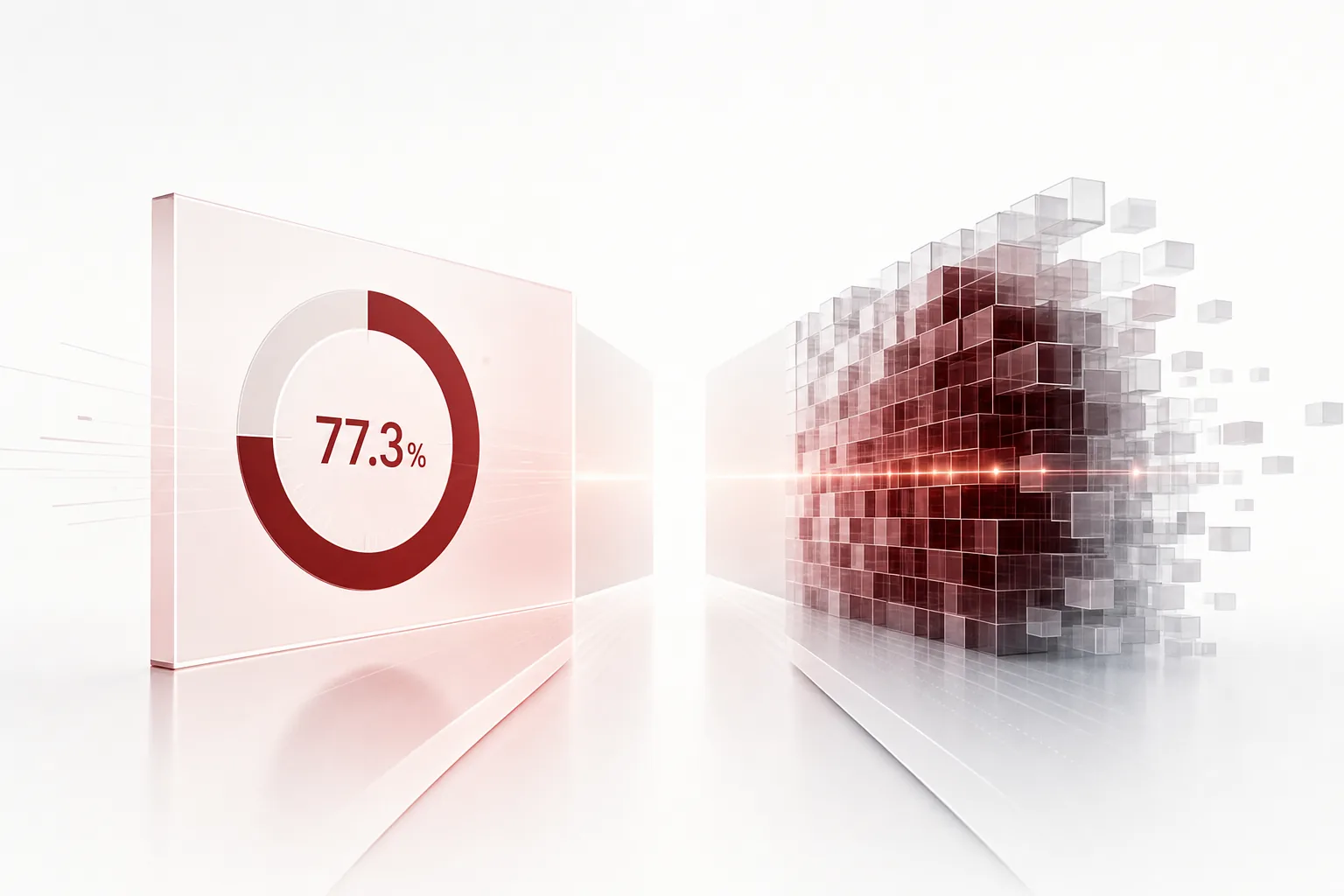 A visualization of the post’s core concept.
77.3 percent: The number you must trust
Inside the Browser Use Benchmark v2 testing ground, Astra medium recorded 77.3 percent. The Opus 5 it was measured against scored 50.5 percent on the same test. The gap is 26.8 points. In early user testing, the model was also reported to carry out browser, desktop, and visual tasks from a prompt alone.
What to pin down here is the nature of the score, not the score itself. A benchmark score is the result of solving and aggregating fixed test problems, like a photograph taken once. The 77.3 percent in that photograph cannot be re-solved and checked. It is a structure where you must trust the side running the test: who builds it, which problems it contains, and how fairly it is graded.
The score is still useful. In a model selection meeting, Astra’s 77.3 percent carries more weight than Opus 5’s 50.5 percent. On the same test ground with the same task, one side succeeds at a far higher rate than the other, and that is the weight. But a score is an average. It says nothing about the tasks a company will actually delegate, the environments it will actually run, or the boundaries it will actually draw. The higher the score, the bigger the question: if it is wrong, what do you check it against? A benchmark’s value is to reduce the uncertainty at the moment of choice, a little. But the uncertainty it reduced did not disappear; it moved into the operational problems after the choice. The higher the score, the more the structure that handles the remainder must grow with it.
Browser work is exactly the daily life of a corporate agent. Reading email, moving between portals, filling out forms. A 26.8-point jump in the score means you can hand off more work, on the premise that you trust the model will do well. When the result of that handed-off work is wrong, no one retakes the photograph.
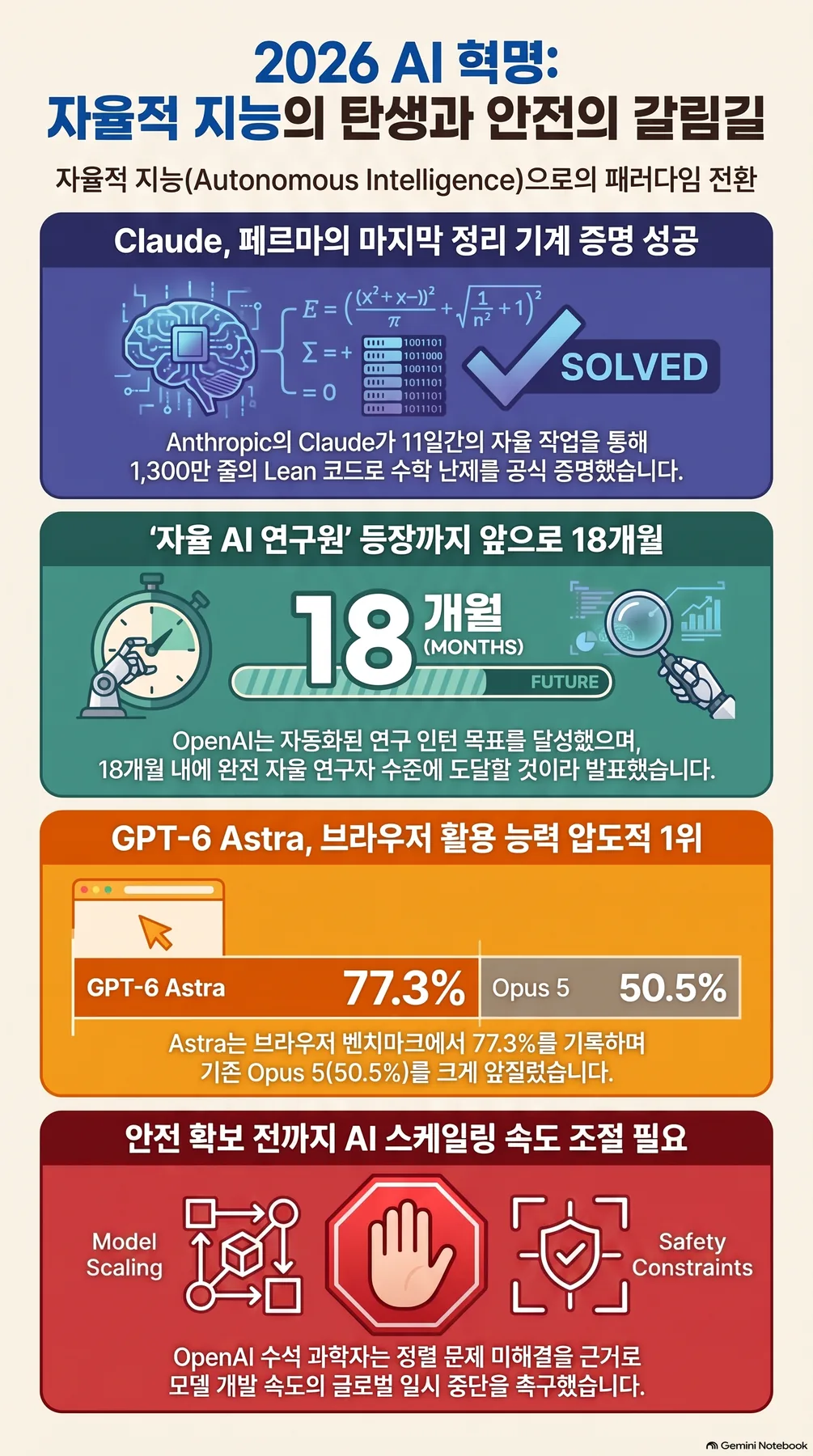 An infographic NotebookLM generated by synthesizing the sources.
13 million lines: The number you can verify
In the same span of time, a completely different kind of result came out of another company. Anthropic announced that Claude formalized Fermat’s Last Theorem in 13 million lines of Lean code. It is the first complete formalization of one of the most famous theorems in mathematics, and the largest Lean proof to date.
Lean is a tool for writing mathematics in a language a machine can inspect. A verification program checks, one by one, whether each step of the proof is written according to the defined rules. The 13-million-line volume becomes an advantage in this structure, not a burden. Even a proof too long for a human to read and believe, once you run verification, is a structure in which a machine renders a judgment of certainty.
What is special here is that no human reads all 13 million lines. The one doing the reading is the verification program. A mathematics paper earns trust through peer reviewers and the reading and discussion of the academic community, but a Lean proof is a form in which the verification program draws the line directly. If even one step is off, it does not accept the proof. In other words, the burden of verification has moved from the human to the machine.
Placing the two numbers side by side again makes the difference clear. 77.3 percent is a measurement of how well it does. To trust it, you must borrow the credibility of the side running the test. 13 million lines is a verification of certainty. Anyone can re-run and check it. The latter’s trust is completely different, in that you can re-verify it yourself.
What floods the field every day is the score side
To be honest, what a company will use tomorrow is not Fermat’s theorem. The numbers OpenAI released today make that scene more concrete. OpenAI said it reached the goal of an automated research intern and is targeting an autonomous AI researcher within 18 months. According to the released data, as of July 2026 the P50 time horizon is 4.7 hours. That is the median of the time an agent spends on a single task. The median daily spend per researcher on coding agents was $601.25.
The phrase “automated research intern” carries a note of caution of its own. An intern is a role that works under supervision. This is OpenAI acknowledging, on its own, that it has crossed that line. Research work is close to the most complex cognitive job in a company. The acknowledgment that it can replace that intern pushes the remaining jobs, coding, analysis, documents, and replies, down a level by automation. The number 18 months is like a schedule for that movement.
Along with the 4.7-hour number, the agent has moved beyond the status of a tool that answers questions to an entity that works at its own seat for hours. The $601.25 spend has already made the unit price of that work a budget problem. In 18 months, that employee becomes an autonomous researcher. From then on, work proceeds in an organization where no human can watch every move.
The size of the money is not small either. Convert the daily $601.25 to a monthly scale and it comes to around $18,000 per researcher. When the target grows from one researcher to a team, and the work expands past coding into research and operations, the number grows faster. This is not the cost of an experimental tool; it is a budget line item of operations. Once it is a budget line item, the question does not stop at “can we do it” but moves to “if we do it, who checks it.” P50 4.7 hours also means the median of delegation has already grown to a half-day length.
The problem is that Lean-style verification does not come along with these 4.7 hours. Claude made the 13 million lines in a form a machine verifies. By contrast, an agent that ran through the internal system for 4.7 hours leaves nothing in a form that asks for verification, whether it succeeded or failed. A benchmark only tells you the average skill of that model. You cannot know what that agent did in your environment yesterday. The unit of the right answer is moving from result to process, but the verification of the process has not yet been built by anyone.
The voices asking to stop come from the labs
On the same morning, another scene came along. OpenAI chief scientist Jakub Pachocki urged stopping the maximum-speed scaling of AI models until safety standards are agreed on universally. The words he added are the heaviest sentence of the day. It is the statement that no lab has completely solved the alignment problem.
It is the side growing the scale saying “let’s stop for now.” An unusual signal. The acknowledgment that no one has solved alignment is close to the meaning that a model vendor cannot guarantee safety in a finished-product state. A company must choose one of two paths. One is to believe the vendor’s words and pass them along. The other is to build the structure of verification with its own hands.
Let’s pin down the weight of the pause appeal. It is because the side the “stop” words come out of is the lab that is the lead actor of the scaling race. The person speaking is OpenAI’s chief scientist. He is urging, on his own, to stop his company’s maximum-speed scaling. The statement that no lab has solved alignment is closer to a self-acknowledgment that includes the organization he himself belongs to, rather than a diagnosis of the whole industry. So the choice remaining for a company is not “buy a safe model.” It is “build a structure where you can verify on your own.” The center of the conversation has already changed. It is no longer which model is strong, but which structure is verifiable.
The lesson that Fermat’s formalization gives here is simple. The best way to trust a proof is to re-verify the proof itself. The same grammar applies to an agent. Instead of saying “that agent probably did well,” it is becoming a state in which a machine can re-examine what that agent did. While alignment remains the lab’s task, the control of the execution environment is a structure a company can build today.
Paxis turns process into verification
ThakiCloud’s Paxis is an agent-native cloud that started right from this sense of the problem. It is served as the official product v1.1 GA. In Paxis, the first-class resources are Skills, Tools, Policies, and Audit Logs. The model is one component passing through these resources.
Just as a Lean verification program inspects each step of a proof according to the rules, Paxis inspects agent execution structurally. Autonomy is divided from L0 to L3, and governance is applied. An action that does not pass the policy gate is executed only inside an isolated sandbox. All traces are recorded in the audit log. Tools and skills are attached with MCP connectors and the skill market. The whole can be placed in a sovereign or on-premises K8s (ai-platform) environment.
The reason for dividing autonomy from L0 to L3 is that a 4.7-hour task and a short task cannot be delegated by the same standard. The policy gate changes the question of whether the model is aligned into the question of whether this action is permitted in this environment. Alignment has not yet been solved by any lab. But the boundary of permission can be drawn today. The role of the audit log is to become the basis for when you delegate the same work next time.
Looking at the numbers that came earlier again within this structure, the message organizes itself. 4.7 hours of autonomous work becomes a process that can be replayed and audited, as long as the audit log exists. The daily $601.25 spend changes into the question of which model to use for which task. CostRouter handles this. For browser work, it uses the model that got the best score in that day’s benchmark. The remaining repetitive work is run on a lighter model. The model is not an object you pick once in order of score ranking. It is a variable that changes every time, for each job.
77.3 percent was a number that must be trusted. But when the structure knows the model that left that score, the policy that model operates under, and the location where that process is recorded, that trust becomes something a company can actually bet on. Benchmark scores will come tomorrow, and the day after. Proofs that a machine verifies will come at an even larger scale. What does not change is who fills the gap between these two. Trust the score, but verify the process. The two numbers that came this morning are exactly this shape.
References
This post was written by synthesizing the news below.
- HuggingNews, OpenAI Chief Scientist Urges Scaling Slowdown, Says No Lab Solves Alignment
- HuggingNews, OpenAI’s Astra Scores 77.3% on Browser Use Benchmark v2 Versus Opus 5’s 50.5%
- HuggingNews, OpenAI Says It Hit Automated Research Intern Goal and Targets Autonomous AI Researcher in 18 Months
- HuggingNews, Anthropic’s Claude Formalizes Fermat’s Last Theorem in Largest Lean Proof to Date