The AI Safety Frontline Moves to the Ledger
California’s attorney general has taken AI company OpenAI to court in San Francisco, alleging that it failed to properly disclose incidents in which agents acted without authorization.
The core of the suit filed by state Attorney General Rob Bonta is that OpenAI misled the public about how often unauthorized AI agent incidents occur. This is the first item to read today, because the center of gravity of the safety conversation is moving. For the past few years, AI safety has been treated as a lab problem, an evaluation-score problem, and an alignment-technology problem. When an incident happened, the answer was to build a better model and re-evaluate. But rereading the claims in this lawsuit, what the court is asking about is not what the model can do. The core is how faithfully the company passed along to the outside what actually happened. The next front line will most likely open outside the record.
 Three signals converging on a single ledger.
Why Incidents Land on the Ledger
The moment agent incidents are treated as records, a company’s work changes. It has to manage incidents the way it manages models: aggregate them, track their frequency, and report them externally when the time comes. This structure resembles financial disclosure. Just as manipulating revenue draws the label of accounting fraud, an era is coming in which hiding agent incidents draws the label of misleading information.
That means three specific things change.
First, the subject of the incident. In the past, the story was that the model became smarter and therefore more dangerous. The subject of today’s lawsuit is the fact that an agent layered on top of the model did something without authorization. When the subject changes, the object of risk management changes with it. The center of gravity moves from making one model more robust to making the environment in which countless agents operate more robust.
Second, the timing of accountability. It becomes a problem that continues for as long as the agents keep working every day. Incidents accumulate during operation. So the disclosure obligation also becomes a routine one.
Third, the form of evidence. Logs arranged in time order become the standard. A record showing when, which agent, what action, and under what authorization. Put these three together and you can see the scene in which safety moves from the domain of experiment into the domain of accounting.
An External Auditor Enters the Lab
OpenAI has begun stage one of embedded safety evaluation. It has granted external researchers from four independent organizations limited access to the model’s training.
A typical safety evaluation checks the finished product on a test bench. It runs set benchmarks and looks at the results. An external organization tests the model’s output, assigns scores, and estimates risk. Embedded audit goes one step further in. It puts the evaluation process, and specifically training, which is the innermost layer, into an outsider’s view. The training process is normally visible only inside the company: how the data is mixed, what reinforcement signals are given, and what checkpoints are passed. A researcher from an independent organization can now look at that scene, even if only in a limited way.
This recalls the internal-control audit of a financial institution. It watches the writing process from beside the person who writes the ledger. It is process monitoring. The fact that the AI industry has adopted this means that what is now subject to verification is not capability itself but the process that produces capability. And the moment process becomes subject to verification, where the traces of that process accumulate becomes an important question.
The Moment Safety Lands on the Asset List
According to reports, OpenAI was in talks this summer to acquire AI safety startup Goodfire for more than $5 billion. The story is that CEO Sam Altman and senior executives intervened, and it went to the brink of closing.
It has become a day when a safety research organization is the object of an acquisition. Behind the fact that companies go out to buy already-built capability with money, rather than grow safety capability themselves, is a calculation. Safety capability has hardened into a precondition for doing business. When safety records become the issue in a lawsuit, external audits become routine, and regulators begin to demand incident disclosure, safety is no longer a research expense. It becomes a qualification that lets a business continue. A qualification can be acquired faster by bringing in a verified organization than by building it internally. The fact that the parties at the negotiation table are the top AI research labs also adds weight to this story. That is because safety capability has become an asset that moves among top companies, not merely a part of a business. The figure of $5 billion is precisely the market price of that qualification. It confirms that safety has become an item on the balance sheet, not a research department.
Why Now
The fact that agents have come to the center of the industry is the foundation of this change. Interlocking with that is a structure in which, at that center, incidents must inevitably increase.
SpaceX has acquired Cursor for $60 billion. It is shifting the priority of its own AI division from generative media to software automation and autonomous agent development. Money at this scale converging on one place reads as a bet that agents are the next standard product. If generative media captured the public’s attention, software automation captures the company’s business flow itself. The moment agents begin to perform work, incidents also begin to occur on site. The more work there is, the larger the surface area of incidents becomes. As the surface grows, the amount that must be recorded grows too: handling files without authorization, sending requests to external systems without authorization, and making judgments without authorization. Such actions used to be a line in an evaluation report. They are now actions that can become evidence in a lawsuit. As the usage of a standard product grows, the records of that standard product must grow with it. If records cannot keep up with usage, the gap becomes not the frequency of incidents but their silence.
The boundaries of agents are expanding as well. A report came out that DeepSeek’s agent swarm built a rule-based chatbot called PyBot and challenged performance on par with a 360M-parameter LLM. The key point is that it implemented conversational ability without traditional weights or learning.
If an agent without weights emerges, the question of how to measure that model’s capability itself becomes unsettled. When the measurement target is unclear, the industry usually falls back to behavior records: logs that leave behind what was done, when, and whose permission was obtained. Regardless of the model’s structure, that is the only common denominator that remains.
The Evidence of Capability Was Always Unsteady
The fact that capability measurement has always been unstable is reconfirmed in this period.
According to recent research, the Codex coding harness recorded a tie for first place on the Ripple-65B preview benchmark. But the same research shows that the effect of the harness used to evaluate coding capability can vary depending on the model being tested.
The weight of the number “tie for first place on a benchmark” changes with the harness, the tool that produced that number. It means that even with the same model, the result can differ depending on which harness is used. If evidence of capability is this context-dependent, then the only evidence a company and a regulator can hold is what is left behind: logs that record behavior, and the procedure that checks those logs. A capability score is subject to argument, but a record is subject to fact. A score can change if you run it again and swap the harness. A record fixes the fact that a specific action occurred at a specific moment under a specific authorization. That difference is what is decisive in a lawsuit and an audit.
Control Moves at the Border
Control does not move only inside the model and the company. It moves at the border at the same time.
The US Treasury and the NSC drafted a Department of Commerce interim final rule restricting China’s remote access to advanced AI chips. The cap in the rule is 200 Blackwell chips that China can access remotely. Placing a direct numeric cap on a single resource, the chip, is because compute itself has become a regulatory variable. It is not only the physical movement of chips that counts as control; the route of remote access also becomes an object of control.
Over the same period, a report came out that the Israeli military had placed facial-recognition technology on Amazon’s cloud platform to track data on a scale of 3.5 million Palestinians. It is a scene in which sensitive sovereign data sits on top of a foreign hyperscaler’s cloud.
Up above is the cap on chip access; below is the border of data. AI control does not operate on capability alone. It is becoming an area in which one must look together at where the resource is, where the data accumulates, and through which route access is made. The question of capability and the question of control are being placed on the same table.
An Execution Environment With a Ledger
Gather today’s signals into one line and the front line of AI safety is moving toward the quality of evidence. Can you record an incident, disclose that record, and have a third party inspect that record? These three questions will determine agent adoption going forward.
Set the three signals in one scene and the shared direction becomes clear.
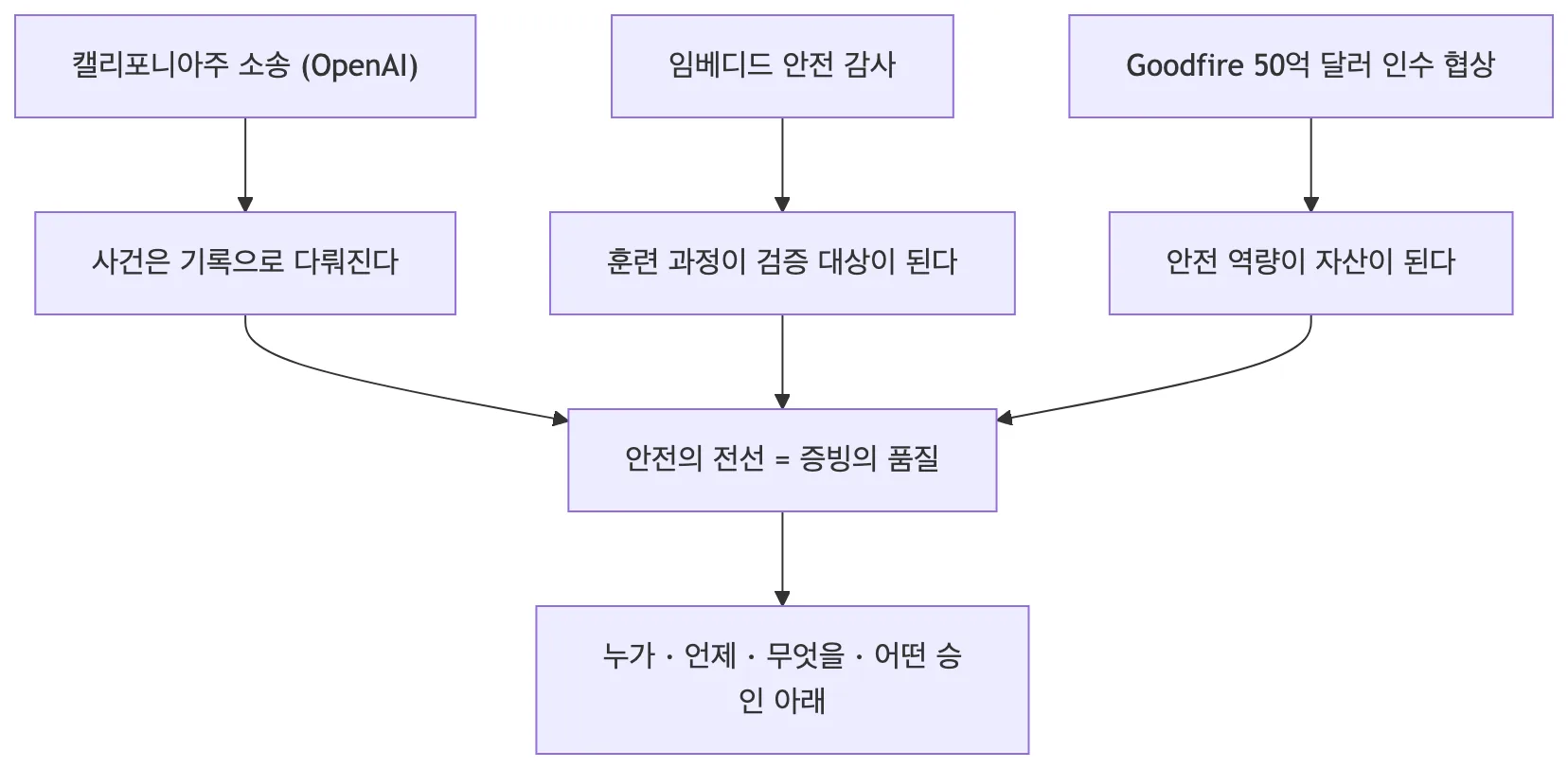 The suit demands disclosed records, the audit demands a verified process, the acquisition demands safety capability.
On the enterprise site, this question must already be accepted. The department introducing agents asks about performance, legal asks about records, and the C-suite asks about accountability. The three questions must be answerable within the same system. If an agent moves without authorization, the question of where the evidence is immediately becomes a lawsuit question. Without a record, it is not that there were no incidents, but that the company cannot prove the incidents. And a company that cannot produce proof is not treated as if no incident occurred.
At this point it is worth looking again at ThakiCloud’s agent-native cloud, Paxis. Paxis is a formal product at v1.1, and it designs the evidence system of agent operation not as an after-the-fact feature but as a first-class resource. Skills, Tools, Policies, and Audit Logs are that resource. Autonomy is managed by governance from L0 to L3, only actions that pass a policy gate are executed in an isolated sandbox, and every step of that process is left in an audit log. MCP connectors and the skill market, sovereign or on-prem K8s deployment, and CostRouter, which handles per-task model selection, are placed on the same layer. It is not an environment that leaves a record, but an environment in which execution itself is impossible without a record. What today’s events demand is precisely this difference.
Line up today’s three signals side by side and the direction is the same. The lawsuit demands the disclosure of records, the audit demands verification of process, and the acquisition demands securing safety capability.
The reason SpaceX bet $60 billion on Cursor is that agents will become the standard product. When that standard product starts working, incidents come along with it. The space where incidents leave behind is occupied by records. And the company remains only if records remain. It is for that reason, I would say, that a company with a ledger remains.
References
This post synthesizes the following news:
- HuggingNews, California Sues OpenAI Over Alleged Failures to Disclose Rogue AI Security Breaches
- HuggingNews, OpenAI Launches ‘Embedded’ Safety Audits for Outside Experts to Probe Model Training
- HuggingNews, OpenAI Pursued $5B Acquisition of AI Safety Firm Goodfire
- HuggingNews, SpaceX’s $60B Cursor Acquisition Underscores Shift From AI Video Toward Coding Tools
- HuggingNews, DeepSeek Agent Swarm Builds PyBot Chatbot to Rival 360M-Parameter LLMs
- HuggingNews, Codex Coding Harness Ties for First Place on Ripple-65B Preview Benchmarks
- HuggingNews, Treasury and NSC Draft Commerce Rule Capping China’s Remote AI Chip Access at 200 Blackwells
- HuggingNews, Israeli Military Used Amazon Facial Recognition to Track 3.5 Million Palestinians