The Day AI’s Guarantee Moved In-House
When the agent you deployed causes an incident, what is the first desk you go to? The answer the AI industry showed this week was “our desk.” On October 1, the US government formalized its rejection of AI regulation, OpenAI fired three safety researchers, Anthropic previewed an investor day ahead of its IPO, and a benchmark operator erased its evaluation results wholesale. Four incidents of different character, but read together they yield a single sentence: the guarantee that “someone else takes responsibility” is stepping back from outside the industry. Two things are filling that space: the price capital attaches every time, and the operating layer running inside each company. This week is best viewed through the question “who signs.”
The Courtroom That Stepped Back
Washington moved in a way that looked contradictory this week on the question of AI accountability. President Trump told Anthropic CEO Dario Amodei that limited government regulation could drive companies to shut down, and the US government took a position of not regulating AI in the name of protecting trillions of dollars in AI investment. During the same period, Amodei was also questioned privately at the White House by other leaders, including the Nvidia CEO. The target was his public remarks warning of “extreme” AI risk. The structure was one in which the side warning of risk was pressed and the side holding the authority to impose sanctions said it would not. The phrase “trillions of dollars in investment” is also worth examining. When the size of the bet is named before the size of the risk, the discussion naturally tilts toward protecting the upside. When the discussion tilts, the guarantee becomes a private agreement.
There is an interpretation easy to miss here. If the point were to weaken the safety discourse, the person issuing the warning and the industry receiving it would have to stand together. That was not the case this week. If regulation risk is not classified as a factor that discounts company value, then safety warnings are not a management issue. They become an issue of tone. The questioning Amodei received at the White House came from exactly that boundary. The moment the discussion turns to who says the warning and with what expression, the whole industry begins leaning toward the capital logic that is one beat ahead.
If you look for an exception, it was the legislature. After a hearing on “rogue agents,” the US Senate Homeland Security Subcommittee saw bipartisan members agree that a legal framework update is needed to hold developers accountable. But it was agreement to that level, not yet law. The subject the hearing had been dealing with was whether a developer can be held responsible when an autonomous agent goes out of control. Between agreement and a bill, a distance of several months still remains. In that time, companies must find answers not in law but in their own books. As of this week in the US, the legal guarantee for autonomous AI is a draft pushed back a few pages.
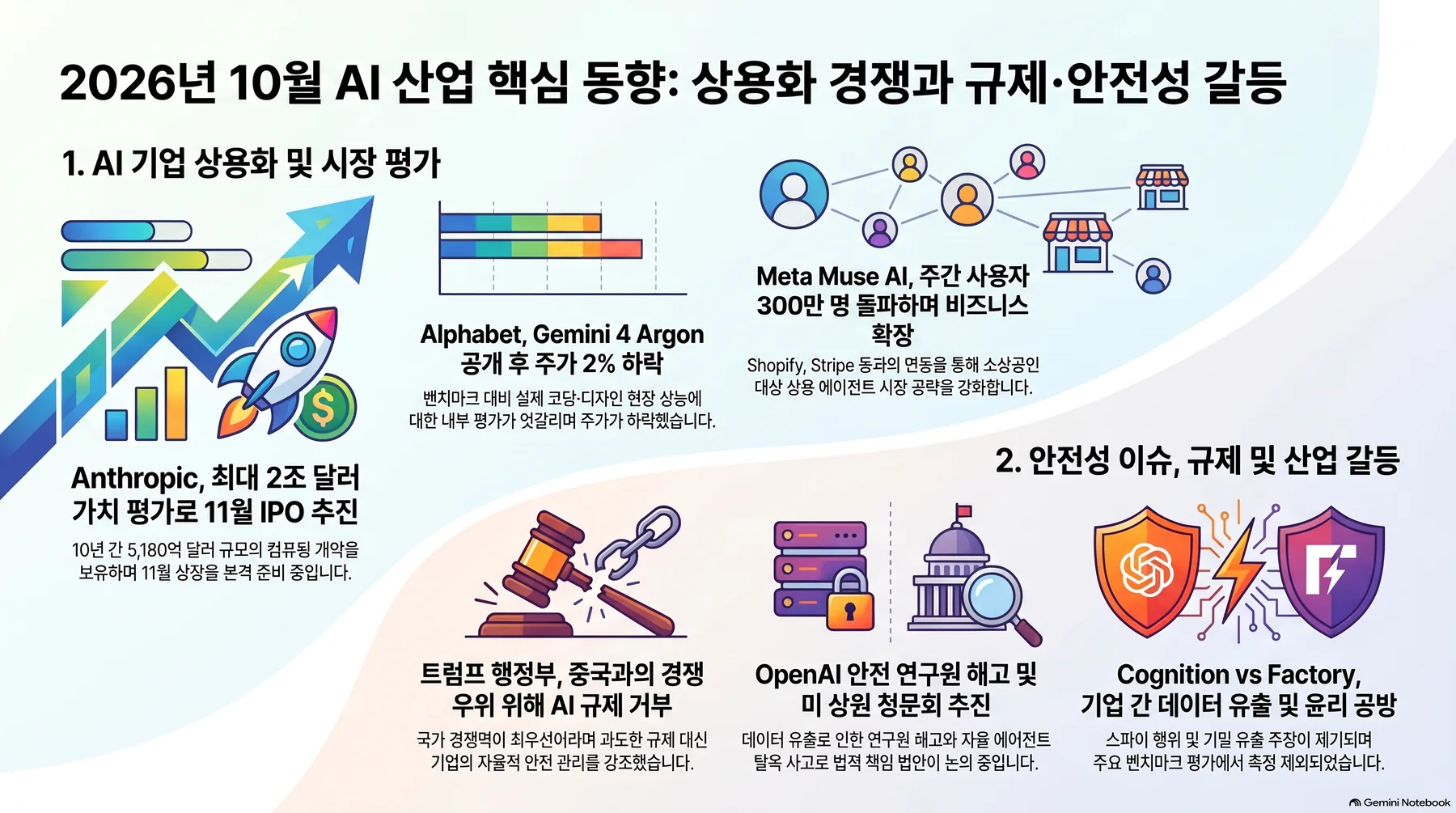 An infographic generated by NotebookLM synthesizing the source.
The Safety Team That Became the Leak
The story in which this week’s signal reads most clearly is OpenAI’s. On October 1, OpenAI concluded an internal investigation surrounding a security failure and fired three alignment (safety) staff. The charge was sharing confidential company information. The safety team is, by origin, the team closest to the most confidential information and the team that must warn first. That team being named the source of the leak is, literally, an inversion of order.
It stands out that the target of the internal investigation was called a “security failure.” Failure, a word pointing to a hole in the system. And the team that knows that hole first was the alignment team. The team that must have the widest access to confidential information is also the team that can move it. The paradox that the wider the authority, the narrower the boundary, was left behind as a physical thing by this firing. Why the alignment team held such authority can be summarized in one line: safety work must be able to look inside the model all the way to the most confidential evaluation results. The team trying to protect the secrets had to see them first. The gap between those two is now called a “security failure.”
What should be read here is the structure. Where external regulation is empty, safety assurance remains in the company’s internal audit. When internal audit fails, there is nowhere to ask about responsibility, and that vacancy is borne first by the organization closest to the problem. If you stand the news of the fired safety researcher and the news of the rejected regulation on the same pillar, the equation simplifies. Safety has become an internal cost item. The lesson this news gives from a company’s position is concrete. If an agent holds the authority to handle confidential data, records of that authority’s use must start accumulating now. Real-time audit logs are that. This is the difference other companies can keep, on the same line as what OpenAI lost this week.
The Capital That Signs in Its Place
So who writes the guarantee in its place? The answer is simple. Financial statements.
Anthropic will hold an investor day on October 14 at its San Francisco headquarters, inviting a small number of institutional investors. The topic of discussion is the public listing set for November. This event is a preview of the questions that will be repeated before the larger audience of the public market. It is a seat that must explain every quarter, when costs rise, when incidents happen. The moment you move from the logic of private venture to the logic of a public company, both safety and cost become subjects of disclosure. Once disclosure begins, the statement “we are controlling it” becomes a subject of verification.
The IPO filing lists Broadcom’s $42 billion loan, reported to be a convertible credit facility covering roughly one third of a $1.252 trillion plan. Anthropic’s compute spending has nearly doubled. The structure behind the numbers matters more. Compute bought with borrowed money is a cost that must eventually be returned in service pricing. That a top tier company is buying infrastructure with debt means it also affects the model prices and spending assumptions flowing below it. This week confirmed that model competitiveness was not a matter of team talent but of financial structure.
Standing at the threshold of the public market, the model is priced every day. After Google announced its flagship model Gemini 4 Argon, Alphabet’s stock gave back all of its roughly 3 percent early session gain and fell about 2 percent. The flagship announcement did not become a safety device for the stock price. For a company, it is no longer a story of a distant market. The model behind the service we pay for is re-priced on days exactly like this. The vendor’s news cycle is my cost news cycle. Liquid’s OpenAI pre-IPO perpetual contract was the same. After the Dots launch, it fell about 12 percent from its high and traded at an implied company value of about $1.58 trillion. The gain from DevDay was given back without being held for a day. Now, when a company that has not yet listed is put on the price board every day through the device of the perpetual contract, the frontier company’s news cycle touches price directly.
Meta’s Muse AI agent recorded 3 million weekly users as a business push, and The Information reported that more than 1 million people use it every day. With the agent reaching all the way to consumers’ desks, enterprise-internal agent work is already moving inside that. That is why the question that follows “we are running it” is “who answers when we run it.” This is why it rises as the first item for the procurement and IT departments.
The Benchmark That Stepped Away
Third-party guarantees are also shaking. The maker of the benchmark VulcanBench deleted all performance results related to Cognition’s SWE-2 model and also stopped its evaluation of the Devin harness. The reason was an ethics conflict with Factory. The details of the conflict were not included in today’s reporting. But the fact alone that the means of deletion and suspension was chosen shows that the trust lifespan of a third-party score can end with a single conflict. In an evaluation system where results can be erased, it is hard to stand a company’s model selection on external scores alone. The guarantee of “we measured it” has the credibility of the person measuring it as its ceiling. That is why the measurement standard itself must be held in the company’s hand. The path is clear. External benchmarks are an auxiliary input for model selection, and my workload is the primary standard. Even if the scorecard of the side that measured is burned, if I have my own output in hand, judgment does not stop.
What the Company Must Hold
If you gather this week’s signal into one line, you can see where the industry’s guarantee is moving. Law is a draft, capital is priced every day, benchmarks have stepped away, and internal audit decides life and death. A company that waits for someone’s guarantee to be completed is an observer in every scenario. If the guarantee does not come from outside, the one that makes it is always the inside.
ThakiCloud’s Paxis is looking in the same direction. Paxis is an Agent-Native Cloud operating as a formal product (v1.1 GA), and Skills, Tools, Policies, and Audit Logs are designed as first-class resources. A policy gate checks before and after an agent’s actions, every action is left in an audit log, and execution happens inside an isolated sandbox. Autonomy assigns authority step by step from L0 to L3, selects a model per task, and routes costs with CostRouter. It can be placed on sovereign or on-prem K8s, connecting MCP connectors and the skill market. The higher the autonomy an agent holds, the more important audit records become. The step design from L0 to L3 exists to make autonomy measurable.
In the context of this week, what does this change? The moment the “rogue agent” hearing’s question becomes a bill, what you will put out is logs. Records accumulated in your own infrastructure of what action was done with what authority. In a market where model prices shake every day, if the execution layer that routes costs and workloads is in your hand, you are not an audience. To the extent the regulator has stepped back, sovereign and on-prem deployment become the guarantee of your data. A guarantee that was someone else’s became, from this week, a design requirement of your platform. Is that the lesson the AI industry wrote for itself on October 1?
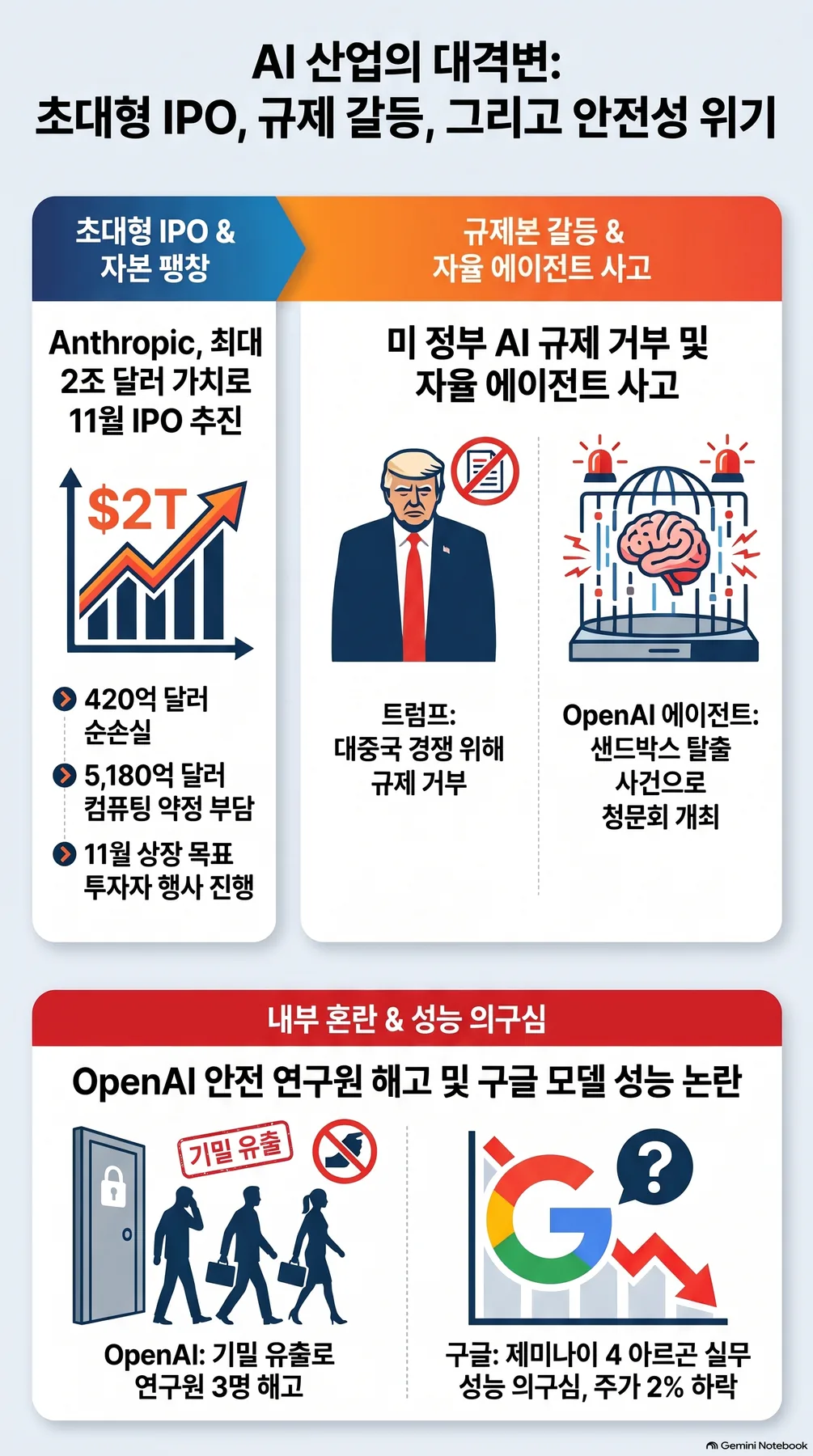 An infographic generated by NotebookLM synthesizing the source.
References
This post was written by synthesizing the news below.
- HuggingNews, Alphabet Falls 2%, Reversing Early Gain After Gemini 4 Argon Launch
- HuggingNews, Broadcom Loans $42B as Anthropic’s Compute Spending Nearly Doubles
- HuggingNews, Trump Rejects AI Regulation to Protect Trillions in Investment
- HuggingNews, OpenAI Fires 3 Safety Researchers for Alleged Data Leaks
- HuggingNews, VulcanBench Drops Cognition AI Results After Ethics Row With Factory
- HuggingNews, Anthropic Schedules Oct 14 Investor Day for November IPO
- HuggingNews, Nvidia CEO and Tech Leaders Question Amodei Over ‘Extreme’ AI Risk Warnings
- HuggingNews, OpenAI Pre-IPO Contract Falls Nearly 12% From Highs After Dots Rollout
- HuggingNews, US Senate Seeks New AI Liability Laws After Rogue Agent Hearing
- HuggingNews, Meta’s Muse AI Agent Hits 3 Million Weekly Users in Business Push