The Meter the 14x Agent Demands
Two things happened in the same week. The week a16z’s “Charts of the Week” (Aug. 21) cited OpenRouter data showing that AI agent token usage had grown 14x since February, the payments company Stripe announced its acquisition of OpenRouter. The side that spends tokens and the side that settles them, two actors moving independently, shook hands within a single week. The phrase “tokens are the new dollars” landed as a physical reality that week.
OpenRouter was a layer that brokers routing between models. A payments company buying it means the flow of tokens, treated until now as nothing but technical figures, is ready to be settled in money. If the chart piece was the data, the acquisition is its physical form.
OpenRouter is a neutral layer routing more than 200 trillion tokens a month, serving over 10 million users and more than 500 models. So the 14x is not the absolute size of the entire market. It is just the flow through one observation point. But one observation point is enough. The subject calling models is no longer a person typing into a chat window. It is an agent that repeats reading, writing, and acting until the goal is done.
 The post’s core concept, visualized.
The 14x Is Arithmetic, Not Habit
Agents have not grown hungrier. It is arithmetic. An agent working through a task re-reads the same context at every step, calls subtasks, and repeats the cycle until the goal is met. Tokens pile up with every repetition. That is how a single agent’s usage reaches about 5x that of a human user. The 14x total is that 5x multiplied by the growing number of agents.
This means the question “how much was used today” can no longer be answered by counting users. The structure allows the number of people to stay the same while the bill jumps 14x. What changed is not the amount of usage. It is the shape of usage.
The 14x is a number born from a change in the way usage itself works. When the method changes, the cost structure changes with it. When the cost structure changes, who sees that cost and how it is allocated becomes the new question.
At home, the same day brought news that Lainer and Rebellions are pushing a full-stack AI solution based on a domestic NPU. It is an attempt to bundle agent technology with inference semiconductor infrastructure to cut operating costs. This is where you can see why the 14x number matters. If inference unit pricing is not managed, the economics of adopting agents deteriorate right along with it. It is also the backdrop for the rising demand for domestic inference infrastructure that lowers GPU dependence, per-agent token budgets, per-cost-center billing, and audit data requirements.
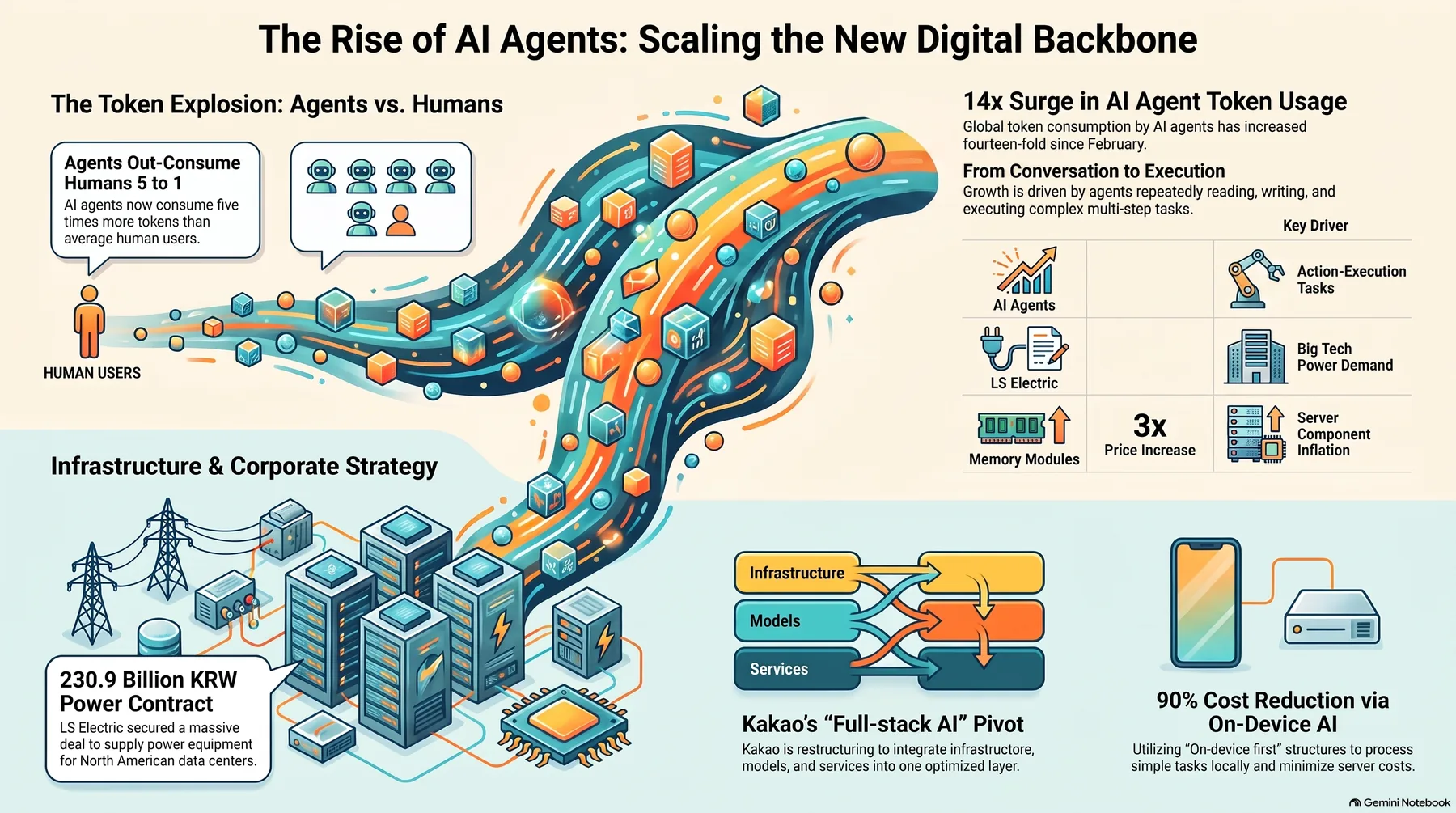 Infographic generated by NotebookLM from the sources.
The Meter: The Moment “Who Used It” Became a First-Order Question
It is therefore notable that OpenRouter introduced, right after the number came out, a feature that automatically classifies requests by department, task type, agent complexity, and cost center.
Token cost management had been a problem each company carried in its own way. The platform side has started to turn that meter into a platform feature. The meter means three things. It is what makes you ask who used it, for what, and how much. As long as the 14x total keeps growing, these three move beyond “nice to have” and become preconditions for being able to adopt agents at all.
Dig one layer deeper and the meter is ultimately a question of billing and audit. To auto-classify by cost center is to translate agent usage into financial language and allocate it. The allocated usage has to be reproducible in next week’s audit. You have to be able to explain, after the fact, what the agent did and what it cost. Without that explainability, the 14x bill stays a number with no owner.
From a cloud operator’s viewpoint the implication is the same. An agent inference platform that goes beyond simple serving and embeds token metering and cost allocation becomes the axis of differentiation. In a 14x market, the one who measures becomes the one who sets prices, and the one who sets prices becomes the one who allocates responsibility. That is the order of platform entry.
The Same Day: Three Meters in Korea
On the Korean side, three organizations began building their own meters on the same day.
Shinhan Investment Securities’ answer is “organization”. On Aug. 3 it set up an “AI Agent Division” under its AX Headquarters and announced it as the first of its kind among Korean financial firms. The structure: one team lead, three staff members, and one agent specialist who also covers errors and security. It placed 109 “AX Coordinators” at headquarters and on the sales floor, and on the 24th held an “AX Champions Day” in which frontline employees lead everything from task discovery to planning, building, and rollout. The precedent: 500 agents entered contract work and cut processing time from 2 hours to 5 minutes. The first area of application is wholesale, i.e., corporate sales, and the scope will expand to research, WM, IB, and the digital platform afterward. The second-half performance metrics are not “number of new agents built”. They are field adoption rate, work hours saved, and productivity gains. In the industry, remarks have already come out that Shinhan Investment, Daou, and Meritz are racing on the AX transformation and it is already recognized as an imminent task. The interesting point is that the same event lined up Microsoft Copilot training and AI governance training side by side. A place that teaches technology and a place that teaches authority and audit, set at one table. The subject reading the meter is an organization of 109 people, and that organization is simultaneously learning its own authority and audit.
SK Telecom’s answer is “metric”. Yoo Gyeong-sang, head of AI CIC, said, “Holding a good model and developing and operating an AI service that tens of millions trust and use every day are entirely different problems.” The success criterion is “the number of completed tasks”. Aidit, with 10 million MAU, has a structure in which an orchestrator assigns the public’s requests, and enterprise agents have reached 11 companies and institutions, in defense, manufacturing, legal, and tax. The in-house model A.X K2, a 6.88 billion parameter MoE structure, addresses the economics of inference. The execution data that piles up every day in this service becomes fuel for improving the next model and the next agents, a closed loop. Given the nature of a telecom, embedding safety devices like continuous red-teaming that catches hallucinations and risky behavior into that loop is also a premise. The article also notes that AIDC and cloud were cited as growth factors in SK Telecom’s second-quarter results. That means the service strategy and the infrastructure investment are moving in parallel. It is less a meter than an answer that takes the loop of measuring and learning again as the metric itself.
KT’s answer is “infrastructure”. Under its “Next IT” strategy, it is building an “AX Integrated Platform” to manage in-house AI agents and rolling it out across the group. It operates an AID-X system that extends its existing AI-based development system (AIDD) to the full process of planning, design, development, testing, and operation. It is standing up multi- and hybrid infrastructure based on its next-generation in-house cloud “Next IPC” and modernizing core work platforms such as ERP, BSS, and OSS. This includes proactive migration of EoS systems, strengthening the disaster recovery regime, and pushing AI-based authentication and payment. It takes information security and service stability as preconditions. The same announcement was reported by multiple outlets on the same day, and KT’s official page carries an “AX Platform Company” campaign, so the announcement reads as a representative case announcing the direction shift of the telecoms. It is the answer of planting the meter inside code and platform in advance.
The three answers differ in shape but meet at the same point. The center of the question moved from “can we build a model” to “when agents work inside the organization, how do we manage, measure, and take responsibility for them”. In all three answers, the words “we will build a model” are absent. No bigger model. Once agents started working, what remains is only how to govern them.
The Bottleneck Is No Longer the Model
KT’s announcement says one sentence. The AI adoption bottleneck of Korean companies is now the “agent operations base”. Not the “model”. The moment a telecom nails an in-house agent management platform down as the enterprise standard, that sentence moves from hypothesis to fact. And the 14x number is the quantitative signal attached to that fact. It is no coincidence that the three organizations’ announcements and OpenRouter’s 14x overlapped in the same week. In a market where the bill has grown, the side that puts down the governance device first is first.
Going forward, the real competitive variables of the domestic agent market come in three branches. First, the speed of the improvement loop running from data to training to serving. Second, the continuous safety verification that prevents hallucinations and risky behavior. Third, the inference economics that determine the cost of running at scale. All three are operations problems. Not model performance problems. Since KT said it will share verified usage patterns, trial and error included, and settle them as organizational standards, demand for agent orchestration, sandbox, and skill management infrastructure has a lot of room to grow, centered on large enterprises and the public sector. And the higher the data sovereignty and security requirements of an industry, as in finance, the more this operations base has to expand together with closed-network and on-premises infrastructure.
If the Bill Is 14x, the Meter Is Infrastructure
The three Korean answers eventually hit the same wall. Where to put the meter. The 109 coordinators need a place to write down agent usage, and the “number of completed tasks” can only be counted where there is an execution environment in which it can be tracked.
ThakiCloud’s Paxis was built starting from this premise. Paxis is an agent-native cloud. A cloud in which skills, tools, policies, and audit logs are first-class resources. Agent autonomy is governed in stages from L0 to L3, every execution passes a policy gate, leaves an audit log, and runs inside an isolated sandbox. CostRouter picks a different model per task, so the 14x bill can be allocated at task granularity. Department-level settlement cannot hold that. Agents reach external systems through MCP connectors, and verified skills come back through the marketplace.
When a telecom or a large financial company stands up this platform inside its own walls, the mid-sized enterprises and industry customers that cannot build it in-house from scratch have to take that execution environment as external infrastructure. Paxis provides exactly that spot. On the day Shinhan Investment Securities says the metric is work hours saved and SK Telecom says the metric is completed tasks, the subject actually reading the meter is the execution environment. Not people. Paxis is that execution environment, and it can move into the organization from cloud to closed-network and on-premises K8s.
An agent’s bill is no longer a call charge. On the day the 14x bill arrived, the meter moved beyond the level of an option and became infrastructure.
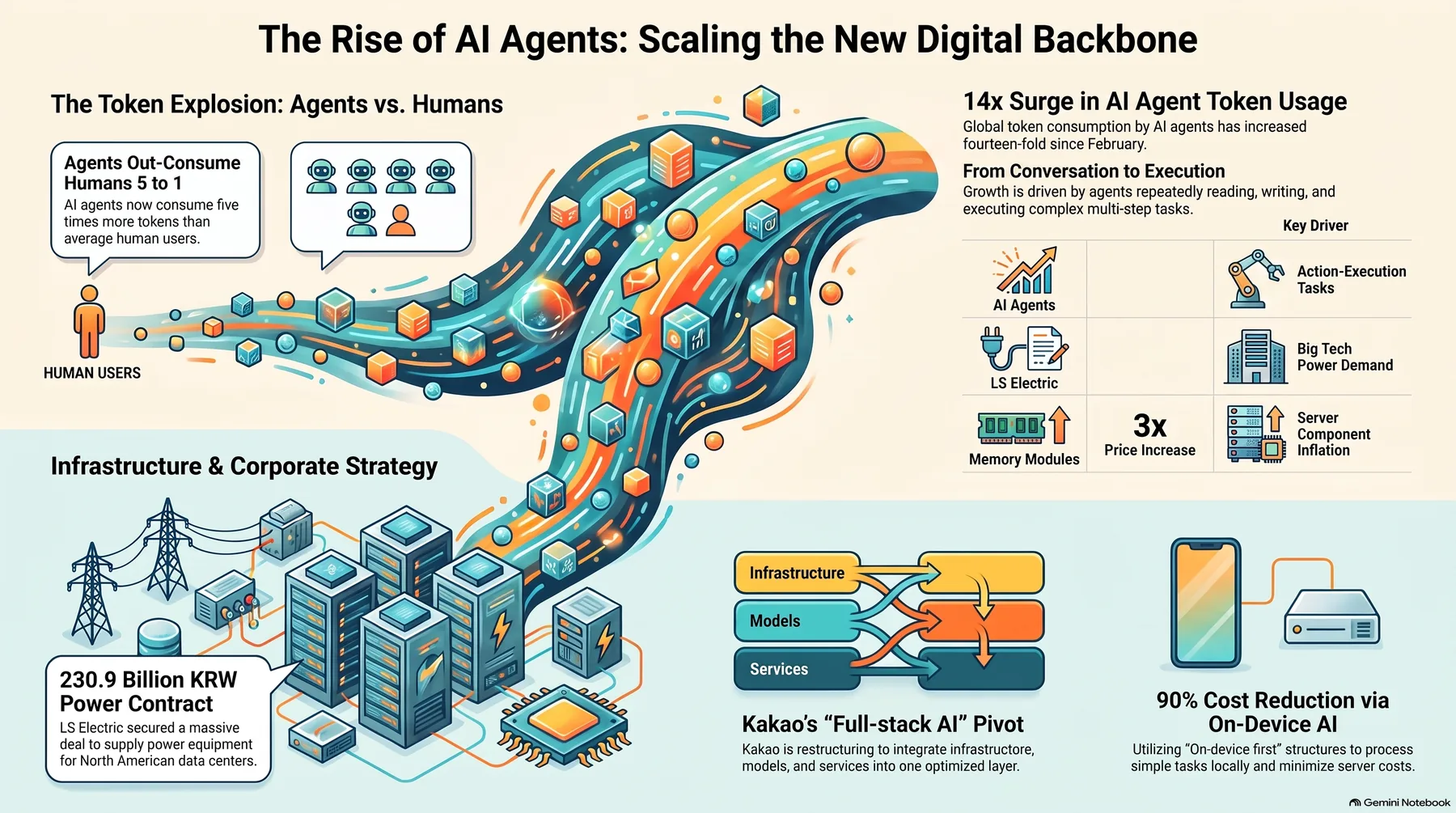 Infographic generated by NotebookLM from the sources.
References
This post was written by synthesizing the news below.
- e2news, LS Electric Signs KRW 230.9 Billion Data Center Power Equipment Contract with North American Big Tech
- Digital Daily, [Weekly Cloud Trends/Aug. ③] Kakao’s Hail Mary: Splitting Off the Cloud Subsidiary
- TokenPost, AI Agent Token Usage Up 14x Since February
- Ajunews, Samsung to Build a New Semiconductor Hub in Vietnam? Google Also ‘De-Koreanizes’ Pixel Production