Thaki Cloud: “Data Sovereignty Is About Choice, Not Location”
70% of Korean enterprises lack a formal data-sovereignty strategy, while the rise of AI agents is expanding the control question from where data resides to who can access, process, and move it
As AI agents begin reading enterprise documents, calling external APIs, and interacting directly with business systems, the way companies need to think about data control is changing.
The question is no longer simply where data is stored. Enterprises increasingly need to understand who can access it, which AI models and systems can process it, what actions AI agents are permitted to take, and where data and workloads can move.
Interest in data sovereignty is already high, but operational readiness has yet to catch up.
According to Everpure's 2026 Global Data Sovereignty Report, commissioned from market research firm Vanson Bourne, 70% of Korean organizations do not have a formal data-sovereignty strategy. The study surveyed 2,100 C-level and IT leaders at large enterprises across eight countries, including 200 respondents in Korea.
Sixty percent of Korean respondents also said they lack complete visibility into who can access, control, and manage their organization's data.
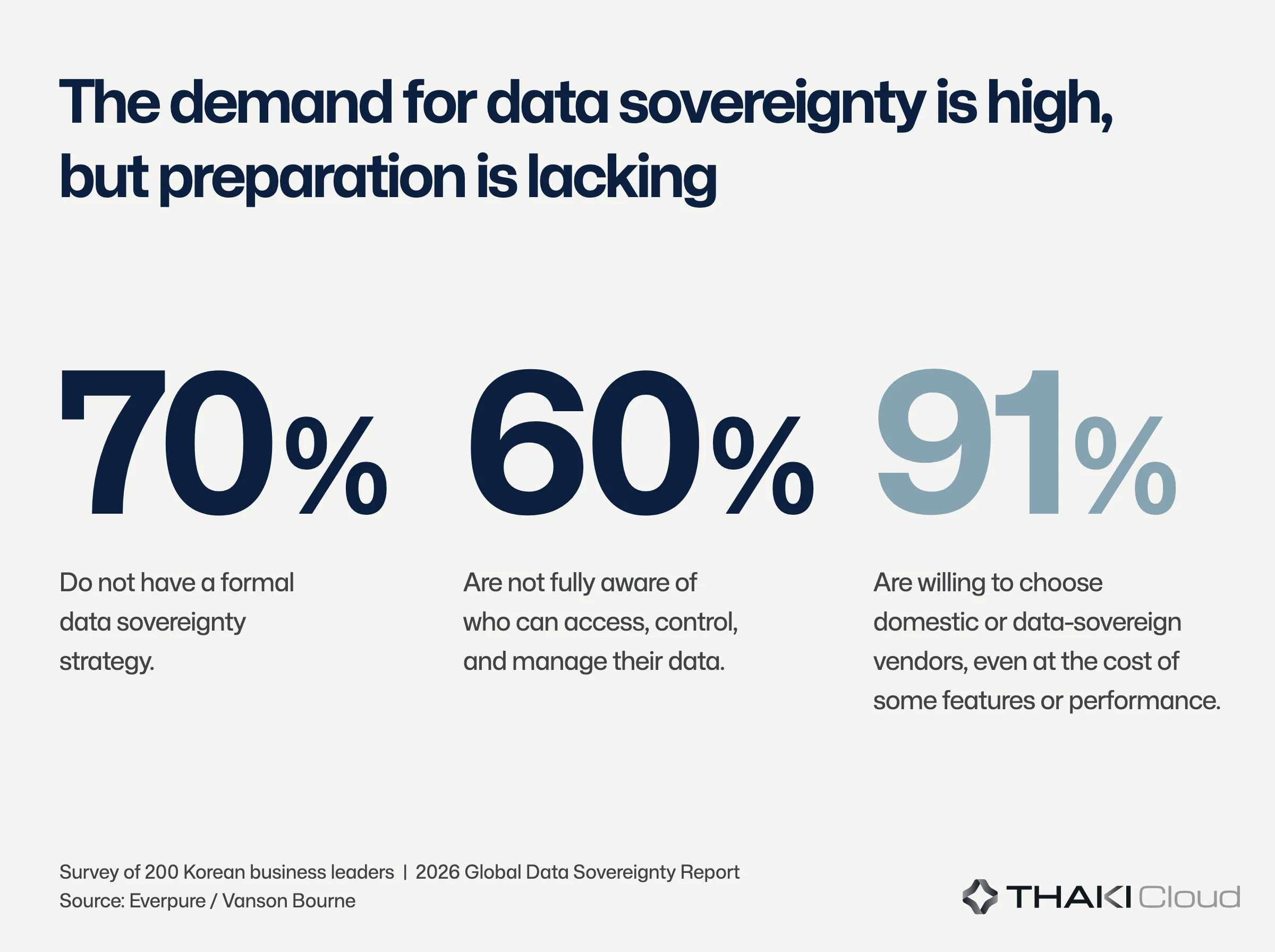
At the same time, 91% said they would be willing to accept some reduction in advanced functionality or performance in order to work with a local or sovereignty-oriented provider. The results point to a clear gap between the level of control organizations increasingly want and their ability to put that control into practice.
Similar questions are emerging at the individual level as generative AI becomes part of everyday work.
In May, Korea's Personal Information Protection Commission published guidance for users of generative AI services. Among other recommendations, the guidance advises users to check whether submitted information may be used for AI training, understand conversation-history retention and deletion policies, follow organizational rules when using work materials, and grant only necessary permissions when connecting external services.
Data Sovereignty: “Who Decides” Rather Than “Where”
Thaki Cloud believes these developments reflect a broader change in how enterprises should think about data sovereignty.
Data sovereignty should not be reduced to the physical location of a server or data center. What matters is whether an organization retains meaningful choice and control over how its data, AI systems, and infrastructure are operated.
For Thaki Cloud, that does not mean keeping every workload inside an enterprise environment or rejecting public cloud.
It means ensuring that organizations can decide for themselves what they are comfortable delegating to external providers and what they need to keep under direct control.
That requires enterprises to consider at least four dimensions.
- The first is Location: the ability to decide where data and workloads run.
- The second is Access: knowing and controlling who can access data and under what permissions.
- The third is Processing: determining which AI models and systems can process data, as well as which tools, APIs, and external services an AI agent is permitted to invoke.
- The fourth is Portability: preserving the ability to move data, models, and workloads to another environment or provider when business requirements change.
The Scope of Data Control Expanded by AI Agents
The spread of AI agents is likely to make these questions increasingly important.
Traditional software typically processes information in response to explicit user actions. AI agents can go further: accessing information, invoking tools and external services, and taking actions inside business systems.
As a result, sovereignty in the AI era extends beyond the question of where data resides. Enterprises also need to decide what authority AI systems receive, what information and systems they can access, and where data can move as those systems perform their work.
This principle is reflected in Thaki Cloud's operating model.
The company provides both Cloud Services and On-Premise Solutions, allowing organizations to use cloud-delivered services where appropriate while operating workloads requiring greater infrastructure and data control within customer-controlled environments.
Thaki Cloud also provides Thaki NeoCloud OS, which enables organizations with GPU and AI infrastructure to build and operate their own branded self-service, on-demand NeoCloud services.
The objective is not to force enterprises into a binary choice between cloud and on-premise infrastructure. Instead, organizations should be able to determine which responsibilities they delegate and which they retain based on the sensitivity of their data, the nature of the workload, and their operational requirements.
Thaki Cloud plans to continue publishing technical analysis and market perspectives on data and AI sovereignty, AI infrastructure operations, Private AI, and AI agent security and control.
The company aims to broaden the enterprise AI conversation beyond performance and cost to include a question that is becoming increasingly important as AI moves deeper into business operations: how much choice and control does the organization retain over its data, AI, and infrastructure?
▶ Find Out More: Data Sovereignty in 8 Slides
Contact Us: https://thakicloud.com/contact
About Thaki Cloud
Founded in February 2025, Thaki Cloud is an enterprise AI infrastructure and platform company. Its business focuses on NeoCloud Enablement, helping infrastructure owners build and operate cloud services, and Private / On-Prem AI Cloud, enabling enterprises and institutions to build and operate AI in their own environments. Through infrastructure platforms including Aegis and AI model operations technologies including Metis, Thaki Cloud supports AI environment deployments across a range of enterprise and institutional needs. For more information, visit thakicloud.com.
Media Contact: Thaki Cloud Marketing Team, David Lee · david.lee@thakicloud.co.kr